After nine solo albums and a forthcoming five-disc box set, Ryan Adams is finally putting his solo career on the back burner. Next for Adams? Working as a fulltime member of his current “backing” band, The Cardinals. Paste catches one of today’s most brilliant, prolific songwriters—sober for a year now—on the precipice of a new phase in his life and musical journey...
{PART I: WHAT IS}
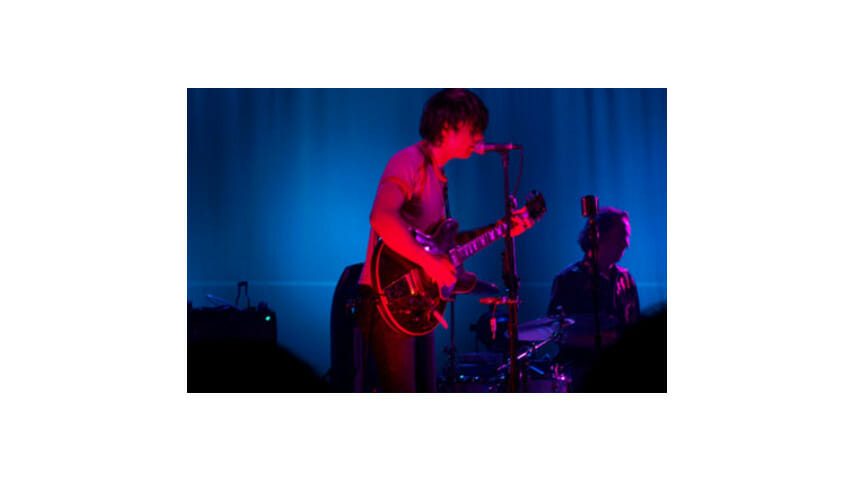
Ryan Adams sits onstage in Memphis under giant spherical paper lanterns, illuminated by bluish-white prisms of light. The haunting changes of 29’s “Blue Sky Blues” drift from the speakers like an apparition before blossoming into the chorus, Adams bellowing the hook, “across the icy lake,” with such gravity you can feel the frostbite. He’s second from the left, little more than a silhouette hidden amidst the other musicians. It’s strange for a solo artist, especially one so alternately vilified and celebrated as an outlandish, attention-craving, drug-and-booze-fueled miscreant. But these days, it’s more and more obvious that Adams—spurred by the clarity and sense of purpose he’s found through sobriety and discovering his musical soulmates in the current lineup of The Cardinals—isn’t much interested in being the center of attention anymore.
While he says he may still occasionally record under his own name, after next year’s box set—which could be his last release on Lost Highway—his solo albums will be second priority. “I’m the singer in the Cardinals, no matter what it says on the marquee, or anything that’s going on now,” says Adams. “That’s how I view my world, and that’s where I’m going with myself spiritually.”
As the show continues, sheltered from the drizzly summer night outside the acoustically mesmerizing Germantown Performing Arts Center, neither Adams nor any of the Cardinals speaks a word to the crowd. Despite his loquacious past, when Adams sings, “Most of the time, I’ve got nothing to say,” from his most recent album, Easy Tiger, he delivers the line with a believable beat-down charm.
“If there’s a super-great audience happening, I don’t have to say shit,” Adams tells me a few weeks later. “I can just play, which is good. But sometimes you gotta be mouth. Sometimes you gotta tell a few jokes. It’s like weather up there. Sometimes it’s a stormy day, which is awesome. Sometimes it’s calm. Sometimes it’s partly cloudy. Every time I go up there, I feel like a farmer stepping out the back door to check the weather. The audience is a big part of it too, ’cause if they’re fuckfaces we will take them down. And it doesn’t take much, musically or otherwise.”
The set is saturated with songs from Easy Tiger and 2005’s Cold Roses, and the music has a timelessness and a primal sense of place, at times so open, free and spacious that the theater suddenly melts away, leaving those who’ve suspended disbelief in the middle of a cool grassy field under starlit skies, a faint breeze blowing past in the night air, carrying quivering notes that explode sonic color into thirsty eardrums.
“I have this weird fascination with this thing that accidentally happens at our gigs,” Adams confesses. “When we get into the E-zone, which is this weird place, songs start giving way to others that aren’t on the set list, and I just start following it. I can feel it calling. It’s like I’m leading, but really I make a suggestion and everybody usually jumps. Once we hit Deep Field, the “E” thing, a bunch of songs that start in different fret placements and octaves of E, that’s usually when this fucking bizarre music starts happening where I don’t know what’s going on. And as soon as I hear it open up, I jump all the way in, ’cause I know there’s no ‘feet-wet’ for this. You gotta go all-the-way wet, and then out a little portal to get back to land.”
Cardinals drummer Brad Pemberton—whom Adams affectionately describes as “a huge monster of a man, with inexhaustible timing”—pulls the band back from these chasms, dragging them to yet another term in Adams’ rock lexicon, The Plateau. “Once we’re at Plateau,” explains Adams, “it’s on. That’s when I’m up there going, ‘Fuck, man, don’t let this ever end.’ I almost start seeing the music visually. It’s very psychedelic and beautiful and transcendental and I don’t know anything else like it."
While most in the Memphis audience are extremely attentive, the lack of banter and the strange sonic forays connecting the dots between songs seem to irritate some fans, especially the ones drunkenly screaming for Adams’ most-requested tune, “Come Pick Me Up,” a breakup ballad from his lauded 2000 debut, Heartbreaker. (“So she took a couple records,” Adams later says of the song’s antagonist. “Big fuckin’ deal. I just made that shit up anyway. I stole her records.”)
“Just from having been a person in my 20s who partied,” Adams says, “I can identify with the Bud Light crowd—the rock drunks who go to shows just to be wasted. I hear them, and I don’t really feel bad for them, because they’re on their own trip. [But] when we play live, we’re trying to find some possibility of transporting to another emotional zone, and that’s just not in some people’s vocabulary. Maybe somebody is in the audience who just listened to Rock N Roll, or just listened to Heartbreaker, and they come to the show and they’re like, ‘Why is it so dark?’ It’s like, ‘Oh my God, rent a Bergman film you fuckhead! Light and Shadow!’” But sometimes it’s hard to think through that because those are people, and they need something, too.”
Sympathies aside, the band is unphased by all the rock-show rowdies and shouted requests; they’re too wrapped up in the music they’re creating to shift their focus. “People might take this the wrong way,” Adams explains, “but the minute I start considering them, I lose my job. The only way the art I make is gonna be good for anybody else is if I keep it between me and the canvas and what hits the canvas.”
Jacksonville City Nights’ breathtaking “Peaceful Valley” materializes and soon slips into an a capella break. Midway through, Adams and guitarist Neal Casal begin improvising countermelodies as Pemberton incorporates jazzy flourishes. The music reaches a sudden crescendo then stops dead in its tracks with a muted cymbal crash. There’s a newness to this rendition; the version on the album seems like more of a blueprint for what’s happening tonight than anything else.
“The other day when we did ‘September,’ says Adams, “it sounded almost like Arabian Nights. That idea of, ‘we’re just going to do this,’ it’s like what I experienced with the hardcore scene. But the difference is, it isn’t going to be a 40-second song. It’s going to be a weird country-sounding lilt that’s going to turn into a scene from Joseph and [the] Amazing Technicolor Dreamcoat for a second, and then into sheer noise, and then a three-part harmony. But if the improvised bits weren’t good, if it felt like gratuitous forced fretting—which it never does—and if there weren’t tunes behind it that we were landing in that I felt really strongly about, then I think it would feel uneven. But we have songs that keep coming up live, and they’re never in the same time signature. It’s a waltz today. What was it yesterday? So it stays pretty interesting.”
With this lineup of The Cardinals, says steel player Jon Graboff, “We all get out there, start playing, and it connects immediately. There’s no dead weight. Nobody’s resistant to going wherever it’s going to go. Everybody’s got a common level of proficiency where you can go and know you’re not leaving somebody behind.”
“The musical trust that happens,” says bassist Chris Feinstein, “when you know somebody’s got your back, or you can anticipate what somebody’s going to do—I’ve never experienced that before.”
“Sometimes,” Graboff says, “I can see Ryan movin’ his foot in a certain direction and I know what song he’s gonna play...”
“It’s true,” says Feinstein. “Or you see a capo change or the back of his hand on the neck.”
“... or somebody plays a little melodic line,” says Graboff, “and all of a sudden you see six little lightbulbs over everybody’s heads. When that happens—man, it’s so thrilling and energizing.”
In the wake of coming together with the current Cardinals lineup (several members have come and gone since Adams first put the group together to back him on Cold Roses), Adams feels like—after much experimentation and many musical relationships—he’s now in the middle of something very special. “I’ve always projected rock ’n’ roll histrionics and mythology into my own life,” he says. “Like early sexual experiences—making out and stuff like that—you mimic the things you see on Cinemax, in order to better understand yourself, and to try to find a natural flow. In that way, I feel like my previous musical relationships were all real—I saw elements of that kind of truth that happens with a band. But never in my wildest imagination did I ever think I’d find myself in a place like this. It’s like a real dream.”
About a dozen songs in at the Memphis show, Adams finally emerges from alongside his bandmates, stepping out front-and-center for a sentimental reading of “Goodnight, Hollywood Blvd.” He taps his pointy-toed leather boots on the stage, standing pigeon-toed and knock-kneed as he sings from some place deep within, conjuring visions of a desperate, hellish and heartbroken L.A. night that somehow—when filtered through his innocent, sighing croon—manages a sort of twisted romantic appeal.
After the song, he and the band silently exit the stage, waving to the crowd as they walk off. Cheers fill the dark room. After a minute, a unified rhythmic chant begins. Then, as anticipation builds, the lights come on. The house music goes up. No encore tonight. Some people boo over The Clash’s “Rock the Casbah,” but most shush them and keep on cheering anyway for the next few minutes, refusing to leave until finally being herded out by the venue’s security guards.
On the way out, I overhear a fan in the lobby: “He’s such an ass, but who cares? This is some of the best music ever!” The sentiment is echoed by other fans in the parking lot after the show. “I had to get a babysitter for two kids and two dogs,” one girl says, “and I expected more. It pisses me off when he doesn’t acknowledge the crowd. I love Ryan Adams, but he pissed me off tonight.”
“It didn’t bother me,” her husband says. “It was a great show.”
{PART II: WHAT WAS}
At the Sunset Marquis in L.A., Ryan Adams is staying under the name “August West.” It’s an interesting, possibly telling moniker. August West is the protagonist of the Grateful Dead song “Wharf Rat.” The “blind and dirty” old man—who spent most of his life “doin’ time for some other fucker’s crime” and the rest “stumblin’ around drunk on Burgundy wine”—begs for spare change by the docks in San Francisco. “But I’ll get back on my feet someday,” West says, his words underpinned by a desperate hopefulness, the kind that—when you hit rock bottom—is the only thing that keeps you from laying down and dying. “I’ll get up and fly away,” he avows repeatedly toward the song’s end.
It seems that Adams’ desire for transcendence doesn’t only apply to his music, but also to the struggles he’s faced in his life.
So far, 2007 has been good for Adams. After years of notorious alcoholism and excessive cocaine and heroin use, he’s been settling comfortably into sobriety. He and the Cardinals have discovered an amazing chemistry, and Easy Tiger has been Adams’ fastest-selling album to date, its first single, “Two” (with Sheryl Crow on harmony vocals), getting regular play on Adult Alternative radio stations nationwide. Adams and the Cardinals also just released a live-in-the studio EP, Follow The Lights, featuring two brand-new tracks (the title track and “My Love For You Is Real,”) as well as re-imagined versions of several previously released tunes.
Then there’s the five-disc box set that’s currently in the works. Scheduled for release in early ’08, the still unnamed collection will offer myriad unreleased gems spanning Adams’ tenure at Lost Highway (from 2001’s Gold to the present). Though no official decision has been made on a tracklist, Adams says the box will likely include material from five “lost” albums he recorded between his official releases: The Suicide Handbook, Pinkhearts, 48 Hours, Darkbreaker and Black Hole.
It’s difficult to imagine Adams ever dreamed he’d be getting the box-set treatment when he was a goth-, punk- and metal-loving teenager in Jacksonville, N.C., just learning to play the guitar.
“The first thing I learned to play was the intro to “Somewhere in Time” by Iron Maiden, but a really, really bad one-note version of it,” Adams recalls, laughing. “But I fucking loved music. I was always really overexcited about it because you could write or listen to music any hour. Play guitar any hour. And I was always a 24-hour personality since I was a kid. I never have had a regular sleep schedule—I’ve always been way too hyperactive, so it fit my personality.”
With all this enthusiasm, it wasn’t long before Adams moved beyond half-assed metal covers. In 1994, at age 20, he started the band Whiskeytown with Caitlin Cary, Phil Wandscher, Steve Grothman and Eric “Skillet” Gilmore. The group released its debut Faithless Street in 1996, and was soon signed to Geffen roots imprint Outpost. The turbulent, seminal alt.country outfit put out four records in all, three before imploding around the turn of the millenium. While the band put Adams on the musical map and is fondly remembered by fans, he isn’t terribly excited looking back.
“It just, it wasn’t a band to begin with. People just caught a glimpse of something I think I did, too, but it was never there again. Fireworks, you know? ... And you wait and see if more come, and they don’t. We made [Stranger's Almanac] first with Chris Stamey in a hurry, and it was really sort of beautiful raw. But by the end of [re-recording the final version with Jim Scott], I didn’t know what band that was. I didn’t know what record that was. I liked that record, but in no way was I in that band or was that me.”
When Adams recorded his solo debut Heartbreaker in Nashville in 2000, he says he was definitely ready to strike out on his own, but he didn’t see it as a grand new beginning. In fact, the acclaim surrounding the album took its creator by surprise. “When I was making Heartbreaker,” he says, “I expected really small records for a really small career. People were totally prepared to say that by Heartbreaker, my career was more or less over. I felt that those were endnotes. But a totally different reaction happened.”
Adams’ solo career was in full swing by the following year when he journeyed to Los Angeles to make the more rocked-up Gold with Ethan Johns, who would go on to produce several more of Adams’ records. Johns immediately understood that Adams couldn’t be made to do take after take in the studio—the assembly-line approach just didn’t jibe with his erratic creative energy and short attention span. “[Ethan] taught me the art of distracting yourself by staying in the moment,” Says Adams. “So very true emotional stuff would come out.”
With each record Adams released, as he explored new sonic and lyrical territory, his sound shifted, sometimes dramatically—the hushed acoustic ballads and Stonesy uptempo shakers of Heartbreaker, the soulful roots-rock of Gold, the sad, bleary-eyed atmospherics of Love is Hell, and the New Wave and post-punk riffing of Rock N Roll. But when Adams began making double album Cold Roses with the first incarnation of The Cardinals in 2004, he began focusing his sound, putting it on a clearer path, down which it has been evolving—more slowly, but perhaps more meaningfully—ever since.
Adams’ songwriting before Cold Roses, had been more in the confessional, singer/songwriter tradition. Of course, there were moments that foreshadowed his later style (which has an earthier, more timeless and mystical feel with oil-on-canvas narratives, simple-but-striking images and less-constricted sonic structures), earlier tunes like “My Winding Wheel,” for example, its chorus subtly hinting at the Tarot’s endlessly spinning Wheel of Fortune and a primal snake-eats-its-tail aesthetic. But the world Adams began creating on Cold Roses—and which he continues to explore—is one of sunshine, bluebirds, cool plateaus, majestic mountain peaks, icy lakes and salt-of-the-earth characters occasionally haunted by wandering specters, as they once were in classic American folk tunes like “The Long Black Veil.” This vibe has continued, gradually morphing to fit the scenery of later Adams albums Jacksonville City Nights, 29 and Easy Tiger.
“I believe in that superstitious element in folklore, specifically American folklore,” Adams says, “because it was this huge unsettled country, and people were fleeing the confines of religion in England. So I think the idea of ghosts is just this sense of guilt—Americans, we ravaged the plains. Native Americans were just slaughtered left and right.
“And something like [29’s] ‘Carolina Rain,’ where you actually have the geography ... a lot of Cold Roses was geographical, [too], because I honestly felt like there was a possibility of creating a false geography like in D&D when you draw your own dungeon map. You gotta come up with the Valley of the Wolves. And you gotta pick where the mountains are, and where the ogres are gonna come from. The whole vibe of creating that—if you’ve got several characters with enough hit points to make it through—it’s always there and you can imagine it changing. I always really wanted to do that in a song. Because I felt like it would give back. “Easy Plateau”—I play that song and I fucking feel like I can see that place and the music starts to conjure it, and it’s creepy.
“Typically, though, I’m thinking about black metal.” Adams laughs at himself before continuing. “Like, truly, I’m trying to figure out a way to get the word ‘witch’ into a country song, but literally mean a hovering, cloaked specter that can, you know, turn people into ice and have the power of invisibility. I completely want to put that into a sweet lullaby.”
{PART III: WHAT WILL BE}
At Hollywood’s legendary Sunset Sound—where albums like Led Zeppelin IV, Janis Joplin’s Pearl and The Doors’ L.A. Woman were recorded—The Cardinals are in the lounge across the hall from Studio 3, gathered around a table intently watching the viral video “Battle at Kruger,” in which water buffaloes, lions and crocodiles collide at a watering hole on the African savannah. The band cheers and laughs as the lions unsuccessfully try to pick off a calf that eventually gets away. After a few more YouTube videos, most of the guys venture across the hall back into the studio.
Before Adams joins them, he jams out, air-drumming along to some old .45 Grave concert footage. He gushes excitedly about the group’s drummer, Don Bolles—who, he points out, was also in The Germs—and about how beautiful singer Dinah Cancer was and how amazing it would’ve been to be around that whole L.A. punk/goth/metal scene back in the day. As much as Adams obsesses over old-school hardcore and metal—“Black metal I also like power metal I’m heavily influenced by dark metal”—it’s funny that his music comes out sounding the way it does, with all those sad-eyed piano ballads and whispered acoustic tunes. He can geek out on Iron Maiden, skating or D&D one minute, then turn around and rip your heart out with a nostalgic country weeper like “Hard Way to Fall” the next.
In the control room, producer and Cardinals pianist Jamie Candiloro is behind the boards playing back a brand new Adams tune. When I ask him what they’ve been up to all day, he rubs his hands together with an almost childlike enthusiasm and says, “We’ve been creating.”
“Yeah,” ribs Feinstein, “Ryan blinked and wrote another song.”
Adams awkwardly shrugs off the praise. “It’s not so hard,” he says.
At this early stage, the track is shaping up to be a piano ballad, but there’s something that immediately stands out about this one. Its fragility and unadorned honesty are striking, Adams singing, “I’m finally at peace with love and being loved,” in a quivering melodic sigh on the chorus, which is subtly colored by the verses’ tranquil, photorealistic images of lightning bugs, radios and summer.
After hearing his vocal take on the new song, which is dripping with unguarded emotion and quiet redemption, an unsatisfied Adams sheepishly says to his bandmates, “I could do it again—a more straightforward read if you guys want.” Almost in unison, Feinstein, Candiloro and Graboff reply, “Are you kidding me? Redo that? No way.” Adams, while at first reluctant, trusts the instincts of his bandmates—who have become an indispensable sounding board for his rapid-fire ideas—and keeps the take.
Candiloro twiddles knobs and punches buttons in the control room, adjusting the mix to get ready for some overdubs. To his left, Adams, a little more introverted now, sits at his laptop working on a script he and his friend, photographer and music-video director Phil Andelman, are co-writing—something about an American traveler who falls in love with a French girl. One of Adams’ favorite pastimes on tour is making short films using his Cardinals bandmates as the cast. Currently in the works are ’70s-B-movie-inspired action kitschfest Nightloop, in which two hitmen are hired by the same thug to whack each other; and also the epic, handheld-action-figure-starring Batman IV, Part 2, in which the once-heroic Caped Crusader is now a slobbering drunk who must be slapped awake by Boy Wonder Robin before he makes futile, hilarious attempts at fighting crime.
After a while, I ask Adams what the song they’ve been working on is called. He looks up, slightly startled, from his script and all the ideas careening around his head and says, “I don’t have a title yet. It happened too fast. But I already have an idea for another song. We probably should start working on that.” (I find out the next day that, since he was so deep into the script, he just decided to let the idea go. So off it floated into the ether—maybe it’ll return someday, or maybe what might’ve been your favorite new Ryan Adams song is gone forever. C’est la vie.)
“I don’t know if it’s strange ’cause I’ve never been inside anybody else’s brain, but I hear music sometimes and I don’t know whose jams those are, but they’re rad jams,” Adams confesses. “I can visualize a guitar in my mind and I’ve played enough to where I can sort of mentally play the guitar. You know the way people fantasize in order to masturbate? They think about breastesses or Princess Leia or whatever,” Adams continues through a mouthful of Doritos. “In that same way of daydreaming, I can make choices in my mind about music, but sometimes I’m not making the choices. I’m just listening. And sometimes it just doesn’t stop. I have an extremely strange and rare form of insomnia where I will not sleep for two weeks if I’m not completely careful, which goes hand-in-hand with a lot of things that went on in my life for a long time in my 20s.
“I think men learn how to take care of themselves in their 30s. This is why Indiana Jones didn’t happen until [Harrison Ford] was in his late 30s. [We’re not introduced to] Han Solo or Indiana Jones [until they’re older]. Dudes figure it out late. But I didn’t know how to deal with that problem because I was just rushing through my life. It allowed me to think that I was best just trying to knock myself out. And how’d that work out? Not too good. So it happens sometimes that [the ideas] are there, and I’m a little physically exhausted for them. But it’s a kind thing. My heart is really open to ideas that are positive and powerful and good for people. They’re good for me, too, and what’s a little sleep, you know? But it doesn’t make me nuts. It just makes me wish that we were in an orbit that was just a little bit further from the sun so that we had a little bit longer of a day and were acclimated to do more stuff.”
Later, Andelman shows up at the studio and I overhear snippets of his and Adam’s intense discussion of the film they’re working on. Ideas shoot back and forth between the two as Adams waves his hand for emphasis, an American Spirit clutched between his fingers: “She realizes men are flawed, and loves him anyway. When he orgasms, his eyes glaze over and we see a rainbow unfold. The cafĂ© conversation, is it all in French? The guy, he should be an American, a drifter type, like those kids who go to Nepal to ‘find themselves.’”
Meanwhile, Graboff warms up in the wood-paneled tracking room, getting ready to lay down some steel. As he gets deeper into this run of takes, Adams isn’t quite feeling it, so he flips on the talkback mic and tries to explain what he’s hearing in his head, which is no simple task. When Adams gets an idea, it’s like he’s channeling some raw force of nature—it’s sudden and erratic and, while he seems to feel it completely, it’s hard to find the words. “Use the steel more as a sound-effect machine to create some nice distance—a widening sound area,” Adams suggests. “Something classic-’50s style, spooky and haunting—be the smoke monsters, for lack of a better term.”
Graboff continues trying different approaches, searching for that elusive, transcendent take. After a while, he seems a bit frustrated trying to grasp at the abstractions. Adams continues attempting to convey his ideas with a diplomatic tone of support and encouragement. “Wait to open up a couple of moments that move you,” he tells Graboff. “When you played that last part it was great—it sounded like it was coming out of a different time. It’s not your fault, but the precision playing to my vocal—it’s making me want to erase it. I want [the steel part] to feel elemental and accidental, like walking through a sound field.”
It’s not long before Graboff hits a particularly inspired take, and wordless, knowing grins and nods run around the room as if to say, “Man, do you hear that?” When he’s finished, Adams excitedly affirms, “You’re a genius! Perfect! You’re making me start to like it again.” When Graboff comes back into the control room, he and Adams discuss what just went down, and any creative tension there might’ve been melts away. After years of recording, both inherently understand that sometimes it takes moments like these to get the really good stuff.
“Even for the stress of all the work,” Adams says, “the bullshit with these guys is so minimal, and it’s taken with a grain of salt ’cause tomorrow’s always around the corner, and everybody’s already been through a lot of shit. We always get on the plane, we always get on the bus, we’re always finding the next laugh, we’re always endlessly entertained by this thing.
“I don’t even feel like I’ve gotten into that place where I feel, ‘Oh, I’m gonna jinx it.’ I can’t imagine—with the six different people we have now, I can’t see a place of exhausted possibility, because even one of those ideas could carry me through writing songs for 10 records. I just don’t think that with this gang of folks, that there’s any kind of musical environment or any kind of musical language that isn’t spoken on some level or couldn’t be learned in a short amount of time, and I want to fuse all that. If it’s been explored before and it’s been played—and even if it hasn’t—I want to go through that. I wanna find shit on the other side of it. I wanna go forward.
“If anything, it’s gotten easier. It’s so good that, at first, you kind of keep your eye on your back so you don’t get your heart broken should it fall through. But that’s gone away. Nobody’s going anywhere. My eye’s off my back ’cause there’s fuckin’ five badass dudes, who are all my friends. We’re all looking out for each other. I think, ‘Game is on.’ It’s like the first five minutes of Wayne’s World. Shit is about to happen.”


Ryan, you are a real cool man if I ever read the words of one. I love your depth and passion with regards to, being a musician / performer and well..., everything. Your words on songwriting, spirituality and life in general are definitely refreshing, sort of funny at times, and make you decidedly compelling. Thank you for being sensitive and male at the same time, and for being one of those people who has some intensity. Sometimes I think your forthrightness is what gets you into so-called "trouble", but to me, life is about being proud to be who you are meant to be, and sharing it to help the world as best you can. Your songs help me. Hope to catch your show in Vancouver. Thanks to Paste for the in-depth interview!
Enjoy the best megaupload file searcher for free downloading at http://megaupload.name/
Sounds like your time with Mr. Lesh really moved you into the smooth current!
Hey Ryan,
Damn Sam I like a man that sings. And plays. And reads and writes and thinks and gets in some trouble here and there. You are a gifted artist and I take you totally seriously--except when you crack me up and remind me of people from my midwestern hometown. You play a mean harmonica--yeah, the mouth organ, as my dad used to call it. Where'd you learn that? And your band, well, those guys are out-of-this-world good. We need you. Keep it all coming!