Release Date: April 18 (limited)
Director: H.S. Miller
Writers: H.S. Miller, Tom Phelan
Cinematography: Fred Murphy, A.S.C.
Starring: Willem Dafoe, Scott Speedman, Clea Duvall
Studio/Run Time: Kamala Films, 103 mins.
From its art-history title to its lectures on crime-scene aesthetics, Anamorph shows more interest in ideas than anything else. Writers H.S. Miller and Tom Phelan use anamorphosis (art in which different perspectives create different images) to show how looking at something (crime? life? art?) in a new way reveals new facets of it. The thought’s not that profound or focused, and it works better as an artistic device—providing the movie with some nice visuals—than as a centering metaphor. Still, Anamorph manages to wrap enough suspense and cunning around its central theme to pull off an engaging serial-killer flick.
The film’s deathly visuals play into the art-history idea, and not only through the use of anamorphosis. The murders replicate classic works of art, such as Michelangelo’s Pietà, but include new details like eviscerated torsos or chopped-up corpses. While they do add tension, the images have a dark playfulness to them, even as they build upon the angle-of-vision conceit. Likewise, Anamorph plays with a knowledge of film history, with The French Connection and Seven providing key influences. The filmmakers don’t play with convention; they simply expose their cinematic context.
And it’s enjoyable, as long as a character doesn’t explain it to us. The film’s biggest flaw comes in the form of Stan Aubray’s (Willem Dafoe) lectures in which he views crime scenes as if they were pieces of art. The movie is metafictive enough without one of its characters providing explanation. The sequences slow the pace and, moreover, give the viewers less credit than the anamorphic theorizing suggests. The big idea, though, is not really that big, and the film fares better when its aesthetic musings are dramatized.
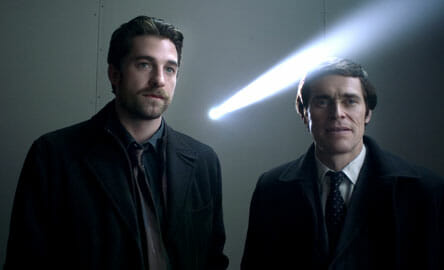
Anamorph‘s two leads, Dafoe as Aubray and Scott Speedman as Carl Uffner, play their characters just off of the expected archetypes. Dafoe stays flat, suggestive that, atypically, we see all there is to him; his control allows him to show the complicated nature of relationship more distinctly than narrative revelations. Uffner gives his rising cop less urgency than the stock character gets; he’s more complex and his motivations are less discrete than normal. Coupling these performances with moody cinematography and well-developed tension, the movie pulls itself far out of the intellectual quagmire it threatens to create.