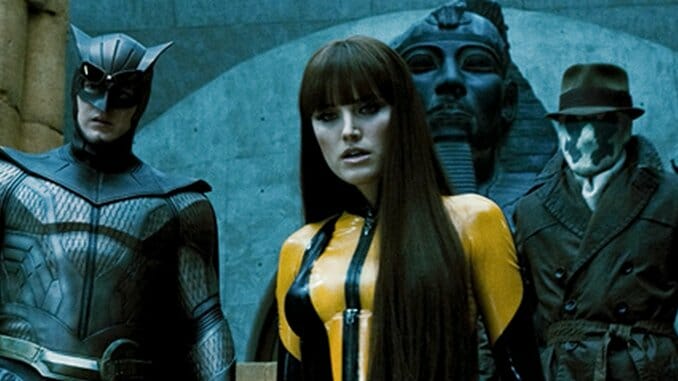
Release Date: March 6
Director: Zack Snyder
Writers: David Hayter and Alex Tse
Cinematographer: Larry Fong
Starring: Malin Akerman, Billy Crudup, Jackie Earl Haley, Patrick Wilson
Studio/Run Time: Warner Bros. Pictures, 163 mins.
Zack Snyder's adaptation of the Watchmen graphic novel takes place in the mid-1980s, after America won the Vietnam war and just before Richard Nixon's fourth term. The U.S. won that war by enlisting the help of Jon Osterman, a former scientist who was involved in a nuclear accident that, naturally, turned him into a god-like blue man who lives simultaneously in the past and the future. As near deity, Jon is able to do almost anything he wants, like asking people to call him Dr. Manhattan or zapping Vietcong with a wave of his hand. New York is also populated by a second generation of costumed heroes, normal people who fight crime like their parents did in a prior post-war era. But the world is on the brink of nuclear war with the Soviets, so many of these crusaders have retired or gone underground. Modern threats have rendered masked heroes quaint.
Snyder’s previous film, 300, was about a big, strong Spartan who pummeled the effeminate Persians against the wishes of a corrupt security council. The political slant of Watchmen is only slightly less transparent. Both films lavish attention on violent individuals who deliver justice as they see fit, on men who are principled brutes, and on women who are sexy, strong and secondary. Each film’s overarching view is that war is productive and weakness is not. The interest in sheer power is as strong as the interest in human bodies, and where the two intersect, Watchmen seems to vibrate with delight. We see the flesh of a female calf ripped by a bullet, the intestines of a splattered victim dangling from a ceiling, a prisoner’s skin melted by a basketful of frying oil (can baskets be filled with oil?), and two arms sawn off because they block access to someone who needs an ass-whoopin'.
The film’s obsession with bodies in conflict has a counterpoint in Dr. Manhattan. Gently voiced (and partially faced) by Billy Crudup, he stands naked, ripped, glowing and dispassionate through most of the film. Neither the attentions of his beautiful girlfriend-heroine nor his research into unlimited energy can raise his flaccid member. He has lost interest in the whole of the earth.
The film's id is an inky-masked character named Rorschach who metes justice with his fists and talks with a throat full of gravel, like Clint Eastwood in Gran Torino, who might very well be the inky one’s uncle. Rorschach, not the disengaged blue god, is clearly the film's ideal. But Dan, a character who shifts between those two poles, is the audience surrogate, a geeky but muscled guy who can’t get it up until he re-dons his Nite Owl costume and, along with a female partner, saves a bunch of kids from an apartment fire. The two of them cap their evening with a mutual orgasm of flame.
Unlike the typical superhero movie, Watchmen is a film of big ideas, and one of them is that mass carnage can usher in an era of peace. The major characters disagree only in the particulars. Dr. Manhattan makes a point of neither condemning nor condoning the film's most controversial, world-altering event, because his head is in the clouds. (He looks as if he’d rather be clearing brush.) Nixon and Kissinger, huddled in a war room, are only slightly more grounded; in their worst-case nuclear scenario they'll write off New England as collateral damage and even see the loss of Harvard liberals as a silver lining. The folks behind Watchmen may have taken the wrong lesson from Dr. Strangelove.
Furthermore, this gang doesn’t seem to realize how brief a violence-born peace may be. Remember when we were all New Yorkers? The assumption of the film is that a moment similar to the post-9/11 pause, if inflicted deeply enough, could blanket the globe with peace indefinitely, and if it happens during Nixon's reign it might preempt and best even Ronald Reagan who, as we know, single-handedly defeated the USSR in our real world.
Snyder never seems to consider the problems of macho justice. My advice to the entire naive lot—to the blue god, Rorschach, the geeky-sexy couple, the effeminate liberal (there's always an effeminate liberal) and Snyder himself—is this: Do not overestimate the longevity of global unity or the productiveness of violence, on any scale.

Watch the Watchmen trailer:


What, a movie has a political bias? Hollywood would never put out a politically biased movie would they? Oh wait, I totally forgot about Milk and the 15 speeches I had to hear from hypocritical actors and bad writers who were only rewarded for producing a mediocre movie with a strong liberal bias.
But then, you aren't really upset about the bias, are you? Just the conservative part.
Yeah, I guess you're right. A superhero movie where the superheroes talked the villains out of their evil ways would have been a much better movie. Give me a break.
Hmmm, seems like you have a problem with the source material, not the movie. After all, it's a freakin' COMIC BOOK. I think a lot of reviewers forget to take this into account. It's a sensational story in a sensational world. Obviously there is a deeper commentary there, but if you were not a fan of the brutal storytelling in the graphic novel (which, the way you come across, you weren't), you most likely will not like this movie and push it aside as rubbish.
I on the other hand, love every minute of it.
Ummm...did you even read the graphic novel?! The story was set in the eighties because it was written in 1986. You're giving credit (or in this case blame) to the film makers for a story that was written over twenty years ago and received the HUGO AWARD for it's content. The work of a critic walks a precarious line to begin with and this is just irresponsible work. I stopped reading other music/film magazines because they couldn't seem to write an objective review based on the most basic research like this. Instead, they push they're own surface level political response and expect us to listen and learn like dumb sheep. Watch out Paste. You're cool but you're not that cool.
Normally, Ant, I'd agree with you on the "it's a freakin' COMIC BOOK" point, but the big problem here is all the fans pointing out, "Actually it's a graphic novel," and spending significant amounts of effort distancing it from comic books. There's a lot of noise around Watchmen to the effect of "it's more than just a comic book" so when it is criticized from the perspective of more than just a comic book you can't really fall back on the "it's just a comic book" defense.
I do agree that this seems more a review of the source than the movie, though. This review tells us almost nothing of the cinematography, the special effects, and that kind of stuff; it almost exclusively concentrates on the story, which is pulled from the book.
Look, I haven't seen the movie yet, but having read the source material numerous times, I can say this reviewer has the story all wrong. Rorschach is in no way the "film's ideal", for one thing. Yes, he narrates the story via his journal entries, which positions him as the default protagonist amongst the ensemble cast. But it's obvious that he's an incredibly deranged individual who sees the world in purely black and white terms, taking pleasure in brutalizing thugs whether they did anything to deserve it or not. He represents the far right in a group of characters who all symbolize faulty ideologies and the flaws of the human condition. Conversely, Ozymandias is, yes, a liberal, but is also consumed with his own vanity and perceived infallibility. The mistake here is to see these characters as "superheroes". Only one of them is genuinely "super", and not one can be called a true hero. Alan Moore's story was intended to show us what the world might be like if real people decided to put on masks and went out to "make the world a better place". Again, I have not yet seen the film, but from what I've heard it does a good job of sticking to the themes from the comic. It's too bad the reviewer couldn't see past the spectacle to the true inner-workings of this wonderfully depraved cast.
Listen guys, it's a movie review. He reviewed the movie. If he's not familiar with the source material, it still doesn't matter, because the material that he DID review was IN THE MOVIE: ergo (and follow me here) he REVIEWED IT.
Gotta admit, the whole flick was a ridiculous exercise in philosophy 101, and explored how deep the shallow end can be. I really wanted to like this movie too.
Your critique is off in several respects because it misses the absolute bottom line of the movie. IT'S A SATIRE. It's not meant to be taken seriously, and the nihilism and fascism involved are not intended as a viable lifestyle or political choice!
All the rote superhero tropes and fascism mentioned was meant to parody the entire genre of superhero films that we've been bombarded with. It's in the spirit of the comic it was based on, which was a satire of comic book cliches and tropes.
Essentially, this is a poorly thought out and badly written review that misses the entire point of the film. There are criticisms to be made about Watchmen, but the ones you chose are way off the mark.
And incidentally, the ending of the film does imply that the peace will be temporary, or did the reviewer not stick around for the epilogue and the lines about how mankind will stick together as long as they still have Dr. Manattan to fear?
I get the feeling that Robert Davis saw Dr. Strangelove and walked away with the message that we should build more mineshafts.
@Whoosh: LOL -- Classic.
As for the review, I actually do doubt the fact that Mr. Davis saw this movie. That is a definite review fail.
I thought Watchmen, the film, was a real success. Not only was it a fine job of adapting a reputedly "unfilmable" literary work (better than the enjoyably, but far-veering Tristam Shandy), but I thought the ending they chose was more elegant and efficient than Alan Moore's.
Fine work, fine film, great achievement in bringing a difficult piece of work to the screen -- it's a shame that some simply won't get it and will miss out on a pretty amazing experience because of their own limits of perception.
To preface: I didn't love the movie. I thought it failed in some ways, succeeded in others. But, I thought this was a poor review (not to mention most of your main issues are with the source material, not the movie). Of course the "gang" doesn't remember when we were all new yorkers, it's a pre-apocalyptic alternate time line set in the 80s. It is a 'what could have been' scenario that begs whether means justify ends.
You missed some very key themes. Is that the fault of the movie, or were you just not paying attention? Who can say. But as a movie reviewer, one would think you'd have a better capacity for suspension of disbelief.
However, I agree with you about the excessive violence and sex. I want to comment, though, on the above discussion on "IT'S A COMIC BOOK" "IT'S A GRAPHIC NOVEL" argument. Watchmen is a comic book, it was released in singular issues. We should not have to rename something a "graphic novel" to make it mature enough to be respected as a piece of art, and Alan Moore believes this more than anyone else. It isn't "more than just a comic book" because that implies it is too good to be compared to the medium. It is just the BEST comic book.
Anyway, ending that rant, as a movie review, this was a failure. Were you to see "Pride and Prejudice" would you critique the movie for the lead picking Mr. Darcy?
I believe your criticisms about "macho justice" are exactly the point that the film and novel make (that these approaches don't work and are temporary at best, unlike Dr. Manhattan who is "timeless" and infinite). I think you need to see this again, and more importantly, read it.
Until last night I thought Zack Snyder was a total hack. There was no possible way he could have done 'Watchmen' justice. I was very vocal about it.
Today I am eating my words. Proudly.
I respect your right to an opinion, but I believe that you're just wrong on this one.
Your central complaint seems to be the moral corruption of the characters and storyline, which I can understand.
Just please try to consider for a moment that just because these dysfunctional 'heroes' are the focus of the story, it doesn't mean they are right.
Alan Moore knows that.
The people that understand 'Watchmen' know that.
I don't think that Rorschach is intended to be an ideal, otherwise he probably wouldn't have lines like 'The whores and politicians will look up and shout save us and I'll look down and whisper 'no'"
One of the many points of 'Watchmen' is the imperfection of every character in it.
Hero, Superhero or God: All human.
I don't like to be one of those fanboys who rails at critics that disagree with them, it's just that I think the entire premise you based your review on is naive and frighteningly narrow.
Was Shakespeare trying to convince young lovers to kill themselves with 'Romeo and Juliet?'
With 'A Clockwork Orange' was Burgess saying 'Go rape and kill'?
Or does satire mean that the message is not always on the surface?
With respect, I ask you to reconsider your thesis.
"Zack Snyder's adaptation of the Watchmen graphic novel takes place in the mid-1980s, after America won the Vietnam war and just before Richard Nixon's fourth term" is what I would put in large letters at the top of my review, too, if I hadn't read the comic, seen the film, or passed the first grade, seeing as how it takes place DURING Nixon's FIFTH term. This is alluded to multiple times throughout the movie (Hollis Mason complains about voting for him FIVE times). Dr. Manhattan didn't ASK anyone to call him that, the US government renamed him so the world would know he was an American force. The fact that vigilantism has been OUTLAWED, not "rendered quaint," is also made quite clear. Whether you have read the source material or not is irrelevant as a movie critic (I think it's safe to assume you haven't), but you have no idea what was going on in the film. I'm not sure how exactly you managed to see the movie and retain so little of it. Maybe you ought to stop wasting your time 'watching' movies and instead spend it looking for a new job.
Justin, thanks for the correction on Nixon's term. The film of course takes place in several different eras, but the bulk happens, as you say, later in Nixon's presidential career. (Hollis Mason might have voted for Nixon as governor. ;-)
The other two examples, however, are intentional wordplay on my part; I'd like to thank Alberto Gonzalez for contributing to this review. The film may be set in an alternate 1980s, but we're watching it now, which gives filmmakers and audiences the opportunity to cast it in a different light. That's nothing new. Jean Anouilh did it with Antigone. The times, they are a changin'.
Anthony Lane has taken some heat for his snarky review in the New Yorker, but I largely agree with him. I tried to dial down the humor, because a serious film deserves a serious response, but the bigger difference is that I wanted to blame only the filmmakers, not Moore and his original graphic novel, for the film's shortcomings. Lane finds violent imagery in the comic, too, but I don't have a problem with that, exactly. And I like the idea of questioning the validity of heroes (see my positive review of The Dark Knight, the original and the DVD review in print).
But I'm always skeptical of movies that say one thing and do another, e.g. exposing the flawed nature of violent vigilantism while doing everything they can to pump up the audience with violence. Rorschach is the film's hero, and if you doubt me, just listen to the crowd when he goes nuts. He gets the biggest applause, the biggest laughs, and surely the biggest numbers in the exit polls. (Again, I'm talking about the film, not the book.) That strikes me as counter to the deeper themes. Similarly, the apartment fire is entirely heroic in the film but tainted by mixed motives in the comic; the latter is much more interesting. The differences are subtle, but the visceral experience of cinema magnifies them, and I feel like Snyder et al are using, building on, and encouraging a love of dumb action and fisticuffs instead of questioning it. Nolan did a better job of that (although he too caved into a fetish at times).
But I wasn't writing a review that compares the film to the book. Everyone's doing that. I just looked at the film as it is. Sorry for the factual error -- I don't think it undermines my point.
This movie is as closed to as it can get to Alan Moore's Watchmen. I personally loved it and going to watch it for the 2nd time on IMAX tomorrow.
Yech!!!! Gag me with a spoon. It's really sad that Hollywood in general can't make a movie worth a damn these days. Well, that's not exactly true because there was "The Wrestler" and"The Reader", two movies that actually had some dialogue and character development. President Obama would be better off signing a Presidential Order that all movies had to contain at least a little bit of artistic content and some redeeming social qualities than he is giving all my money to the Robber Barons. We just don't need crap like "Watchmen". There is already way too much violence in the world and there is no need to glorify it any more.
With you Mr. Davis.
I wanted to like the movie, even though I hadn't read the graphic novel. So, my fiancee and I went on opening night. Unfortunately, I thought it was boring. Perhaps if I had read the graphic novel, it would have filled in some gaps in the story. But the moview didn't draw me into the story, it didn't make me want to care about the characters and what happens to them. In fact, the movie didn't even make me want to read the graphic novel. The movie made me want to leave early...
I think the reviewer may have missed the point of the ending to this movie. The point was exactly his argument...that a peace brought on by unimaginable violence will not last.
This is embodied by the true secret of this catastrophic event being revealed through Rorschach's journal. This secret will inevitably lead to the toppling of this temporary 'peace'
Wow, a movie review that manages to bastardize and misinterpret the original source material even more than the Hollywood adaptation it's reviewing. That's quite an accomplishment.
Watchmen is the greatest superhero movie ever made, period. It is also the biggest, loudest, horniest piece of crap ever committed to 'digital film,' period. It will be dissected for generations for how it delved into the psychosis of anyone daring to don a costume to 'fight crime.' It will also be almost immediately forgotten after April as just another actioner with high nipple quotient. It is for the intellectual who lives for subtext and for the ravenous fan-boy who demands the strictest adherence to the text while, conversely, it's an enormous waste of everyone's time, should be relegated to the scrapheap of pop culture, never to be resurrected and those supporters should hang their heads in shame for backing such an obviously lame duck.
There. I have now separated out the two ridiculous, cliched extremes vomiting joy and misery over this film. We must now accept the fact that it is neither good, nor bad, but 'eh.' You too will come to this conclusion in a few days, once the collective mind has moved on to the next big thing.
This movie was awesome. Whoever didn't like this is an idiot.
Robert Davis
Hmm, I've seen better impressions than that, anonymous-claiming-to-be-me on March 10, 2009 3:54 PM. :-)
Curtis, the close-up of the diary -- Dum-dum-DUM -- was enough to make it clear that trouble is brewing in peace land. I get it. What I mean is that, first, the characters are all naive enough to believe that it could last for some time: one of them engineered the plan, another killed a leaky vessel 'cause he thought he'd spill the beans and upset the harmony. The newspaper guys seem to believe it, too. ("Who wants a cowboy...") We could even say that Snyder believes in a certain stability because the only fly that he sees in the ointment is the diary. In reality, there are six billion flies in the ointment. The premise is simple like a game of checkers.
Second, if we assume that Snyder is critiquing all of this naivité in the movie's characters, as you say, I'm not sure I'm ready to be lectured on the negatives of violence from the guy who just spent 2.5 hours jacking up the adrenaline in the audiences' bloodstream through violence. My point has two sides, and I'm interested in the schizophrenia on the part of such filmmakers (which I read as cynicism, actually).
Dw Dunphy, I agree, but actually the middling view is a lot more common than the extreme ones, in my experience. Even this review, 45 of 100, falls just to the negative side of the middle.
And again... in all of the above, I'm talking about the film, not the source material. BTW, I have to paraphrase John Hodgman: feels like we're all participating in a Nerd Affairs world summit.
You know, after reading the review, having read the graphic novel a few years ago and not having seen the movie yet and after reading all the comments: the one thing I'm left wondering....was it entertaining? Seems to me from the trailers(and yes, we all know they put the best bits in sometimes)it looks like something I would gladly spend my money on to see. Especially in IMAX. I don't go to see a movie unless it's screen worthy. I won't go if I can rent it on Netfix and get pretty much the same experience. I don't get into "the deeper socio-politcal thing". For $10 bucks a shot...I want to be ENTERTAINED...BLOWN AWAY by the special effects! I read a little grousing but no..."but it was entertaining."
Movie was an A+, this reviewer is taking out his unfounded* frustration with the source material on the movie. And i hate to break it to him its a classic work of art that doesn't NEED his approval, its stood the test of time already... In fact it is the only comic I've ever heard of being read in a college class! (I read Maus in a high school class, but Watchmen was assigned in college :) So if you didn't like the novel why go see the movie? Anyone who gave this bad reviews without knowing what Watchmen WAS first needs to take a cool pill, cause your a dork.
*Unfounded = comparing 9/11 (which was a thousand people in ONE city which immediately caused us to go to war with 2 separate nations because it happened does NOT compare to a VISIBLE GOD blowing up MILLIONS in cities all around the world. 9/11 was nothing compared to this. (not saying 9/11 was nothing, it was real this is fiction, but he brought up the inappropriate comparison). Plus Dr Manhattan is STILL watching, the Taliban is a "little" less scary than him.
Sorry gotta post again to some readers responses I read...
To anyone on either side of the argument who says "Actually it's a graphic novel": It was released as 12 comics before it was released in novel from, so it IS a comic, but it was a comic written in a new way (Much like Dark Knight, V for Vendetta, or Kingdom Come). And the "comic" did win a HUGO award, this isn't your daddy's Spiderman, its the next level.
Also to the person that posted that we don't need movies like this because we have "the Reader", you are no fun and you also have to take a cool pill because you're a dork.
RD, my initial reaction to your review had me indignant over your fundamental misunderstanding of Watchmen's intent, and I continue to be disappointed in your narrow and surface interpretation. But in reading the discussion, I must agree that the "artful" (and thus, arguably, glorified) portrayal of violence belies the potential message that violence is not necessarily an acceptable solution.
I say "not necessarily" because the graphic novel implicitly communicates the ambiguity of how justice or peace should be achieved: the flaws and contradictions exercised by a range of viewpoints is illustrated symbolically on a larger-than-life scale provided by superhero tropes.
Mass murder is committed to prevent otherwise certain mass extinction, and the world is at peace for the time being. Can one really say definitively that Veidt's solution wasn't the best? The longevity of the peace is beside the point, and the characters are not naively accepting "macho justice" as a pardonable solution. Veidt is not applying justice: he is committing a clearly reprehensible act, murdering millions of innocents, for an indisputable good. Every other character represents a different view on this act. The psychology behind this is too complex to be simplified into a message like: "violence is not the answer" (or even "violence can be the answer").
But absolutely correct: Snyder's portrayal of street-level brutality and gore smacks of hypocrisy and threatens to undermine an otherwise seamless synergy with the novel's themes.
Could PASTE not find anybody who actually read the comics??
The reason violence accomplishes peace in this sensationalist story is because the world can unite against the common enemy of Dr. Manhattan rather than a Post 9/11 attack against an unproven source for blame. In any case, the ending of the movie shows how world unity spurned through violence fails three years later through the uncovering of Rorshach's diary. Through the forces of nature, even a painful truth will always prevail.
You also keep pointing out how the violence was "cheap" and "just to get our adrenaline going". Well then how do explain so many reviews saying this movie was boring? This wasn't made to be Rambo or Saw. The violence meant something
You just don't understand the context of the violence. the artists have each character use violence to show a bit about themselves. Compare Manhattan's uncaring, inhuman, messy kills; and Comedian hunting down retreating troops and laughing - to Night Owl's bloodless kills.... Its how you can tell Captain America apart from Punisher.
Plus this comic was MEANT to be violent, sexy, cuss filled, and adult. It was in an era of rebellion against the COMIC CODE. This book is classic not only for its story, but for its milestone status in comic history. It showed comics weren't "just for kids".
J. Hunt, thanks for the comments. I agree that the psychology of the situation at the end, were it to happen in real life, would be too complex to sum up in neat phrases. This would be a morally complicated situation of interlocking what-ifs: what if you could save billions by killing millions; what if you had unlimited power that could act as a galvanizing force to maintain detente with humanity. These are actually magnified versions of the decisions that generals and presidents face routinely (magnified like the superhero tropes, as you say), and those decisions are complex. And yet I don't think that complexity is in the film, at least not sufficiently.
And here's why we may disagree about that. The complexity is in the graphic novel, and it's possible to see the film as a kind of appendix to the graphic novel, so that when you see Dr. Manhattan on the screen, you're seeing only some of the events that were in the novel but you still consider him the same person. You know what he's like, and you understand where his viewpoint fits within the prismatic story. That's entirely valid, but it means the film gets to piggy-back on the themes that are already set in your head.
But another way to look at it, and one that's also valid, especially for the millions of people who will see the film without reading the novel, is to see the film as its own thing, entirely separate. All I know about Nite Owl II is what I see on the screen, for example. I purposely went this route with the review. In this view, you still have the cultural context, the political climate in which we live, the truth about the world around us (which are notably different from the times in which the novel were written, by the way)... but the film needs to shape and define the characters on its own.
The "range of viewpoints" that you mention feels a bit flatter in the film to me, like a continuum from Dr. M on one end to Rorschach on the other, and gliding between them is Nite Owl II -- first inert like Manhattan then energized like Rorschach, but not to either extreme. I mentioned this in the review. And I suspect that the filmmakers wanted someone likable who would be the "audience surrogate," which means they removed some of the complexity from the apartment fire rescue. In the novel, Nite Owl II isn't such a nice guy during that rescue, which makes his motives really hazy... and interesting.
If you're taking the film as a standalone item, it builds these characters frame by frame from scratch. When we see Dan do X and Jupiter do Y, their characters are coming into view. The longevity of the peace matters only because it seems farfetched to think this period would be anything bug fleeting, and yet that's what the characters seem to believe (to some degree), which defines them in the film as strangely flat, simple, naive. And each cut in the film, each decision, defines not only the characters but the attitude of the filmmaker (in my auteurist view of film as an art form). So I found it interesting to think about how those decisions are consistent with others made in Snyder's 300, and I'd argue that they are closer in spirit to the film 300 than they are to the graphic novel Watchmen. 300 essentially celebrates power, which is why the same attitude when applied to Watchmen, even subtly, feels out of place, contradictory, and odd.
It may surprise some of the commenters here, but I like the graphic novel a great deal, and I don't mean to paste any simplistic statements of the theme onto Moore's work. No pun intended.
Having loved the comic for many years, and taught it to my students alongside 1984 and Farenheit 451, I spent the past year both hastening and dreading the film. Though I was thrilled to be able to hear the story told anew, in a way I was afraid that its existence, whatever its merits, it would push people away from original source. The arguments on boards like this across the net remind me me that whether the film was dreadful or inspired or merely "eh", it will indeed pull people to Moore's courageous work, and that makes me very happy.
I went to see Watchmen with my geeky comic-shop-owner best friend and our respective sweethearts. My friend had idealogical arguments, but he loved it. My girlfriend, who has not read the comic, was disturbed by the violence, but also loved it. These reactions surprised me a bit, as I am still not sure whether I loved it or not.
I wanted to. I still argue with myself. But I think the boards here and elsewhere represent a good mix of that-- the defence of a beloved story in a new form, because we want to love it, and the brutal questioning of motives and ideas, of why we aren't sure we did. I think, though, that the intention of the original source, as well as (one can argue) the film, is to ask us for such brutal honesty. Perhaps the graphic violence of both the comic and the film are there for a purpose. Perhaps we are meant to be disturbed, to rail, to question, the intense and sustained violence in the cause of peace, and to bring those questions to bear in our own, chillingly similar world.
As a visual adaptation of a visual medium, the film was superb, exacting, even beautiful. As a translation from written word to spoken, with much of the script word-for-word Moore, it worked well and felt authentic. As a piece of satire on the merits of violence in the cause of peace, its success is debatable, and I'm sure we shall argue for years; as a film standing alone, it falls in a much weaker plane and merits its weak reviews. But for fervent fans, acerbic critics, curious viewers alike, as long Watchmen makes us question and think, the film has done its bravest job.
I direct you to a short story which I feel illustrates David Hayter's treatment of the Watchmen adaptation.
Based on a true story!
http://fathouseblog.blogspot.com/2009/03/bottomless-void.html
Watchmen is a visual and psychological cornucopia -- definitely worth watching
76/100 Commendable
My first impression of this film is completely relegated to my own bent empiricism. The overwhelming passion that inhibits every dark corner of "Watchmen" is at points overpoweringly carnal. Nevertheless, there is redemption in the character of Rorschach, the truth-driven, misperceived, Jesus figure of the film, who through his sacrifice at least instills some piece of dignity into the minds of the viewers. Albeit a fairly predictable film, the stunning visual qualities piece together the loosest parts, glazing over what could have been a comic disaster, pun intended.
The big disappointment is of course Dr. Manhattan, not for the qualities of his own personality, but through the lack of foresight from the writers, who should expect a man who could predict the future to be able to see the human sway to forget our memories, especially those of peace. This film is a worthwhile 150 minute punch to the gut, although don't expect to feel clean at the end.