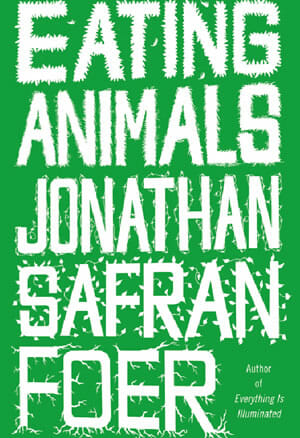
Jonathan Safran Foer’s novels are dense, energetic, concerned with all things moral and Jewish, pleased with themselves, sentimental, and too wordy for a lot of us. They are like wild Russian dances that leave you breathless and wondering why you stayed on the dance floor. Without argument, he is enormously talented and passionate, but his writing and gimmicks can get in the way of the material.
His first nonfiction book, Eating Animals, is both everything good and annoying about Foer’s fiction. It’s bursting with passion, facts, insight, sentimentality, overwrought pleas, and a deep conviction that it’s an important book. I underlined many gushy descriptions and self-righteous passages, but an equal number of times I was blown away.
I do not mean by this that I enjoyed the book. This is an exposé on the industrial factory farms that provide America with 99 percent of its meat and chicken, the barbarity of high-speed industrial slaughter, and the disgusting and unhealthy nature of factory-farmed meat—an argument for why no decent person, especially an environmentalist, should eat meat with a good conscience. Foer writes, “We know that if someone offers to show us a film on how our meat is produced, it would be a horror film.” He gives truly sickening descriptions of the suffering of factory-farmed animals, plus studies that prove eating meat is a dangerous risk to health. Oh, and he throws in childhood memories and mini-essays on seahorses and kosher foods.
Eating Animals makes a solid case for the absolute devastation meat production levels on the environment, and it’s a polemic for vegetarianism, undertaken by Foer when he became a father and faced deciding for his son whether they could eat the animals of their favorite nighttime stories and songs. It’s a weave of short chapters about his family, the earth, firsthand accounts of breaking into a factory chicken farm in the middle of the night, interviews with factory and family farmers, animal-rights people, slaughterers, scientists and experts on food-borne illness.
Many readers will find this book a serious buzz kill. I cannot think of a single friend to whom I might recommend it, even though they are all tenderhearted souls, passionate about the environment. They are also food lovers, and mostly great cooks, and they love their animal protein. Even so, the book is riveting, addictive, heartfelt and fair, with surprising humor. Sometimes it sounds like a screed, but so did Rachel Carson’s warnings to many people, and Al Gore’s. One has to earnestly care about saving the earth, whether or not one is moved by the suffering of, say, turkey chicks.
When I told my priest friend about the chicks, he said, “Who cares?” Then he headed out the door to Ikea for a platter of Swedish meatballs.The detailed suffering of those chicks is child’s play compared to Foer’s descriptions of cattle-kill floors or factory chicken barracks. Here’s a sentence about USDA chicken inspectors who each examine about 25,000 birds a day: “Every week, millions of chickens leaking yellow pus, stained by green feces, contaminated by harmful bacteria, or marred by lung and heart infections, cancerous tumors, or skin conditions are shipped for sale to consumers.”
This is not appetizing prose. And I am not even going to go into the so-called “fecal soup,” in which 99 percent of US poultry producers soak their dead chickens, described a few paragraphs later. The point is, you may not even want to finish this review—yet I am urging you to read all 352 pages of the book, for any number of reasons.
My priest friend called me after lunch from Ikea.
“How was your plate of steaming ebola E-coli baby-calf meatballs?” I asked nicely.
“Yum, yum,” he enthused. “Look. This is a totally private decision. Jesus ate Passover lamb every year, and barbecued ribs every chance he got. I care about HIV/AIDS, the polar bears, and poverty. But not about meat.”
That’s his opinion. But Foer made me see how important our questions are. He published this book for the best possible reason: Like all honest writers, he wrote it because he couldn’t not write it. And I’m glad he did.

The Perfect Seven-Course Multi-Fast-Food-Chain Meal
Jonathan Safran Foer's Nonfiction Book, Eating Animals,…
I'd be curious what your priest friend would have to say about the following. The Garden of Eden is where God laid out his ideal for our diet. The Garden of Eden was a vegan paradise (not referred to as "vegan" of course by scholars, but there is no argument among them that no animal products were eaten). Even after they ate the forbidden fruit and god added new items to our diet (including herbs), God forbade the eating of animals though there were plenty around. Not until humanity turned wicked and god flooded the earth in Noah's time did God allow for meat eating and then only because the flood had destroyed all the vegetation! Interesting how he allowed us further from our natural diet as we got more and more "wicked". Also the new testament describes the second coming as a return to a vegan paradise. Again, not using the term vegan specifically, but scholars agree that this is what is meant. Finally, as for Jesus eating a passover dinner every year... It is well known that many of the first sects of christianity that sprung up immediately after Jesus' death and who were his most devout followers were vegetarian sects. Also, it is well documented that James, jesus' brother was raised as a vegetarian and so its at least a reasonable assumption that Jesus likely was as well. Finally, there is the proposal that Jesus' final act where he expressed his disapproval with the sellers in the temple was not about them doing business in the temple but was actually his displeasure with the selling of animals for sacrifice. A vegan Jesus would certainly fit the man's exceptionally compassionate nature. Biblical scholars have long known that many of the bible's passages were added well after Jesus' death by people who may not have understood his teachings as well as we think. Ask your friend if its possibile that Christianity did not actually not shun vegetarianism until Paul decreed it as bunk, well after Jesus was gone. With all of this evidence, ask if its not possible that Jesus was actually a vegetarian. And regardless of whether he was, is it not also possible that God is waiting for us to return to his ideals? Perhaps our eating a vegan diet will cause the messiah to come that much quicker! And regardless of all of THAT, watch a factory farm video. Look in those animal's eyes. Do they not suffer? As a christian, how can one defend this practice? After all, the only reason there is to eat meat is our own pleasures. Pleasure at the price of another's suffering does not sound very christian to me.
Anne, I'm a long time fan of your work and have enjoyed reading about your spiritual journey as well. I hope you'll take your priest to task a little bit for his attitude toward the suffering of animals.
And, I'll add some comments to what Eric said. First, I know your priest was being obviously facetious about the eating habits of Jesus. The fact is, there is just one mention of Jesus eating flesh in the entire Gospel. It's in Luke and it was after the Resurrection to prove that Jesus had returned in the flesh. Some scholars believe that this is one of the passages added later by the church to put to rest any argument that Jesus had risen only in the spirit.
There is no mention of his ever eating lamb. Indeed, he was the sacrificial lamb and he was clear about the fact that animal sacrifice was to end. And since sacrifice was directly related to meat-eating (only ritually sacrificed animals could be consumed) it seems clear that an end to animal sacrifice meant an end to animal consumption.
Finally, in the original Hebrew, in the first chapter of Genesis, the words nephesh chayah which are translated to "living soul" are used to describe all creatures--human and animals. That is how God spoke of the creatures he created--as all having identical souls. If God thinks animals are important, maybe we should, too.
But really--it doesn't much matter. The fact is that no one who tries to walk in the steps of Jesus and who embraces the values of mercy and justice that were at the core of his message would ever participate in the atrocity of factory farming.
eating animals is depraved. i am glad safran foer is using his book to inform and/or guilt trip. people need it. people are so indifferent and incorrigible. it is sad, but i believe it will make no difference. his efforts are applaudable (which the author recognizes, yet admits, it's a "buzz killer"). yeah...that's how you should feel when you recognize you are contributing to suffering on a large scale.
Hi Anne, Thank you for reviewing Foer's book and helping more people to to consider going meatless, which is healthier for them, really helps the environment, and obviously is much better for the animals. Keep up your great writing! r
Forgetting the fairy tales of the bible, I'd like meat=murder or one of the other fonts of righteousness to tell me exactly WHEN meat became "murder"? Was it back in the Middle Ages, during the French Revolution, 1933, When? Sounds like Foer is yet another tiresome young man who suddenly wakes up one day and realizes the "naked lunch" that's at the end of his fork, and instead of dealing with his own self-revulsion honestly goes hog-wild (yes) and starts wagging his own blood-stained Prospect Park co-op millionaire's fingers at us. Twee, self-righteous bozos like Foer poison their kids' minds with guilt and terror, then expect us to applaud. He's a true American nightmare. Oh, and Morrissey is a screaming idiot.
Wow, your priest friend sounds like a bit of a douchebag. Even if Jesus ate meat during his lifetime, that fact has absolutely zero to do with the morality of eating meat under the modern factory farm system. In the time of Jesus, meat production was relatively benign. Factory farming did not exist. If Christ lived today, there is absolutely no way he would condone the eating of meat, given the horrific, anti-human conditions under which it is produced.
Frankly, I think the #1 article of evidence that the eating of meat is immoral is the unhinged hostility that greets even the mildest of suggestions that people give up meat. The fact is, most of us are at least dimly aware of factory farms and how our food is produced. Unless you're completely soulless, or a complete moron, the only way you can continue to eat factory farmed meat is to compartmentalize and block out the reality of what you're doing. That's the kind of denial that leads to irrational anger and spiritual corrosion.
We eat meat because we like eating meat. Nothing wrong with liking it. I believe human beings, as omnivores, are designed to eat some meat, if only opportunistically. But we're also designed to do a lot of things we no longer accept, because we live in a modern society. The fact that humans no longer require meat in order to survive means that meat eating is now a strictly voluntary choice, which makes whether or not to kill for our food a moral decision. Now, I love me some meat. I drool at the thought of a perfectly grilled ribeye. But at some point I realized that the choice I was making, to contribute to a food system so inhuman and brutal that, if you were to film it as a theatrical movie, it would get a NC-17 rating, was stunting my spiritual growth and making me an unhappy person, and for what -- entertainment? Screw that.
People can make reasonable arguments in favor of eating meat, period, and an honest debate can be had on that topic, but there's no rational or supportable defense to be made for supporting factory farming. You can't justify it; all you can do is plug your ears and make the truth go away from your mind.
Aren’t humans amazing Animals? They kill wildlife - birds, deer, all kinds of cats, coyotes, beavers, groundhogs, mice and foxes by the million in order to protect their domestic animals and their feed.
Then they kill domestic animals by the billion and eat them. This in turn kills people by the million, because eating all those animals leads to degenerative - and fatal - - health conditions like heart disease, stroke, kidney disease, and cancer.
So then humans spend billions of dollars torturing and killing millions of more animals to look for cures for these diseases.
Elsewhere, millions of other human beings are being killed by hunger and malnutrition because food they could eat is being used to fatten domestic animals.
Meanwhile, few people recognize the absurdity of humans, who kill so easily and violently, and once a year send out cards praying for "Peace on Earth."
~Revised Preface to Old MacDonald’s Factory Farm by C. David Coates~
Check out this informative and inspiring video on why people choose vegan: http://veganvideo.org/
Also see Gary Yourofsky: http://www.youtube.com/watch?v=bagt5L9wXGo
Hmmm, It is well known that many of the first sects of christianity that sprung up immediately after Jesus' death and who were his most devout followers were vegetarian sects.
Bankruptcy Tulsa
priests are as ignorant as everyone else.
i enjoyed the book and can say it has changed my eating habits drastically.
And you know what? I don't even miss gorging out on a mcdouble...or any other meat for that matter.
ignorance is bliss. sitting at a table and chomping on a slab of dripping torture.