
Van Morrison: T.B. Sheets

A future legend’s raw, heart-wrenching first solo session
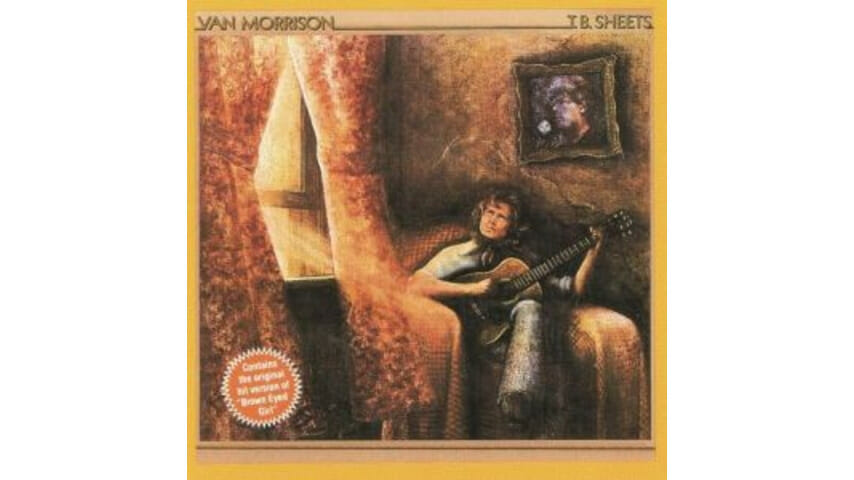
The sound of a sick room. Of terminal bed sheets sticky with cold sweat and sputum. The seemingly endless waiting, tambourine ticking off minute after monotonous minute. There’s an eerie inevitably to the groove of “T.B. Sheets,” the titular nine-and-a-half-minute psychedelic R&B opus at the center of this 1974 Van Morrison compilation (recently reissued by the preservation-minded Friday Music in its original form, with no extras to cloud the proceedings).
For such a heavy, personal song, it isn’t sad or angry or scared like you might expect, which makes it even more gripping—and disturbing. There’s a numbness to the whole thing, an obsession with minutiae in the face of a hulking truth too painful and frightening to confront. As Morrison narrates this true story about a girl with whom he once lived, he takes a magnifying glass to mundane details, grasping at distraction, trying desperately to sidestep the creeping Conradian terror—the horror— of experiencing firsthand our fleeting, fragile mortal existence.
“T.B. Sheets” is one of the most real songs about death you’ll ever hear. As life saps steadily from the singer’s beloved, tuberculosis-ridden Julie, there is no trite drama, no nostalgic sugar coating or grand deathbed epiphany, but rather an “Is That All There Is?” fatalism—a mild, detached, slowly-suffocating bleakness. “The sunlight shining through the crack in the window pane numbs my brain,” Morrison moans over a skittering Hammond organ.
What makes this track so moving and powerful—beyond its stark, unapologetic realism—is Morrison’s unflinching courage to deliver a story that spotlights a moment of such unabashed selfishness: While this girl is dying in front of his eyes, he actually has the nerve to snivel about his own problems, whining, in so many words, What about me? This is hard for me, too. Of course, this reminds us that we’re only human—even the selfless have their breaking points. It’s no surprise that Morrison fell apart after recording “T.B. Sheets,” so distraught after revisiting that dark place that he cancelled the remaining sessions.
This emotional title track and the seven other cuts collected here—including the original 45-rpm version of Morrison’s biggest hit, “Brown Eyed Girl”—were recorded in New York in 1967 for producer Bert Berns’ Atlantic imprint, Bang Records. They are songs of innocence and experience—the raw, unpaved bridge between young Morrison’s stint fronting Irish garage-rock outfit Them and his acclaimed solo career. These tunes have been released together in several different forms over the years, five of them originally appearing on Morrison’s 1967 debut Blowin’ Your Mind, and all of them appearing on the more comprehensive 1991 Bang Masters compilation.
But it hardly matters how the music from these sessions is packaged. No matter which set you choose, the blaring lead guitar whirls, dervish-style, sparring with Van’s soul-drunk slur. Tiny-but-constant fuzz-guitar licks weave around strands of shimmering organ like a garland—the Stratocaster noodling of the gods, bursting broken, slinky and blown-out, as if from a cracked speaker cone the size of a crumpled cigarette pack. Smoke ’em if you got ’em, Van, one at a time, chasing long slow gulps of neat whiskey as a candle burns down to black. The saloon piano chimes and the six string warbles with each whir of the Leslie speaker, and every rotation of that vinyl disc is a world turning on its axis, locked in a tight spiral, a pirouette of humanity. Loose-lipped and languid, Van shouts down angels from their clouds, the syllables barely formed on his quivering tongue. Smoke rings drift, glasses clink and bodies brush against each other in the muggy night, all pheromone-drunk swagger and swaying innuendo.
With Van, it’s not so much the words that matter. Not that they’re bad; Morrison is actually a lightning-rod poet. Still, he knows words are full of shit, and that—when you’ve got a voice like his—it’s more the way you sing ’em that matters. He yelps and howls like a dying man, a possessed shaman, a lovestruck lunatic, smug even in the slippery shadow of discontent. Nothing’s gonna end prettily, but he won’t let on that he knows—even though he knows all too well.
His vague, wandering lines, blazing with urgency and passion, do more to capture our inability to communicate than anything we could say. Snatches of impressionistic poetry are shaken in a hat with screams, grunts and other onomatopoeias imbued with more meaning than most singers can wring from their easier-to-understand (if less-inspired) couplets.
When Morrison recorded these songs, he was still growing as an artist, and was not yet capable of the refined statement he made the following year with artistic breakthrough Astral Weeks (which features more fully formed, carefully arranged and somber acoustic versions of “Beside You” and “Madame George”). But if that masterpiece is a diamond, T.B. Sheets is a handful of uncut, unpolished stones, bursting with potential.
 Keep scrolling for more great stories.