Introducing Endless Mode: A New Games & Anime Site from Paste
The world (still) isn’t fair, but the gimlet-eyed songwriter keeps singing about it
Many albums I receive in the mail include an artist bio that describes something other than the album I’m listening to. Emo bands cite Van Morrison influences. Metal ensembles insist their album isn’t like all the rest; that it features more in the way of inventive melody. And singer/songwriters transcend the clichés of their chosen genre—often alt.country—only to sing more songs about girls who haunt their memories as they stare down the barroom floor or wait on a train that never comes. I’m not calling these people liars. They’re just not as creative as they’d like to think. Or maybe they’re just too subtle for my taste.
But when Randy Newman decides to finally release the pause button on his songwriting career (taking a break from his lucrative Grammy-winning film scoring career), I know I’ll find myself intrigued. Because Newman believes his songs should be about something. He likes concepts and characters. He doesn’t mind making people uncomfortable. And if he was willing as a young, struggling songwriter to alienate his audience, you can be sure that, as he gets closer to that grand retirement, he isn’t likely to hold his tongue just to uphold some sense of decorum.
In context with other songwriters and their socially gracious platitudes, Newman can seem a tad mean. But it’s one of his greatest strengths. He deals with human nature. For every fine songwriter who dreams of a world holding hands like one magical Vaseline Intensive Care commercial, Newman uncovers the paradoxes, ironies and difficult decisions that “good” people face when their comfort zones are in jeopardy. Love is absolute but conditional.
On Harps and Angels, even Newman is kicked out of his comfort zone. “A Few Words in Defense of Our Country” began as a concert favorite and a YouTube offering where Newman’s frustration with the country’s right-wing shift caused him to bleed a little. “But I defy you, anywhere in the world / To find me two Italians as tightass as the two Italians we got,” he sings of Supreme Court Justices Antonin Scalia and Samuel Alito. The verse was cut from the New York Times’ lyric reprint that ran as an Op-Ed piece—and here Newman recites it with all the contempt he can muster.
You don’t get Newman like this very often. His conscience is strong, but long ago it accepted mankind’s limits, which is where he finds his best material. “Only a Girl” revisits his obsession with the battle of the sexes that turned up frequently on his last studio album, 1999’s Bad Love, where love often played like a corporate-boardroom move. (“Why would someone beautiful as she / Love someone old like me / Maybe it’s the money… / God damn it.”)
“Korean Parents” makes a case that the ever-escalating permissive parenting of the past few generations could benefit from the tighter, performance-driven expectations of the Korean immigrants who don’t coddle their young. “So sick of hearing about the greatest generation / That generation could be you / So let’s see what you can do / Korean parents and you.” Yet, of course, Newman eventually throws one right down the plate. “Feels Like Home” is the song anyone could cover, almost sentimental as the album’s closer, a lonely old man glad to have another person’s affection.
So many laugh-out-loud moments resonate beyond the punchline, and each new spin of the album reveals another. “A Piece of the Pie” looks at the economic disparity that puts Newman in the uncomfortable spot of the “have-mores” and pins our hopes on Jackson Browne(!). “Potholes” reflects on aging and the possibility that losing your memories is as useful as keeping them. Of course, loved ones remember the things about you that you wish they’d forget.
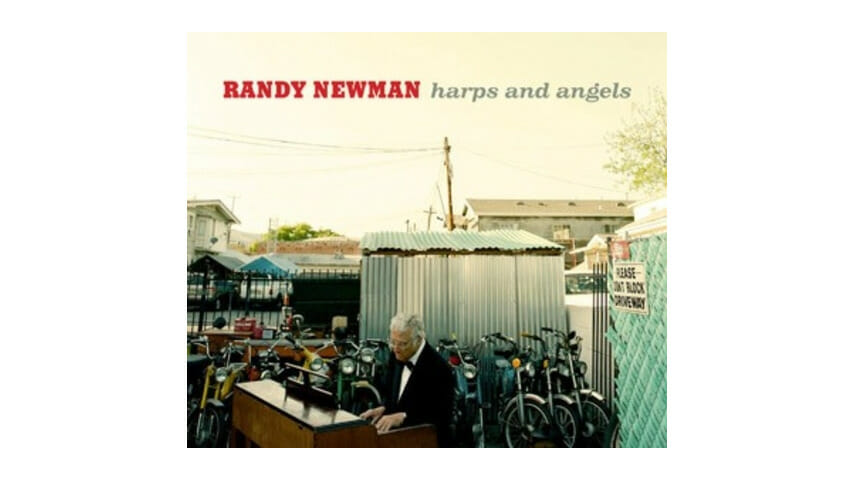
Harps and Angels is another fine Randy Newman album, minimally produced by Mitchell Froom and Lenny Waronker; Newman arranges and orchestrates as he sees fit with an emphasis on New Orleans-style piano fills, and with no attempts at rap, hard rock or girlpop. Not that that would’ve been bad. It’s just not here.