
Bugonia’s Darkly Amusing Ending Undermines its Critique of Internet Conspiracy Culture

When Korean director Jang Joon-hwan penned and directed his cult classic 2003 ecological sci-fi farce Save the Green Planet!, he couldn’t have known how brutally apropos its depiction of a certain species of conspiracy-obsessed, isolated modern male would end up becoming, a little more than 20 years later. When Joon-hwan’s film hit theaters, we were still in the first term of the George W. Bush administration, only a few years removed from the fall of the twin towers, and although online conspiracy theorists had begun to occupy a more prominent niche of popular culture (jet fuel can’t melt steel beams!), “niche” was the operative term.
Depiction of those internet “kooks” could still afford to be lighthearted in this moment, even lovable in the mold of fare like Chris Carter’s The Lone Gunmen, given that it was to be understood by the overwhelming majority of any audience watching that the topics depicted in such media were nonsense, a combination of satire and simple entertainment, and we were expected to be in on the joke. No one espousing flat earth or weather control theories, or broadly denouncing vaccines, was occupying positions of power in critical sectors of government, medicine, major political parties or globally popular entertainment–that kind of earnest belief in bullshit would have gotten you laughed out of the room in any professional setting. But 2025 is not 2003, and director Yorgos Lanthimos’ English-language remake of Save the Green Planet!, Bugonia, is now being offered up to a very different culture, one uniquely suited to miss its meaning. And although it serves as a largely faithful interpretation of Jang Joon-hwan’s story, it fails in some key ways to reinvent itself for the age in which we now sadly exist–an age when the delusional mindset of its central character has become closer to the norm than some kind of noteworthy aberration. Bugonia has been released into a country that has been culturally toppled by the effects of rampant disconnection from reality, seemingly without considering how its narrative might need to change as a result.
The rise of delusional online communities is a topic I’ve been sensitive to for a few years now. The transformational moment must have been the Jan. 6, 2021 Capitol riots, which for many of us was the precise instant that wholly online absurdity such as the QAnon community first became tangibly and undeniably a real topic that we could no longer afford to simply deride and ignore. The crowd that assembled in Washington D.C. on Jan. 6, 2021 was cloaked in the language of conspiracy, bearing the arcane symbols of 1,000 different outlandish beliefs–often conflicting, diametrically opposed beliefs–that all managed to be welcome under QAnon’s big, frenzied tent. What had been a group defined by its purely online existence had manifested in the flesh, and then put that flesh to terrifying collective use. It was the moment when an online generation seemingly addled by quarantine lockdowns and subsequent mental health deterioration finally had its coming out party, and I started keeping regular tabs for Paste on what the hell these people were talking about in the years after, as they raged, prayed for bloodshed and bemoaned a world they could no longer understand.
[ad]
Here in 2025, in what feels like a lifetime later, “QAnon” has long gone the way of the dodo as a useful label or descriptor for any still-existing group, but that doesn’t mean that things have gotten any better. Instead, as fixation on a figure like the original “Q” diluted and faded away to nothingness, the openness to fantastical, magical and bigoted thinking that the QAnon movement had cultivated simply metastasized and spread out to infect every other corner of politics and popular culture, co-opted by countless grifters. Candidates championing bizarre, demonstrably false beliefs found themselves thrust into local and national office, as constituents stopped caring. Ideas on race, gender and science that would have been unthinkable to utter in public a few years ago were brutishly smashed into the discourse over and over until people grew inured to them, and the so-called Overton window shifted. Armies of bots attempted, with great success, to inflame division and hatred across social media networks, spurred on by foreign powers with obviously destructive intentions, as newly developed A.I. technology rendered items like photos and video functionally useless as tools of debate. Society became the conspiracy theorist’s playground; objective truth lost its power to persuade.
And considering that setting, does it not strike one as problematic, almost irresponsible, for Yorgos Lanthimos’ Bugonia to ultimately conclude itself with an outcome that vindicates its addled central character to at least some degree? In doing so, the film has lost some of its satirical potency, and assured that a genuinely sizable portion of its contemporary viewing audience is likely to ultimately draw the wrong conclusions from it. They will see a conspiracy theorist who (although very dead, by the end) is that most holy of things: “proven right.” And to those viewers, “proven right” is all that matters.
Bugonia, Aliens and Delusion
First, to be clear: I don’t believe that Yorgos Lanthimos as director, or screenwriter Will Tracy, are literally attempting to make a case for conspiracy theorists here. Rather, they’re engaged in a faithful adaptation of the prophetic Save the Green Planet!, which touches, as mentioned, on topics that have grown far more relevant now than they were in 2003. In doing so, they’ve preserved the film’s twist ending; the potential problem is that this ending plays quite differently in 2025, in this context, than it did in 2003. Lanthimos and Tracy are absolutely attempting to engage in a critique of the internet echo chambers and fractioning of society that has allowed so many people to partition themselves into increasingly crazy territory, but Bugonia’s ending risks allowing too many of its viewers to simply write off its points and choose to believe what they want to believe, as has become a massive hurdle of our post-objective-fact society. All too many viewers will rejoice in any depiction of a derided conspiracy theorist who is ultimately, technically correct about much of what he believes, missing out on any of Bugonia’s other commentary on the character.
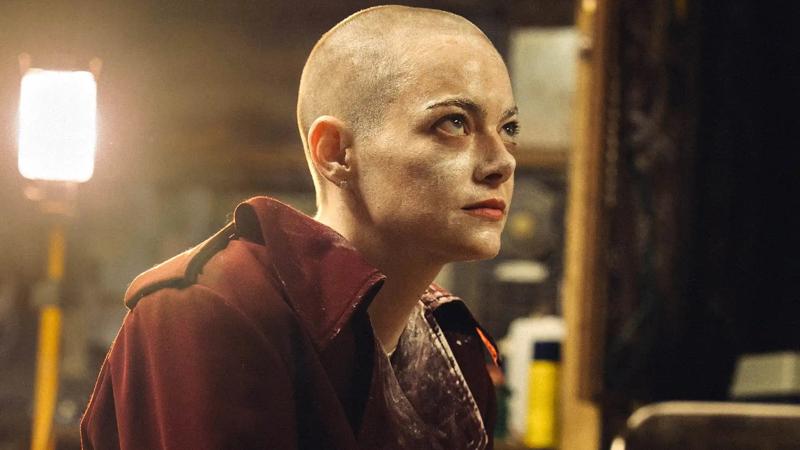
Lanthimos’ film has two major poles: Conspiracy theorist Teddy Gatz (Jesse Plemons) and pharmaceutical megacorp CEO Michelle Fuller (Emma Stone), the woman he abducts because he believes she’s secretly a space alien working to undermine the human race. Like so many right-wing uncles who descended into conspiracy obsession over the course of the pandemic, he cites armchair YouTube crackpots as his guiding lights in arriving at his conclusions, which include the need to shave off all of Michelle’s hair in order to prevent her from communicating with her mother ship, or the need to chemically castrate both himself and his developmentally disabled cousin Don (Aidan Delbis). It doesn’t take Michelle long to wrap her head around his seeming pathology; he’s a man whose personal and family lives fell apart, and he compensated by finding a new target of obsession to give his life meaning.
Teddy, like many conspiracy theorists, is adept at self-deception, and he is able to very effectively lie to himself about his own motivation for embarking on this dangerous mission, as well as the deeply unlikely convenience of discovering a hostile, clandestine alien who just so happens to also be your own boss. He’s able to mentally cast himself as a heroic human resistance fighter and altruistic martyr making a sacrifice for the good of his species, while ignoring that his fixation on Michelle unavoidably must have begun as a simple wish for justice or revenge for her role in the medical experiment that sent his ailing mother into a yearslong coma. He can’t admit this to himself, because doing so would tarnish the moral purity of his position, the idea that he is risking everything for the good of humankind. To Teddy, it’s just incredible luck that the very alien he needs to unmask already happened to be in his immediate orbit.

For the vast majority of its runtime, Bugonia thrives on the uncertainty of never being able to definitively say if there’s even a grain of truth to what Teddy believes, but even more important is the uncertainty of not knowing how far he will dare go to prove what is almost certainly nonsense, or how he might react when his carefully constructed delusion is finally punctured. The fact that he is prone to violent outbursts hints at the raging cognitive dissonance that exists under his attempt at a composed and stately surface; he attempts to regulate for professionalism but there’s always madness underneath threatening to break free and run wild. This is contrasted beautifully by the restraint and discipline of Michelle/Stone, who believes with a CEO’s superiority complex that if she can simply keep her wits about her, that she can eventually turn the scenario in her favor with manipulation and her own force of personality. This is more or less exactly what happens, as Michelle plays along with the alien role and eventually has Teddy bring her to her own office compound, where he is ultimately killed by errant use of his own homemade explosives.
But then … the twist. After surviving her ordeal, Michelle returns to her office, to the coat closet where Teddy blew himself to bits an hour earlier, and it’s revealed to the audience that not only is it in fact a real stellar transporter, but that Michelle is indeed an “Andromedan” alien, a species that has apparently been guiding over human evolution and societal development since our very beginning. Every one of Teddy’s seemingly absurd beliefs is in fact validated, from the Andromedans using their hair to communicate, to the design of their ship, to their own societal structure. Somehow, in the course of his YouTube noodling and enthusiastic castrations, this greasy haired recluse figured out the finer points of the secret history of the human race.
Beyond the obvious logical pitfalls one must immediately begin to skirt with this reveal–why does an ancient alien disguised as Michelle need to wake up at 4:30 a.m. every day for kale smoothies and VO2 max training?–it does a disservice to the character of Teddy to symbolically absolve him of so many of the actions that he carried out over the course of Bugonia, because he was ultimately “proven right.” One can certainly argue that no, just because Teddy is correct about Michelle’s identity, that doesn’t somehow justify his use of tools such as torture in an attempt to get information from her, but many in the audience are likely to conclude that because Teddy says the stakes are existential for humanity, we must now accept that the ends justify the means in how he goes about things. If you took a purely utilitarian reading, it’s not hard to reason that Teddy abducting and killing a few innocent humans would be a small price to pay for ridding the planet of the nefarious aliens plotting its downfall, as he believes is the case.
The likelihood of audience members–especially ones touched by conspiracy culture themselves–drawing these conclusions makes me particularly uncomfortable, because this kind of delusional martyr mindset is a defining characteristic of 2020s online conspiracy culture. Forget fiction; you don’t need to go farther than the blasted remnants of Twitter to find scores of guys very much like Teddy Gatz, often proudly proclaiming how their righteous conspiracy beliefs have alienated them from all the friends, coworkers and ultimately family members who they were once close to in their former lives, before stumbling onto the truth. In most of their cases, these are men (an overwhelmingly male archetype) who have given up on the idea of conventional, fulfilling relationships, instead repeating a mantra that the ultimate vindication of their beliefs will be worth so much more than human relationships ever could. A story in which a conspiracy theorist, even one who ends up pathetic and dead, also ends up being right, is catnip to these guys, and it allows them to both absolve Teddy of any wrongdoing and recast him as a tragic hero. Case in point: I typed “Bugonia conspiracy” into Twitter, and the first reply to the first post to come up is a guy defending Teddy’s character on the basis that he was “right,” citing the character’s dedication and ignoring the fact that he’s implied to have kidnapped, tortured and murdered random human beings along the way. None of that matters to a conspiracist, when the glory of vindication is right around the corner.

Granted, there are some interesting thematic threads that are tugged in Lanthimos’ film by the reveal that Michelle Fuller is an Andromedan after all, even if it does feel like the kind of predictable ironic twist that, on paper, might have been culled from a lesser Twilight Zone episode or M. Night Shyamalan screenplay. The Andromedans are implied, in some ways, to be just as fallible and pathetic as we are: Their superior intellect and technology has not rid them of overconfidence and susceptibility to the unforeseen consequences of their actions. By Michelle’s own admission, The Andromedans accidentally wiped out Earth’s dinosaurs and have been more or less spinning their tires since, creating humanity in their image and trying with little success to iron out our many wrinkles. You might consider them a metaphor for the U.S. billionaire industrialist class, believing that their vast resources and eagle-eyed view of the situation gives them not only the ability but the right to interfere and play god, only to find that even with all their gifts, they still can’t predict the negative consequences of their spurious leadership. After her ordeal, Michelle ultimately pulls the plug in rather spiteful fashion, ending the Earth experiment in a macabre (and darkly hilarious) montage of dead humans littering the Earth’s surface as nature simply goes on without us. But given what we’ve seen of the prior effectiveness of their actions, perhaps even this step will ultimately doom the Earth and its cherished bees through some other unforeseen ripple effect. Lanthimos seems to be making some commentary here on the arrogance of thinking that we can mold systems that are far too complex for anyone to grasp.
But that’s just the problem: Far too many viewers will watch Bugonia and, instead of digesting its critique of that kind of arrogance, they’ll believe that the film is encouraging them to go the distance in dedicating themselves to delusion, all because Teddy just so happened to be “right” in the end. It’s an outcome that Lanthimos and Tracy might have avoided had they more effectively read the room in updating Save the Green Planet!, perhaps by spending more time trawling in the very echo chambers they namecheck in its script, to more fully understand the depth to which Teddy has become a spiritual avatar of a disturbingly large percentage of internet users. As for the ultimate assessment of Bugonia, perhaps you shouldn’t be surprised if your conspiracy-addled uncle ends up heartily recommending the film to you over Thanksgiving dinner. It would be just one more misinterpreted signal in a deepening crisis of internet fluency that stands as a bellwether for our collective descent into a delusion of our own choosing.
[ad]
Jim Vorel is Paste’s Movies editor and resident genre geek. You can follow him on Twitter or on Bluesky for more film writing.
 Keep scrolling for more great stories.