
Liam Hemsworth’s Arrival Is the Least Interesting Thing About The Witcher Season 4
(Photo: Netflix)
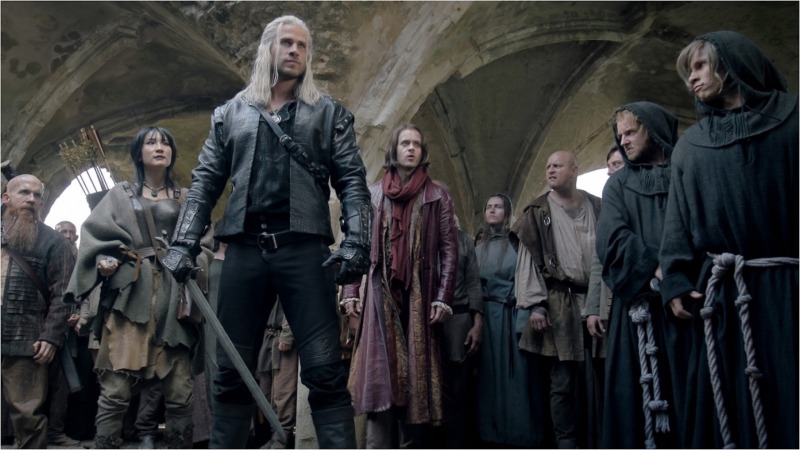
Netflix’s fantasy drama The Witcher is clearly building up to an ending. In its fourth (and penultimate) season, the stakes are higher, the losses more devastating, the political wrangling somehow even more needlessly convoluted. There are difficult choices, genuine surprises, a handful of excellent action set pieces, and an ending that leaves several of the show’s most beloved characters in dark and dire straits. And almost none of that matters. Because the only thing that pretty much anybody’s going to want to talk about when it comes to Season 4 is the fact that it swapped out its lead actor in between seasons.
On some level, that’s fair—it’s a fairly unprecedented sort of move, and former star Henry Cavill was essentially created in a lab to play the show’s titular monster hunter Geralt of Rivia. But while Liam Hemsworth may gamely up Cavill’s witcher mantle for the show’s penultimate season, viewers will likely be surprised to discover that he—and, subsequently, Geralt—are actually the least interesting part of the story this run of episodes is telling
That isn’t really a criticism, much as it might sound like one. As an actor, Hemsworth is generally charming, likable, and easy on the eyes. (Sorry to be wildly shallow there for a second.) Yes, his occasional grunts and F-bombs can occasionally come off like a try-hard Geralt cosplayer. But he also displays a remarkably deft hand when it comes to mining the character’s increasingly visible emotional depths. It helps that Hemsworth is taking over the part at a moment of radical interior change for the character, and that the plot of Season 4 largely requires the show’s three leads to be essentially siloed off into their own stories for the bulk of its eight episodes (all of which were available for review). This allows Hemsworth the space to establish his version of Geralt on his own terms, and though—for me, at least—the jury’s still mostly out on how well he’ll integrate into the show’s main trio, it seems safe to admit that this little experiment is more successful than any of us probably expected.
But a big part of the reason for that is, again, that Geralt’s story just isn’t the most important thing happening in Season 4. That honor, once again, belongs to the series’ women. The female characters of The Witcher have always been this show’s secret weapon, but in this penultimate outing, they’re its beating heart. From the new sisterhood that sorceress Yennefer of Vengerberg (Anya Chalotra) begins to build out of the ruins of Aretuza, to Princess Cirilla of Cintra’s (Freya Allan) furious attempts to run away from both her past and the future she doesn’t want to face, the emotional center of this season runs through the show’s women who fight—in very different ways—to shape their own fates.
Picking up almost immediately after the events of Season 3, we follow Geralt as he sets off to rescue Ciri, aided by the bard Jasker (Joey Batey), the archer Milva (Meng’er Zhang), and, eventually, a ragtag squad of old faces, former enemies, and new friends that will come to be known as his hansa. But unbeknownst to them all, the Ciri they believe to be currently held by Emhyr (Bart Edwards), Emperor of Nilfgaard, is actually a young imposter named Teryn (Frances Pooley). The real Lion Cub of Cintra is living under an assumed name in Geso, where she’s joined a gang of misfits known as the Rats and is desperately hoping to hide from her destiny. As for Yennefer, she’s busy picking up the pieces after the fall of Aretuza and desperately seeking a way to bring down the dark sorcerer Vilgefortz (Mahesh Jadu) before he can find Ciri and use her Elder Blood for his own ends.
Though Geralt, Ciri, and Yen spend the season on their own paths, each must open themselves up to others in new ways, whether that means building new relationships or stepping into new roles. In the wake of his injuries and reeling from the loss of his daughter (again), Geralt is forced to confront what it means not only to care about others, but to care about a purpose larger than himself. Admittedly, watching Geralt allow himself to be openly vulnerable with others is…a bit weird, at first, but also strangely welcome. (And, in many ways, feels like we’re being allowed to get to know the character all over again in a new and different way.)
Ciri, for her part, is very clearly in her rebellion era, living on the fringes of Nilfgaard with a group of young people who have, in different ways, had it as hard as she has. Using the name Falka, she purposefully embraces a sharper, colder demeanor, seemingly hoping that it will help her forget all the aspects of herself she’s left behind. Allan gives the character a delightfully entertaining edge this season, without ever letting the light of Ciri’s essential goodness dim (even when she’s not exactly behaving like her best self). Unfortunately, however, other than Mistle (Christelle Elwin), the kind young woman with whom Ciri begins a tentative romantic relationship, the rest of the Rats are woefully underdeveloped, and you’ll likely struggle to remember most of their names.
But in truth, Season 4 of The Witcher belongs to Anya Chalotra. Book readers will already know that this is quite the statement—the character of Yennefer is largely absent from events at this part of the story in Andrzej Sapkowski’s novels, so her arc this season is pretty much made up out of whole cloth. And, spoiler alert: it’s fantastic. We get to watch Yen finally fully step into her own power—as a mage, as a leader, as a mother, as a hero—and it’s wildly satisfying on virtually every level. So much of this season is about Yennefer embracing the community she once tried so hard to abandon, and finding strength and purpose in the sisterhood of her fellow sorceresses. It’s the kind of growth that is not only thrilling to watch unfold, but that also feels incredibly earned in terms of everything we’ve seen this character go through on this series to date.
The Witcher, like the character at its center, is going through something of a metamorphosis in its fourth season. The show’s never felt so much like a true ensemble piece, nor has its story been allowed to stew in elements of its own darkness quite so thoroughly. And as it prepares to bring its sprawling epic tale to a close, The Witcher feels like a different beast than what has come before—in ways that go well beyond the fact that a different guy is now wearing the show’s signature white wig. What that means for how the series will ultimately wrap up is anyone’s guess, but this outing certainly seems to promise that anything is possible.
The Witcher Season 4 premieres October 30 on Netflix.
Lacy Baugher Milas writes about TV and Books at Paste Magazine, but loves nerding out about all sorts of pop culture. You can find her on Twitter and Bluesky at @LacyMB
For all the latest TV news, reviews, lists and features, follow @Paste_TV
 Keep scrolling for more great stories.