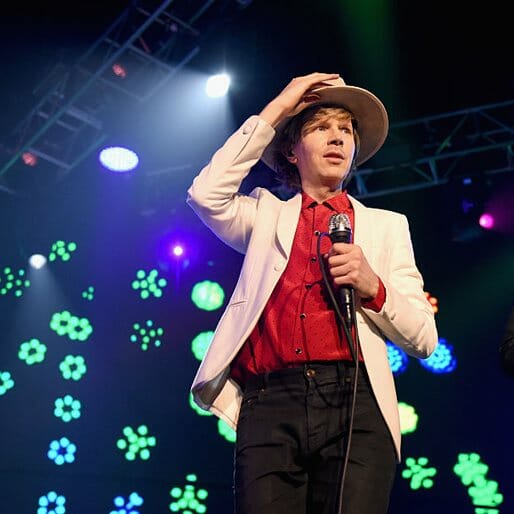
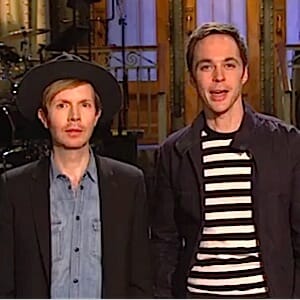
Well, if you want to get technical about it, he launched it a minute before this story was posted. But still.Starting today at 3pm EST, Beck took over Left of Center, Sirius' channel 26, with Radio Beck. The show will air through Sunday.

Well, if you want to get technical about it, he launched it a minute before this story was posted. But still.
If you haven't already been properly dosed by Beck's psychedelia-tinged Guilt trip, you're overdue. On the Danger Mouse-produced album that hit the streets last week, Mr. Hansen pours a suave croon over fuzz guitar, melting synths and bouncing drumbeats (matching go-go boots not included). In support of his latest creation, Beck has slated some fall dates, kicking off in Reno and closing in Chicago.
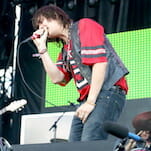
It’s tempting to call Modern Guilt a return to form for Beck Hansen. After releasing a pair of bloated, unmemorable records, he recruited producer/collaborator Danger Mouse to help him out with his latest project, and the results of this partnership are pretty hard to argue with. In Danger, Beck has found a genre-hopping, kindred spirit who can be credited for helping the notoriously perfectionist artist record Modern Guilt in a mere two and a half months—the amount of time it usually takes Beck to tune the low e-string on his guitar.
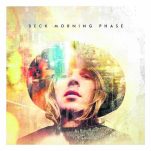
The results, however, sound anything but rushed. Set to the same eerie psychedelica as Danger's work with Gorillaz and Gnarls Barkley, Modern Guilt is full of nods to The Zombies, 13th Floor Elevators and even Radiohead. In fact, tracks like “Replica” and “Profanity Prayers” play like In Rainbows b-sides, an ironic twist considering that this is one of the rare Beck records that Radiohead producer Nigel Godrich didn’t have a hand in.
Lyrically, Beck shuns the mad-lib rapping that made “Loser” such an unexpected hit. Instead, he focuses on constructing haunting lyrics that preach the end of days with the zeal of a street-corner prophet. Embracing his role as a shaggy-haired doomsayer, Beck stoically laments our melting icecaps on one track (“Gamma Ray”) while declaring that “some days are worse than you can imagine” on another (“Walls”). All this adds up to Beck’s darkest record to date, one that captures the uncertainty of 2008 as well as Mellow Gold distilled apathy in 1994.
But calling Modern Guilt a return to form misses the point. One of the biggest problems with records like Guero and The Information was that they both sounded like Beck was trying recreate the artistic formula that made Odelay such a landmark album. For an artist that spent years constructing one of modern rock’s most diverse discographies, these “returns to form” were frankly pretty disappointing, even if they did vaguely sound like “Devil’s Haircut.” But by eschewing his best work on Modern Guilt, Beck paradoxically ends up doing what he does best—tweaking our expectations.
It’s official: Beck’s forthcoming record will be titled Modern Guilt, and will drop on July 8 in North America.
During the month of May, rumors began swirling about the upcoming release by Beck. Was Danger Mouse the producer, and does it feature Cat Power? Would it be released by Universal a'la The Raconteurs latest effort? Would it be given a name prior to it hitting the streets? Is Beck Hansen really his name? (Okay... maybe not that last one.)
Let's do a quick rundown of a few of Beck's buddies/coworkers: Jack White, Danger Mouse, Radiohead... notice a connecting thread?
Word started spreading on Monday that Beck would be "pulling a Radiohead/Raconteurs/Gnarls Barkley" and dropping some new pollution in the very near future either digitally or corporeally. After a two-day tempest, triggered by a secretly-sourced MTV News Blog, Beck's publicity folk confirmed this morning that Mr. Hansen will release his latest studio album this summer. Whether "this summer" means in the next four-to-six weeks, as MTV reported, remains to be seen.
Perhaps Beck will preview some of the 10 Danger Mouse-produced, possibly scratch-lyricked tracks on the shorty short album (clocking in at barely 30 minutes!) on his summer tour (see dates below) and headlining slot at this year's Austin City Limits Festival.
Beck stars in a "hometown show" at the Hollywood Bowl on Sept. 20 with openers MGMT and Spoon; good to know he'll be consorting with utensils again. On Beck's 2006 tour, the fruitful partnership of kitchen mainstays and musicians resulted in the amazing dinner table symphony performances—here's a clip of the band playing "Clap Hands" on Germany's Sarah Kuttner Show:
Tour dates? Hell yes:
June
25 - Norway @ Hove Festival
27 - Berlin, Germany @ Columbiahalle
28 - St. Gallen, Switzerland @ St. Gallen Festival
30 - Amsterdam, Netherlands @ Melkweg
July
4 - London, England @ Hyde Park (O2 Wireless Festival)
6 - Werchter, Belgium @ Rock Werchter Festival
7 - Paris, France @ Olympia
9 - Madrid, Spain @ La Riviera
August
22 - San Francisco, Calif. @ Golden Gate Park (Outside Lands Festival)
30 - Seattle, Wash. @ Bumbershoot Festival
September
20 - Los Angeles, Calif @ Hollywood Bowl
27 - Austin, Texas @ Zilker Park (Austin City Limits Festival)
Related links:
Beck.com
Beck on MySpace
Feature: The Impenetrable Beck Hansen
Got news tips for Paste? E-mail news@pastemagazine.com.
It's not officially summer until three things happen: neighborhood pools open, really smart people get really terrible tans, and Beck announces his latest warm-weather tour. Well, it's time to grab the SPF 15 and light up the BBQ, because everybody's favorite Midnite Vulture is headlining a summer trek that's sure to get all you neon mamacitas' totally bzooty. What's "bzooty" mean, you ask? Look it up in the Becktionary. (For more detailed information, please refer to the Encyclopedia Becktanica.)
Before hitting up the U.S., Mr. Hansen has a bunch of European dates in June and July. He'll make it back home at the end of August, stopping by the Bumbershoot and Austin City Limits festivals in September. No word on whether he'll be performing new material from his upcoming Danger Mouse-produced album or those tracks he recorded with Jamie Lidell about a year ago. But a guy can hope, right?
Dates:
June
25 - Norway @ Hove Festival
27 - Berlin, Germany @ Columbiahalle
28 - St. Gallen, Switzerland @ St. Gallen Festival
30 - Amsterdam, Netherlands @ Melkweg
July
4 - London, England @ Hyde Park (O2 Wireless Festival)
6 - Werchter, Belgium @ Rock Werchter Festival
7 - Paris, France @ Olympia
9 - Madrid, Spain @ La Riviera
August
22 - San Francisco, Calif. @ Golden Gate Park (Outside Lands Festival)
30 - Seattle, Wash. @ Bumbershoot Festival
September
20 - Los Angeles, Calif @ Hollywood Bowl
27 - Austin, Texas @ Zilker Park (Austin City Limits Festival)
Related links:
Feature: The Impenetrable Beck Hansen
Beck.com
Beck on MySpace
Got news tips for Paste? E-mail news@pastemagazine.com.
Its been almost 12 years since Beck released his Grammy winning album Odelay. Having passed the decade mark, your copy of the wicked-good record might be a bit tattered and in need of a proper face-lift. Luckily, the album has been getting the medical attention in deserves, and come 2008, Odelay will be standing out and looking sharp.
The record is set to be released in a two-disc Deluxe Edition format. The rejuvenated version will include 16 b-sides and two unreleased tracks. Look for it to hit stores January 29.
Related links:
Beck.com
Paste: The Impenetrable Beck Hansen
Paste: Beck - Guero
Got news tips for Paste? Email news@pastemagazine.com.
Beck, who’s been cool for so long that the children have taken to calling him Grandpa Hipster, will release a new song next week. The self-produced “Timebomb” will be available on iTunes on August 21, and at other online music providers on August 28.
The song is Beck’s first output since 2006’s The Information, and will have to sate us for now, as reports tell us that no more recordings are in the works for the foreseeable future.
Related links:
Beck.com
Beck on MySpace
Video for “Clap Hands” with the band playing their parts on a dinner table
Got news tips for Paste? Email news@pastemagazine.com.
Above: Not Zach Braff
Ah, Los Angeles: the only place on earth where even the mannequins are, well, buxom. The city—Beck and Jamie Lidell’s recent recording place of choice—is home to Infrared Sound Recording Co.
Engaging in direct-to-disc recordings at the studio, Pitchfork reports the tourmates are opting for equipment that put their live performances onto vinyl masters, later to be turned into singles.
Brit soul-o-meter Lidell and the unpredictable alt-rocker's sessions will be released in the indeterminable future.
Related links:
4 to Watch: Jamie Lidell
Beck.com
The Impenetrable Beck Hansen
Got news tips for Paste? Email news@pastemagazine.com.
Like Beck? Love satchels? Then design firm Jeremyville’s limited edition Beck Sketchel just might be your (shoulder) bag.
With original artwork by Frenchman Genevieve Gauckler, the ultra-chic accessory follows in the wake of the “design your own album cover” concept behind Beck’s latest release, The Information.
The $90 bag is available in the U.S. only at Beck.com, so get yours now or forever be stuck with that eggplant L.L. Bean you’ve been sporting since fifth grade.
Related links:
Jeremyville’s homepage
Beck’s homepage
Beck on MySpace
Four mysterious figures in identical black shirts stand behind a draped box as the house lights at the Shepherds Bush Empire in West London go down. When the spotlights flash on, Beck Hansen—dressed in a waistcoat, with a farmer’s hat over his lank hair—storms out from stage right as the instantly recognizable opening chords of his mid-’90s breakthrough hit “Loser” ring out. The curtain over the aforementioned box is suddenly lifted, revealing a miniature theatre.
Turns out the four unknowns aren’t covert agents, backup singers or even stagehands—they’re puppeteers. On the tiny stage beneath them, six-inch-tall marionette replicas of the band members jerkily wave drumsticks, thrash guitars, pump keyboards and flail to the beats pulsing through the theater. Kneeling before them, a cameraman collects video images that are simultaneously projected on a giant stage-dominating screen.
The Beck puppet is only distinguishable from the original because of the pallor of its skin, the smallness of its eyes and the tell-tale lines on either side of the jaw that allow the mouth to open in time with the vocals. Ripples of laughter shoot through the audience whenever a difficult guitar break or drum solo is executed by tiny hands.
After a few songs, it’s natural to get wrapped up in the puppetry instead of the music, or end up glancing at the band members only to check out how well the look-alikes are imitating them. In fact, it’s not even the puppets that dominate, but a film of them projected on the screen at the back of the stage. So rather than looking at Beck, the audience is gazing at a filmed image of a puppet replica of him.
It could be that Beck is just having fun—doing it simply because he can. He does have a reputation for playful juxtaposition. Or he could be putting us on, getting the critics scrambling for interpretations, then laughing himself silly in the dressing room after the show. But I’ll take the bait: With this stage setup, is Beck encouraging a discussion about the nature of spectacle? After all, we’re already accustomed to one degree of separation when we watch stadium rock on LCD screens; how about two degrees of separation? Is this show less real because we’re glued to digital images of puppet representations, or is it more real because we’re offered two extra dimensions of the same experience?
Since he’s a studio hermit who tends to spend years rather than months on each new project, it could even refer to having to take this character—“Beck”—out on the road and dangle him in front of audiences. Maybe he feels like a puppet. Maybe he feels that he’s now mimicking himself, or mimicking the person that he’s become in the imaginations of his audience.
Clearly Beck loves making music more than he does promoting it. He spends extraordinary amounts of time in the studio trying to replicate the sounds he hears in his head. For his latest album, The Information, he estimates that 80 percent of what was recorded was eventually thrown out. It was two-and-a-half years ago that he and producer Nigel Godrich (Radiohead, R.E.M., Paul McCartney) started the first track, and when the project was finally completed, Beck says it felt as though they’d worked on five albums.
“The luxury of that time allowed us to get something that was more interesting,” he says during an evening off in London while touring Europe. “We would usually get to the obvious thing first and then, after the track had sat around for a year or so, Nigel would do something totally different with it. We would lose whatever we had in the beginning and go somewhere far more interesting. In a way, you couldn’t be precious about anything you were putting out, even if it was your heart and soul.” Beck seems genuinely unconcerned about fame and reputation. His clothes wouldn’t look out of place on an impoverished student, many of them bought in Tokyo or Kyoto because Japanese shirts and jackets fit his slender frame better than European or American ones. His hair goes from short to long and back again, due not to the dictates of fashion magazines but the sporadic availability of a hairdresser friend who’s regularly out of town styling for film shoots. Beck doesn’t need to seek anonymity. His natural look is anonymous. Which is why he can slip, nearly undetected, into Mexican restaurants and play guitar in the back—as he did at Pancho Villa in San Francisco last year—while hardly anyone in the place bats an eyelash.
He says that he never reads reviews of his shows or albums because it makes him feel as if he’s a contestant on a TV makeover show where his tastes are being weighed by a panel he feels isn’t necessarily qualified. “It’s just embarrassing,” he says. “It’s kind of… unseemly.” He has the same opinion about interviews. On the rare occasions he’s read an “Interview with Beck,” it’s been “an exercise in frustration,” not usually because of misquotation but because of selective quotation.
There have been two books written about Beck—Beck: Beautiful Monstrosity by Julian Palacios and Beck by David Quantick—yet he claims to have only read part of one of them. Most young people getting into music dream of the day that they’ll be considered worthy material for a full-length book and it seems only natural to wonder what others have said about you. But Beck explains, “I just like making music and records. I’d be happy if that was all I did.”
He says that he never reads reviews of his shows or albums because it makes him feel as if he’s a contestant on a TV makeover show where his tastes are being weighed by a panel he feels isn’t necessarily qualified. “It’s just embarrassing,” he says. “It’s kind of… unseemly.” He has the same opinion about interviews. On the rare occasions he’s read an “Interview with Beck,” it’s been “an exercise in frustration,” not usually because of misquotation but because of selective quotation.
There have been two books written about Beck—Beck: Beautiful Monstrosity by Julian Palacios and Beck by David Quantick—yet he claims to have only read part of one of them. Most young people getting into music dream of the day that they’ll be considered worthy material for a full-length book and it seems only natural to wonder what others have said about you. But Beck explains, “I just like making music and records. I’d be happy if that was all I did.”
His whole life appears dedicated to exploring music and imagining new fusions and collisions. And the breadth of his musical knowledge is impressive for someone who’s only 36. As a onetime anti-folkie, he’s naturally had an interest in the roots of American music, but this has been supplemented with input from hip-hop and techno, U.K. post-punk and Japanese noise bands, Mexican mariachi music and ’40s bebop, not to mention ’60s psychedelia and ’70s funk. He’s one of the rare musicians who can speak with equal passion about The Louvin Brothers and Aphex Twin, Mississippi John Hurt and Chuck D.
This raises the question of what he’s actually good at. Is he a singer/songwriter or an architect of sound? Is he an artist engaged in self-revelation or is he a compilation expert ripping and mashing the archives of modern music? He says the most important thing is that he’s good at getting the job done. “What am I good at? Persistence. I work on something until it turns into something. I won’t give up on it. I have a pretty strong work ethic. I don’t know if that gives me an advantage over other people but it’s what it takes me to do what I do.”
He seems to have been born with a studious inclination. As a boy, Beck would read books and write rather than play sports. By age 12 he was a fan of French New Wave film director Francois Truffaut, and two years later he was listening to Library of Congress field recordings of blues and folk singers collected by John and Alan Lomax in the ’30s and ’40s. A British magazine once reported that the young Beck, who was raised in Central L.A., grew up as a surfer. This couldn’t be further from the truth. “I barely went to the beach when I was a kid,” he says. “I was locked in my room listening to the Velvet Underground and Woody Guthrie. I was the antithesis of a surfer.”
Beck was brought up in poor immigrant neighborhoods (“pretty rough to extremely rough,” as he describes them) because his parents didn’t have much money at the time; his father, David Campbell, was a struggling arranger and composer yet to get his big break. So while Beck heard the music of Mexico drifting through his bedroom window, the records on the living-room turntable were often the movie soundtracks of Henry Mancini and John Barry.
Being the odd one out forced him to discover freedom in his interior world. His imagination became the best—and safest—place to play. Even now he constantly refers to his music as something constructed within him long before he’s able to capture it on a recording. “I don’t really write things based on books or anything else,” he says. “They’re movies I make up in my head.”
He left school after junior high, but if his parents had been better off he would’ve liked to have studied art. “That’s the world I wanted to be in but I didn’t know how to get into it,” he says. “But I could go down to the coffee shop and pick up an acoustic guitar. In that way, music was empowering for me. I think that’s how my grandfather made his way in art. He made art out of garbage because he couldn’t afford art supplies.”
Al Hansen, Beck’s maternal grandfather, was part of the New York avant-garde art scene of the ’40s and ’50s, taking part not only in visual arts but in theatre, poetry readings and happenings. Much has been made of the connection between the artistic approach of Al—with his gutter-and-trashcan-mined collages and sculptures—and his grandson Beck. They were both, in their own way, taking what seemed irredeemable and turning it into art—tin cans and candy wrappers in one case, breakbeats and neglected music forms in the other. Al once wrote of his work, “I decided to un-compose it. That is, instead of composing and melding [the objects I found in the street] into unified wholes, I would put them together in a way that jarred, that made apparent that they did not go together.”
Beck’s materials might not be literal garbage, but they’re often taken from overlooked, forgotten or less-exalted musical styles. “I embrace genres that are typically not at the apex of the hierarchical pyramid,” he explains. “I was interested, especially with Midnite Vultures, in how it was possible to do something weird or art-driven with a genre of less-respected music. It’s probably much easier to do that within the tradition of art-rock music, like the Velvet Underground or Joy Division, than it is within the funk tradition. I think that once you’ve done a funk track you’ve discredited yourself!”
When Odelay came out in 1996, its range of references—and the aplomb with which Beck pulled o their incorporation—was stunning. It was a perfect example of postmodern music. The lyrics made little linear sense, the title couldn’t be found in a dictionary (it was a misspelling of the Chicano greeting “órale” which, loosely translated, means “go on” or “way to go” and was the original title of “Lord Only Knows”), the artist’s image was not included on the cover and the music emanated from no single musical tradition. Tradition, in Beck’s case, was not to be honored but rather plundered.
His subsequent records—although different from Odelay—have had a similarly adventurous spirit. Nigel Godrich has said that Beck regards the recording studio as “a party place, a village hall.” With Midnite Vultures he ventured into funk to create what he calls “a strange, technologically generated, sonic Fellini film mixed with early Prince videos, Fluxus happenings and Japanese noise bands.”
Mutations, the first album he did with Godrich, was deliberately non-Odelay, an attempt to show he could do things the old-fashioned way. “I purposely did no songs with beats, no funky tracks, no slice-and-dice, no kid-gone-mad-with-a-sampler,” he says of the laidback record. “I wanted real traditional songwriting that went in the opposite direction.”
Each album seems a reaction to what preceded it, almost as though Beck is fearful of being caught loitering in a particular genre. Just as Mutations was very non-Odelay, Midnight Vultures was a huge leap from Mutations. And just when the audience expected more Prince-like funk, Beck came out with Sea Change, another Godrich production, which captured him in a mellow, introspective mood. Guero picked up on the heat and dust of South American music, while Guerolito, released in the same year, was a daring remix.
Of Guerolito Beck says; “I was listening to a lot of Miles Davis records from the early ’70s where he would do multiple versions of one song. There was this idea in rock that there was only one definitive version of a song. On Guerolito, we did all the remixes and then I went into the studio and—for our own amusement—started doing a calypso version of ‘Scarecrow’ and then all these other strange versions. A song is just a skeleton and you can just do whatever you want on top. That was the idea I was exploring.”
While each album is united by feel, Beck has never worked to a theme. His method is to go into the studio with some beats and start improvising vocals over them. He has no lyrics prepared on paper. As he puts it, he just gets on the microphone and “lets it fly.” When something magical happens, he keeps it. This process was made easier on The Information because it was the first record he and Godrich used computers on. “It afforded us the ability to experiment,” he says. “We could try a lot of things and waste a lot of ideas. There are almost too many options. You can drive yourself crazy with options.”
Often, Beck’s best lines will come up when he’s not even aware he’s being recorded. It happened that way with the chorus of The Information’s lead track, “Elevator Music.” He describes the state of mind he has to get into to do this as being almost like that of someone meditating. He has to ignore his surroundings and forget that close friends are listening in the control room. He can’t afford to be self-conscious. “There are so many internal rhythms and rhymes,” he says. “If I was to sit down right now and write out a couple of stanzas and tried to rap them, they wouldn’t flow. The rhymes come out of the beat. They come from a conversation with the beat. Rhythmically, the process is closer to jazz improvisation.”
It’s tempting to describe this method of composition as stream-of-consciousness, but it’s not quite as soul-baring because he has the opportunity to revise and erase. “It’s like a conversation with another person,” he explains. “Both people willfully talk about what they want to talk about, but it’s not scripted. There are times when I go up on the mic when it is just stream-of-consciousness because I don’t know what’s coming next, but anyone who writes has to have some kernel of an agenda or plan. But we’re all ultimately talking out of our necks. We’re all making it up as we go along.”
Back in the ’90s, especially after the success of “Loser,” Beck was being hailed as a Dylan for Generation X. Allen Ginsberg even called him “the most important voice of his generation.” But, given the ambiguous, fragmentary nature of his lyrics, was this too optimistic a claim? If Beck is simply holding up a mirror to his culture, smashing it and then reassembling the shards, is he offering any kind of real commentary?
“I’m definitely saying specific things,” he says when asked if Beckologists who revere his words are engaged in a wild goose chase. “I articulate things, but in a way that’s encoded. I’m not always saying it in plain language because if I did it would come out trite. It’s a song, not an essay, so I include images and wordplay. Each song is about something specific to me, but I like to add random pieces so that the picture is more blurred—more like life. Life is full of extraneous parts so I like to have these things in my songs.”
The Information, he says, is a further crystallization of an idea he’s been pursuing throughout his career. “I’m just getting closer to the sound in my head,” he says. “Every record is an experiment. It’s like going back to the classroom. When you come out the other end you figure out the things you’ll do differently next time.”
The sound he’s trying to nail combines the beats and energy of hip-hop with the reflective lyricism of folk, country and blues. In his own career he sees these poles represented by “Where It’s At” and “Loser” on one hand and Sea Change on the other. “I wanted the beats to be in the foreground and I wanted them to be nasty and heavy,” he says. “I wanted the vocals to be right there and I wanted everything to sound a bit raw. There’s an element of that left [on The Information], but as we went along we stumbled onto other things. We stumbled onto quieter things like ‘Motorcade’ and ‘New Round.’ ‘Movie Theme’ was something we just messed around with one afternoon before we started work. So we strayed off the path but I think that’s what makes an album diverse.”
One of his influences was French writer and performer Serge Gainsbourg, who experimented with African and Caribbean music as far back as 1964. After hearing Gainsbourg Percussions, Beck wanted an album stripped down to drums, rhythm and vocals, believing that the imposed limitations would spark creativity (perhaps a la filmmaker Jørgen Leth’s The Five Obstructions). But with The Information, the original version was discarded, making room for new ideas. “This album is very different from anything I’ve done with Nigel before. A lot of it was recorded live. We were creating our own imaginary world of breakbeats—the sort of thing a DJ would base a track on. We created this alternative universe of tracks, put it on vinyl and scratched a lot of it. A lot of it was played back in. We were going for a traditional, organic process of recording but at the same time influenced by a completely artificial style of recording. It was a bit backwards. We were trying to capture the character of hip-hop records but with people playing instruments.”
In some ways this sounds remarkably similar to what he and the Dust Brothers set out to achieve with Odelay. “Sure, yeah,” he says. “[But] the difference is that 10 years ago we didn’t know how to record the drums to make them sound like classic breakbeats. In a way, that was the beauty—because it was haphazard. Anybody today can find a great old record with a great break and loop it up. We were trying to take that aesthetic, but do it ourselves—that was the challenge.”
To many of his critics, all the playing around with sounds and ‘genre hopping’ indicates Beck’s fear of exposing his deeper feelings. They suggest that the obscurity of his lyrics and his collage-like approach to creating are really just attempts to hide behind his music.
In conversation, he reveals little of his personal life. He’s non-specific about his time away from the studio, rarely comments on current affairs and is notoriously touchy about discussing his adherence to the teachings of L. Ron Hubbard.
Like anyone would, he bristles at the implication that he doesn’t think for himself. “In Scientology what’s true for you is true for you,” he says. “Nothing is dictated. What I see in the world is what I see. It’s my own opinion. Someone else might be a Scientologist and have a wildly different opinion of the same thing.”
The suggestion that he should recommend the belief he says has “helped me in my life” is abhorrent to him. “You can’t sell it. It’s got to be something you want to do. The interest has to come from you. The idea of selling it is distasteful. It’s personal. You can’t sell an idea.”
So is Beck the puppeteer or the puppet? What did he intend us to read into his recent, theatrical performance setup? “In one way, it was just an experiment,” he says. “But in another way, the puppets toy with the idea of the artificiality of stage shows in the first place. When I was a kid, shows seemed miraculous. The people up there onstage seemed larger than life. As a performer, I’ve seen behind the curtain. It’s just loud amplifiers, lights and all this stuff
“The puppet show plays with the idea of how, ultimately, it’s all absurd. There’s a bit of The Wizard of Oz in it as well. I’ve been in situations where the power has gone out in the middle of one of my shows and I’ve had to carry on with an acoustic guitar and shout as loud as I could. Suddenly you don’t have that powerful sound behind you. When Jimmy Rodgers was traveling around he didn’t have amplification. He had to stand on stage and sing as loud as he could. Same with Bob Dylan.”
The naked human voice is often associated with the naked human spirit. Traditionally, the singers most exposed in this way have exposed the most about themselves. Herein lies the paradox of Beck. He believes he’s opening himself up in his music. He speaks, for example, of hearing the music of Mississippi John Hurt as a teenager and being inspired “to add a human quality” to his own music.
Yet Beck often emanates a seemingly calculated detachment. While some listeners are dazzled by his skills as a collage artist, they might not necessarily feel a soul connection. It’s something Beck is aware of. He realizes that in the studio he can deal in concepts, but when he’s onstage he has to deal with bodies and emotions.
“I definitely enjoy the avant-garde art world that my mother and grandfather inhabited,” he says. “I feel a part of it, but another half of me is in the world where you’re just a musician playing songs for people to move to or sing along to. Being a musician is more workmanlike whereas, as an artist, you can stay in this laboratory and be more conceptual. “What I like is the idea that you can take components of the art world and bring them into music performance. When you’re onstage, you either engage the audience or you don’t. In the art world it’s not quite the same.”
Thanks to everyone who joined Paste in New York and Atlanta last night to celebrate the release of issue #26, featuring Beck.
The New York party featured performances by Hem and Hymns, and a 50-minute, full-band surprise performance by Beck himself. ?uestlove of The Roots served as DJ for the night. The party turned into a gathering of musicians by the end of the evening, with James Iha (Smashing Pumpkins), Adam Schlessinger (Fountains of Wayne), Ben Kweller, the Benevento Russo Duo, Sam Cohen (Apollo Sunshine), Willie Nile, Matt Mays & El Torpedo and Matisyahu all in attendence.
The Atlanta party at Vinyl featured performances by What Made Milwaukee Famous and Manchester Orchestra.
We look forward to our upcoming issue release parties.
(Beck photo by Neda Abghari)
No matter how well Beck’s new album, The Information , does in its first week of sales in UK, it will not be on the charts. There has been a ludicrous ruling by the UK’s official Chart Company. The OCC claims that The Information ’s packaging, which includes stickers that allow buyers to create their own covers, give Beck’s album an "unfair advantage" over other albums released.
This preposterous reasoning ignores the declining amount of music buyers and the next marketing steps that artists might have to take in order to promote the consumption of actual albums, rather than ripping the music illegally or downloading the songs online. It seems that Beck’s innovative approach might be appreciated and lauded rather than disqualifying him from the charts.
The Information was released in the U.S. yesterday and has not been deemed ineligible.
For fans of the enigmatic musical stylings of Beck and Sean Lennon, Oct. 3 won't come soon enough. The day marks the release of Beck's The Information and Lennon's first album in eight years, Friendly Fire.
Now Atlanta-based fans are in for a special treat: On Tuesday evening, the Plaza Theater will hold a free showing of a collection of short films by both artists. The event begins at 9:30 p.m. and is sponsored by local music store Criminal Records. Fellow sponsors Capitol Records, Interscope Records and Paste will be giving out gifts and prizes throughout the night.
Lennon's films, directed by Michele Civetta and produced by the artist himself, are inspired by the issues of human relationships that pervade each song on Friendly Fire. Lennon stars in each of the videos, with Lindsay Lohan (Mean Girls), Jordana Brewster (The Fast and the Furious), Bijou Phillips (Havoc), Carrie Fisher (Star Wars) and Devon Aoki (Sin City) making appearances as well. Beck's contributions include music videos from The Information, which can also be found on the album's accompanying bonus DVD.
Paste's involvement with these artists spans further than just this screening. Beck is set to appear on the cover of the magazine this November, and the sampler CD includes his song "Strange Apparition." Meanwhile, the Paste Rock 'N' Reel video competition includes the video for Lennon's "Dead Meat."
Beck will follow up last year's Guero success with new album The Information, out Oct. 3. Produced by Nigel Godrich (Sea Change, Mutations; Radiohead's OK Computer, Kid A), Beck has been working on the album for three years—long before Guero was released—but had to hold off on finishing it because of touring due to Guero's popularity.
The Information is 15 tracks with accompanying homemade videos on DVD, which were shot in the studio during recording. Keeping in line with his eclectic tendencies, Beck has hand-picked American and European artists to design the collectible sticker sheets that will accompany The Information's blank cover art packaging. "Cell Phone's Dead," one of the tracks from the new disc, will get the Michel Gondry treatment (The Science of Sleep, Eternal Sunshine of the Spotless Mind) for its music video.
According to a report at www.DennisYang.com, Beck recently performed unannounced at Pancho Villa, a taqueria in San Fransisco.
Apparently, the chameleonesque musician was largely ignored as he played in the back where a traditional mariachi musician usually performs.
The following night, July 18, Beck headlined a show with Le Tigre at San Fransisco's Bill Graham Civic Center.
Ever since Beck Hansen released his landmark melding of hip-hop, rock and country with 1996’s Odelay, he’s been a man fitted for a narrative in which he’s never been a willing character. But instead of being written into a script designed by marketing teams seeking to make him a household name, he snatched away the pen and changed the story. In the process, he expanded the modern singer/songwriter’s job description more than any artist in the last 20 years.
A series of albums that didn’t make much sense from a commercial perspective followed the iconic Odelay as Beck dabbled with Brazilian-tinged space folk (1998’s Mutations), absurdist soul-funk (1999’s Midnite Vultures) and broken-hearted chamber-pop ballads (2002’s Sea Change). For fickle fans and industry insiders alike, every Beck release has simply been delaying the inevitable follow-up to that million-selling breakthrough. With new album Guero, Beck has made the first step that makes sense. As for a narrative, it’s tempting to assume that the pressure to deliver the logical follow-up to Odelay has finally worn him down.
“Not really,” Beck says, taking a break between rehearsals for his Saturday Night Live performance to smash my hypothesis. “It’s not anything that I took on myself. They’re all just records, and I think Odelay was really successful here [in the U.S.], but Midnite Vultures was bigger in Europe. So it depends on who you’re talking to what would be the one to live up to,” he continues, knowing any talk of follow-ups is necessarily tied to market concerns. “Whatever that mentality is, I happened to hit some kind of mark. But there was never pressure on me. I’m just following more of an instinct about what I wanted to go out and play live and what I wanted to go into the studio and thought would be cool to put on a record. After Odelay, I was probably thinking of doing the opposite, to go from being the cut-it-up, sample guy to doing something completely live and do it in 14 days,” he says, referring to Mutations, the album that was so dissimilar to Odelay that Geffen refused to market it as the album’s follow-up.
For the last nine years, Beck hasn’t stopped to take credit for an album that represented a sea change in the way rockers approached music, as Odelay made computers and turntables safe for dudes with guitars. “I thought Radiohead inspired a lot of people in that way,” he says, changing the subject. “I do remember thinking with Mellow Gold and then Odelay that people’s reactions were kind of confused as to what we were doing. Some of those records were kicking around for years before they were released, so I sort of got an honest reaction that wasn’t based on what kind of success the records had. And I remember people being not really sure if it was real music or not,” he laughs, knowing just how unusual it is for an artist who broke through with an undeniable novelty hit (1994’s “Loser”) not only to survive his sophomore effort but to move millions of records in the process.
“In retrospect, I think that was a good thing,” he says of the bafflement with which his anti-folk and noise-rock constructions were received. “At the time, maybe it felt like we were wasting time and money and were childishly pursuing our own ideas and our own folly, and that was the feeling for me. If Odelay was going to be it, at least it would be kind of f---ed up, an interesting curiosity. It wouldn’t be the generic, trying-to-cash-in-on-the-right-sound-at-the-time kind of thing. It was funny at the time that people were buying it. I even forget all of the little interludes and half-formed ideas that we had thrown into it. But I don’t really know what other people take from it. I do know that I hear a lot of bad TV commercials that try to sound like [Odelay’s breakout hit] ‘Where It’s At.’ That pretty much turned me off from using the electric piano for a lot of years.”
Listening to Odelay today, it’s easy to re-experience that original bewilderment, as the album remains a gloriously noisy, disjointed affair, screeching electronics and creaking tape splices woven together into a surreal sonic patchwork. Stranger music never sold so well. If Guero is Beck’s sequel, it’s an entirely different animal, more cohesive, muscular and polished by far.
“Yeah … not polished,” he says, “but the experiments on there are incorporated into the songs instead of just tagged onto the end of the songs. Like, ‘Here’s a good jam. Let’s stick it at the end of this song!’” he laughs, recalling the Odelay sessions. “Another big difference to take into account is that at the time we recorded Odelay the technology had not evolved to the point that we could actually hear all of the tracks while we were making it. We didn’t actually know how the song sounded or what the transitions were like. Now ProTools and all that has evolved that you can pretty much hear everything, and it’s all instant. But back then it was kind of like working in the dark, so we actually didn’t know what the album sounded like until we went to a studio and put it on tape and mixed it.”
Though he seems far from comfortable declaring Guero as Odelay’s creative cousin, he admits they share more common ground than any of his albums. “It was pretty much the same,” he says of the seven-month recording process that birthed his eighth full-length. “The only difference is that it’s pretty much impossible to clear samples now. We had to stay away from samples as much as possible. The ones that we did use were just absolutely integral to the feeling or rhythm of the song. But, back then, it was basically me writing chord changes and melodies and stuff, and then endless records being scratched and little sounds coming off the turntable. Now it’s prohibitively difficult and expensive to justify your one weird little horn blare that happens for half of a second one time in a song and makes you give away 70 percent of the song and $50,000,” he laughs. “That’s where sampling has gone, and that’s why hip-hop sounds the way it does now.”
Legalities aside, while Beck’s approach to melody and arrangement has changed little since he unwittingly became the symbol for the slacker ’90s with his non-sequitur rhymes on “Loser,” his songwriting now is more literal and concrete. Whether it’s his marriage and family life, or simply the maturation of his artistry, largely gone are the unusual junk-culture references, Satanic-taco obsessions and stoner epics that marked his eccentric early recordings. Still, he bristles a bit when I suggest his writing is becoming more conventional and less surreal.
“Surreal? Maybe …,” he says, sounding somewhat offended. “Yeah, I mean, some of that’s dialed down a bit. I don’t think of surrealism; I think of metaphors. And it’s funny—if you write metaphorically or use imagery, it’s thought to be ‘psychedelic’ or ‘nonsense,’” he says, pushing out each of those words with breathy faux-derision. “But it’s not that lazy. There’s actually more to it. It’s just an aspect of how I write. I definitely try to convey something that translates and makes sense, but I will use images, too, where it might not be exactly clear what I was trying to say. At least you can just get the feeling. Even if you say something absolutely directly, words can’t convey exactly your exact state of mind or the feelings that you’re trying to articulate. Sometimes it takes a bunch of images or a little explosion of words to really convey that idea that maybe doesn’t exist in language. Some languages have words that have 40 or 50 letters in them. In German they have these words that create these compound concepts, and they have this kind of thing in the East, as well. I think messing with language is absolutely OK. And it’s valid,” he continues, as if accused of abusing his artistic license.
But just how much of the shaggy kid with the flaming acoustic guitar is left in the now-34-year-old auteur? The post-modern makeover he gave Harry Smith’s “old weird America