
YA Fan Favorite Marie Lu Breaks Down the Inspirations Behind Her Adult Fantasy Debut, Red City

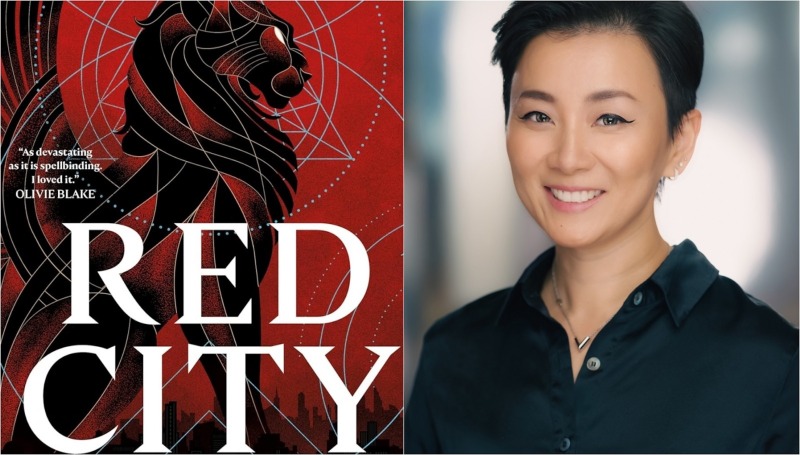
If you’ve been even a semi-regular reader in the world of young adult fiction in the past few years, you’ve probably heard of the name Marie Lu. The author of such blockbusters as Legend, The Young Elites, and Warcross, her stories run the gamut from sweeping fantasy to high-tech science fiction. Her adult debut, Red City, hit shelves this month, and its sweeping story — described as The Godfather meets The Magicians — blends many of the elements that have long made her YA fiction so compelling.
Set in a world where alchemy is real but the majority of humanity remains largely unaware of its existence, Red City unspools a dual chosen one narrative full of impossible odds, difficult choices, and morally gray characters. Samantha Lang is the daughter of a Chinese immigrant mother, a quiet kid who’s so unobtrusive that many never even seem to see her at all. Or at least, everyone except Ari, a classmate from the slums of Gujarat, India, who has been brought to Angel City to study at a secret school of alchemy.
The pair’s lives become intertwined, even as they each grow up to join opposite sides of a violent underground war between rival magical syndicates. It’s pretty much inevitable that the former best friends (and maybe something more) would one day have to face off against each other. But nothing about how that very obvious plot twist unfolds is what readers will likely expect,
We had the chance to chat with Lu about her adult debut, building the world of Red City, and much more.

Paste Magazine: So Red City is your official adult debut — congratulations! I feel like a lot of my YA faves are making this leap this year. But what inspired you to try it now? Was it a challenge you set for yourself, or more like this is the story I want to tell, and it happens to be darker or more adult?
Marie Lu: Yes, it’s so exciting to see all the amazing adult fiction from fellow YA authors! Red City has actually been in the works since 2019, so I’ve been hammering away at it for a while now.
The story is definitely darker and more adult than my YA work, but I also knew that its themes of love, ambition, and the pursuit of perfection at any cost needed to play out across a wider expanse of time and perspectives than I think YA can allow. We are going to see the origin of Sam and Ari’s respective ambitions, as well as the long-term ramifications throughout their lives.
Paste: Was writing an adult book terribly different from a YA one? Were there any unexpected challenges about it?
Lu: It was incredibly different and challenging for me–and why the book took me so long!
I struggled early on with trying to nail the voice of an adult book. My first drafts kept getting passed back to me with the note that it felt “too YA,” and for a long time, I couldn’t understand what that meant. What’s so refreshing about YA is its immediacy and limitation of perspective; everything is happening right now and usually directly to one or two protagonists.
Adult fiction tends to see decisions and consequences of the same event through a wider lens. It’s hard to describe, honestly, and of course, there is a gradient between YA and Adult nowadays, but I’m still working on understanding this difference.
Paste: Where did the idea for Red City come from? I was particularly intrigued by the author’s note that said some of Sam’s early life drew inspiration from your own (murdered stuffed animals aside).
Lu: Yes, fortunately, my stuffed animals all had very good lives! Sam and her mother are quite different from me and my mother, but their lived experiences were very much ours.
Like Sam, I was an immigrant child, and like Connie, my parents fought to make ends meet during our early years in America. In fact, the opening scene for Red City–depicting a young Sam sitting in a restaurant’s closet and waiting for her mother’s waitressing shift to end–was taken directly from my childhood. My parents did a great job sheltering me from much of our poverty at that time, but as an adult, I can wholly empathize with their long work hours and exhaustion and determination to give their child a better life. Their struggles, paired with thoughts that haunt me about our world, inspired the earliest inklings for this book.
Paste: Tell me about how you see Sam and her journey in this book.
Lu: There’s a line in the book that goes: Wounded hearts with something to prove are always the ones who change the world.
Sam is a girl who has spent her entire life struggling to be seen–by friends, by strangers, by her own mother. She begins the story starved of love and full of yearning, and many of the mistakes she makes are centered around these wounds: wanting to be loved, wanting to be liked. Even as she realizes that some of her perceived weaknesses are actually her greatest strengths, she will have to make some hard decisions about what she’s willing to sacrifice in the pursuit of something greater.
Paste: Same question, I suppose, but for Ari. I think it’s so interesting that, for all they’re so alike, the holes they’re trying to fill with alchemy and sand are very different.
Lu: I loved playing with the foils that are Sam and Ari. While Sam is a girl who has always struggled with being ignored and invisible, Ari has the opposite problem—he draws attention, both good and bad, like moths to a flame. While Sam has to fight tooth and nail for her place in the world of alchemy, Ari is dragged there against his will. He is someone destined for greatness but who doesn’t want it.
Many people love the idea of Ari, but not often Ari just the way he is, and he seems doomed to hurt those who truly love him in order to protect them.
Paste: I think your interpretation of alchemy in particular is quite different from some of the other stories I’ve read recently. Tell me a little about how you decided on how this “magic” system works. (The soul bit is so interesting to me.)
Lu: Strangely enough, the earliest draft of Red City had no magic system. At the time, I was struggling to figure out what element of fantasy could best symbolize the book’s themes of ambition and power. A bit of serendipity led me to taking a summer course at the University of Oxford, and while I was eagerly exploring the shelves of their Bodleian libraries, I came upon several books about the history of alchemy. That was the lightning bolt, I suppose, that alchemy—the transformation of something into something else—was the exact metaphor to represent our relentless pursuit of perfection.
You always know when an idea is right because your head just floods with ideas. Instantly, I was asking myself questions like: How would alchemy exist in our modern world? What would alchemy be like, if its magic were as studied and structured as science? What would it be used for in our capitalist society? How would alchemists organize themselves? What branches of alchemical studies would exist? On and on. But like any good magic system, using alchemy in Red City has a cost, and the cost is a fragment of your soul. The better you get at alchemy, the more of your soul you lose. Building this alchemy system was one of the most fun things I’ve ever done as a writer.
Paste: A handful of additional POVs behind Sam and Ari’s appear in this story—but not some of the figures you would most expect. What, for you, made it important to include these brief glimpses of, say, Connie or Edward?
Lu: Anytime there was a point in the story where I felt like we needed to see the reasoning behind a decision from a wider lens, or a glimpse of this world’s bigger picture, I would add in a new POV. Sam and her mother Connie, have a deeply complicated relationship, and for me, there was no way to show both sides of that equally without letting the reader into Connie’s mind.
Similarly, Edward is a detective on the outside of this secret, magical undercurrent of the world. He is one of us, but he has noticed that something isn’t quite adding up, and he’s not about to let it go. Edward plays a larger role in the sequel, but I wanted to plant his point of view in the first book to allow us that glimpse into how little the outside world understands of alchemy.
Paste: That was really a roundabout way of asking why we didn’t get a Will POV and if we might get one in the sequel. 😉
Lu: Will! What do we do with you! Seriously, though, I initially did have a POV for him in Red City and then removed it. There is always an air of mystery around Will, and in order to preserve that, I couldn’t give him a POV in the first book. The sequel, though….
Paste: Can you tease anything for us about the sequel? I’m desperate to know where this story goes next.
Lu: I’m eager to take readers out of Angel City and into the broader world of alchemy, so in the sequel, we are heading overseas to Londinium and Europe. Possibly some other places, too. We’ll see how the book shakes out!
Paset: Are you working on anything else at the moment outside of Book 2? Or is that taking up all your time?
Lu: I am indeed working on something else! There are always two projects going for me at any given time, and while I can’t speak much about the other project yet, I can share that it’s also fantasy. I’m very excited to share more in the near future.
Pasre: What are you reading right now? Not that my TBR needs to get any longer but I always like to ask…
Lu: I’m glad you did, because I always like to answer this! I’m currently reading Maddie Martinez’s glorious and lush fantasy debut, The Maiden and Her Monster, as well as Sarah Beth Durst’s The Enchanted Greenhouse, which makes me want to snuggle up with a blanket and a good cup of tea.
Red City is available now, wherever books are sold.
Lacy Baugher Milas writes about Books and TV at Paste Magazine, but loves nerding out about all sorts of pop culture. You can find her on Twitter and Bluesky at @LacyMB
 Keep scrolling for more great stories.