
Cait Jacobs on the Relatable Heroine at the Heart of The Princess Knight

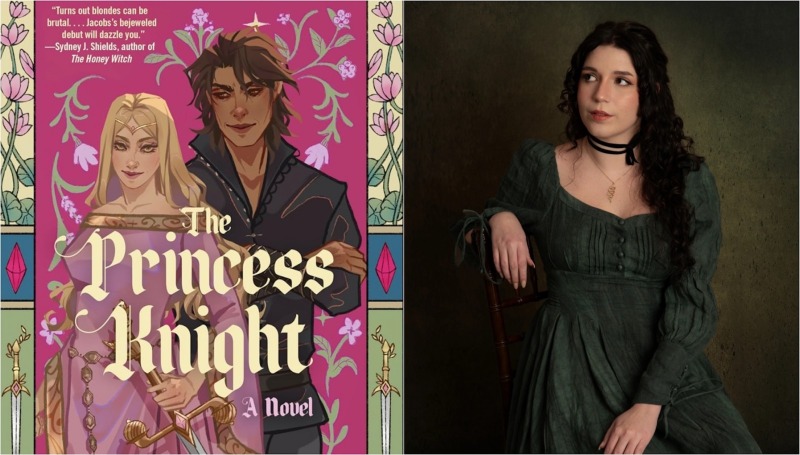
Cait Jacobs is known for being one of the founding influencers behind BookTok, the TikTok publishing phenomenon that has reshaped the industry as we know it today. So maybe it was always inevitable that they’d become part of it themselves. And now they have, with the instant USA bestseller, The Princess Knight.
Jacobs’ debut is a charming fantasy rom-com inspired by Legally Blonde, and it’s exactly as adorable as you might expect. The story follows a princess who, after the prince she thought was about to propose breaks up with her, decides to follow him to an elite military academy to prove she’s stronger than he thinks she is. (And, hopefully, find a chance to win him back.) But when her ex’s handsome captain of the guard agrees to train her, sparks fly—even as rumors of war swirl around their academy. The characters sparkle throughout in a story that’s one part traditional coming-of-age tale, one part journey to self-acceptance, and one part softly sweet romance between two people (begrudgingly) learning their own worth.
We had the chance to talk to Jacobs about their debut novel, the importance of writing a heroine who is exactly like other girls, the power of BookTok, and much more.

Paste Magazine: Let’s start with the basics. Tell me about The Princess Knight! Where did the story come from, and what made you want to tell it?
Cait Jacobs: The Princess Knight is a medieval fantasy novel about a princess trying to win back the prince who ruined their betrothal plans, and it’s a betrothal that her kingdom really needs. So, to prove him wrong, she decides to go to a medieval military academy, where she meets his guard and best friend, Ronan, and they spend some time together. There might be some late-night training sessions, and they also might discover threats to both of their kingdoms.
Paste: I have to tell you, I love the original title of this book so much, and I’m really sad that they changed it.
Jacobs: Oh, Medievally Blonde — yeah, it was definitely a fun title, but the new one I feel like… I think it fits the tone a little bit better, but R.I.P.
Paste: Much as I loved the former name, I do feel like The Princess Knight kind of really fits the vibe right now, because in publishing, there’s this real ladies with swords trend going on in fantasy.
Jacobs: I am living for this moment right now; it is everything I’ve dreamed about. There are so many lady knight books coming out and that are already out, it’s amazing.
Paste: I know a lot of this is probably an accident of publishing timing, there’s no way you could have known that this was going to be Lady Knight Fall. But still.
Jacobs: It was pure luck, but the best luck in the world.
Paste: Where do you feel like this kind of trend is coming from? What are readers getting out of girls with swords right now?
Jacobs: I feel like there’s always been a bit of an interest in girls with swords. I remember in 2020 I would talk to some of my other friends in [writing{ communities about how much we loved girls with swords, but I feel like when it comes specifically to knights, it was just a lot of hype for fantasy and a lot of hype for awesome women who may or may not kill people.
But I’ve definitely noticed, just in general, a kind of medieval revival lately, and I think it’s the combination of the already there love for women with swords, combined with that medieval trend that’s happening all across culture, with fashion, and with music, it’s… Again, really living for it.
Paste: Talk to me a bit about Clia and her journey, and what aspect of her story you wanted to make sure got onto the page.
Jacobs: With her journey, and I think in general this is true for both Clia and Ronan, is that it’s very much a story about characters who don’t feel like they’re enough, and the lengths that they’ll go to prove to themselves or to others that they are enough.
Clia, especially, is a people pleaser. She is a people pleaser, and it was also very important to me that she’s like other girls. There’s the “not like other girls” type thing you see in fiction often, and she is not that. She loves fashion, she loves jewelry, crystals, and shiny sparkly things. She enjoys that, and she’s not ashamed of it, and those interests actually can be a part of her strength.
This story is very much about her finding herself and finding comfort in who she is, and accepting herself to a degree before she tries to force other people to accept her because that’s what’s needed first. It also, in part, came from my experience as an autistic person, of dealing with masking and always trying to present and be what other people want you to be, and trying to learn to let that go and when to let that go, and also just be comfortable with who you are at your core outside of all of that.
Paste: I love the idea that Clia actually really is just like other girls, because I think in fantasy a lot of times you get that thing where, not to bring everything back to Game of Thrones, but everybody wants women in fantasy to be like Arya instead of Sansa, without acknowledging there are different kinds of heroines with different kinds of strengths.
Jacobs: I think it definitely is a thing in fantasy sometimes that people forget the strength that’s in femininity, and that a lot of times things that are dismissed and deemed girly can be so helpful and beneficial in fantasy settings, especially when you have a lot of fantasy worlds inspired by history and historical time periods and historical events.
There were ways that women were strong in those times, and I think it’s really interesting to examine that. For me, with Clia, fashion is a very big thing for her, and that is something that’s typically dismissed and often considered almost like a selfish or self-centered thing in a way. Vapid.
But fashion historically could play a huge part [in life and politics]. It could be used to show status, to influence courts, to do all that. Fashion had a lot more for it than just what was trendy and what people were wearing. There are deeper layers than that. You can even look at it today, with how fashion can offer insight into the economics of a country, it can give insight into where a country is landing politically: is it leaning more conservative, more liberal?
There is so much there that doesn’t get explored because it gets dismissed as too female-focused. So, I wanted to have a character that was interested in fashion, and that’s something that just brings her a lot of joy, and can be her strength in a way. I had a lot of fun with that.
Paste: One of the other things I really love about Clia, her anxiety is so relatable to me, and while I know it’s not the only disability representation in the book, it’s really refreshing to have the issues of struggling with something like this front and center. Why was it important for you to write these characters that way?
Jacobs: I’m disabled. And I feel like if you read the book, a lot of people might be able to guess that this is coming from a very personal place with me. I’m disabled myself, and I have dealt with disability, whether it’s mental health or, more recently, with my physical health, for the majority of my life. I’ve struggled with my mental health. A lot of people say that with autism, I was late diagnosed, but I was born autistic. I was struggling with it long before I was diagnosed; we just didn’t know what was wrong with me or what it was called.
So, it has always been something that’s been very much at the forefront of my mind, because it’s been so prevalent in my life. In school, I always really struggled, and I would have accommodations and then would have to figure out how to get through everything. So it was always something I had to think about. And while I love reading fantasy and romance, it sometimes would be strange for me, especially growing up, where I wouldn’t see characters thinking about it like I had to in my everyday life. So I wanted to write a book where characters are dealing with their disabilities and are at different places with them.
Ronan and Clia…Clia is a little bit less obviously disabled, in the sense that it’s never explicitly said on page, but she was written to be autistic. She and Ronan are at different places with their disability journeys, and I wanted to show that, and have that just be something casually there. I didn’t want it to be this huge thing or for the entire book to revolve around the fact that these characters are disabled, but I want them to be there. I wanted disabled characters to save the day, to be at the forefront, to find love, to have their own adventures, and to still be able to do it because all of us with disabilities are able to do things.
Sometimes we have to do things differently; we have to figure out a way to do it safest for ourselves, and I think that is definitely a part of this book. How do you take care of yourself, and also, how do you be kind to yourself and still do what needs to be done? I think it was just really important for me to see characters in this world that were like me, so I decided to write them.
Paste: It feels really important that both Clia and Ronan have to come together, not with that between them, but that’s just something extra that they have to navigate in their relationship.
Jacobs: Yes. It’s just there.
Paste: They really are so cute. Tell me about the two of them and why they were the relationship you wanted to center in this story. Because I don’t feel like The Princess Knight is a real love triangle, even though she technically goes to military college to chase after a different boy,
Jacobs: Yeah, it’s kind of funny because now that people are reading it, I’m seeing some people say that it’s a love triangle, and it’s so funny because I never intended to write a love triangle.
I don’t view Clia as having romantic feelings for Domhnall. Not really. She’s just confused and a people pleaser who will people-please her way into a marriage if they let her. But for me, I really wanted something… I wanted a simpler romance. I wanted something sweet and tender, something that was healthy and based on friendship and mutual respect.
Paste: Healthy, that’s such a good word for them. They communicate, they listen, they take each other seriously. Their whole relationship feels so healthy.
Jacobs: That was what was so important to me—I wanted this relationship to just be a soft place to fall for them. I wanted it to be something comforting, something simple. And it’s a book, so there’ll be some drama, but it’s not going to be anything too much between them. [The conflict] is not going to be anything too intense.
Paste: It’s external more than internal conflict.
Jacobs: Yeah, the conflict’s not going to be between the two of them as people; they’re always going to be rooting for each other. That was very important to me.
Paste: The pitch email I got about this book mentioned you as one of the founders of BookTok, which is an idea I kind of love. How did you go from being a person in the book community to being an author?
Jacobs: It’s a strange and terrifying transition, but in the best possible way.
Paste: You’ve seen both sides of it now!
Jacobs: Yeah! [laughter] It was very interesting. I was lucky, at least in the sense that I had written The Princess Knight before I ever got on BookTok. I wrote this in 2018, I think. So, when I was on BookTok, I was just in the editing stages, and I was actually, for a while on BookTalk, I was using it to avoid editing it!
But, I think for me the most important thing is keeping authenticity on my page, and trying to make sure that for the people who’ve been following my journey, that it’s not an abrupt transition for them, that they’re still getting what they like from my page. But it’s also been very fun because it means I haven’t been going through this journey alone. I’ve had a whole bunch of people who have been cheering me on through some of the steps in this, who have been there the whole way.
I have a book club online, and when the ARCs came out, people would talk about it, and I would be able to see their reactions as they were reading it, and it really made this all feel like so much more of a communal effort. And I’m someone who I loves doing things with friends and with other people. I love to have that community there, and it’s made me feel so much more secure and so much… I was already over the moon excited with this entire process, but it took it to levels of fun and incredible that I could never have imagined.
Paste: Confession time: I’m not really a TikTok girlie, but I’ve definitely been influenced by BookTok specifically, despite not actually being on the platform or in the community. What do you think it is that makes this space…well, what it is? Because BookTok, I think, is very different from almost every other book community elsewhere online. What is it that has made that hit? What is it giving readers that they’re looking for in that space?
Jacobs: I think a lot of the difference in BookTok versus other platforms is really due to the TikTok algorithm. This is my fun chance to nerd out because I originally was going to school for mathematics and computer science, so I love talking about tech. I think it’s really, the TikTok algorithm is a little bit different than say Threads or even Instagram, where your videos are being exposed to people who have never seen you before. A lot of people are spending their time on the For You page, and they’re mostly seeing people they have never seen before, whom they’ve never interacted with.
So that leaves, in the book space, a lot of non-readers are more likely to find bookish content than they would otherwise, than say on any other platform. You’re getting a lot of people who are newer to the hobby, who are very excited to be joining the hobby, and that, I think, is leading to a lot more excitement and positivity.
BookTok still is going to have its flaws; it’s no different than any other bookish community or social media platform, but I think because the TikTok algorithm kind of keeps you in a bubble a little bit, and you’re less likely to be exposed to some of the stuff that’s going on in an entirely different corner. So, if you are only reading, let’s say, historical romance, you’re just not seeing what’s going on in the nonfiction side of BookTok as much. Or if you’re reading romantasy, you may not see the dark romance side of BookTok as much. And so, you’re a little bit more in your bubble with people who are a little bit more like-minded. I’ve noticed this a lot, too, where people will say they only see the same five books on BookTok, and it’s just because you haven’t trained your algorithm yet; it’s going to take time. You will only see the things you interact with.
So, you need to start interacting with the things that are… If you want to start seeing more diverse books, if you want to start seeing books by marginalized authors, you’ve got to interact with the creators who are talking about those books. But once you do that, you’ll be training your algorithm, and you’ll be seeing the type of content you want to see,, and I think that kind of keeps the peace a little bit better, even though I do deeply wish that it could be a little bit easier, especially for marginalized authors to get their stuff out there. Because, unfortunately, with that kind of bubble that you can fall into, it can be very hard, especially for BIPOC authors, to get noticed and seen on the platform.
Paste; I’ve heard that kind of often, unfortunately. But, back to your stuff, what’s next for you? I know that this book [has only just] come out, but I feel like everybody’s constantly writing something.
Jacobs: Always. I’m working on a new project now, it’s nothing under contract, so it’s just my little side project that I’ve been working on for a bit. It’s been fighting me, but I am finally getting to a good place with it. So, hopefully, once I’m solidly at a good place with it, I’ll be able to talk more about it, but I plan on staying in the fantasy sphere for a while, and I plan on keeping writing for as long as the universe will allow me.
Paste: I know The Princess Knight is a standalone, but I feel like there’s still space in this world that you could write more if you wanted to. Would you?
Jacobs: I would really want to, if the publishing Gods let me. I would love to one day. This world is so special to me. I really had a lot of fun with it, and I’ve even just… I have so many ideas for things I could do in this. So, it’s just a matter of timing and when the universe aligns to make it happen, but hopefully one day it will because there’s a lot more I want to explore.
Paste: Speaking of reading, what do you like to read? What are you reading right now? That’s my favorite question to ask people, mostly because I need more on my to-read list—I really don’t— but still.
Jacobs: I’m reading a book that actually isn’t out yet, it comes out in January. You will recognize the author’s name, it’s We’ve Hit Turbulence by Jessica L Cozzi. Jess, who is my lovely publicist, has also been my friend for years.
Paste: That’s so cute!
Jacobs: It’s been so fun working with her on all of this. We met at Book Expo six or seven years ago. But yeah, I’m reading her book, which is out in January, and I’m very excited for it; it’s very good so far. It’s a YA contemporary romance, second-chance romance. Very fun. Yeah. And then after this, I’m planning on picking up Cruel is the Light by Sophie Clark.
Paste: I will end with a big picture thing. What do you hope readers take away from The Princess Knight?
Jacobs: I really just want people to take away the importance of knowing your own worth, and feeling that you are enough, and also knowing your limits and being kind to yourself, and knowing that you are worthy no matter what cards you’re dealt in life, and that you deserve the best and you deserve to be kind to yourself.
Paste: Kindness is truly so underrated, I think, just in real life and in fiction. People assume it’s a weakness, and that’s just not true.
Jacobs: It’s really not. Kindness is a strength. Kindness, hope, optimism, these can all be strengths. A lot of people will brush it off as naivete, and they will dismiss it, or they’ll view it as a weakness. But I think it’s honestly one of the biggest strengths to be kind, to stay kind, no matter how cruel and horrible the world can be.
The Princess Knight is available now, wherever books are sold.
Lacy Baugher Milas writes about Books and TV at Paste Magazine, but loves nerding out about all sorts of pop culture. You can find her on Twitter and Bluesky at @LacyMB
 Keep scrolling for more great stories.