
Soulful Documentary Caterpillar Gazes Unblinkingly at Our Wish to Transform

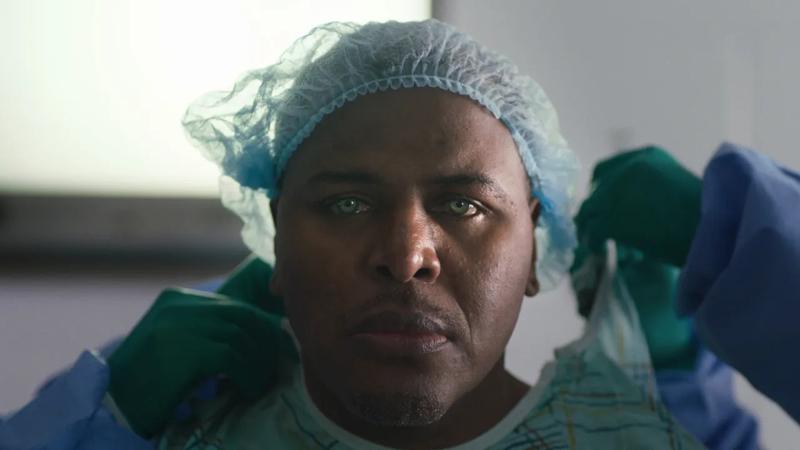
There are many potential reasons a person might yearn to introduce a radical change into his or her life, even if that person may have trouble fully expressing the need. “I cannot stay stagnant anymore,” says Raymond David Taylor, the primary subject of filmmaker Liza Mandelup’s beautiful and empathetic new documentary Caterpillar. In the case of our protagonist, who mostly goes by David, the need for change comes with an accompanying sense of desperation, and a clear depression that spills forth regardless of feeble attempts to cloak it behind a veneer of positivity. “I want to feel different,” he implores. “I’m tired of feeling sad, because if I feel sad one more day, I don’t know if I’m going to make it.” David wants to change, to transform his identity into something more beautiful, something more accepted, something that he feels will somehow get his life back on track. The issue Caterpillar confronts is this: What qualifies as change, really, and where does the value lay in the act of trying to make a dramatic, possibly foolhardy leap into a new self?
What David wants is a deeply symbolic change, but also a very tactile and real alteration of the body he was born with: He wants to change the color of his eyes. And this, he’s presented with an opportunity to do thanks to a company/procedure known as BrightOcular, which essentially inserts a “permanent” implant above the iris, a colored disc that can neatly swap someone’s unassuming eyes into dramatic or unearthly shades. We watch as David falls in love (and becomes obsessive) with the idea of a new self, tumbling down a self-reinforcing spiral of YouTube testimonials and social media advertising, each influencer tacitly agreeing with his own assessment that not only is he not enough on his own terms, but that he has a prerogative to fix himself. Fervently, he believes that this one change to his physical appearance will make him more fulfilled and successful in all his endeavors, that it can paper over the clear dissatisfaction he has with so many other aspects of his life as a gay man in Miami approaching middle age, raised by an overwhelmed mother who can’t bring herself to genuinely accept her son for who he is. David is a man in a crisis of identity and self-worth, and in the fantasy of vividly bright gray eyes, he sees an escape into a new life and a chance to start fresh.
And he won’t even have to pay for the privilege, either: In exchange for participating in promotional marketing materials, BrightOcular agrees to foot the cost of the procedure, a dead giveaway for the audience that we’ll soon be confronting some suspect operations. The surgery, as it turns out, is not approved by the FDA, and despite BrightOcular styling itself as a “New York company” and a “United States developed” procedure, it can only be legally performed abroad, in a handful of countries that have become havens for more implicitly dangerous cosmetic surgery. Soon, David is on a jet to India, meeting up with a cadre of other dreamers with their own fantasies about the BrightOcular procedure. From pure vanity, to delusion, to trauma, they all clearly have something that drove them across the globe in search of answers. Notably, none are causasian, which speaks to the underlying air of colorism that is difficult to disentangle from the BrightOcular procedure as a concept–every single one of them is there to get lighter colored eyes. Glancing at the company’s promotional materials, they don’t even seem to offer darker colored implants, presumably because the market for such a thing simply doesn’t exist. No one gets surgery in pursuit of beautiful brown eyes.
Caterpillar is a stunning piece of documentary work, both for its incredible degree of access to both its central character and his journey, and its unconventional style of presentation, which skirts the boundaries of documentary and narrative feature. One could be forgiven, in fact, for not realizing that they were watching a documentary at all in Caterpillar’s first 20 minutes or so: There are basically no talking heads or direct addresses to the camera from David or others in the early going, with Mandelup’s camera instead simply getting up close and personal with David as he goes through mundanely personal routines of daily life, whether it’s fantasizing about his new eyes or arguing with his conservative mother. Disembodied narration is sparingly used to get a point across, but the film often feels much more like a low-budget narrative feature thanks to the employment of evocative, striking B-roll and the sheer grittiness of its depiction of David’s humble life. Mandelup will even cut together disparate footage from David’s days and nights–him swimming, dancing at a rave, a close-up of his mother’s careworn face, snatches of audio from an argument–to effectively create the impression of a flashback or mental thought process. There are moments that feel perfectly scripted for characterization, like when he’s walking down an alley in India and is clearly afraid to pass by two angry-looking barking dogs, ultimately turning back. The filmmaker is essentially trying to take the inner turmoil expressed on David’s face and visualize it–one wonders how accurate David would actually find the end result.
That said, the empathy that Mandelup has for her subject can’t be doubted, and the pure sense of longing she captures both in him and in some of the secondary personalities also in India to have the BrightOcular surgery makes the heart of the viewer swell with goodwill. David has clearly long struggled with a lack of direct emotional support–his mother in particular is not shy about casually volunteering deeply personal things in front of the camera as she demonstrates her lack of understanding, mentioning drug use and suggesting at one point that David wanted to transition to female, but that she couldn’t support him because “he gotta be a man.” Painfully dense, stuck in a prior generation, she follows by asking “Was I not supposed to say that?” as her son breaks down in tears in the background. Unable or unwilling to modernize her outlook on American society as it currently exists, she makes it clear that her support for David has limits she simply can’t cross, and the pain of this reality is frequently etched in his face.
In India, meanwhile, David both finds community with the other patients about to undergo the BrightOcular process, and seems to be processing waves of cognitive dissonance as he can’t help but compare himself to them. To some of these others, the eye color surgery is just one more procedure among so many other cosmetic travels, and it seems to make him uneasy to see other people who are treating BrightOcular as just one more step in an ongoing glow up. To David, changing his eyes is supposed to be the thing that repairs his wounded soul, and each time he’s forced to face the less romantic realities of the process, you can see the bubble of his dream in danger of bursting.
Never is this more pronounced than when–absolutely incredibly–the first surgery on David’s eye goes askew and he is in fact given the wrong color of implant, meant for one of the other people in his same cohort. It’s a spectacular bit of incompetence, instantaneously torpedoing the joy he fantasized about feeling at the moment of reveal. We hear the anguished audio of David arguing with nurses and physicians, them begging him not to cry for the sake of avoiding damage to his newly operated on eye. They suggest removing and swapping implants with the other patient, the idea of which both men find repellant and deeply offputting. We immediately wonder: What are the odds that with a documentary crew following one man having this surgery, that this kind of basic mistake is allowed to happen? Just how frequently are these things botched? David ultimately embraces the sunk cost fallacy and has the other incorrect implant added for the sake of matching, ending up with bright green eyes rather than the gray ones he envisioned.
Which brings us to the underbelly of Caterpillar, which is its jaw-dropping access to the unregulated, danger-ridden surgical procedures happening outside of FDA jurisdiction, so much of which Mandelup was somehow allowed to capture as if her camera crew was completely invisible. In an exam room, we sit like a fly on the wall as an Indian doctor speaking passable English attempts to gather medical information from a Chinese patient who barely speaks any English at all, making it quite clear that there’s a huge, wildly irresponsible gap of understanding between the two that is not being bridged. Our anxiety flares, knowing how much vital information may be lost, even more so when we learn that the patient is apparently unaware that he already has poor eyesight. In another doctor’s office, a deeply awkward exchange ensues as an intensely evasive doctor attempts to dodge questions from a woman clearly seeking basic reassurance about the procedure’s safety. Asked if he would get the surgery himself, he replies “No … because I’m happy with the color of my eyes.” Pressed on if he would recommend it to his sister, the same doctor brusquely replies, “I don’t have a sister, madam.” It’s inconceivable how anyone at BrightOcular thought that having a documentary crew anywhere near this topic was a good idea, but then again, we never actually meet anyone “from BrightOcular,” nor do any of the patients. It seems to be just one more corporate defense mechanism, shielding themselves from being directly contacted by patients in the event that the implants eventually cause complications or vision loss. The whole thing feels like an incredibly unstable house of cards, preying upon the sincere but insecure dreamers like David who are driven by the fantasy of transformation.
Eventually, the reality of the situation arrives for most of the eye surgery patients, and we hear a late-developing series of accounts from patients who ultimately needed to have their implants removed, months or years later. That includes David, who less than a year later begins to experience troubling side effects amid a move to New York City. To his credit, the transformational aspect he envisioned as part of the surgery actually does seem to have panned out to at least some degree: In New York, the new version of David seems energized, fulfilled and embracing possibility, building a newly supportive community around himself. We’re left with at least some sense of hope as well, as David appears to have gained some modicum of perspective on the emotional state that drove him to travel to India in the first place, acknowledging that “I’m happy that I got to try a dream.” And hey, his brown eyes were never bad to begin with. We find ourselves sincerely hoping that he’ll continue to embrace the autonomy he’s gained, a little wiser for the experience.
Caterpillar is a beautiful look at longing and insecurity, the way that these feelings are nurtured and amplified by social media echo chambers, and the dangers of potentially falling prey to someone attempting to sell you a dream of transformation. Liza Mandelup’s deeply impressive instincts for telling an empathic story make her a documentarian we should all be watching.
Director: Liza Mandelup
Release date: Nov. 7, 2025 (NYC), Nov. 25 (On demand, digital)
Jim Vorel is Paste’s Movies editor and resident genre geek. You can follow him on Twitter or on Bluesky for more film writing.
 Keep scrolling for more great stories.