
Christy Is Miserable Abuse Drama Masquerading as Inspiring Sports Biopic

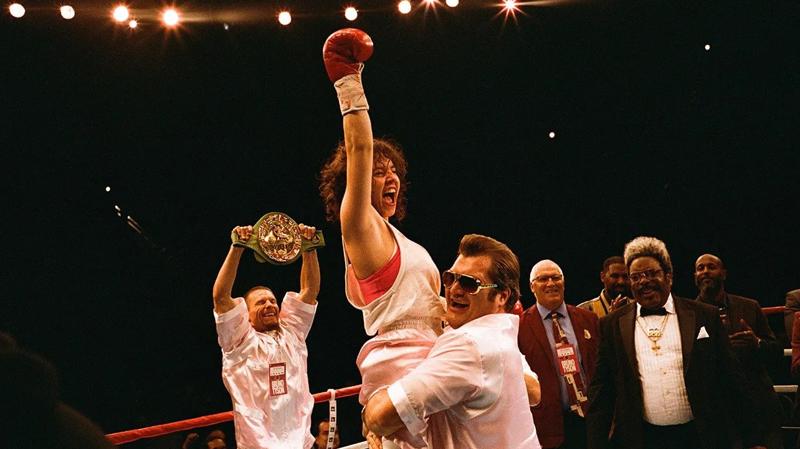
Once one has seen Christy, director David Michôd’s Sidney Sweeney-starring biopic about boundary-breaking female boxer Christy Salters/Christy Martin, then seeing the marketing for Christy causes a certain degree of dissonance. To see the poster, a victorious pugilist exulting in her triumph, calls to mind the substance of so many sports biopics and “inspiring” dramas that have come before, in the mold of Cinderella Man, The Fighter, etc. To see its trailer, you’d enter a theater expecting thrilling in-ring action, with a side of family turmoil, an uplifting pop feminist tale about punching straight through the glass ceiling en route to becoming a champion. After seeing Christy, on the other hand, you’d be more likely to look at those marketing materials and note the way they skirt by reflecting the film’s harrowing depiction of marital strife and abuse, nor the way the real-life Christy Martin’s victimhood and exploitation ultimately cast a long shadow over any suggestion of “inspiration.” This is a misanthropic story rather than a feel-good one; a story that also feels curiously disinterested about its own titular protagonist’s genuine, inner self. It’s so busy depicting the worst events of her life, it has no time to sell us on the supposed sense of triumph that it insists is there. I’m unconvinced.
We meet Christy Salters under fluorescent lights and a comically low community center ceiling in 1989 as she bobs in a makeshift boxing ring, entirely uncertain of what she’s doing, having signed up for a “tough woman” contest, wildly throwing haymakers at her equally inexperienced opponent. She’s clearly green, but there’s thunder in her fists: Christy never really gets across what elements as an athlete made Martin the sport’s most successful female boxer in the 1990s, except for implying that she hits like a truck, whether or not Sweeney can genuinely convey that impression with her own physicality. Christy is a closeted lesbian with an open secret of a girlfriend, something that drives a wedge between her and her undermining, comically horrible mother Joyce (Merrit Wever) and easily cowed father John (Ethan Embry). “We want you to have a happy, normal life,” says the truly abominable Joyce at the breakfast table, literal seconds after suggesting that they want to take Christy to a priest in order to cleanse her of gayness. It’s instantly clear that Christy will flee as her familial relationships fray, leaving her free to dedicate herself entirely to boxing. But unfortunately, this will only place her more deeply in the control of another man who will (at his best) treat her like a cash cow.
That man would be boxing coach and eventual husband Jim Martin, played here with supreme, oily impotence by Ben Foster, as a character somehow even more pathetic and reprehensible than his drug lord antagonist from this year’s gimmick-laden actioner Motor City. He’s immediately dismissive of Christy, appalled by the very idea of someone with two X chromosomes besmirching the sacred squared circle. Nevertheless, after seeing Christy fight, he can immediately see dollar signs as well, and thus begins a campaign of the least subtle psychological manipulation you’ll ever encounter, with such timeless chestnuts as “I’m the only one that believes in you.” His material draws heavily from the Big Book of Naive Ingenue Cliches, and bear in mind this is before the physical abuse has begun. We’re privy to what must be one of the greatest all-time cinematic proposals, immediately after Jim barges in on Christy reconnecting with her old girlfriend: “Do you want to lose your family, your trainer, your career, all of it? Or do you want to marry me?” This is quite literally the first time that the man has mentioned marriage, but for him it’s par for the course. His sole goal is to isolate her as far as he can from any other human, to make her as dependent on/subservient to him as he possibly can.
The tragedy of Christy is that he largely succeeds, for literal decades, which is part of why the film’s intent to uplift tends to ring false, buried under the grime of who Jim Martin turns Christy Martin into, the level he drags her down to. For the cameras, she becomes the model housewife, smiling for interviewers and saying things like “I’m just a regular wife who happens to knock people out for a living.” In the ring, Christy now plays the aggressive bigot, taunting opponents and hypocritically calling them “dykes” while embracing her assigned role of femininity and subservience as it enriches her. She’s portrayed like a complicit traitor to womankind; a lady quisling, before the film’s third act then attempts to walk it all back in a reclamation of her soul, her sexuality and her dignity, albeit through further victimization and token resistance. But it’s quite a thing for the film’s title character to be so predominantly unlikable through the period in which she’s having what is ultimately her greatest professional success. Who wants to root for the jeering, bigoted bully of a fighter, even when she’s your viewpoint character?
A more deft screenplay might tackle this kind of multifaceted, challenging protagonist by exploring her inner self, giving us some kind of window into her interiority or the unspoken struggle she’s wading through every day and the cognitive dissonance caused by the gulf between her true self and the projection she’s forced to put into the world. Christy fails to do this to the degree it needs, however: We are held at arm’s length from what is genuinely going on inside her head, and she seems less cowed by Jim’s simmering propensity for violence than seduced by the glitz of life in the fast lane. She lies to herself with far more zeal than Jim Martin could ever manage, and even when her other trainers express cautious concern for her wellbeing at the hands of a clearly abusive man–who they continue accepting paychecks from, to be clear–they quickly wash their hands of any responsibility when Christy assures them that everything is fine. It will take a final step across the line of potentially mortal violence to finally break her free, after 20 years of hell.
Lest we forget: Are there boxing matches to be had, in Christy? Sure, there’s some, but like the true essence of Christy herself, the film isn’t particularly interested in them, and they pass in a hazy series of montages rather than the genuine setpieces one might expect. The fight scenes are shot with admittedly realistic sloppiness, all clinches and scuffling, but without any real verve to them, and rarely is any of Christy’s important storytelling actually unfolding within the ring itself. Even in one of her career-defining bouts against a bigger, stronger Laila Ali (Naomi Graham), the film fails to even note that the other female boxing legend–obviously the daughter of the most famous boxer in history–originally decided to become a boxer as well because she was inspired by Christy Martin, in Ali’s own words. Somehow, that real-world factoid passes right by without the interest of Michôd and co-writer Mirrah Foulkes, unremarked upon. Ali, like most of the film’s supporting characters, is paper-thin and soon discarded. The only one to stand out for his larger-than-life charisma is promoter Don King (Chad Coleman), whose scenes do provide some much-needed levity, portraying King as a giddy, chuckling opportunist who smiles right up until it’s time to flex his power over you. But most of the film is as dour as its lackluster fights. Likewise, Katy O’Brian of Love Lies Bleeding puts in solid work in a limited role as one of Christy’s other notable opponents and eventual trainers, demonstrating a more robust sense of physicality and intensity that makes one wish we could see a version of the film where she is instead granted the lead.
Christy is a blunt boxing opus, profoundly overlong and ultimately on the miserable side as it steadily lowers itself into its final third as an abuse drama, which culminates in a scene of violence genuinely difficult to watch. As Christy subsequently clings to life, survives her ordeal and then immediately sets her mind on returning to the boxing ring, her determination is meant to be read as gritty and inspirational, but because we’ve never developed her characterization deeply enough to genuinely know what she truly values in this pursuit, it’s hard to know whether to accept the eventual return to the ring as the triumph that is implied. Did Christy Salters/Martin truly love boxing in the first place? We don’t know. What did she love about it? Christy never puts us in her head long enough to develop a grasp for what truly matters to her. It seems just as likely that boxing was just another thing she was railroaded into by the various people who for decades exploited her, and that the fight to return to the sport is less the noble quest of a true believer to reclaim their agency, and more the action of someone who just didn’t know what else to do, in the wake of tragedy, rather than return to what they had always done. Nevertheless, her stated intention to return results in the following absurd line of dialogue from a trainer: “You got shot and stabbed two weeks ago; I don’t know that you should be training yet.” Sound advice, my man.
At the end of the day, Christy has a knack for bluntly stating the obvious in this way, as when Christy observes that “I wish I would have walked out the first time he promised to kill me.” To which we can only reply: Yeah, that checks out. It would be far more surprising for someone to say that they wish they’d stayed longer with the person promising to kill them. Sydney Sweeney may have taken this role with Oscar statuette dreams and “legitimate actress” intent, but thanks to its sketchy screenplay and languid boxing bonafides, the result tends to be as dull and thudding as gloves striking a heavy bag.
Director: David Michôd
Writers: David Michôd, Mirrah Foulkes
Stars: Sydney Sweeney, Ben Foster, Merrit Wever, Katy O’Brian, Chad Coleman
Release date: Nov. 7, 2025
Jim Vorel is Paste’s Movies editor and resident genre geek. You can follow him on Twitter or on Bluesky for more film writing.
 Keep scrolling for more great stories.