
Train Dreams Chronicles the Quiet Passage of History and Loss of Time

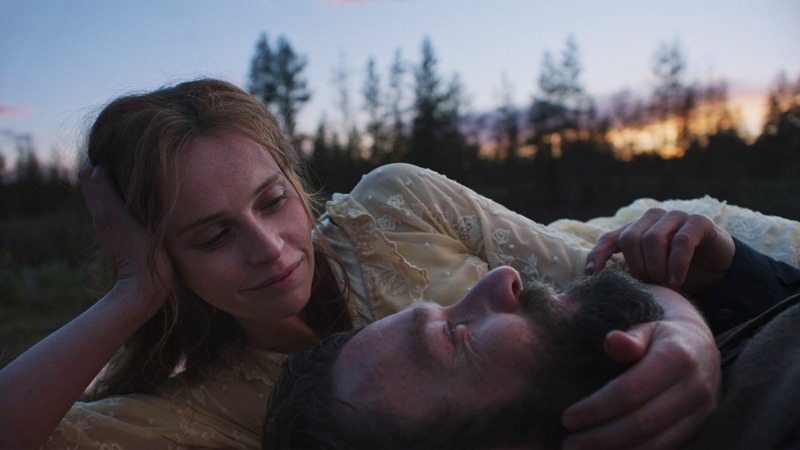
Train Dreams is set over the course of a lifetime, and in this way it is not just about the passage of time but the loss of it. Robert Grainier (Joel Edgerton) lives from the late 19th century well past the halfway point of the 20th, and bears witness to enormous changes, including certain things falling away like downed trees. Most of us will go through a similar process, should we be lucky enough to live for 70 or 80 years or more. But there’s a particular acceleration that Robert experiences by living through the second industrial revolution – sometimes at a painstakingly close vantage point, working for companies that chop away at woods and lay down railroad tracks around the United States, particularly the Pacific Northwest.
Because of these jobs, he loses time with his wife Gladys (Felicity Jones) and their young daughter Katie – their “little one,” as Robert usually refers to her. A narration track filling in details about Robert’s inner and outer life, adapted from a Denis Johnson novella and perfectly read in third-person by an unseen Will Patton, does not particularly lament the speed or the slowness of this time loss. Train Dreams, running 102 minutes but without a traditional driving narrative, could go at either speed. Most of the time, it uses some kind of magical alchemy to operate at both, at once as vast and intimate as its modest 1.33 framing of its majestic, receding wilderness. But even when the movie occasionally cuts in a scene out of strict sequence (there are apparently more of these reshufflings in the novella), it is only ever really moving in a single direction.
This trip deep into the 20th century is guided by Clint Bentley, who directed and co-wrote Train Dreams with close collaborator Greg Kwedar. (They also co-wrote last year’s Sing Sing, with Kwedar directing.) The obvious point of comparison is Terrence Malick, who also explores the boundaries between men, women, and the natural world, with less traditional narrative in his recent work. But Train Dreams isn’t as elusive as later-period Malick in function or in form; Bentley has a more presentational style. He depicts the motion of the work crews with action-movie-style shutter-speed adjustments that make them appear slightly otherworldly in speed, and his vignettes of workers at rest are often neatly constructed. In one, the camera stays steady on a wide shot of the logger crew as a stranger approaches, announces himself, and a single worker meets a particular fate. That this man is played by Paul Schneider brings to mind Bentley’s fellow Malick acolyte David Gordon Green, who made such good use of that actor’s unique presence. There is some of Green’s found-actor-style naturalistic monologuing here, too, and the accompanying humor, but largely reassigned to more familiar faces. Most familiar is an indelible William H. Macy, playing an old timer who sticks it out in demolitions even as he’s come to lament what they’re doing to the world.
Robert feels troubled, too, but he’s not in a position to stop this world from changing. None of them are. Early on, the murder of a Chinese worker unfolds in front of Robert before he manages to intervene (and it’s not clear what, if anything, he could do beyond place himself in harm’s way). He wonders, through the narration as well as Edgerton’s quiet and perfectly judged performance, whether this failure has cursed him. The cabin he builds in the woods for his family seems like an opportunity to stave off that curse. Amidst all of the technological progress, their simple little house away from industrial advances carries hushed hints of fairy tales – the ones with pitiless fates, not the Disney versions that won’t emerge until Robert is nearing middle age.
Train Dreams also feels like a post-Western, though Robert is born just early enough to peek into the Old West period, had he wound up on a train moving in a different cardinal direction. Instead, his Western-style homestead has towering trees, rather than vast skies or plains. Later, under less cheerful circumstances, Robert meets Claire (Kerry Condon), a forest worker who lives in an outpost lifted above the grounds. There, from her perch, are the wide-open spaces, at least for the moment. These scenes and others see Edgerton giving a career-best performance. Without especially denying the taciturn sensibility he’s brought to other characters, as Robert he finds a way to capture how the currents of time push us forward, ready or not, fair or not, without sliding into passivity. For once, the universally suppressed accents – the Australian Edgerton, the English Jones, and the Irish Condon are all playing Americans – work in sync, creating a subtle feeling of immigrant-country displacement.
It’s difficult to do full justice to the spellbinding nature of Train Dreams, especially knowing how few people will see it in a brief theatrical release ahead of its Netflix debut. It deserves a big screen if possible, though; Bentley and Kwedar have made an enveloping movie, one that might more closely echo its obvious influences from the comfort of home. This is a movie that belongs out in the beautiful, terrible world.
Director: Clint Bentley
Writers: Clint Bentley, Greg Kwedar
Stars: Joel Edgerton, Felicity Jones, Kerry Condon, Clifton Collins Jr., William H. Macy
Release Date: Nov. 7, 2025 (limited); November 21, 2025 (Netflix)
Jesse Hassenger is associate movies editor at Paste. He also writes about movies and other pop-culture stuff for a bunch of outlets including A.V. Club, GQ, Decider, the Daily Beast, and SportsAlcohol.com, where offerings include an informal podcast. He also co-hosts the New Flesh, a podcast about horror movies, and wastes time on social media under the handle @rockmarooned.
 Keep scrolling for more great stories.