
Being Eddie Sounds Like Fun, But We Know How Much Is Missing

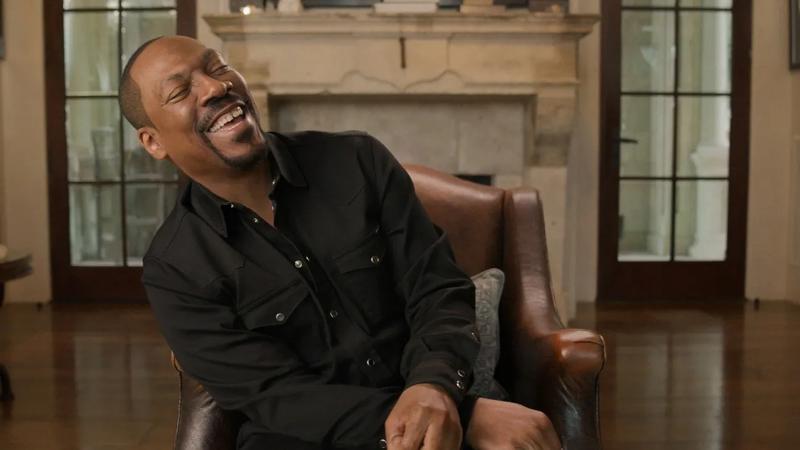
Before hitting play on Being Eddie, Netflix’s new, career-spanning documentary on the fabulous fame and comedic genius of the iconic Eddie Murphy, one might want to consider for a moment the motivation in releasing said film in 2025. Why is now the time to reflect on the vast achievements, beloved roles and notably closed-off personal life of one of comedy’s all-time icons? What exactly does the 64-year-old Murphy have planned, and how does the documentary play into the course he’s charted for his ongoing career renaissance? Because to hear the man talk in Being Eddie, there’s no missing that Eddie Murphy has a plan, and that said plan has been roughly unchanged since he first gave voice to it as a teenager pounding the pavement to get to stand-up sets in Brooklyn: Be the biggest star there is. Being Eddie is a portrait of the single-minded determination that Murphy employed to do exactly that throughout his life, whether or not his efforts were working at any given moment. Unsurprisingly, the film skirts many of Murphy’s pitfalls, gray areas, and controversies, and displays next to no interest in reevaluation of his past work through a modern lens … but at the same time, it does provide some value in what we can glean of how the man views himself, and his undiminished hunger for success. Like Murphy’s filmography, it’s a real mixed bag.
Also unavoidable is the distinct possibility that Being Eddie is simply meant to function as a 90-minute preamble to an eventual Netflix return to stand-up comedy, a long-delayed project that Murphy has been mulling and hinting at for more than six years at this point. Much is made here of the performer’s reluctance to get back on stage since 1987’s landmark stand-up comedy film Raw, and one gets the sense that Being Eddie is likely part of a coordinated effort to stoke hype and hunger for just such an event, likely one that has already been preordained. That can’t help but give the documentary a certain underlying air of cynicism, but it thankfully doesn’t entirely defeat the pleasure of simply having a chance to hang out with Murphy for a relatively brisk 90 minutes.
And at its heart, that’s precisely what Being Eddie mostly is: A casual hang with Murphy as he guides you through various moments of his life, with varying levels of honesty and candor, but a wit that in no way seems to have diminished with the decades. He manages to at least sound interested in the endeavor, and on some level that makes sense, because it gives him a chance to talk about Eddie Murphy, something that he apparently relishes. One of the most prominent characters, both addressed and glossed over, in Being Eddie becomes Murphy’s own ego, which director John Landis at one point credits for keeping Murphy from barreling toward self-destruction at the height of his fame in the 1980s. “He was too vain to participate in his own destruction,” Landis keenly observes, and even Murphy can’t help but agree. His hunger for achievement was so strong that he simply wouldn’t allow anything to threaten it.
Certainly, no one is going to watch Being Eddie and subsequently describe Murphy as humble. The things he says in reference to himself can’t help but draw a guffaw at times. In the opening moments, he hits us with the following: “I can’t think of another actor, black, white, that’s done so many different types of things, from just me on stage with a microphone, to where I’m everybody in an entire scene, to everything in between.” He essentially opens by calling himself the most versatile performer in film history, as if he has some doubt that the other talking heads consulted for Being Eddie won’t praise him in sufficiently florid detail. And this is by no means some isolated line, as later he goes on to effectively take credit for all achievements by Black performers in his wake with this banger of a line: “I was the psychological soil that was required for everything that happened after me.” It’s not that Murphy is wrong, per se, but these are the types of aggrandizing lines typically delivered by ardent admirers in the course of a documentary, not by the subject himself, directly to the filmmaker, without a shred of sheepishness in his eyes. Only Murphy could somehow still project a likable aura while saying these things.
Being Eddie does provide the nostalgic reminiscences you would expect it to have from Murphy’s prolific career peak throughout the 1980s, at a time when he was first a Saturday Night Live star, and then a feature film leading man in flicks like 48 Hours or Trading Places, and even a Platinum-certified singer. Along for the ride was of course older brother Charlie Murphy, and we get a few clips of Charlie talking about those days in front of a green screen, almost certainly culled from the same recording sessions that gave us his beloved “True Hollywood Stories” segments on Chappelle’s Show. Eddie, while eulogizing his deceased brother, briefly refers to those sketches and remarks that although he found them funny, they’ve always seemed strange to him because they were merely culled from single nights of his life–and for Eddie Murphy in the ‘80s, “every single night was like that.” It’s a casual admission that makes you sit back for a moment and marvel at the fact that Murphy is still here with us at all, and that the era of rubbing elbows with the likes of Rick James didn’t drag him into a precipitous decline. Chappelle later observes the following: “I know a lot of people who survived a lot of weird shit in their lives, but surviving being Eddie Murphy is a hell of an accomplishment.”
What Murphy is willing to share, more than anything in Being Eddie are insights into the roots of his humor, such as his childhood passion for “makeup movies” like The Hunchback of Notre Dame, or performers such as Peter Sellers who could disappear into numerous distinct characters in the course of a single film. We hear a bit on philosophies of life and death, of the grounding power of prayer, of his detail-oriented planning, which he eventually self-diagnosed as a child as obsessive compulsive disorder. What’s missing is a sounding board, someone to push back or challenge his assertions, for instance, that he effectively cured his OCD by simply deciding, through sheer force of will, to not entertain his compulsions. Whatever comes out of Murphy’s mouth is merely treated as gospel.
There are tender moments to be found here as well, as in the aforementioned discussion of Charlie Murphy’s 2017 passing, or in his early childhood memories of a house punctuated by violent arguments. He remarks that his first childhood memory is of his parents fighting, and at one point he points to a childhood portrait of himself and Charlie that he says was “the straw that broke the camel’s back,” with the argument about its purchase eventually leading to his parents’ divorce. It’s an interesting thing to keep in one’s living room, to be able to remark, “hey, this is the photo that ended my parents’ marriage.” Of course, these kinds of surprising moments become a sort of running theme as we ramble around in Murphy’s comically extravagant palazzo of a house. At one moment, he notices a photo of himself on the mantle and says “This is a picture of me punching Muhammad Ali in the face.” At another, he putters into a sun-soaked central courtyard and announces “it’s getting kind of cold, I’m going to close the roof,” and a giant mechanical glass roof begins unfurling over the top of the house like a domed sports arena. He has an air of unflappability that comes along with having been so famous, for so long.
Unsurprisingly, there are also many areas where Being Eddie feels much less forthright. No mention is of course made to his heavily publicized 1997 detainment for picking up a trans sex worker, nor is Murphy asked to engage in any way with modern reappraisals of sexist or homophobic readings of segments of Delirious or Raw–the film treats that conversation as one that can be avoided by just ignoring it hard enough. Things feel particularly simplified and idealized, meanwhile, in the passages of Being Eddie that deal with the star’s romantic and family lives. We’re given some requisite platitudes about how important “my kids” are, without any acknowledgement of just how complex and challenging Murphy’s family life must have been in the years since the birth of his first child in 1989. Murphy has subsequently had 10 children by five different women in the decades that followed, including one of whom he denied was his child for many years, and yet as far as I can recall not one of them appears in a Being Eddie interview. The family component as a whole feels paper thin, as if Eddie can’t bear to shift the topic away–his half-brother Vernon Lynch Jr. appears in an interview for about five seconds, only to have Eddie immediately pop up and begin ribbing him. You can feel his apparent need for control, radiating from the screen.
In a way, though, seeing this determined and control-seeking side of Murphy, whether or not he intends for it to be seen, is the film’s greatest value. It’s undeniably funny to watch him talk about his enjoyment of MTV’s Ridiculousness and inexplicably compare it to the films of Alejandro Jodorowsky, but it’s more illuminating to see Eddie ruminating about David Spade’s famous “Hollywood Minute” burn from SNL in 1995, still lingering in bitterness over a single sentence from 30 years ago. Despite not necessarily intending to do so, Being Eddie punctures some of Murphy’s aura of cool and detachment by illustrating that these things weigh on Murphy more than he would like to let on. The star frequently opines about how he doesn’t care what others think, but then the memory of that Spade “falling star” joke comes along and he can’t help but demonstrate how thin his skin still appears to be–real “please don’t put in the newspaper that I got mad” energy. It would take another 20 years after that comment for Murphy to appear on SNL again, only to win an Emmy for doing so when he finally returned in 2015. Because despite it all, he’s still Eddie Murphy!
Being Eddie is not the all-access, honest recounting of a star’s rise that some fans would no doubt like for it to be, and it may well be intended to mostly serve as a table setting for the stand-up return that Netflix will presumably announce one of these days. But despite its shortcomings, the sharp-eyed viewer will still glean some interesting tidbits about the comedy legend from what is left unsaid.
Director: Angus Wall
Release date: Nov. 12, 2025 (Netflix)
Jim Vorel is Paste’s Movies editor and resident genre geek. You can follow him on Twitter or on Bluesky for more film writing.
 Keep scrolling for more great stories.