
Old Ghosts Plague Unpolished Reproductive Horror House of Ashes

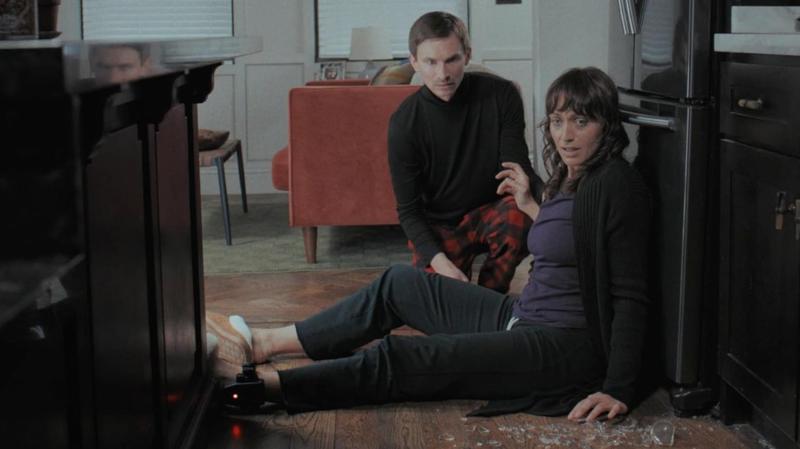
The real-life horrors of existing as a woman in America during the current political regime are plain to see, so it only stands to reason that indie horror cinema would soon adapt to speak to some of the gnawing anxiety centered around the topic of reproductive freedom. House of Ashes, the feature debut from decorated short filmmaker Izzy Lee, would like to be that film, crafting a story in which a protagonist must suffer through the alienating consequences of a restrictive, far-right regime after a miscarriage that was no fault of her own, while simultaneously contending with all the classic beats of haunted house cinema. Although it touches upon very real threats, however, Lee’s film is often overwrought and underdeveloped in its approach, and ultimately more interested in gender dynamics than specific questions of reproductive freedom as one might initially expect, losing track of some of its thematic threads in the process. It feels like an inexpensive feature debut, in other words, effective in isolated spurts but lacking the kind of polish that could have helped to smooth over its more amateurish tendencies.
Mia (Fayna Sanchez) is a woman who has been through some shit, with additional shit looming on the horizon. Formerly married and pregnant, she lost her child and then her husband in rapid succession, the first to a traumatic miscarriage that is briefly depicted in the opening moments, and the latter soon thereafter when he was found dead, suspiciously pumped full of veterinary drugs in what is eventually ruled a suicide. Cleared of suspected wrongdoing in the death of husband Adam (Mason Conrad), Mia is nevertheless made an example of via her state’s (the setting is unclear) draconian laws regarding miscarriage, forced into a one-year period of house arrest where she must constantly report in to a leering, abusive parole officer and wear an ankle monitoring device. You can’t accuse Lee of exaggeration in this regard, not when the situation is clearly based on cases like that of Oklahoma’s Brittney Poolaw, who was sentenced in 2021 to four years in state prison as a result of what a jury decided was a negligent miscarriage. House of Ashes is merely following the thread of where our fundamentalist-infiltrated justice system has clearly been leading us.
With that said, Lee tends to wield these themes with the delicacy of a sledgehammer, with the chintzy voiceover of the film’s opening moments consisting of a string of poorly rendered newscaster audio, filling the audience in on the entire backstory of Adam’s death and Mia’s legal struggle rather than allowing for any naturalism in how exposition is delivered. It’s no doubt accurate, likewise, that there are people in this world who would treat this woman as a monster and a murderer after she arrives at home to begin serving her house arrest sentence, but what is more difficult to buy is every single person in the neighborhood being fixated on and obsessed in their condemnation of her. Even Mom calls to cheerfully inform her that “we disown you.” Co-writers Steve Johanson and Lee craft their premise as if it’s a world where empathy is an impossibility, as if Mia is the first person who has ever experienced this sort of random, cruel tragedy and is thus fair game for inexhaustible community abuse. Everything is cranked up past the point of believability; even the misogyny. “Cry me a river IN HELL,” growls the intruding parole officer, relishing his chance to act as a petty tyrant. “This house is a prison, and I am your warden.” Alright, I guess we’re just announcing the metaphors out loud, then?
The stage would seemingly be set for a story of a lonely, grieving woman running up against threatening external forces and an upwelling of supernatural portent from within, but Mia isn’t alone here at all–in fact, she already has another romantic partner in the form of Marc (Vincent Stalba), who moves in with her as she begins her house arrest, already making references to them being “together forever.” Did we miss something? When did Mia, who is clearly just in the early stages of grief, have a chance to reconnect with Marc, described as an old high school friend who now lives in the same town? How exactly did this supposed romance blossom, when Mia is seemingly just getting out of a correctional or psychiatric facility? Was finding a new boyfriend really a top priority when she was being treated as a suspect in her husband’s potential murder? And even if Marc appears to be devoted to her (he’s shifty as hell, naturally), what are the odds that this kind of rebound relationship is going to fare well in this type of story? Our inclination, given the genre and subject matter, almost has to be to inherently distrust everything about Marc, and House of Ashes never gives us any reason to reconsider that base assumption.
This dynamic leaves the meat of the film free to explore the deteriorating psyche and gnawing guilt of the cloistered Mia, a sort of Disturbia riff with a twist of House on Haunted Hill, which the couple watch at one point. As the supernatural elements ramp up and the nature of the haunting increasingly comes to suggest the presence of Mia’s dead husband, House of Ashes does deploy a few solid scares, particularly when it chooses to play with audience perspective and the elements of a scene’s background that we may not immediately register. It also turns to more grisly material here, although there are times when it feels like a specific horror beat has been derived from a memorably bloody moment in someone else’s film: A well-liked shock from Mike Flanagan’s Oculus comes to mind in particular.
In terms of style, meanwhile, the film finds itself butting up against the limits of its budget and the desire of its makers to seemingly channel a few more heavily stylized horror classics without the aptitude to really pull it off. In particular, Lee and cinematographer Sophia Cacciola play around heavily with contrasting dynamic lighting and color, but what is meant to be eerie and expressionistic ends up feeling palpably forced, like what a first-time filmmaker might try to sell as a Dario Argento tribute. Simply bringing some orange and blue lighting tones together do not a “stylish” film make, and this particular aesthetic feels like it has become particularly abused in recent years by low-budget filmmakers (especially in the horror genre) attempting to evoke a more “cinematic” look in their inexpensive digital shooting. With that said, there are occasional moments in House of Ashes that work considerably better in taking on the more ethereal air that the filmmakers were clearly going for here, piercing the veil with an evocation of macabre fantasy in a way that briefly lifts us from the doldrums–perhaps the best is when Mia is on her back in bed, staring up at what appears to be a swirling, miniaturized weather system in her bedroom as it cycles through colors like an RGB fan light.
It’s even impressive the way Lee’s film sticks its landing in the closing moments, embracing a more rebelliously spiteful reading of its central character that actually earns the metal music playing over its end credits. If only the preceding 90 minutes had possessed more of this suddenly kickass attitude, then House of Ashes might have more to recommend it on the front of pure horror entertainment. As is, it’s a story that was clearly made with the best of sociopolitical intentions, but it lacks both the gumption and the know-how to translate its dissatisfaction into a truly biting critique.
Director: Izzy Lee
Writers: Izzy Lee, Steve Johanson
Stars: Fayna Sanchez, Vincent Stalba, Mason Conrad, Lee Boxleitner
Release date: Oct. 30, 2025
Jim Vorel is Paste’s Movies editor and resident genre geek. You can follow him on Twitter or on Bluesky for more film writing.
 Keep scrolling for more great stories.