
Anniversary Commemorates the Rise of American Fascism with Chilling, Stagy Drama

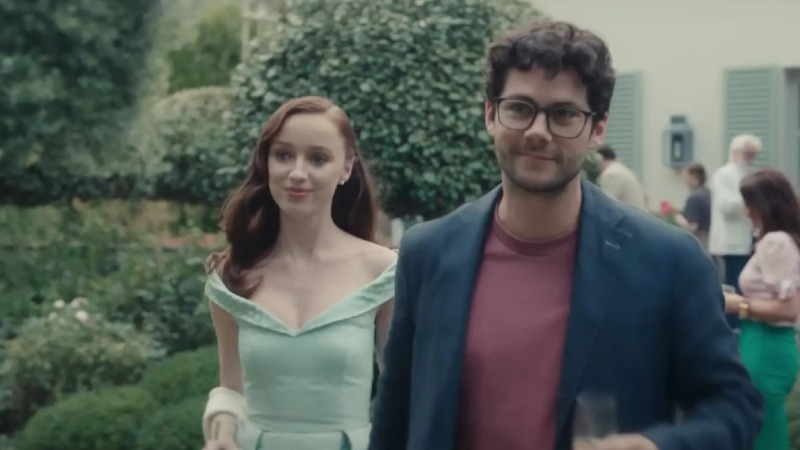
Let’s not talk politics, Paul (Kyle Chandler) repeatedly urges his family on a series of get-togethers. At the first, celebrating the 25th wedding anniversary of Paul, a restauranteur, and Ellen (Diane Lane), an academic at Georgetown, it scarcely matters, may even literally go without saying. The couple’s four children converge upon their childhood home, and any unease or sniping seems purely familial. But for Liz (Phoebe Dynevor), an outsider, there’s more going on. She’s newly engaged to Paul and Ellen’s only son Josh (Dylan O’Brien), an as-yet-unsuccessful writer, though it turns out she also took a class with Ellen at Georgetown. There are small-p political undertones to Josh’s interest in Liz, too: They met through a shared agent, and he’s helped her with a book project that seems much further along than the sci-fi novels he’s about to abandon.
Anniversary lets this information out gradually, with intentional awkwardness, as it introduces these characters as well as daughters Anna (Madeline Brewer), a firebrand stand-up comic; Cynthia (Zoey Deutch), an environmental lawyer alongside her partner Rob (Daryl McCormack); and youngest Birdie (Mckenna Grace), an introverted teenage science prodigy. Liz, who Dynevor plays with a wounded, self-conscious poise perfectly suiting her suppressed English accent, finds it difficult to gain social footing with the family, though they’re not altogether unwelcoming. But you also get the sense she knew, going in, that this would be a struggle. She has other plans.
The movie is largely about those broader plans coming to fruition through the publication of Liz’s book The Change: A New Social Compact, which kicks off a movement disguising single-party authoritarianism as third-option humanism. There are certain conceits Anniversary asks the audience to accept, and perhaps the most difficult is the idea that a lengthy nonfiction book becomes a galvanizing force for social change in the 21st century. It’s logistically cleaner than setting up Liz as an influencer or a podcaster, and the loftier packaging of her ideas strikes more directly at the intellectual reputation of her eventual mother-in-law, but also: come on. If there’s something the movie gets particularly wrong, it’s the degree of whitewashing it imagines fascism requiring in the United States, maybe because its right-wing revolution was conceived and shot during a brief four-year pause in the real-life version. The movie also indulges some retrograde ideas about who would be persecuted first and most thoroughly in this situation – namely, “truth-telling” comedians like Anna; neither her rise nor fall scan as especially believable, because she’s an academic’s idea of a comic (which also means the movie misses any opportunity for more contemporary critique of what counts as free speech in comedy and what doesn’t).
What Jan Komasa’s film gets right is how so much right-wing radicalization, especially in upper classes, stems from status-based grievances. As it surveys a five-year period through a series of increasingly grim family gatherings – Thanksgiving, with the obligatory no-politics-at-the-dinner-table warning; a birthday; another anniversary party – Josh clearly relishes the opportunity to go from mild failson (at least compared to two of his successful sisters) to coattail-riding thought leader. O’Brien is a cast stand-out as he radiates serenely toxic smugness, becoming one of the year’s most chilling on-screen villains without ever raising his voice. Dynevor’s Liz, too, is essentially out for well-heeled, primly spoken revenge in the form of national unity. Though the cast is large, Komasa and screenwriter Lori Rosene-Gambino juggle a variety of reactions to the rise of fascism, from numb despondence to fiery resistance to Paul’s no-politics capitulation. It’s especially gratifying to see Lane given such a dramatically substantial lead role.
So why is it easier to regard Annivesary with interest and some admiration than to wholeheartedly recommend it? I think it’s because the shape of the material repeatedly cries out for a different medium entirely. There are countless dialogue scenes that are easy to picture translating perfectly to a stage setting, and if some of the performances lose the additional nuance of Komasa’s close-ups, the electricity of live, real-time confrontations would likely more than compensate. (Plus, it wouldn’t require looking at the dreary washed-out digital-indie look of this film, which is probably appropriate but does the actors no favors.) A novel, on the other hand, could grant characters like Anna, Cynthia, and Birdie an interiority that a packed ensemble film doesn’t have room for.
The movie, on the other hand, allows our eyes and minds to drift towards the limits of the frame, turning the family home set into a distraction, rather than an effective dramatic tool. A play or a novel could make better use of those empty spaces. Still, I understand why Komasa wanted this to be a film (and not just because he’s a filmmaker). After all, who reads these days?
Director: Jan Komasa
Writer: Lori Rosene-Gambino, Jan Komasa
Stars: Diane Lane, Kyle Chandler, Dylan O’Brien, Phoebe Dynevor, Madeline Brewer, Mckenna Grace, Zoey Deutch, Daryln McCormack
Release Date: Oct. 29, 2025
[ad]
Jesse Hassenger is associate movies editor at Paste. He also writes about movies and other pop-culture stuff for a bunch of outlets including A.V. Club, GQ, Decider, the Daily Beast, and SportsAlcohol.com, where offerings include an informal podcast. He also co-hosts the New Flesh, a podcast about horror movies, and wastes time on social media under the handle @rockmarooned.
 Keep scrolling for more great stories.