
25 Years Ago, Spike Lee Played with Fire (and Blackface) in Bamboozled

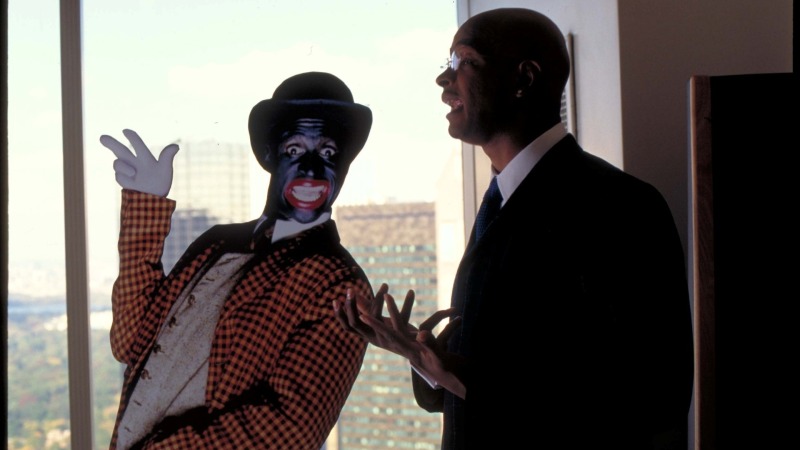
Why does it look like that? That was one of several common reactions a quarter-century ago when Spike Lee unveiled Bamboozled, a blistering satire and morality tale about the treatment of Black culture on mainstream television, particularly comedy. In a movie full of provocative images – it’s about an effete Black writer getting two talented Black performers to work in blackface for a literal modern-day minstrel show – some critics seemed most concerned with the texture of the many scenes in between. While the performance scenes of Mantan: The New Millennium Minstrel Show were captured on 16mm, lending the blackface some vivid, high-contrast color and grain, the rest of the movie was shot on then-nascent (at least for cinema) digital video.
Though George Lucas and Robert Rodriguez were starting to convert their work to digital-only around the time of Bamboozled’s October 2000 release, those were high-end uses of the tech designed to simulate the look of celluloid (and still not quite nailing it). Lee, meanwhile, used Mini DV, technology originally intended for home recording, giving most of the movie an intentionally dreary reality-show immediacy. The transition from sitcom-and-drama dominance to a world where buzzy fiction shows have to share space with the likes of Survivor was only beginning – Survivor had just completed its first summer season, began well after this movie was completed – and so Bamboozled had “real world” scenes that looked significantly cheaper and less polished than a lot of actual TV at the time.
Lee would echo this contrast 25 years later with Highest 2 Lowest, where scenes of Denzel Washington’s wealthy music mogul in his penthouse element are shot with clean, bright, borderline antiseptic digital video – now standard for feature films, especially the streaming companies most likely to give generous budgets to ambitious vets like Lee. When Washington’s character must venture onto the 6 train for an extended ransom-drop sequence that involves traversing the entirety of Manhattan on his way up to the Bronx, that polish gives way to vibrant 16mm film stock, one of the most sublime moment in American cinema this year.
There’s not quite the same sense of exhilaration when Lee switches to more vibrant tones to capture the blackface performances, though they’re being delivered by talented men. Manray (Savion Glover), a gifted tap dancer, and his creative partner Womack (Tommy Davidson) scrape by as street performers until the Harvard-educated Pierre Delacroix (Damon Wayans), in a fit of pique, casts them in his new show, created to spite his racist boss (Michael Rapaport) who considers himself “blacker” than the intelligent, ambitious Delacroix. Rechristening the pair Mantan and Sleep ’n Eat, Delacroix creates a full-on minstrel show, even calls it that: Mantan: The New Millennium Minstrel Show, a Producers-like scheme to get himself fired so he won’t have to quit. Over his own doubts and the protestations of his assistant Sloan (Jada Pinkett Smith), the show accordingly becomes an unlikely smash. Initially appalled, Delacroix has no choice but to believe his own hype, and much of the movie is about the fallout from his massive success, pointedly released around the time that UPN was reaching new lows with Homeboys in Outer Space and The Secret Diary of Desmond Pfeiffer, both name-checked here.
Plenty has changed since the release of Bamboozled, though a lot of the movie’s specifics were also never accurate; I immediately gained sympathy for anyone driven crazy by whatever music-industry details whose fudging I missed in Highest 2 Lowest. Presumably for the sake of simplicity, Lee simply makes up the corporate structure of network TV in the year 2000; Delacroix is one of many network staffers attending regular in-office meetings to regularly pitch shows and write/produce them if they get accepted. These shows have seemingly zero production-company middlemen in between the network execs and the creators, not to mention any seasonal cycles that defined the network schedule in real life; the movie conflates and compresses at least a dozen different jobs. (If ever there was an artifact of the time before the Cult of the Showrunner, this is it.)
Of course, Lee isn’t seeking a behind-the-scenes docudrama. The whole movie is heightened, from the positive reaction to New Millennium Minstrel Show to the violence it eventually engenders. The most actively distancing of the movie’s strategies is the Wayans performance, where he affects an self-consciously “intellectual” (and white-coded) elocution that can’t help but make Delacroix nearly as much of a caricature (albeit not as charged or offensive) as the stereotyped characters he creates. This is a movie deeply suspicious of crowdpleasing, so it’s no accident that Lee cast a sketch comedian and movie star prone to broader characters as a buttoned-up nerd who nonetheless has a stiff affect of a sitcom bit player. It’s easier to hook into Manray’s conflicted and tragic character, but he’s not the focus; ultimately, none of the people on screen really are, which weirdly puts satirical non-characters like Rapaport’s aggressive dumbass on the same level of pop as the sympathetic ones, all secondary to the film’s messaging.
On that level, Bamboozled has some astonishing passages, especially the way it weaves in Lee’s closing montages of Black characters (not all played by Black actors, but not all in blackface, either) from the first half of the 20th century as a plot point that’s eventually unveiled like an ugly version of the kissing montage from Cinema Paradiso. This supercut makes it clearer than ever that Lee isn’t targeting TV in particular (hence it not necessarily mattering that he doesn’t show much interest in how that part of the industry actually operates) but the image-making of crowd-pleasing comedy, the way that Black life has so often been reduced to what might make white audiences laugh or clap with delight, saving a greater spectrum of human experiences for themselves.
This feels somewhat less true now, 25 years later, but not as antiquated as we might hope. The slow splintering of network TV has allowed for more varied Black characters, situations, and genres, while also assuring that something like The Cosby Show (itself looked at very differently now than it was in 2000, thanks to its star’s monstrous crimes) may never again happen at that scale of acceptance and popularity. It may have struck some viewers as farfetched, the idea that a minstrel show could be revived in such flagrant, unmasked terms to such delight from audiences. But then, Bamboozled’s Malcolm X-quoting title (not the only self-reference in a movie that namechecks its own director early on) is in the past tense. This stuff has happened, it’s in the culture, and even those with good intentions may wind up tapping into its legacy. That may also be why Bamboozled doesn’t fully register as acid satire. It’s ultimately a movie of mourning.
Jesse Hassenger is associate movies editor at Paste. He also writes about movies and other pop-culture stuff for a bunch of outlets including A.V. Club, GQ, Decider, the Daily Beast, and SportsAlcohol.com, where offerings include an informal podcast. He also co-hosts the New Flesh, a podcast about horror movies, and wastes time on social media under the handle @rockmarooned.
 Keep scrolling for more great stories.