
Rarely on a TV: What the UCLA Study Gets Right (And What It Leaves Out) About Gen Z Media Consumption

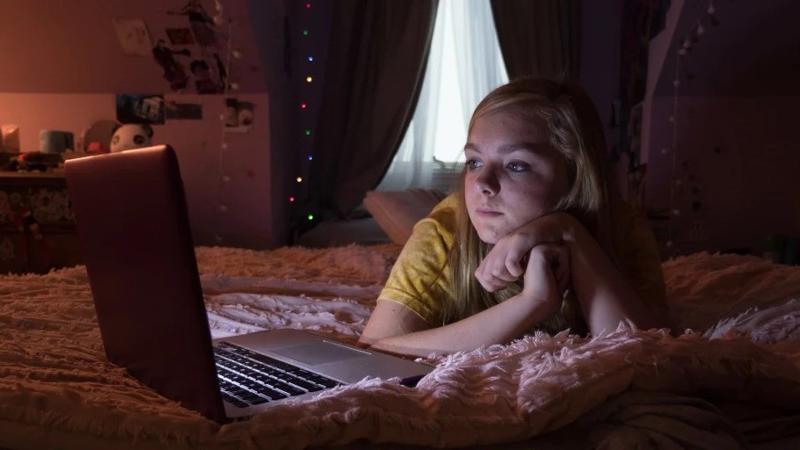
UCLA’s latest Teens & Screens survey reveals that Gen Z is craving less sex in movies and television, more friendship, and rarely watches on an actual TV. Beneath these stats is a portrait of a generation quietly rewriting what connection, and long-form storytelling, can mean in the digital age.
If millennials were raised by cable, Gen Z was raised by short clips. According to UCLA’s Center for Scholars & Storytellers, nearly half of respondents between ages 10 and 24 said they “rarely” watch movies or TV on an actual television. Instead, they’re catching fragments on TikTok, YouTube, and Instagram, bite-sized doses of cinema filtered through vertical screens, reaction edits, and fan commentary, but that doesn’t mean they’re wholly disengaged. 57 percent believe they actually watch more traditional content than adults give them credit for, they just do it differently. Watching no longer means sitting down for concentrated periods of time, it means scrolling, sampling, recombining. In a way, Gen Z has remixed the act of viewing itself.
For many, movies now sit as the subtext of conversation, the reference that punctuates a group chat, or 12-second moment that resurfaces on someone’s “For You” page six months later. This isn’t entirely passive consumption, it’s participatory and voluntary, reflecting the way our attention spans and pressures for productivity, optimization, and speed seep into every day lives.
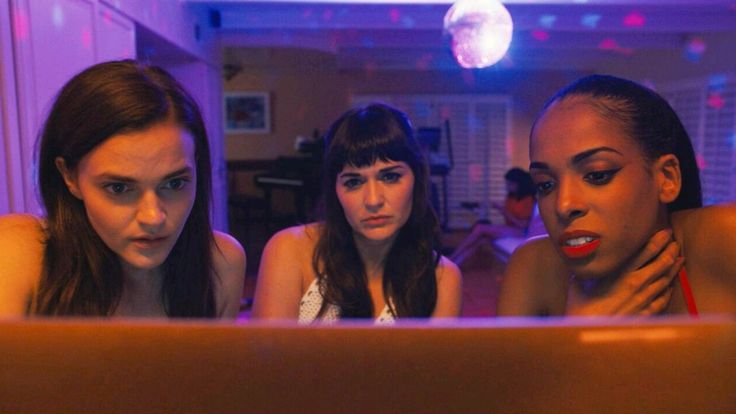
Cam (2018) follows a rising camgirl whose online identity is mysteriously stolen and replicated by an algorithmic double that continues performing without her, tapping directly into Gen Z’s blurred boundary between the self and the screen. This still captures the collective viewing experience, gathering around a single screen.
The report’s subtitle, “Get Real: Relatability on Demand,” captures a tectonic shift in taste. In just one year, UCLA found that “relatable content,” stories about “people with lives like mine,” jumped from 24 percent to 33 percent in preference, overtaking fantasy or large spectacle entertainment. This craving for the ordinary may be less about realism than regulation. When your daily feed already looks like surrealism, and we are living in a time of political, social, and technological absurdity, “relatable” and grounded relationships between people becomes a form of comfort, proof that the world still obeys some recognizable logic. There is an interesting paradox here though: while Gen Z wants relatability on screen, they still flock to fantasy novels. In books, escapism thrives. Look no further than Sarah J. Maas, Leigh Bardugo, Rebecca Yarros. Entire fandoms rise around dragon academies and otherworldly wars, sprawling universes that feel galaxies away from real life.
Maybe that’s the distinction. Reading is private, immersive, and slow, a ritual that invites you to leave the body. Film and television by contrast, are social and collective. In that communal space, relatability seems to matter more. We want to see ourselves reflected in the same glow that lights up our friends’ screens. So now, books are the portal, but screens are the mirror. The fantasy novel offers escape from the chaos, the show or movie offers orientation within it. It’s as if Gen Z craves the mythic when we’re alone, and the realistic when we’re together. In a way, the split says everything about how we’ve learned to process the world, either yearning for transcendence or craving proof that the world is still real.
For decades, adolescence onscreen was aspirational. Think Clueless, Gossip Girl, Euphoria, heightened worlds of status, sex, and spectacle. This cohort, overstimulated and algorithmically exhausted, is gravitating toward what feels grounded. The most-named favorite shows, Stranger Things, Wednesday, SpongeBob, Spider-Man, all orbit friendship, belonging, and characters who are weird, lonely, or both.
Sex, meanwhile, isn’t selling like it used to. Here’s the stat that made Hollywood blink: 48% of Gen Z respondents think there’s too much sex in film and television. More than 60% say they want romances depicted as “more about friendship than sex.” The takeaway may be less about prudishness than dissonance and fatigue. Gen Z is the most digitally sexualized generation in history, raised on algorithmic thirst, parasocial infatuation, and the casual surveillance of bodies online. But instead of translating that saturation into appetite, it’s produced a kind of sensory burnout. When intimacy is infinite, it becomes meaningless. What they’re seeking, consciously or not, is a new grammar of intimacy. In the UCLA study, friendship consistently outranked romance as the relationship Gen Z most wants to see onscreen. That tracks, this is a generation fluent in self-analysis but starved for sincerity, skeptical of love and sex as it’s been marketed to them.

Babygirl (2024) is a film that went viral, following Nicole Kidman’s high-powered CEO who risks her career and family by starting an affair with her much younger intern (Harris Dickinson), contradicting the notion that Gen Z wants less sex in films by making power-imbalanced eroticism the central engine of its drama rather than sidelining it.
Of course, this isn’t the whole story. The survey only paints a statistical mood. Many of us exist in a corner of the internet where the film Secretary has gone viral again, where queer media thrives, and where there is constant open discourse about desire and power openly and unapologetically. Gen Z isn’t uniformly prudish or purified, we’re just extremely polarized. For every teenager rejecting sex scenes as gratuitous, there’s another craving more liberation and visibility, trying to reclaim sensuality from the algorithmic sludge.
The same internet that has dulled desire has also radicalized it, splitting our generation into camps of abstinence, excess, irony, and overexposure. The “less sex” impulse may represent the silent majority, those exhausted by performance, not opposed to pleasure. It’s not that sex has disappeared from our screens; it’s just been dispersed, scattered across subcultures, coded aesthetics, and niche communities.
The UCLA study sample size consisted of 606 adolescents, ages 16-24. Out of curiosity and interest regarding the influence of echo-chambers and niche communities on this study, I organized a much smaller sample size of my own. I surveyed 60 people from a range of different backgrounds, asking the same questions that the UCLA study asked. Out of my sample, only 11 percent said they watch TV and movies on platforms like YouTube or TikTok, while 89 percent prefer the big screen, as opposed to the “nearly half” found in the study. 60 percent of my sample group shared that they would actually prefer more sex in film and television. 66 percent of my sample shared that they don’t necessarily look for relatability as the key factor in a viewing experience, and are more interested in exposure to different kinds of lives. To me, these numbers reinforce the pattern of polarity with Gen Z’s means and preferences of consuming stories.
Despite the platform fragmentation, one of the study’s most fascinating contradictions is communal: 53 percent of young people discuss movies and TV with friends more than they discuss social-media content. And when asked how they’d spend an ideal weekend (if cost weren’t an issue), the top answer wasn’t “play a new video game” or “scroll TikTok.” It was go see a new movie in theaters. What looks like shortened focus spans could actually be evolving pattern recognition, learning to derive meaning from fragments. Gen Z’s cinematic literacy is hypertextual, they can read an edit, a meme, a facial twitch, and infer story faster than prior generations.
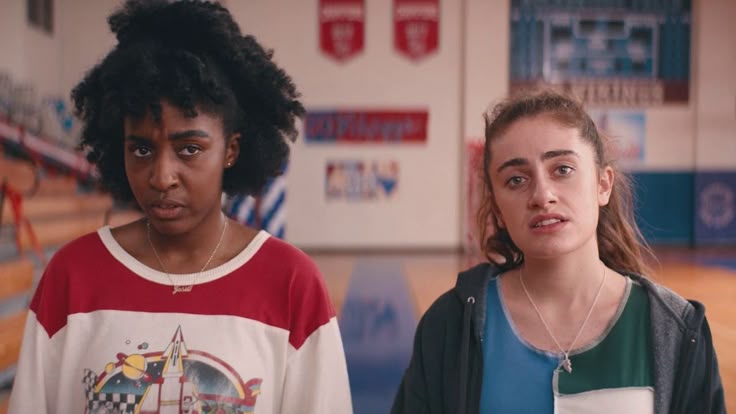
Bottoms (2023) is a queer teen fight-club comedy about two outcast girls who start a self-defense group to hook up with cheerleaders, and it became a unifying Gen Z film because its humor, queerness, absurdity, and sincerity felt like an inside joke the whole generation was finally in on.
“Rarely on a TV” is a generational philosophy. Gen Z is re-engineering what it means to experience stories. We grew up surrounded by moving images, but we’ve learned to read them differently, to search for recognition. The screen is no longer a portal out of reality but a prism through which we try to make sense of it.
Relatability is what happens when fantasy is no longer foreign but folded into daily life. In a culture obsessed with spectacle, sincerity feels almost radical, an act of resistance against irony, detachment, loneliness, and curated perfection. For a generation raised on infinite access, the most powerful stories may not be the ones that dazzle us, but the ones that make us feel seen.
 Keep scrolling for more great stories.