
Color Theory: Shades of the (Un)Natural in Yorgos Lanthimos’ The Lobster

“I raise my left foot. I bring my elbow to my knee and tap it twice. I bring my foot to my knee and tap it three times. I lie facedown. I kneel down. I touch my left cheek and then lie face up.” -David
Biscuit Woman, Loner Leader, Limping Man, Lisping Man, Short-sighted Woman, Nosebleed Woman’s Best Friend. And who could forget Donkey Shooter? The characters of The Lobster are a laundry list of minor physical flaws and one-note generalities, concepts under the satirical microscope in Yorgos Lanthimos’s absurdist romcom about a society that punishes the single. There’s an intentional irony in the naming, given how foreign tropic construction and surface-level consideration are to the Greek writer-director’s English-language debut (and filmography at large).
In the 10 years since its release, Lanthimos has made a global name for himself as one of the most idiosyncratic filmmakers working, and perhaps the most idiosyncratic among directors operating on Hollywood-sized budgets. He instills a bizarro sense of being into his characters that could, under another hand, render them immediately irrelevant – tawdry quirk for quirk’s sake. But Lanthimos, a prolific and mindful master of the strange, has proven his taste for the preposterous.
On the heels of Bugonia, his tenth feature in 24 years, we look back at The Lobster – the film that broke open the Lanthimos floodgate in pop culture – with a focus on the director’s use of color to create engrossing moods, accentuate darkly comedic themes, and heighten the storytelling craft he’s honed through cinema.
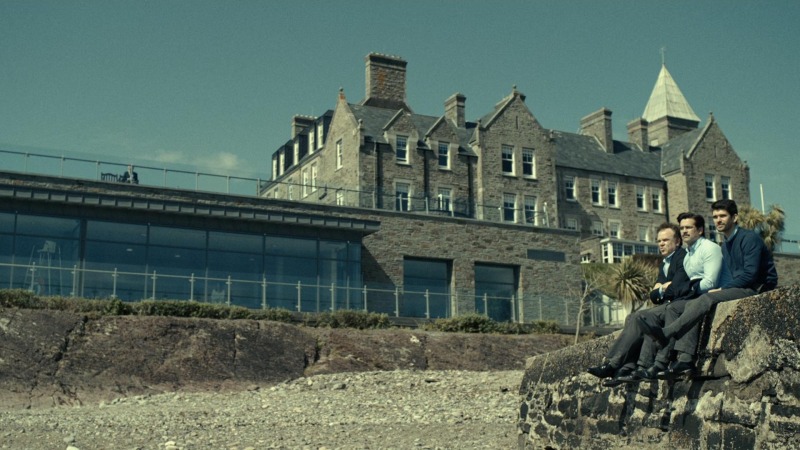
In the header image, the clear-eyed exterior of The Hotel is dominated by sky blues and Irish stone grays, an ornate edifice presented as a temple of love. To the coloring’s credit, as sinister as The Hotel’s operations are, they’re all incredibly aboveboard, as is often the case in dystopian societies. But, the shadowed frame above reveals the darkness within. There’s a civil-right-suffocating bent to the reigning social ethic of The City, the governing body that erected The Hotel as the exiled destination for the temporarily un-partnered – a societal shame most accept out of sheer powerlessness to oppose it.
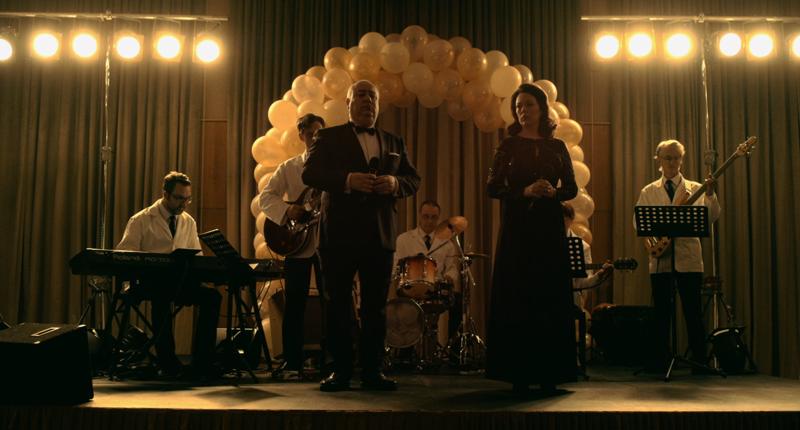
Inside The Hotel, there’s a pervasive darkness in the absence of the occasional imposed light, which flaunts its artifice here across 12 miniature Mikado suns backlighting the band and illuminating the dance floor. The orange-hued shade of yellow swallows the image in a near-monochromatic color scheme – if not for the pistachio shades – that includes the sunburst drums and straw balloons.
The plain black and white outfits reflect the colorless, authoritarian nature of The Hotel and its leaders. In a moment, a spotlight will hit the Hotel Manager and the Hotel Manager’s Partner in the center, and their apathetic demeanors, highlighted by shadow, will change. As we’ll find out at the end of the scene, there’s plenty of daylight on the other side of the steel trap curtains behind them, a fine metaphor for the pretense on display.
[ad]
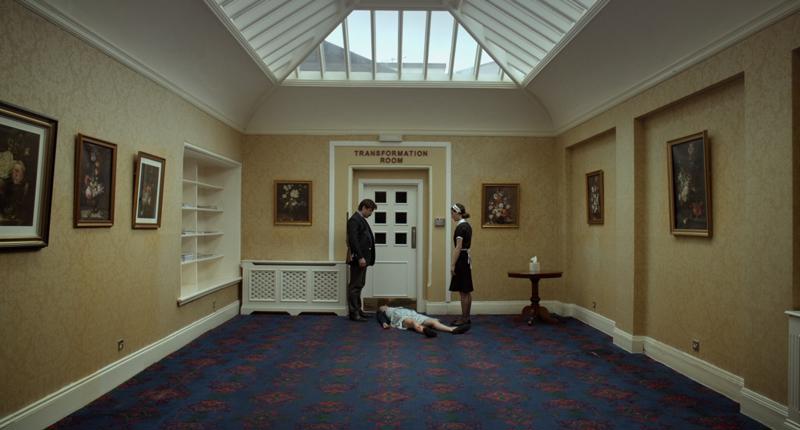
The Hotel has three team colors: navy, gold, and white. Here, at the door of the Transformation Room, they’re neatly layered into the image from top to bottom. An unwavering institutional white lords over the frame, the skylight in the center outfitted with beams like prison bars caging the involuntary “guests” in from above.
The two-toned vanilla-gold walls stretch out to the corners of the frame, creating a golden triptych of surfaces strewn with regal still lifes that mirror the lifelessness in the halls of The Hotel and, more literally, through the Transformation Room doors – not coincidentally white and black, like The Maid’s uniform – where people are turned into animals.
The navy floor is so deep in color it almost subsumes the red and green accents in its design. But the oozing red manages to seep through the dark blue carpet like blood rising to the surface. Between nosebleed, suicide, consequence, and cover-up, blood red becomes a consistent motif associated with sacrifice. And together, the shades of yellow, blue, and red form a sneaky primary color scheme.
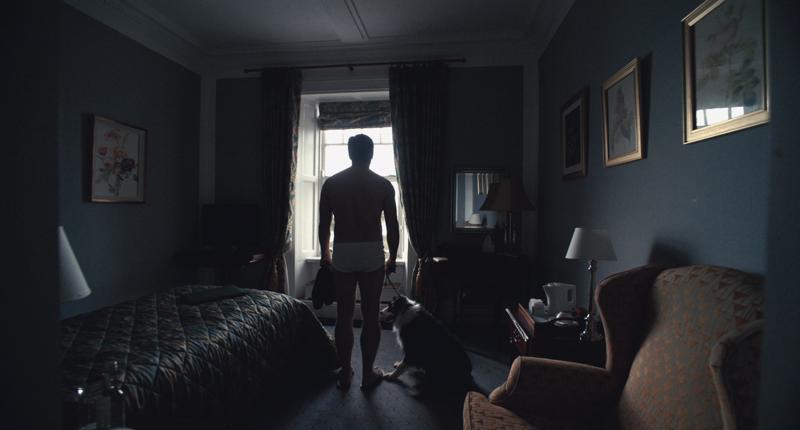
Inside the guests’ rooms, the situation is more accurately represented in color and light. Darkness reigns around David’s near-naked body. A faint light pierces the window, and he stands square in its shine, staring right back as if he were clinging to his only hope. More 17th century Dutch still lifes – too dim in the dully daylit room to add more to the color scheme than golden accents, or marks of the city, via frames – decorate the steel glaucous walls, which match the floor, blend in with the blue/gold comforter (whose color scheme is inverted in couples’ rooms), and devour the frame outside of some mahogany furnishings and a copper-colored armchair, which every room has.
Much like the paintings on the wall, the image reflects a still life but one of a different ilk – still-heartedness at the core of the culture they live in. Lanthimos shows us singleness through the eyes of The City: dismally blue, hardly any light, and even less hope. The focal character is simply a silhouette, and if we didn’t already know he was David, he could be anyone: identity-less.
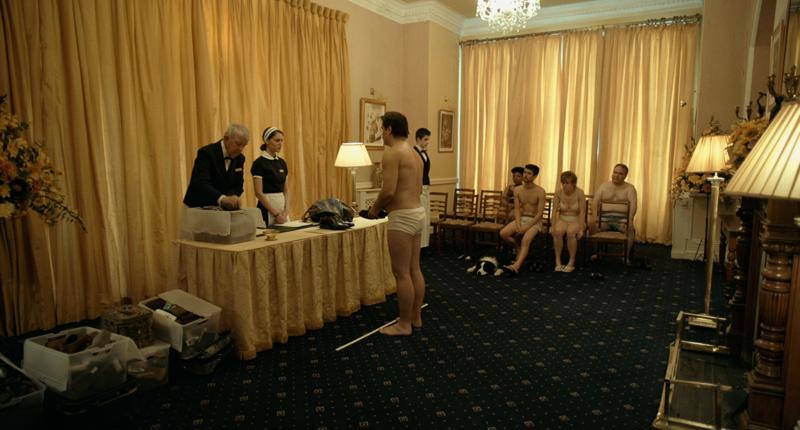
The imposition of artificiality and barrenness on its subjects is The Hotel’s idea of a fair, fresh start. The arraignment room is overflowing with gaudy, warm light, gamboge curtains, cornsilk shades, and wheat walls that blend in with the nude of the guests’. The midnight blue carpet acts like an abyss of animalia almost all guests are bound to fall into eternally. Brass accents and orange and yellow flowers – the latter a staple of The Hotel in almost every room that, in its inviting color, suggests comfort and naturality where there is none – heap more of the same palette onto the image, stressing the comical heavy-handedness of The Hotel’s ways.
One of only four named characters in The Lobster (which includes one dog and no women), David is a middle-aged man of distractingly strong excuses. His extreme deadpan expression matches most other characters in Lanthimos’s movies. We meet him on the other side of a marriage that lasted “about 12” years (11 years and 1 month, to be exact), as he enters The Hotel, learns its rules and regulations along with us, and begins his 45-day journey to find a partner or be transformed into an animal of his choosing.
That is, unless he can match the prowess of The Hotel’s more cutthroat residents in the hunting phase, in which each guest earns an extra day per loner (read: illegal) that they catch. You could say the hotel guests are the ICE of The City. His choice, should he fail, is a lobster. Why? They “live for 100 years, are blue-blooded like aristocrats, and stay fertile all their lives” (a very different take on lobsters from the Limping Man, who focuses on the torturous way lobsters are picked apart and boiled alive).
[ad]
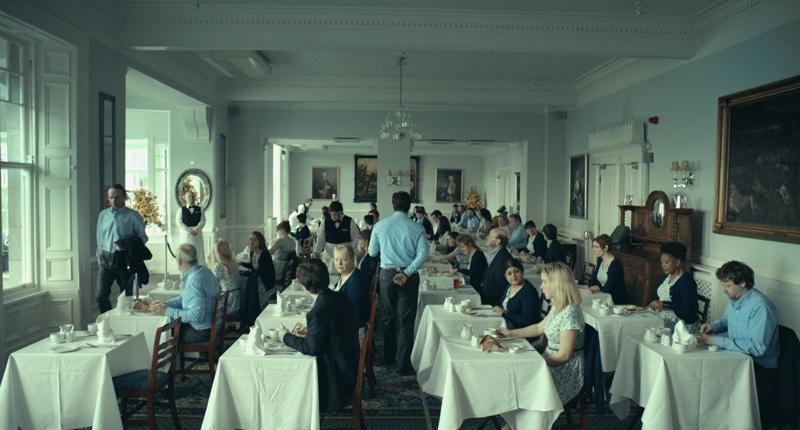
Even in ice-bright natural light, the colors of The Hotel take on deadening hues. In the dining room, where all are a table of one, the cold, blue-hued light shows how unkindling the social environment of The Hotel is. A single, clear, crystal chandelier hangs above them. The spotless white table clothes, gendered navy and cornflower blue uniforms, and powder blue walls conjure a sterile, dentist-like atmosphere.
The orange and yellow flowers – a symbol of the enduring duplicity of The City – stick out in the pale palette up against the ham-fisted warmth of the previous shot. In its mosaic of blues, the rug looms below like a pit of despair yet again. The chestnut tones of the wood bury themselves in the palette, much like they do in the previous shot, as representations of the traditionalism embedded in The City’s beliefs. In The Hotel, we almost never encounter a shot without an accent of fine wood furnishings.
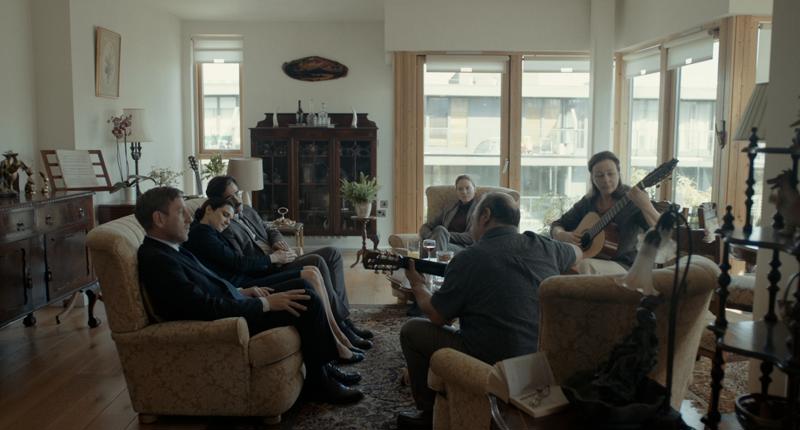
In The City, where married couples have an otherwise recognizable existence, there’s a strength and neutrality in the palettes that suggests we’re seeing through the eyes of The City again – color is replaced with clarity. Nothing clashes but nothing is too expressive. From the chrome and glass shopping mall they visit, to the white and wooden living room of the Loner Leader’s parents’ house, harmony (dueling guitars) and balance is accentuated to show that couples are living clear-headed lives, according to the state.
Pricks of wine red, orange juice orange, and verdant green scatter throughout, but the image comes across achromatically with so many shades of brown and a white so balanced it can’t be called warm or cool (compared to the warm and chilly whites of The Hotel). The arid palette matches the interior of the yachts in which the new couples play out their final test of love.
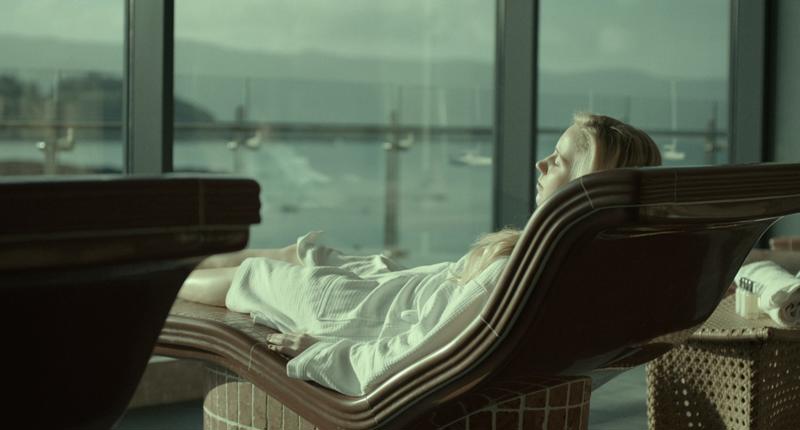
A sleeper pick for the most beautiful shot of the film – with its Dune sci-fi-desert palette and even Duneier spa furnishings – the dichotomy of simplicity and complexity that defines Thimios Bakatakis’s delectable, decade-topping cinematography is on full display here. The complementary scheme employs only two colors, blue and brown, but creates a rich world of color with light and shadow. A range of pale and dark silvery blues fuzz out of focus around soft, crisp, in-focus browns ranging from emperador to a creamy cashew.
The white linens glow like a celestial material in the spa as the Nosebleed Woman’s Best Friend basks in the muted light of her final moments alive. Her empyrean blonde hair and skin meld with the linens in their sheen, carving a glowing-blonde sculpture out of the serene woman that’s as solid and variously hued as the brick lounger she rests on.
Before she dies, she’ll watch Stand By Me and discuss the significance of her hair with David in a way that helps us understand how inculcated The City’s concept of physical compatibility is in the masses. She and David could feign attachment to save their lives – like the Limping Man and the Nosebleed Woman – but they don’t entertain the idea, knowing what awaits them. In that sense, there’s a complicity represented in the simplicity of color and concept in the scene. They paint her as someone willfully embalmed in their own misunderstanding.
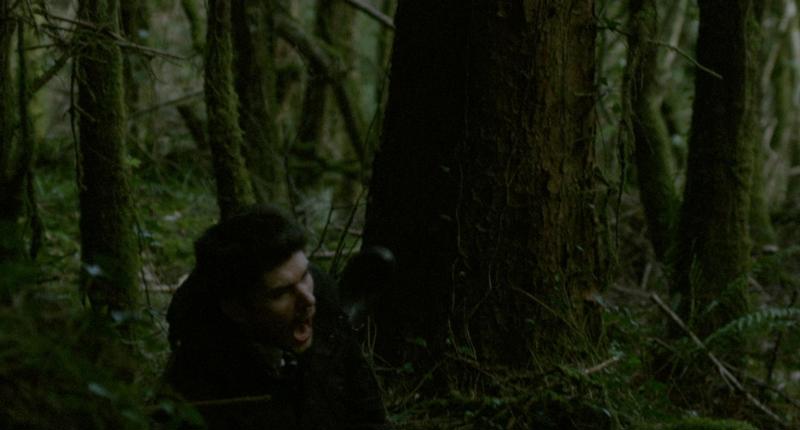
When the guests go hunting, we find ourselves in the loner forest that houses the second half of the movie. When in the loner forest on The Hotel’s side (i.e., with the hunters), the color of the woods is dark, threatening, and saturated. Woods are licorice, onyx, and burnt umber where they aren’t overtaken by moss.
Green plays like a gorgeous invasive disease that gives a little bit of itself to every color it touches. It ranges from darker shades, like shamrock and hunter green, to subdued electric shades, like emerald and lime. Together, the heavy and alarming greens suggest danger – evil lurking in the branches. But when we’re on the loners’ side, we see things anew, and the forest feels like a completely different place in color.
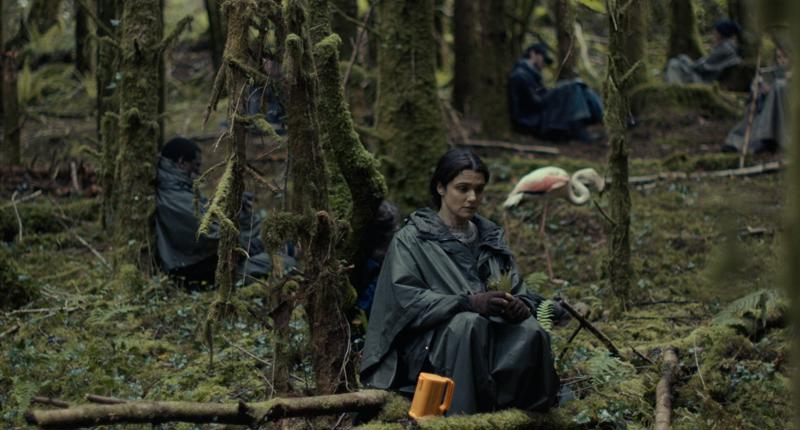
The palettes of real love in The Lobster – ironically bred in the love-restricted woods of the loners – are natural, while the palettes of The City’s instituted love (or fear, for that matter) always have an artificial or metallic sheen. From David and the Short-sighted Woman’s perspective, especially in their honeymoon phase, the woods are a softer, earthier, unsaturated blend of forest colors: otter, donkey, and saddle browns; greens ranging from celadon to fern. Their uniform ponchos are a lincoln green that could almost be a stone gray.
In the loner forest, fantastical dottings of pink flamingos, varicolored peacocks, chartreuse tennis balls, sunflower flashlights, and the like all connect directly to The City in their source and vibrance. In step with the theme, the more vibrant the color of the forest gets, the further David and the Short-sighted Woman get from having a life together.
[ad]
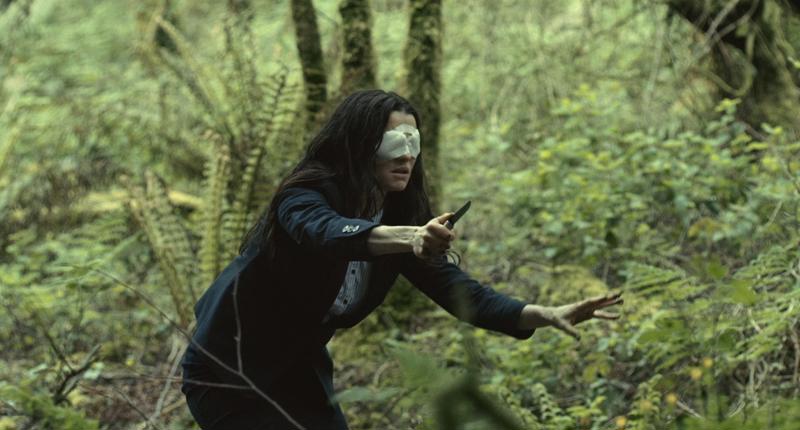
In the aftermath of the film’s most devastating moment – the surprise blinding of the Short-sighted Woman – the woods light up with a fresh fear found in vivid, glaring greens. Menacing and alluring shades of malachite, mantis, and nyanza surround her in the normcore navy costume she wears when she imitates a married woman in The City, as she was led to believe she was doing.
The contrast in color isolates her in the frame and spotlights her fear. Where the natural shades of green in the images above evoke an instinctive solace and approachable romance, the peridot shades here ooze with the savage acidity of the Loner Leader in her ominous deceit.
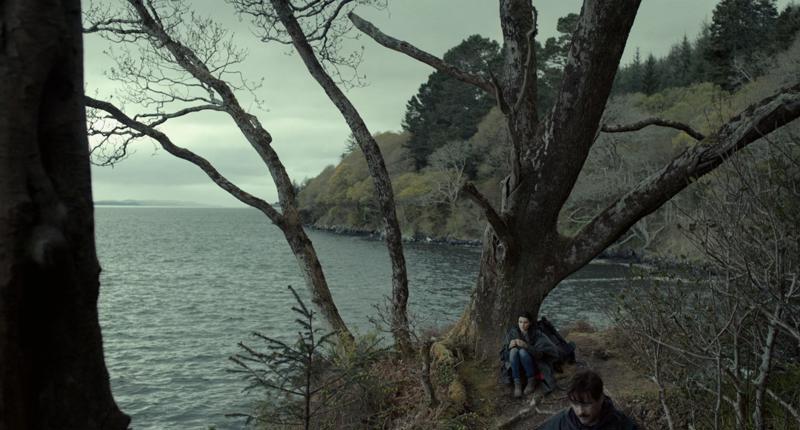
Seen here leaving a blind woman to fend for herself on the edge of a cliff that backs up to wilderness after another riveting game of Touch-Guess-Think-Win, David enters a state of emotional turmoil that looks almost identical to his state of emotional bliss after learning about her blindness. But as the colors of the forest become more natural, the hope becomes more real, despite the suggestion of overcast light and color.
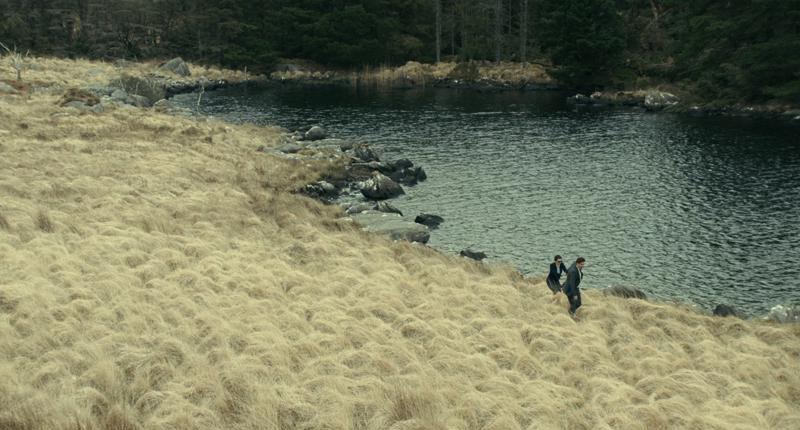
On virtually the same overcast day as above, the couple flees the loner encampment. The hope of a life together in The City emanates from the radiant blanket of tall, blonde grass that surrounds the gloomy pit of loneliness in the pond behind them. The viscosity of the pond is so thick that the viridian hue of the water becomes reflectively chameleonic in sun and shade. The dark patches reach out for them like the Loner Leader in pursuit, but the patches of light are too strong to get through.
The colors match those of the shot of the Nosebleed Woman’s Best Friend in the spa, with its metallic-pool palette of astral blondes and muted blue-greens. It’s worth noting that both shots precede guests’ respective escapes, be they endings or beginnings. The colors also happen to be the dampened, natural inverses to the hotel’s hot yellow and powder blue shading.
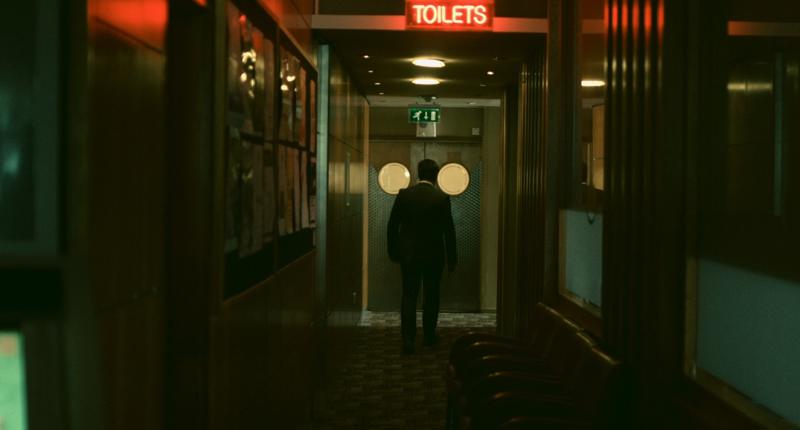
On the night she saw David for the first time, the Short-sighted Woman had a dream. After having anal sex with David, a “thug” broke into their large, well-lit kitchen and stabbed them both repeatedly in the stomach with steak knives. Here, in the penultimate moment of The Lobster, the steak knife returns. David walks down the shadowy turquoise and gold hallway that looks nothing like the spaces we’ve seen in the rest of the movie. It’s an alien tunnel to a resident alien life, living with the one he loves, yes, but in constant disguise as a legally married couple, in fear of deportation to the Transformation Room.
The bright red sign hangs above and behind him and shines on the walls, waiting for David on his way out, a bloody herald of whatever choice he makes, whether that’s blinding himself with a steak knife or committing suicide (he can’t go back to The Hotel or the forest, and there doesn’t seem to be anywhere else in The Lobster).
As a result, we’re left with an eye-stabbing ultimatum equally as sickening as the violence in the dream. (The Killing of a Sacred Deer would take that ultimatum concept to the next level two years later, as if to spend an entire feature in the final tension of The Lobster, but with implications beyond the scope of lovers.) For David and the Short-sighted Woman, steak knives will become a symbol of one of two things: an indestructible love or an abandonment most cruel.
Lanthimos leaves it up to us.
[ad]
Luke Hicks is a New York City filmmaker, film journalist, and musician by way of Austin, TX. He earned his Master’s studying film philosophy, theology, and ethics at Duke University and is the founder of the Brooklyn-based Art Mob Productions.
 Keep scrolling for more great stories.