
Beck offered listeners a strange and beautiful invitation on the genre-shattering Odelay
Thirty years ago, one of alt-rock’s greatest chameleons shed his slacker label to create one of the most puzzling and innovative albums of the nineties with the help of one Hungarian sheepdog, a pair of Dust Brothers, and two turntables and a microphone.
Image via Beck/YouTube
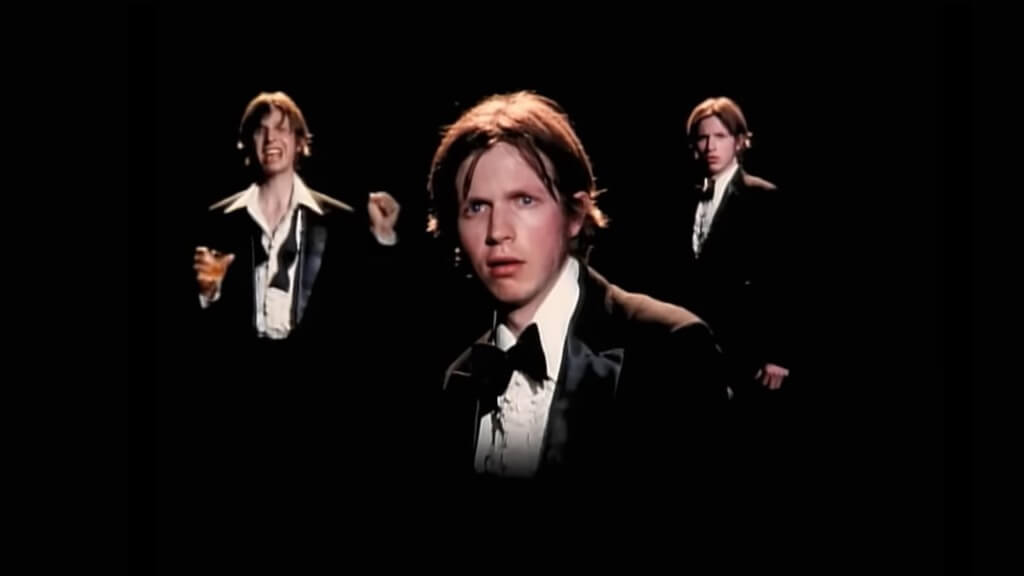
“I thought Odelay might be the last time I got a chance to make a record,” Beck told Rolling Stone in 2008. That might sound like false humility from an artist who, at the time of that interview, had already sold millions of albums, received Grammy nods by the flatbed, and spent the better part of a decade heralded as arguably the most imaginative musical chameleon of his generation. However, a quick rewind back to the mid-nineties finds Beck suffocating in a creative coffin nearly nailed shut by his own success. “Loser” had blown up beyond comprehension, and Beck’s image had been hijacked and relegated to a knitted hat-wearing, leaf-blowing caricature of slackerdom.
While 1994’s Mellow Gold sold well on the disenchanted, anthemic appeal of “Loser,” nobody yet championed the record’s fuller picture of Beck the artist as they do now three decades later. His own label, Geffen, had largely written him off as a novelty one-hit wonder, while Beck wanted nothing more than for the “Loser” hysteria to die out so that he could slink back to his folk roots. Fortunately, that retreat proved futile, and Beck instead concocted a new pollution: 1996’s Odelay, one of the strangest and most beloved invitations of the decade. All it took was one Hungarian sheepdog, a pair of Dust Brothers, and two turntables and a microphone.
After the slacker shenanigans of “Loser” shoved Beck into a corner he never truly belonged in, every creative fiber of his being screamed to pick up an acoustic guitar and belt out some Mississippi John Hurt songs. He even began working on a batch of stripped-down tunes with Mellow Gold producers Tom Rothrock and Rob Schnapf before finally abandoning the project. The only song from those sessions that made it onto Odelay was its closer, “Ramshackle.” While the downtrodden yet hopeful cut has become an integral, introspective exhale at the end of Beck’s most celebrated record, it also underlines the fact that the 24-year-old artist needed to thumb a ride with another production team if he was going to get to someplace truly different.
Enter Michael Simpson and John King, better known as the Dust Brothers. The hip-hop production duo’s greatest claim to fame at that point had been sonically painting the eclectic, sample-heavy landscape of the Beastie Boys’ 1989 landmark sophomore album, Paul’s Boutique. In the Dust Brothers, Beck found not only a team with the hip-hop acumen to take his fascination with the genre to new levels but also kindred spirits who believed that inspiration could be drawn from all types of music and used to create something unprecedented. On Odelay, the trio would explore and sample from a staggering range of unlikely genres and esoteric media to create a style of songwriting that seemed to owe as much to collage and hip-hop culture as to Beck’s beloved folk and blues traditions.
One common misconception about Odelay is that Beck and the Dust Brothers were simply cutting and pasting samples to make songs. While “sampledelia” has its own rich yet complicated history as a practice, Odelay borrows far more inspiration from the wax stacks than actual ripped audio. Beck and the Dusts rummaged through crates of vinyl in search of the most obscure departure points they could find; however, the Brothers recall that Beck’s talents as a musician largely drove the songwriting process. One reason the samples on Odelay are actually more limited than listeners suspect is that Beck insisted on replaying parts himself. For instance, that now-iconic, rumbling riff that opens “Devils Haircut” actually features Beck on guitar, not Jim Armstrong from Van Morrison’s sixties Irish rock band, Them. A Them cover of James Brown does add drums on verses, while a Pretty Purdie sample provides drum breaks and drumming on the choruses, but that’s Beck playing everything else on the track apart from the Dust Brothers’ turntables. Borrowed bits from deep dives—a flutter effect from Z’s Music for Sensuous Lovers or some glassware percussion from an old Ramsey Lewis Trio record—may add flavor, but they’re clearly the A.1. sauce to Beck and the Dust Brothers’ sirloin sizzle.
Nowhere do Beck and the Dust Brothers turn their blend of songwriting and sampling into a purer alchemy than on lead single “Where It’s At.” Beck recalls that most of their studio sessions would begin by “turning on the tape and playing the Wurlitzer or the guitar or coming up with a bassline and then building the whole thing around that.” That leopard-skin, staccato electric piano played by Beck forms the track’s funky core with a Les Baxter drum sample. The famous refrain of “I got two turntables and a microphone,” a perfect boast for Beck’s playful hip-hop cadences, comes from a robotic clip from Mantronix’s “Needle to the Groove.” The title itself borrows from, of all places, a 1969 sex education record called Sex for Teens (Where It’s At), and the cornball teen voice actors in question pop up throughout the song (“That’s beautiful, Dad!”). Session musicians add organ, trumpet, and saxophone to the Dust Brothers’ warm, crackling production in a final product that feels as fit for line dancing as breakdancing. Beck has talked about the “spooky” ability of older samples to “fracture time” in unexpected ways. Certainly, nothing about “Where It’s At” hints that it’s an alternative rock song from the mid-nineties, and yet it’s come to define the decade as much as, if not more than, fare that wears the musical timestamps of its origins like a flannel shirt or, yes, even a leafblower slung over the shoulder.
One of Beck’s pet peeves as a teen was buying a record only to find that all the songs sounded the same. One of his goals for Odelay was to build a collection of eclectic tracks that still feel like they’re cut from the same scratchy cloth. Take “Hotwax” and “Lord Only Knows,” the album’s disparate second and third tracks, respectively. The former bounces in on rusted-out, rubberband strings, samples more drums than Neil Peart, and finds Beck dropping “Loser”-style bars when not singing en español on the chorus or holding court with the “enchanting Wizard of Rhythm.” The latter, minus its opening scream and an Edgar Winter drum part, generally eschews samples, moseying along as Beck takes a youthful stab at a country croon while shading in the track with electric, acoustic, and slide guitar backed by band member Joey Waronker’s tumbleweed drums and shakers. You can stack almost any two songs on Odelay beside each other and reach the same conclusion. They sound almost nothing alike, and yet, they’re pulling from the same palette, one that sounds like the orangish-brown color of Napoleon Dynamite’s fall formal tuxedo. Toss in the hurdling Komondor sheepdog on the album cover, the art design’s hues and fonts, and even the communication breakdown in the studio that heard “odelay” instead of the Mexican interjection “órale.” It all adds up to a sound that feels strangely at home with one foot outside a sweaty Texas truckstop that sells armadillo keychains and the other propping the door open at an air-conditioned taqueria in East Los Angeles.
The variety of styles and sounds that Beck and the Dust Brothers could wring out of that palette contributes to why Odelay remains so listenable all these years later. It really never repeats itself. The catalyst for the primal, industrial groove of “Derelict” was Beck answering an ad for Indian instruments and returning to the studio a couple of hours later with a sitar and a tamboura. He then created a rhythm section using mbira, marimba, and tablas, among other exotic instruments. Absolutely nothing on nineties alternative radio sounded anything like “The New Pollution,” with its drum-and-bass looping, psychedelic keys, and sexy, Joe Thomas-sampled saxophone. “Novacane” could be the captain’s log of a coked-up trucker’s final haul, his burnout screamed into a CB radio, and freak-out “Minus” taps into a raw punk energy that leaves a sonic vapor trail in its frantic wake. Most mesmerizing of all, “Jack-Ass” borrows the keyboard and flute from Them’s fragile, dreamlike cover of Bob Dylan’s “It’s All Over Now, Baby Blue” to whisk listeners away on a melancholy cogitation.
Even some of Odelay’s staunchest champions sometimes give short shrift to the deft lyrical work Beck brought to the album’s songs. His bars have at times been dismissed as surrealist gibberish or merely scratch lyrics (placeholders) for the structures he built with the Dust Brothers. While it’s true that you can probably allocate your time to more productive tasks than analyzing and cataloging beat-poetry moments like “mouthwash, jukebox, gasoline,” there’s an undeniable musicality to the words and a variety of feelings they can conjure. On “Readymade,” Beck uses dilapidated images (“watches tick out of tune” and “rubbish piles fresh and plain”) to talk about how hard it is to be human in an industry that requires you to turn on and off like an appliance. Elsewhere, the whistling putdown “Sissyneck” finds laugh-out-loud humor in false bravado (“I got a beard that would disappear if I’m dressed in leather”), and Beck depicts the drowning heroine of “The New Pollution” like a vintage pin-up model (“She’s got a cigarette on each arm / She’s got the lily-white cavity crazes”). While none of these examples are by any means straightforward, they’re also far from impenetrable, full of linguistic playfulness, and more than capable of soliciting an emotional response.
Not all of Odelay’s lyricism is that far out on the surrealist front, either. “Something’s wrong ‘cause my mind is fading / And everywhere I look there’s a dead end waiting,” Beck confesses in the opening lines of “Devils Haircut” as if in a therapy session. For an album—and a time in Beck’s life—that seems to be all about being dropped into chaotic, absurd, and confusing situations without a map or guide, it’s hard to imagine a more revealing opening line. We can totally imagine Beck as the character in the song’s music video, wandering through the different environs of New York City with nothing to his name but a shitkicker cowboy hat, a leather jacket, and a boombox. Similarly, “Jack-Ass” puts the listener in a surprisingly relatable headspace alongside its protagonist with the beautiful opening line: “I’ve been drifting along in the same stale shoes / Loose ends tying a noose in the back of my mind.” We may not know exactly what emotional quicksand the singer has begun to pull himself out of or what calls him to do so, but we can certainly agree with Beck that these confusing transitions in life are certainly, like Odelay in general, “a strange invitation.”
After multiple years on the road promoting Odelay, Beck eagerly stepped back into the studio with Radiohead producer Nigel Godrich for 1998’s Mutations, a far simpler collection of spaced-out folk songs. While critics praised the departure from the intensive, collaged chaos of Odelay, some fans got their beefcake pantyhose in a bunch over the lack of hip-hop vocals, sampling, and alt-rock vibes. Why had Beck abandoned the sound that had made him a worldwide star? Beck himself viewed Mutations very differently. He took the project as a reminder that there is no single place songs come from, no single way of making music. “I’m trying to move as far ahead without losing the reason why I started playing music or what I like about music,” he once explained to VH1. In other words, there’s always “a destination a little up the road” that Beck will be heading toward on his own terms. As Odelay taught us, that’s where it’s truly at.
 Keep scrolling for more great stories.