
Bedouine turns homeward
For years, the Syria-born, LA-based musician wrote about love and desire and sadness with a veteran’s knowing eye, wading into the gunk of human emotion with a clear-eyed serenity. On Neon Summer Skin, her ideas are more visceral.
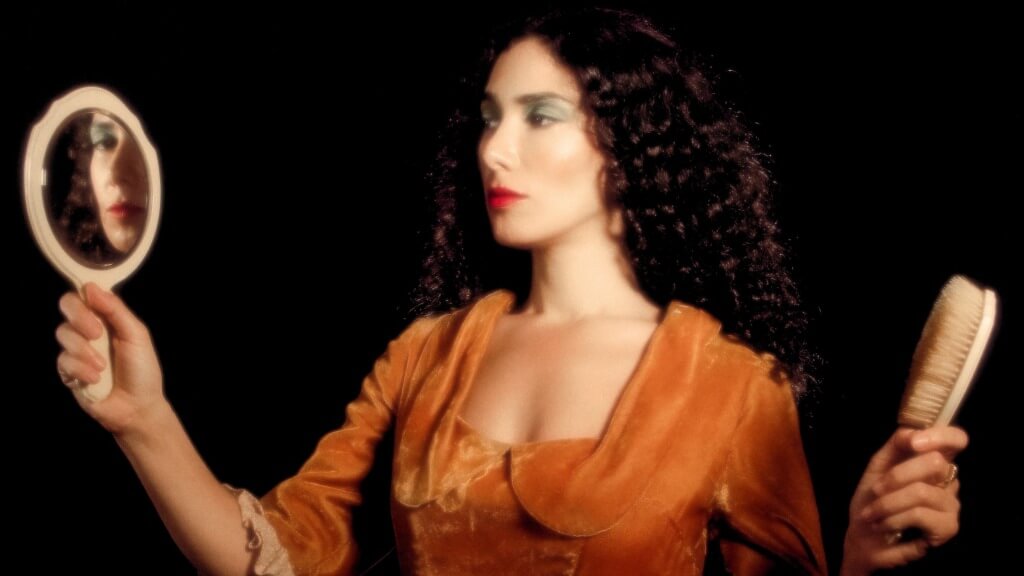
Photo by Janell Shirtcliff
The word bedouin, the gallicized version of the Arabic badawī, translates roughly to “desert-dweller.” The Bedouins, a nomadic group in the Middle East, have been thrust from place to place throughout their eight-hundred-year history. To maintain an identity in such circumstances is, as anyone who has spent much of their life traveling will tell you, no small feat. It requires a special care for the stories you hear, the mythology, the family secrets and admissions murmured in passing—requires a sense of responsibility to the traditions, spirits, and magic inherited from your forbears. So when the Syria-born, LA-based musician Azniv Korkejian adopted the name Bedouine, she was bound to bring the ghosts along.
Bedouine and I meet virtually on a lovely spring day in early May. She asks if we might keep our cameras off, as the urge to watch her on-camera counterpart distracts her from the conversation at hand. Embarrassingly, a wave of relief washes over me: I seem, over Zoom, to have a perennial just-out-of-bed look, and I know Bedouine to be strikingly beautiful. On the cover of her self-titled 2017 debut, the singer slumps into an infinite parquet floor, all high cheekbones and jet-black hair. She has the austere, omniscient look of a queen on an ancient coin, boasting a gravitas matched only by her voice—a calm, deliberate thing, lucid in tone even when her lyrics delve uncomfortably deep. It is this measured intentionality that has made her a beloved voice in the last decade’s folk scene; the sweet, lilting folk of Bedouine, 2019’s Bird Songs of a Killjoy, and 2021’s Wayside have earned her comparisons to Karen Carpenter, Todd Rundgren, and Nico. But in her new record Neon Summer Skin, Bedouine turns to a different source of 20th-century inspiration: her own family history, with the help of her partner and long-time collaborator Guy Syffert, the Lemon Twigs’ Michael and Brian D’Addario, and producer Jonathan Rado.
Bedouine was born in Aleppo, Syria, to Armenian parents in 1985. She spent her early childhood in Saudi Arabia—then, as now, an Islamic absolute monarchy. Six years before her birth, a wave of protests across the Middle East had solidified the region’s authoritarianism as an authoritarian one; free expression in the form of dissent was not to be tolerated. But at ten, Bedouine and her immediate family “won” the Green Card lottery, moving to America and spending the next several years flitting between states like hummingbirds. Then, after attending the Savannah College of Art and Design, Bedouine struck out for Los Angeles: a city where everyone was from somewhere else. Rootedness was the exception that made the rule. Still, she returned to her parents’ home in Houston with affection—“my old stomping grounds,” she says, a smile in her voice. When her parents sold the home and returned to Saudi Arabia, a part of her felt sad, set adrift, but a bigger part buzzed at the thought of returning more frequently to the first home she could remember.
Besides, she explains, she was “restless” as a young musician. She stayed light on her feet, refusing to buy furniture and instead crisscrossing the country in her car with all the frenzied, kinetic need of a twenty-something creative. When she began touring internationally—which, she clarifies, was “never the plan”—she would tack on visits to Saudi Arabia at the end of her European legs, happy to be among the rugged mountains, the sandstone caverns, the smells and tastes and sounds of her youth. When Bedouine visited the country in 2019, though, things seemed different. The censorship that had long defined the country was worsening under Crown Prince Mohammed bin Salman, and immigrants like her father were finding it increasingly difficult to stay in the country as its borders tightened, constricting residents and punishing migrant workers. As Bedouine watched, the region grew less and less stable: Israel’s oppressive occupation of Gaza and Lebanon suffocated the area, and the war in Syria scattered inhabitants like, well, Bedouins. Her parents, ready to retire, moved back to Armenia. “It just kind of dawned on me that I probably wouldn’t go back, maybe ever,” she says.
It feels childishly simple to write that distance takes on an entirely different psychic quality when one’s home is inaccessible, but childish, simple things are often fundamentally true. “I felt really lonely,” Bedouine explains. “I felt like I no longer belonged to a family.” She winces at the perceived cliché, refusing still to back down from it. “One day you wake up and you realize that your family is scattered,” she sighs. “There’s no anchor. It feels too light.” It was this lightness, as she puts it, that brought about the singer’s heaviest album to date. Neon Summer Skin, the singer’s third record, is an ode to a version of her family that no longer exists.
At a glance, this seems like a tonal shift for the Bedouine who burst into the folk scene in 2017 with the sonnet-like “Dusty Eyes” or the defiant manifesto of “Solitary Daughter.” Known for her economic, poetic language, soaring string compositions, and clarion voice, Bedouine became something of a poster child for a sort of gently intellectualized folk music. She wrote about love and desire and sadness with a veteran’s knowing eye, wading into the gunk of human emotion with a clear-eyed serenity. Neon Summer Skin is different: it’s visceral, involved, searching, and needy in the way our childhood memories always seem to end up becoming. She describes it as “swimming into the feeling,” which seems apt: only once you allow yourself full immersion does the water kiss the hot spot on the top of your head.
“On My Own” swan-dives without hesitation “into the feeling,” and it was Neon Summer Skin’s galvanizing force—a spill of words that rushed out of her after that fateful Saudi Arabia trip. “Woke up with a heavy heart,” Bedouine coos over weepy mellotron, “cradled it like it was a baby… What can I say and what can I do? Passing time can be so cruel.” She is, as always, direct to a degree that might detract from her vocal magic were it not so exact. Bedouine calls her words “bloated,” a term she ascribes to Leonard Cohen (although she admits it may be a misattribution). It’s a more positive connotation than one would think: “You pack a word with so much meaning,” she clarifies. “That’s how I think about words. What can you say, and how can you phrase something where you’re making it so heavy, you create a texture to it and a new meaning?”
That tune flows easily into “Long Way to Fall,” a minimalistic, orchestral ballad about a family member of Bedouine’s who was struggling with addiction and whose company she craved during her own nomadic touring days. Over nostalgic strings and a soothing bassline, she imagines reconnecting with her relative, an anonymous loved one she keeps close to her chest in interviews. They don’t talk about these things much in her family: “It kind of comes up here and there, but it’s such a small part of what we talk about.”
The statement stands in contrast to the enormous influence her loved ones hold throughout the record; its centerpiece, and Bedouine’s favorite song on the album, is preceded by an invocation from her mother herself. “Canopies,” a heart-rending acoustic ballad, recounts the story of her mother’s childhood through the eyes of her grandmother, who placed Bedouine’s mother in a Lebanese orphanage as a young child to protect her from her father. Expansive and aching, the song sees Bedouine fill in the emotional gaps her family left in its story, whether for convenience or protection. “I loved you too much to keep you all to myself,” she murmurs, “so I committed a crime.” She felt it was important to record her mother’s story, one she knew little about during her largely peaceful childhood. “As kids, we forget to be curious about our parents,” she laughs. “Especially immigrant parents, who have lived so much life before we came about as their kids.” Appropriately, the song flows into the record’s sole Armenian-language tune, a deceptively upbeat bossa-nova number about the immigrant experience. “Deghma Cheega” begins with the refrain, “I lived, there was nowhere to go.” That lightning-rod sentence combines the impossible with the inevitable. “People talk about immigrants as if they’re such a terrible thing, as if they want to be there, feeding off of them, wanting to leech off of everyone,” she says, growing audibly frustrated. “Most of them just want to go back home.”
The struggle to name what the word “home” exactly means to an immigrant is explored on “White Patent Leather,” a number that arrived when Beoduine was on the road with Father John Misty. The song—about a sacrificial lamb ritual common in Syrian wedding ceremonies—arose from a casual conversation. “We were just on the tour bus talking about something, just childhood stuff, and he was like, ‘Whoa. I hope you’re gonna write a song about that.’ And I was like, ‘you know, I haven’t, but I probably should.’” She wrote the song with Tillman’s voice in mind; she calls him a “crooner,” a mainstay of the kind of theatrical singing she doesn’t often get to do. “He takes up so much space,” she says. “It’s so fun!” Musically, a violin rises and falls throughout the song like a breath, as Bedouine sings of being eight years old at a wedding: seeing the dying little animal on the doorstep, wondering how she fits in to and rejects the culture to which she was born. “Watching the guests arrive and get to the other side of an empty little lamb,” she intones, “Innocent eyes of a sacrifice, plotting my way.” She interweaves the narrative with a photo she has of her parents’ own Aleppo wedding, the two of them grinning in front of a dead lamb of their own. Like it or not, this is what home is.
The lack of that home is felt deeply. Bedouine still cannot return to Saudi Arabia, nor can she go to Syria, where much of her family lives, nor to Lebanon either, where the rest reside. “There’s an alternate timeline where that is a part of my life still, and it’s hugely frustrating and disappointing that that’s not the reality,” she says. “When people think of the turmoil in West Asia, in the Middle East, they think of bombs and deaths, and rightly so. But there’s also this—which is the best-case scenario—families being torn apart and affected for the rest of their lives, where you don’t get to see each other regularly, you fall out of contact with them, and life carries on.” She pauses. “People don’t want to be resilient. They want to live a normal life.”
This desire for normalcy, for a return to prelapsarian belonging, is perhaps the central thrust of Neon Summer Skin. The title track reveals as much: over soft horns and a hypnotic guitar riff, Bedouine reaches back tenderly to a childhood torn from its physical locus. “I was just someone’s little fool,” she breathes in her sweet head-voice, “I was so small, yet nothing at all could alarm me.” “It always came back to the feeling of safety,” she explains, “and to the degree to which you don’t have to think about your own safety.” As the song unfurls, Bedouine exhales, “everybody’s older now.” All of a sudden, you’re responsible for yourself. All of a sudden, you’re on your own.
As “Neon Summer Skin” comes to a close, Bedouine sings the line that matters most to her on the record: “Never thinking once of her safety, only twilight in the water.” It is, for her, a metaphor for the childhood to which she will never return, the one she hopes to give her own daughter. “This kid that just goes to sleep thinking about how they’re pulled away from the day at the pool,” she smiles, describing the image in her mind. “And they get to go to sleep, just only with that in mind, the sun setting in the pool and having to leave, and nothing else.” It is the feeling of being held, bound, protected. It is the feeling of home. Everyone has somewhere they wish they could return to. On Neon Summer Skin, Bedouine has discovered a way to do so.
Neon Summer Skin is out June 5 on Thirty Tigers.
Miranda Wollen is a staff writer at Paste and is based in New York City. Follow her @mirandakwollen or email her.
 Keep scrolling for more great stories.