
Bob Dylan’s dream, riddle, and prayer
Blonde on Blonde recently turned sixty years old. To this day, nothing in Dylan’s catalog holds a candle to its eleven-minute finale of sheet-metal memory and magazine-husbands, “Sad-Eyed Lady of the Lowlands.”
Photo by Michael Ochs Archives/Getty Images
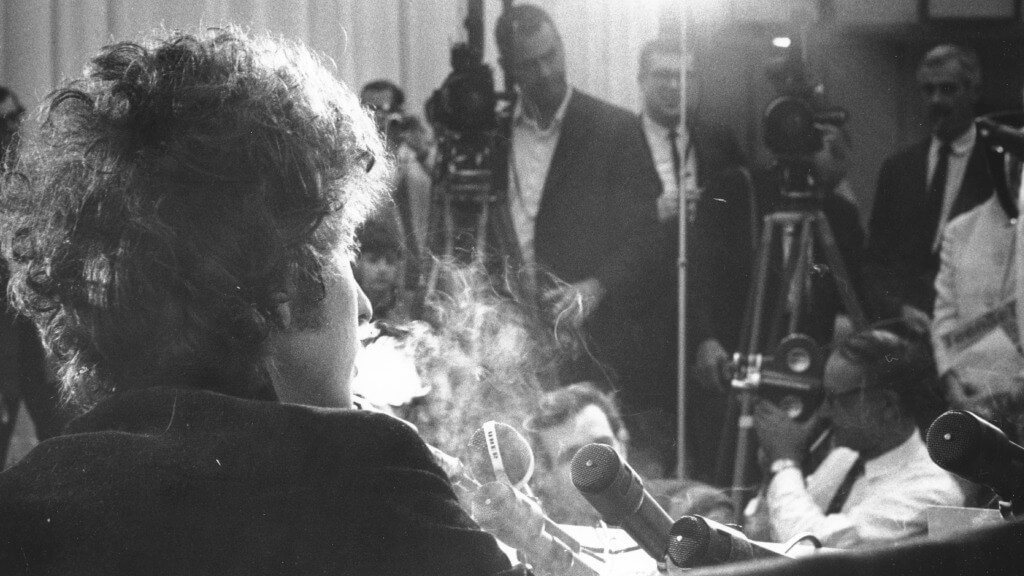
I’m not ready to say that Blonde on Blonde is the best thing to ever happen to Western music, but its concluding statement, the rambling and inscrutable “Sad-Eyed Lady of the Lowlands,” does turn the rest of the American songbook green. When it’s playing, I don’t care about Elvis Presley recording “That’s All Right” at Sun Studio, or Jimi Hendrix using his teeth as a guitar pick at Monterey Pop. It’s easy to look back on the album now and marvel at what it represents. Here was the greatest lyricist of his time, backed by some of the greatest musicians who ever lived—a handful of them belonged to a group so good that they eventually just called themselves “The Band.” Together they came up with hours of unprecedented, unparalleled material. It was masterpiece after masterpiece after masterpiece, written by Rimbaud with a tousled frizz. In the exhaustive myth of rock and roll, we talk so much about the stretch of eighteen months that spawned Rubber Soul, Pet Sounds, Revolver, unfinished (and abandoned) sections of SMiLE, and Sgt. Pepper’s Lonely Hearts Club Band. But what about January 13, 1965, through March 10, 1966? In that thirteen-month span, Bob Dylan recorded Bringing It All Back Home, Highway 61 Revisited, and Blonde on Blonde.
The funny thing is, I spent years resisting the idea that Dylan’s mid-sixties period was his best, and I’ve been especially cruel to the legacy of Highway 61 Revisited. Maybe that coincided with my embrace of Dylan’s plunge into Sinatra pop standards, or my general attraction to the songs he wrote while separated from his wife Sara Lownds forty years earlier. Maybe I’d gone through four breakups in twelve months and was in my own “divorced era” by age seventeen. But now I’ve put a lot more road under my feet, settled into a wonderful love, and allowed Highway 61 Revisited to become my go-to album of Dylan’s. Mike Bloomfield’s guitar tones—bent strings coughing in the backdrop of “It Takes a Lot to Laugh, It Takes a Train to Cry”—could yank me out of a deep sleep.
But in my sweetest days of ignorance, Blonde on Blonde was the sexier “yes, but” counter to Highway 61’s ubiquity. In Rolling Stone’s 2010 list of the five hundred greatest songs of all time—a list I printed out and pored over during every study hall and lunch period—the magazine ranked “Like a Rolling Stone” number one. And that word was God, as far as I was concerned. But I’d already quit believing in God by then and instead sought shelter in Blonde on Blonde’s seventy-two minutes, each one as disorienting as the blurry picture of Bob Dylan on the front cover. To my ears then there was nothing like it. To my ears now there’s nothing like it. The music is a part of my world, like an AirDrop tone or a choir of mourning doves.
The road to Blonde on Blonde was complicated. Mike Bloomfield, who had worked with Dylan on Highway 61 Revisited and even stood behind him when he turned into Judas at Newport Folk, chose to play in the Paul Butterfield Blues Band rather than join the nine-month USA, Australia, and Europe tour Al Grossman had booked for Dylan. Even the mighty Al Kooper, whose organ is the soulful backbone of Highway 61, dropped off of the tour after just a few weeks.
So Dylan called Levon and the Hawks, Ronnie Hawkins’ backing band. It was a group of crackshot players from Canada: Levon Helm, Robbie Robertson, Rick Danko, Richard Manuel, and Garth Hudson. They’re all dead now, but sixty years ago there wasn’t a better fivesome on this planet or any other. Dylan and the Hawks rehearsed in Toronto in September 1966 while they played a residency at Friar’s Club, before convening in Studio A at Columbia’s New York office to record Dylan’s seventh album.
It started with “Can You Please Crawl Out Your Window?,” the eventual “Highway 61 Revisited” B-side. Dylan and the Hawks came up with an arrangement for it, along with three other songs that weren’t completed, including “Jet Pilot” and “I Wanna Be Your Lover.” They also worked on “Medicine Sunday,” an early iteration of “Temporary Like Achilles,” and “Freeze Out,” which later became “Visions of Johanna.” On November 30, “Can You Please Crawl Out Your Window?” was completed and Dylan and his bandmates shipped off to California to do a string of shows.
A few months before he started working on Blonde on Blonde, Dylan had married Sara Lownds in secret. Their first child together, Jesse, was born in January 1966—and right after his birth, Dylan returned to Studio A to work on “She’s Your Lover Now,” a song that went through nineteen takes but was never completed. Dylan and the Hawks just weren’t working out, though he kept Rick Danko and Robbie Robertson around, along with Bobby Gregg, Paul Griffin, and a returning Kooper. Late January sessions yielded little more than a single finished song, “One of Us Must Know (Sooner or Later),” and even more dissatisfaction from Dylan, who’d yet to record a completed take of “Leopard-Skin Pill-Box Hat” and “I’ll Keep It with Mine.”
So he packed up and, on producer Bob Johnston’s suggestion, relocated to Nashville with a new band: Kooper, Robertson, Charlie McCoy, Kenny Buttrey, Joe South, and Wayne Moss. In the studio room, they got rid of the baffles and played close to each other like an airplane bathroom ensemble. A piano was installed in Dylan’s hotel room, and Kooper would use it to arrange songs to Dylan’s lyrics and then relay the charts to his bandmates. They recorded “Visions of Johanna” and “Fourth Time Around” on February 14, 1966, leaving with more finished songs from that session than in the previous ten combined. The February 15 session was supposed to begin at 6 p.m., but the band slept and played cards while Dylan wrote “Sad-Eyed Lady of the Lowlands.”
Though the song’s subject has long been up for debate, I believe it to be a beautiful, biblical ode to Sara and Jesse, especially Sara. A lot of people thought, and still think, that the song is about Joan Baez (she herself has alleged this), but, by Dylan’s own admission in “Sara” ten years later (“stayin’ up for days in the Chelsea Hotel, writin’ ‘Sad-Eyed Lady of the Lowlands’ for you”), it’s about Lownds. But, as Lester Bangs once pointed out, Dylan wrote the song “wired out of his skull in the studio,” not at the Chelsea. Still, the allusions are there: Lownds’ father was a scrap metal dealer in Delaware, which gives the “with your sheets like metal and your belts like lace” a particular context. Maybe I’m just being dense, but “Sara Lownds” and “Sad-Eyed Lady of the Lowlands” don’t sound terribly different.
But, yes: Dylan scrawled his impenetrable verses during an eight-hour stupor on a dead-air Nashville night. If you told me no other singer in the city managed to come up with anything in those hours, I’d believe it. “Sad-Eyed Lady of the Lowlands” sounds like the work of someone who nicked every whim in earshot. So at 4 a.m. on February 16, Dylan whisked his bandmates into the studio room and they played and played, with minimal guidance, until the version of “Sad-Eyed Lady of the Lowlands” that wound up on Blonde on Blonde came out. According to Dylan himself, they got it on the first take. It was a combination of everything that made songs like “Desolation Row,” “Mr. Tambourine Man,” and “Like a Rolling Stone” so perfect: a collision of tranquil melody and esoteric, -absurd, and poetically abundant lyricism.
“If you notice that record, that thing after, like, the second chorus starts building and building like crazy, and everybody’s just peaking it up ‘cause we thought, ‘Man, this is it… This is gonna be the last chorus and we’ve gotta put everything into it we can,’” Buttrey later recalled. But then Dylan erupted into another harmonica solo, and then another verse, riffing on William Blake’s “The Tyger,” Algernon Swinburn’s “Dolores,” and excerpts from the Bible. I can imagine the seven of them cracking up while twisting together with a sea at their feet and the child of a hoodlum wrapped up in their arms. Ten minutes in and Buttrey, Kooper, McCoy, Moss, South, and Hargus “Pig” Robbins had to all be saying, “Where do we go from here?”
In total, there are five verses, each of them delivered with some of the sharpest phrases of Dylan’s career. I won’t go on and on about them, but “magazine-husband,” “into your eyes where the moonlight swims,” “your cowboy mouth and your curfew plugs,” and a “mercury mouth in the missionary times” deserve mention. There’s nothing flashy about this song. It’s cyclical, protected, and, despite its vast runtime, small. It makes sense that “Sad-Eyed Lady of the Lowlands” was recorded in the early morning hours. Kooper once said it is “the definitive version of what 4 a.m. sounds like”—a nocturnal, sidelong hymn that could be a soundtrack to love or death, the “ethereal twilight light” that splendors through open windows. No one knows what any of the lyrics are about, but I think Dylan is just describing someone. His metaphors, impossible as they may be, just darken the silhouette.
Where the last Highway 61 Revisited session was spent completing its eleven-minute conclusion, “Desolation Row,” “Sad-Eyed Lady of the Lowlands” ignited a period of ambitious recording from Dylan. In the three weeks after tracking the Blonde on Blonde finale, he and the band put a bow on “Stuck Inside of Mobile with the Memphis Blues Again,” “Absolutely Sweet Marie,” “Just Like a Woman, “Pledging My Time,” “Most Likely You Go Your Way and I’ll Go Mine,” “Temporary Like Achilles,” “Rainy Day Women #12 & 35,” “Obviously Five Believers,” and “I Want You.” They’d located that “thin, wild mercury sound,” as Dylan later called it in Playboy.
“Sad-Eyed Lady of the Lowlands” is just one polka dot on Dylan’s shirt, sung a hiccup before Buttrey’s beat, but it’s a white-hot star in my universe. George Harrison thought that too, when he referenced the song while imagining the chords to “Long, Long, Long.” “Sad-Eyed Lady of the Lowlands” also changed Roger Waters’ life, and he told Howard Stern that “it in no way gets dull or boring. It becomes more and more hypnotic.” But I’d say it’s Tom Waits who gave the best approximation of the song. In 1991, he said it’s like Beowulf—a song that “can make you leave home, work on the railroad, or marry a Gypsy. I think of a drifter around a fire with a tin cup under a bridge remembering a woman’s hair. The song is a dream, a riddle, and a prayer.”
That’s not to say, though, that it’s universally beloved. Variety cast it aside as “an imposition on the patience of his most dedicated fans.” In his book You Lose Yourself, You Reappear, Paul Morely argued that it was an “overambitious caricature of a love song.” The Observer’s Clive James declared that Dylan’s “unstable sense of organization is most readily noticeable in the long songs that don’t justify their length.”
I recently sold my vinyl collection. Well, most of it. About eight hundred records, dropped off at various shops across Los Angeles. I’ve been collecting for twelve years, since my parents gifted me a cheap Crosley turntable for my sixteenth birthday, but I never put much thought or order into my collection. It turned into this hodge-podge of crummy used copies of albums I like, modern pressings of titles I couldn’t afford originals of, and sealed copies sent to me by labels and publicists. It was curated not by my taste or even self-image, but by necessity and convenience. So when my partner and I recently bought a house, I took the fresh start as a sign to finally lighten the load.
I kept the first stereo pressing of At Folsom Prison that belonged to my grandparents, and my dad’s copy of Harvest that he bought just to hear “Old Man.” I let go of all my Bob Dylan vinyl, except for Blonde on Blonde, a first-pressing I saved up for by working weekends on campus for $7.55 an hour. I must have spent ten, maybe fifteen thousand dollars on all those LPs, and I sent them away for a fraction of that. Turns out that you can put a price tag on the songs that don’t change your life. Since 1966, few musicians have attempted to cover “Sad-Eyed Lady of the Lowlands,” and just a single recorded live performance of the song exists: a rehearsal take from the Rolling Thunder Revue that lingers in the background of Renaldo and Clara, performed by Dylan, Scarlet Rivera, Rob Stoner, and Howie Wyeth. I hung onto my physical copy of Blonde on Blonde so I can always return to side four’s inimitable metaphors, an entire world recited in eleven perfect minutes. So I can remember Bob Dylan’s warehouse eyes spiraling into Sara Lownds’ ghostlike soul at the bowery where they both still wait.
Matt Mitchell is Paste‘s Editor-in-Chief. They live in Los Angeles.
 Keep scrolling for more great stories.