
Boy Throb takes New York
After "the people’s boy band" brought their pink velour sweatsuits and yellow sneakers to a sold-out “Throbchella” show at the Bowery, three-fourths of the viral group sat down with Paste for an interview.
Photos by Matt Weinberger

The security guard at New York City’s Bowery Ballroom thinks Boy Throb needs a bigger venue. At least that’s what he told Anthony Key, Evan Papier, and Zachary Sobania—three-fourths of the rookie boy band—as they exited the lower Manhattan venue after their debut performance last week. (Boy Throb’s fourth member, Mumbai-based Darshan Magdum, appeared via video call. He’s still waiting for a final decision about a work visa that would allow him to perform alongside his bandmates in the U.S.)
Technically, the sold-out “Throbchella” show at Bowery Ballroom was not Boy Throb’s first performance. The social media-savvy group, who call themselves “the people’s boy band,” went viral in November 2025 after performing for residents at a California nursing home. Their setlist included Hilary Duff’s “What Dreams Are Made Of,” KPop Demon Hunter’s “Golden,” Justin Bieber’s “Love Yourself,” and an original bop about staying positive in the face of internet or IRL hate called “Finger.” Even then, they wore their signature pink velour sweatsuits and yellow sneakers. (Magdum, of course, performed via a laptop video chat.)
“The nursing home was kind of like the training wheels,” Key tells me in a post-Bowery interview at the New York offices of Air, a creative operations software company that sponsored the concert. Papier, the self-proclaimed diva of the group, disagrees with the assessment. The nursing home was whatever comes before a bike with training wheels, he says, and The Bowery was like a Peloton. “We didn’t think it’d be this high stakes,” he adds about the concert, noting how the group only started to understand they might have a good turnout the previous day, when they held a meet-and-greet in Washington Square Park. “I think this would have given us a freaking insight into what would happen today, because it was a two-week notice, and all these people [showed up].”
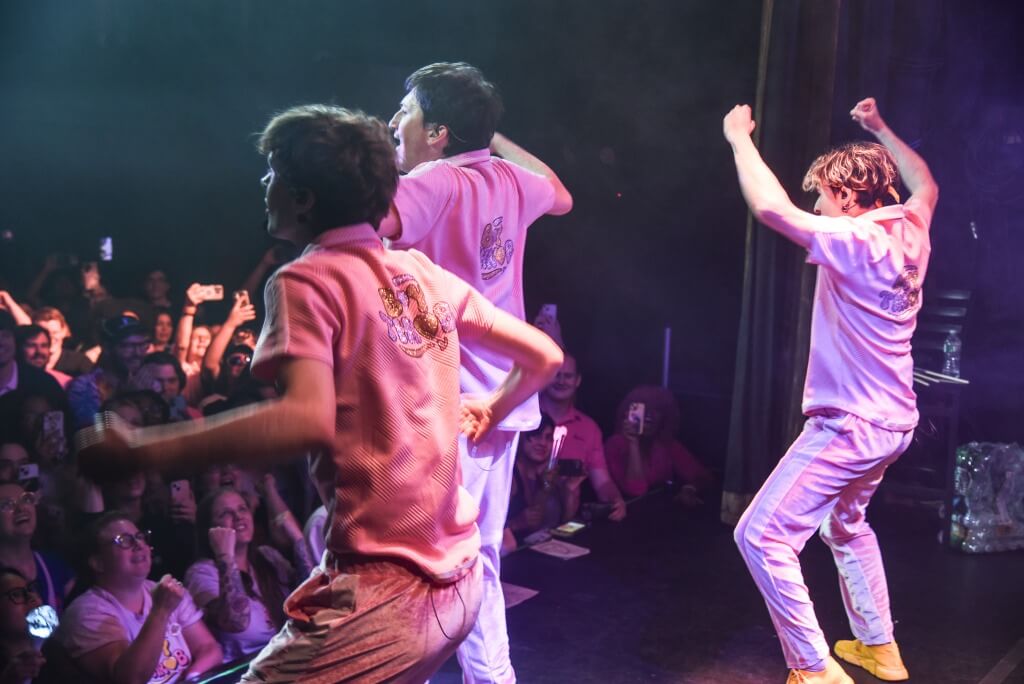
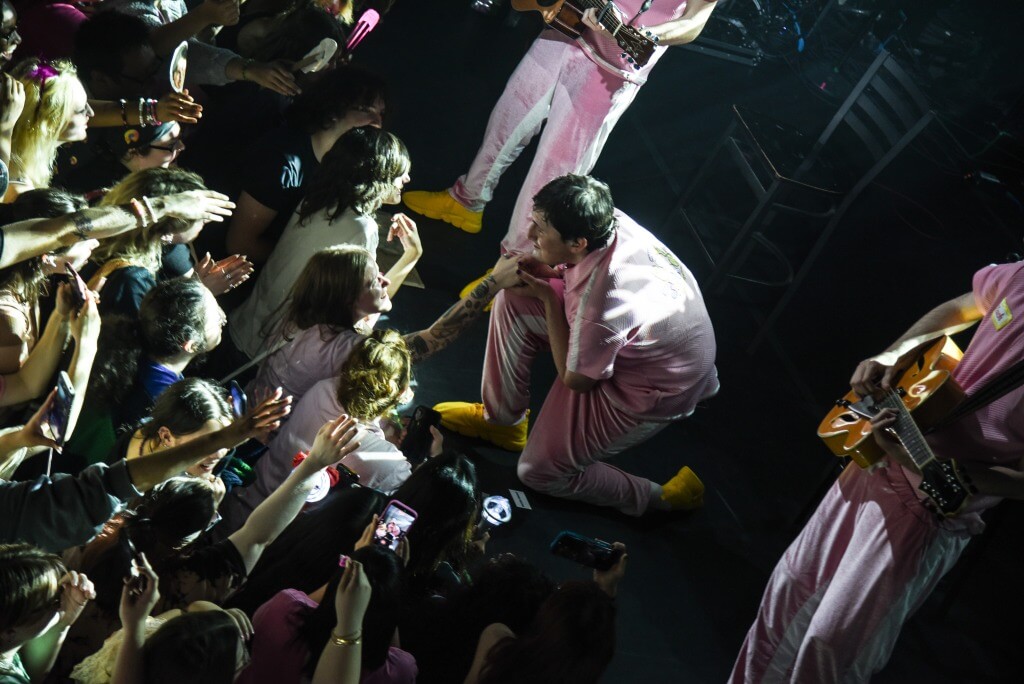
The Bowery easily hit its 575-person cap, leaving many fans stuck outside. Boy Throb visited the unlucky shutouts following their opening song, an acapella version of the national anthem first performed by them at an L.A. Kings game. Then, they burst back onstage to dance, sing, and strum through the rest of the set. Key, Papier, and Sobania performed all three of Boy Throb’s already released original tracks (“Finger,” “Can’t Stop the Throb,” and “Number One Boy”) in person, and debuted a new, original club banger featuring Kesha. Magdum popped up via pre-recorded vocals and video to perform his parts, including a solo reinterpretation of Annie’s “Someday.” During the show’s emotional climax, he video-called in to say hello to fans, even though it was early morning in Mumbai. He thanked the other members for holding down the fort and said that he can’t wait to be united, as audience members chanted his name.
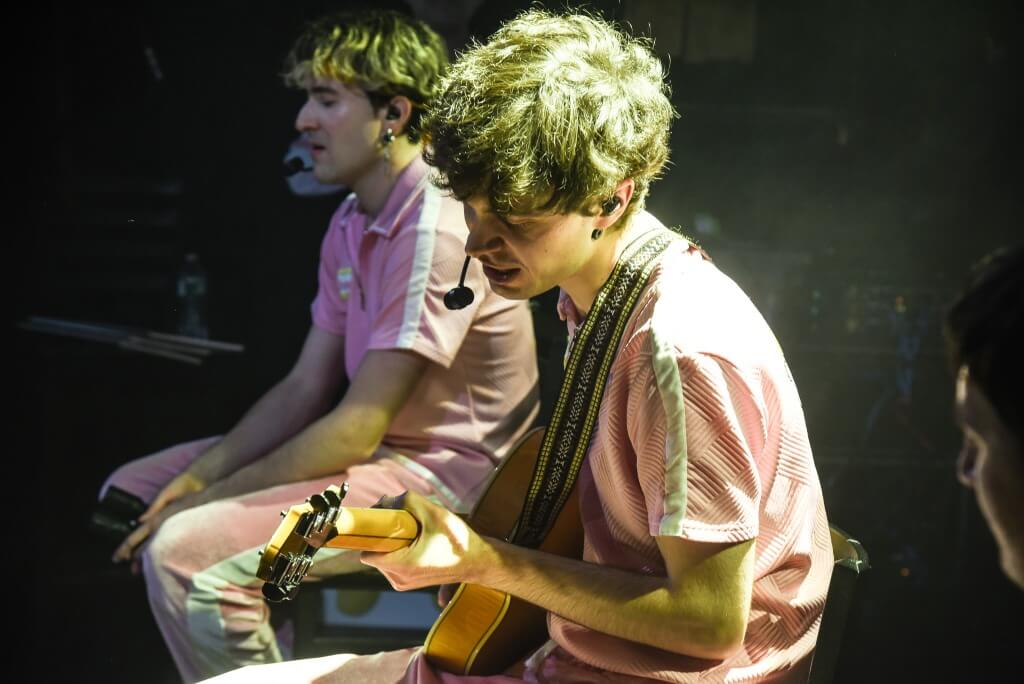
Elsewhere in the show, Key and Berklee graduate Sobania broke out guitars for the group’s cover of One Direction’s “Night Changes,” which Papier says he chose because “it is such a beautiful song” and suits his voice. “These guys probably knew that when I was picking it,” he continues. “For me, so far in the group, we haven’t done anything that shows my bread and butter vocally yet. I feel like ‘Night Changes’ gave me the opportunity to show that off, and also some really cool harmonies that we are so proud of.”
Papier, who teaches vocal lessons when he’s not doing Boy Throb, admits that he was a little intense during a last-minute group practice for the song. “We were in the exercise room at 10 p.m., and I was being like nails on a chalkboard with the harmonies,” he recounts. “I literally was like a freaking choral director with the amount of times I was like, ‘Nope, try again. Nope, try again.’ Because I envisioned a certain way of this going, and the way it went tonight was the way [I had hoped].”
Preparation for the Bowery show mostly had to be done remotely. Magdum may be the most geographically distant member of Boy Throb, but Key, Papier, and Sobania all live in different parts of the U.S. (They temporarily rented an Airbnb in L.A. together to film some of their viral content.) The members practiced for the show individually and together over Zoom with their choreographer, Meghna Chakraborty. “We do some of our stuff together, but she has really done a lot of our choreography for us, and we’re so thankful for the amount of time that she has dedicated to us,” Papier says. “And I said this to her when we were in the green room after the show, ‘I would not be ready for the show without you.’”
Since launching last year, Boy Throb’s legitimacy has been questioned by the media, internet users, and even the U.S. government, but it’s hard to argue with the sweat of a live performance or the group’s sincere commitment to making and performing music together. All four members of Boy Throb had notable social media presences before the group’s formation, with Key and Papier connecting after they both unsuccessfully auditioned for American Idol. From there, they met Sobania—whose endearingly awkward dance videos have gone viral—and Madgum—whose falsetto covers have been recognized by Adam Levine, Bruno Mars, and Rosé—via DMs.
When asked what makes a good boy band, Boy Throb understands the format: “Heart,” says Papier immediately. “Yeah, a lot of heart,” echoes Key. “Emotion,” Sobania adds. They also care about the music and performance. “Good dancing and singing,” says Papier. “And having a rapper. I think it’s important to have a rapper in a band, yeah? Because these days, in music, when you just have the vocal and dance, you lose a third element of rhythmic vibe.”
Key, who worked as an Uber driver and hall monitor to help fund his music and seems to be the biggest boy band fan of the group (he performed BTS’ “Dynamite” for his American Idol audition), lasers in on the vocals. “Harmonies are very important,” he says. “I have such a bone to pick when I see a group together and they don’t harmonize. Please, work on that. Please harmonize. And that’s what we want to do. We wanted to bring back [harmonies].” In an era when technology can cover all manner of singing sins, Boy Throb wants to be a group known for its live vocals. “We want to be a band where you can take away all the glitz and glamor, the music, the tracks, everything, and we can sing,” Key explains.
However, before Boy Throb can perform together in its complete, corporeal form, Magdum needs a work visa. The Bowery Ballroom show was an opportunity to connect with fans, but also a chance to gather evidence to convince the U.S. government that Boy Throb is a financially viable, nationally recognized musical act. “We did that tonight, gentlemen,” Key says to Papier and Sobania in the middle of the interview, still processing the performance.
Boy Throb tells me that they thought Magdum would be in the U.S. by now. “Honestly, we were kind of expecting Darshan to get here after the first application,” says Sobania, who is currently attending law school when he is not busy Boy Throb-ing. “We were planning to be performing live with him now.” Key adds that they were hoping they could start touring in April or May of this year before receiving a letter from the U.S. government in March that they needed more evidence to decide Magdum’s O-1 visa, a non-immigrant work visa for individuals with “extraordinary ability.”
Though Papier describes himself as someone who pays attention to the country’s political landscape, Magdum’s difficulty getting a work visa has “really opened our eyes to how brutal this can get.” Boy Throb has chosen to be open with its fans (aka Throbbers or The Throb Mob) about the ins and outs of the process, perhaps teaching those who don’t have personal experience with U.S. immigration a little bit more about the system. “We’re Schoolhouse Throb,” Papier jokes when the subject comes up.
Boy Throb will continue gathering evidence for Magdum’s application, whether in the form of the hundreds of fans who showed up at the Bowery Ballroom show with homemade merch, signs, and K-pop lightsticks, or new music like that unreleased Kesha track. “I think the three of us are really comfortable keeping this up,” Papier beams. “As we said at the show today, we’re holding down the fort until [Darshan] can get here. And I think we’re doing a pretty damn good job of holding down that fucking fort.”
Kayti Burt is a working-class journalist based in New England with more than a decade of experience covering the world’s most popular stories and songs for outlets including Paste, Rolling Stone, Vulture, TIME, the LA Times, Den of Geek, and Polygon.
 Keep scrolling for more great stories.