
BTS in a time of American imperialism
The K-pop group's comeback tour begins in the shadow of an American and Israel-provoked war in Iran that has killed more than 3,000 people and is disproportionately driving up energy prices in Asia.
Photos courtesy of press
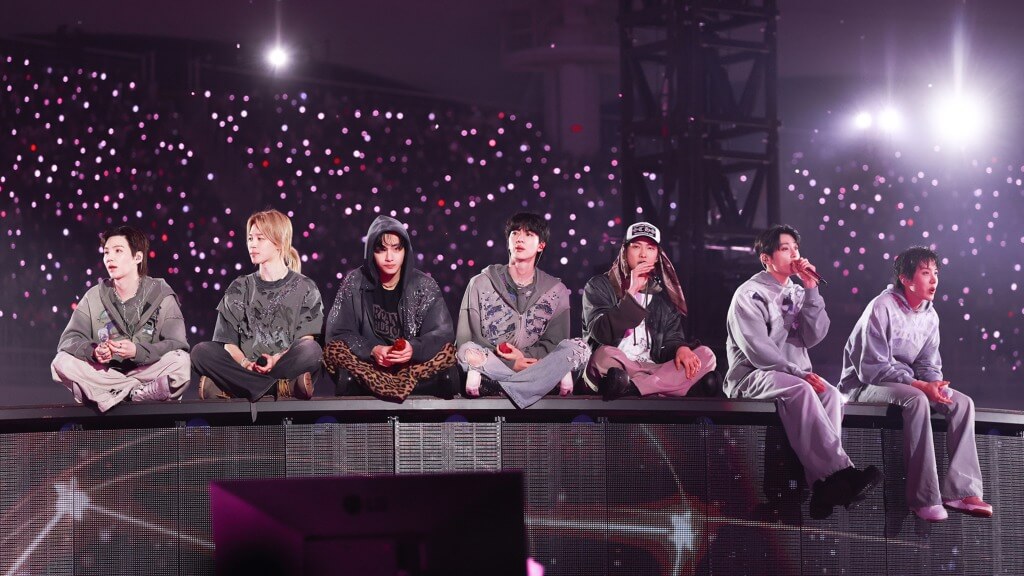
In every phase of BTS’ steady rise to global superstardom, most mainstream press coverage has couched the group’s success as in spite of their Korean identity, rarely if ever considering that their origins outside the core of American empire might be integral to the scope and depth of their geopolitically diverse fandom’s unprecedented regard. Last week, in Korea, BTS began their world tour over three days in Goyang Stadium. Launched in the shadow of an American and Israel-provoked war in Iran that has killed more than 3,000 people and is disproportionately driving up energy prices in Asia, the BTS tour will see the Korean group embarking into a world reeling from the intensifying throbs of American imperialism.
The more successful BTS has become, the more American entertainment industry doors have been opened to them—and to HYBE, the Korean entertainment conglomerate built from BTS’ success. American capital looking for the key to infinite corporate growth has finally realized that there is big money to be made in foreign-language media, and BTS is one of the surest bets in town. Many fans have celebrated these partnerships with U.S. players, especially as it seems to be something the members want, while others have expressed disappointment at the way BTS has moved closer to the U.S. industry.
Since BTS returned with their 14-track Arirang album last month, the Korean artists’ perceived proximity or not to American culture and capital has been a hot topic of conversation. Critics say the 14-track album isn’t Korean enough to support its title, which is a reference to the centuries-old traditional folk song that every Korean elementary child knows. That the album, which was recorded at Los Angeles’ Conway Studios, is overly reliant on American producers. That elements of the songwriting and performance are appropriative of Black American culture.
These kinds of comments aren’t new, nor are they without their measures of truth. The album’s construction was led by BTS’ longtime in-house producer PDogg and by the members themselves, but also by controversial American producer Diplo, who acted as an executive producer on the album following a personal request from HYBE chairman (and the man who put BTS together) Bang Si-hyuk. The album also includes credits from Jasper Harris, Kevin Parker, Mike Will Made-It, and JPEGMAFIA. The first half of Arirang in particular is deeply influenced by the American hip-hop culture that BTS members RM and Suga in particular grew up admiring and immersed in. Tracks like “Hooligans,” “Aliens,” and “Body to Body” meld Korean culture references and language with trip-hop and old-school hip-hop sounds to satisfying results.The second half of Arirang settles more into the pop that has played a larger role in the latter half of BTS’ career thus far.
But of course BTS, who debuted as a hip-hop idol group back in 2013, is deeply influenced by American culture. How could it not be? The United States has been exporting its pop culture to the world for decades, and the dominance of that export was particularly foreceful when it comes to South Korea. The U.S. military has had a sizable presence on the Korean peninsula since the end of World War II, when America and the Soviet Union swept in to “help” shepherd the region towards self-governance after decades of Japanese occupation. When the dust on the Korean War settled, the U.S. had a military foothold on mainland Asia that remains in place today. The U.S. operates 750 military bases across 80 countries and territories, including 75-85% of the world’s overseas bases, but its largest one by area is in Korea, where tens of thousands of American soldiers are stationed.
How does this all connect to BTS and K-pop? In the years following the war, South Korea was one of the poorest countries on Earth. In this economic environment, the population of American soldiers represented one of the only viable consumer bases. Business catering to the foreign soldiers popped up around the military bases across the country, including in Seoul’s Itaewon neighborhood, which bordered the longtime U.S. military headquarters at Yongsan Garrison. Korean musicians and singers found work as “musical day laborers” at U.S. military clubs, playing jazz, pop, blues, and rock and roll rather than the folk or trot songs that were popular in Korea before the war.
By the late 1950s, entertainment companies like Hankook Entertainment, Geukdong Entertainment, and Shinil Entertainment formed to supply shows for American soldiers. In the 1960s, these companies had consolidated into a single company called Hwayang that was holding 400 shows per month and earning between $1.2 and $1.5 million annually at its peak, Oh Kwang-soo writes in Korean magazine Cultura. In order to perform for the U.S. Army, singers, dancers, and bands had to pass a USO audition. Hopefuls had to be adept in multiple Western music genres, and needed on-stage charisma that could sustain a performance across an entire evening. This was the system through which almost every popular Korean singer and musician of the time (e.g. Hee-joon Choi, Patti Kim, and the Kim sisters) passed, as performers who were popular with the American military community often became popular with the broader domestic audience— which probably included at least some of the grandparents of future BTS members.
It’s hard not to see the varied influences of this system on today’s K-pop scene, which often gets flack for its perceived mimicry of American music genres and trends. This is seen as a more recent development that started with K-pop’s formation in the 1990s. But the messy, military-driven influence of American pop culture on Korean pop culture goes back much further than that, and cannot be divorced from the U.S.’ longheld occupational presence in the East Asian country. (Neither can the necessity of BTS’ group hiatus at a height of fame and artistic development in order to complete mandatory military service—a direct result of America’s arbitrary division of the Korean peninsula in the aftermath of World War II, and the political tug-of-war and literal war that came afterward.)
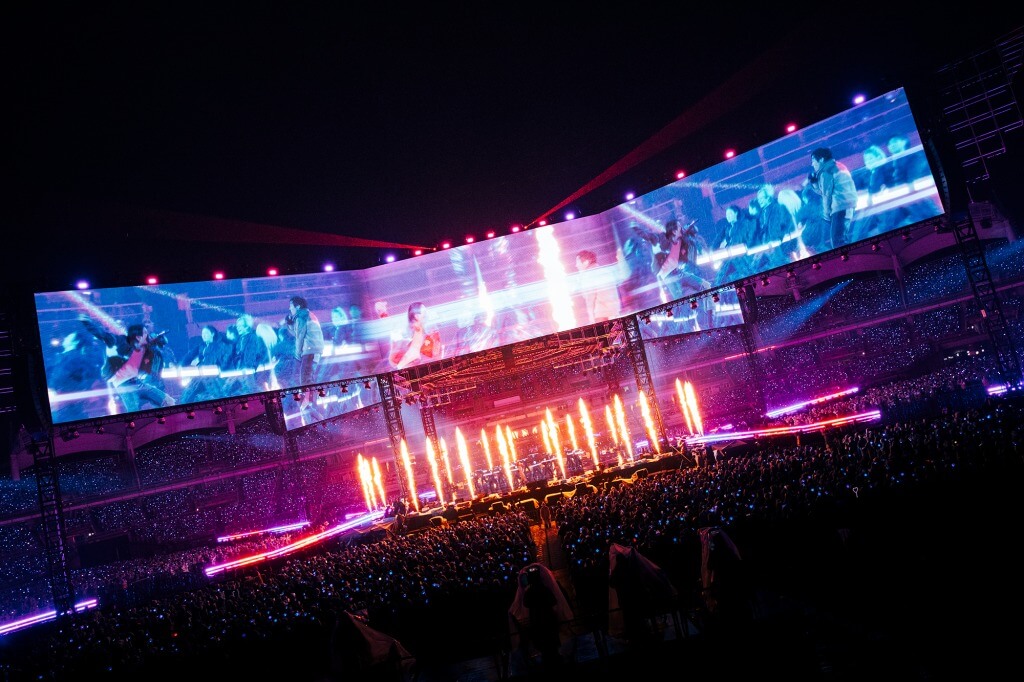
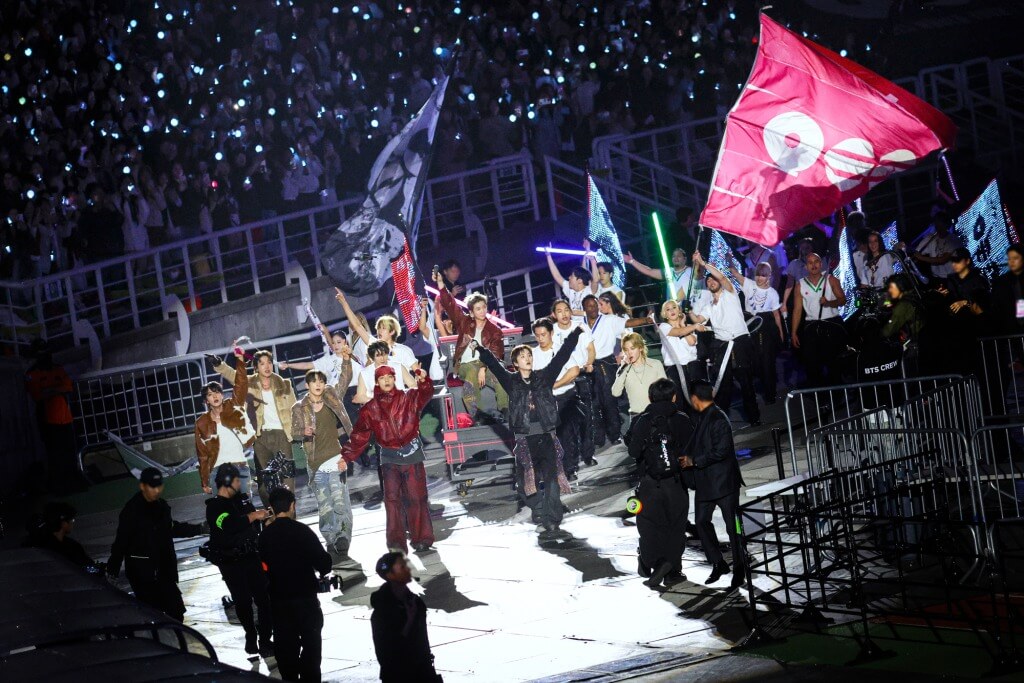
On the Arirang Tour, BTS’ Korean identity is expressed in overtly traditional ways. For example: in a stage design inspired by Taegugki, the Korean flag. The flag’s central red-and-blue symbol symbolizing harmony between two opposing forces, is incorporated into the stage floor, while the extended runways that thrust out into and towards the audience draw inspiration from the flag’s four tri-grams. In one of the show’s grand transitional moments, as the members take a breath to change costumes and catch their breaths off stage, dozens of dancers dressed in red and blue robes arrange themselves into a Taeguk pattern at the center of the stage. In this segment, the stage comes alive with the elements each of the flag’s individual features represent—heaven, earth, water, fire, shadow, light, and purity—as if it is a living, breathing thing rather than a canvas for BTS and the audience to project meaning onto.
But it’s also in the way BTS’ music and performance is all tangled up in America’s grasping, global influence. Because hip-hop too came to Korea through Itaewon, in an evolution of the club culture of the post-war decades and directly tied to the community of American soldiers that temporarily called Seoul home. In one of the Arirang tour’s most dissectible moments, BTS perform their pop rap track “Body to Body,” which includes a sample of “Arirang” in its bridge. On the album, it is an intro track; in the concert, it is part of the second act’s climax. Decades after the post-war Korean entertainment industry sang foreign hits to American occupiers, a crowd composed of domestic and international fans sang Korea’s most sacred folk song back at BTS.
In 2023, BTS rapper and group leader RM was asked by Spanish outlet El País about the “cult of youth, of perfection, of overachievement in K-pop” as related to Korean cultural traits. “In the West, people just don’t get it. Korea is a country that has been invaded, razed to the ground, torn in two. Just 70 years ago, there was nothing. We were getting aid from the IMF and the UN. But now, the whole world is looking at Korea. How is that possible? How did that happen? Well, because people try so fucking hard to better themselves. You are in France or the UK, countries that have been colonizing others for centuries, and you come to me with, ‘oh God, you put so much pressure on yourselves; life in Korea is so stressful!’ Well, yes. That’s how you get things done. And it’s part of what makes K-pop so appealing, although, of course, there’s a dark side. Anything that happens too fast and too intensely has side effects.”
Does a colonizer’s culture also belong to the colonized? What about when that subculture is born of its own oppressed population? Who gets to decide? Should BTS face a different kind of accountability now that they are well-resourced global superstars rather than teenaged K-pop underdogs? More broadly, what role should pop culture artists, with higher degrees of money and power, play when it comes to political discourse? And what do we lose when we burden popular art with the insatiable demands of corporate profit-making and/or a nation’s soft power? These are questions at the heart of global pop culture in an age of imperialism, and they’re ones that I think we collectively might need to get better at asking and answering without falling into a kind of fandom politics that privileges corporate interests over humanity. It can be so hard when the internet architecture that currently plays host to these forums rewards bad-faith cruelty and conflict over sincere efforts at connection and solidarity.
From Korea, the Arirang Tour will travel to at least 34 cities across North America, Europe, South America, and Asia through 2027. If completed as planned, it will represent the longest tour from a South Korean artist ever, and its estimated revenue could rival Taylor Swift’s Eras Tour. I say “if” because, right now, the world order and economy feels more precarious than it has since COVID. Pax Americana, the term for the long period of relative peace following the end of World War II and under U.S. global dominance, has arguably come to an end, and it’s not clear what exactly the new arrangement will look like.
There has been much discussion of if BTS has gone too American and too English-language with their return, but less discourse about why it might matter and why some people care so much. The world BTS returned to following hiatus is not the same one they left. In the messy transition to whatever comes after Pax Americana, the U.S. is not going quietly into that good night. Working with American industry is not the same thing as working with the American government, but it is not as different as we often like to pretend, especially in an era of corporate kowtowing to a Trump administration that unapologetically crossed the line into crony capitalism months ago. Or maybe—as the U.S.’ long, controlling presence in Korea proves—this is how it’s always been, and the current administration and its billionaire allies plan to make as much money as possible before boarding their highly exclusive lifeboat, is simply more obvious.
Sometimes, I don’t think the individual members of BTS understand just how much cultural power they wield, and the potential they have to ignore the established gatekeepers in favor of something new. That underestimation may be necessary for the members to keep themselves grounded, and perhaps to maximize profits for a company that went public in 2020, but it doesn’t always serve them when it comes to discussions of what they must sacrifice for global “accessibility” like the ones we see play out in Netflix documentary BTS: The Return. Or maybe I am the naive one who puts too much faith in the power of BTS fandom as something extricable from the cult of American capital. In my assumption that this is even something the members of BTS might want—we all project our own desires onto pop culture parasocial relationships, after all.
When BTS was leaving the stage on their final night in Goyang, 15 American warships were getting ready to blockade the Strait of Hormuz after the latest round of negotiations between the U.S. and Iran stalled. It can be exceedingly human for those of us who have the privilege of ignoring the world’s conflicts to temporarily look away. But that doesn’t mean they still don’t inform our experience of art. Even when we aren’t actively considering the geopolitical context, it’s in the air confetti falls through. It’s in the textures of cultural imperialism and resilience ingrained in BTS’ every song and stage, and our own experience of them.
Kayti Burt is a working class journalist based in New England with more than a decade of experience covering the world’s most popular stories and songs for outlets including Paste, Rolling Stone, Vulture, TIME, the LA Times, Den of Geek and Polygon.
 Keep scrolling for more great stories.