
The disastrous “Celebration of Life” was the Fyre Festival of 1971, but much worse
The mostly forgotten Louisiana festival had organizational hiccups, biker gangs going rogue, and at least a couple of drownings.

The 2017 Fyre Festival was pretty bad: influencers were fed cheese sandwiches. The horror! The issues, in reality, ran deeper. A lot happened, so here’s a simplified retelling: logistical problems forced a change of location just months before the event. Everything else fell apart, too. The caterer pulled out on short notice, and so did most of the artists set to perform—a lineup that included Pusha T, blink-182, Kaytranada, and some others. Organizer Billy McFarland, though, opted to push forward and be problematically secretive about the downgrades he was forced to make. The festival, or the shell that was left of its initial vision, was a viral, documentary-inspiring debacle. And, McFarland ended up in prison for his financial crimes.
Fyre was not the first disaster of a festival, of course. One of the most infamous is 1969’s Altamont Free Concert, known for the extreme violence—and even a death—inflicted by the Hells Angels motorcycle gang, who had been hired to provide security for the event. It turns out those guys weren’t rule-followers. A few years later, though, the small, unincorporated community of McCrea, Louisiana, hosted the Celebration of Life festival, which has been mostly forgotten but had a lot of chaos, violence, and death for an event named that.
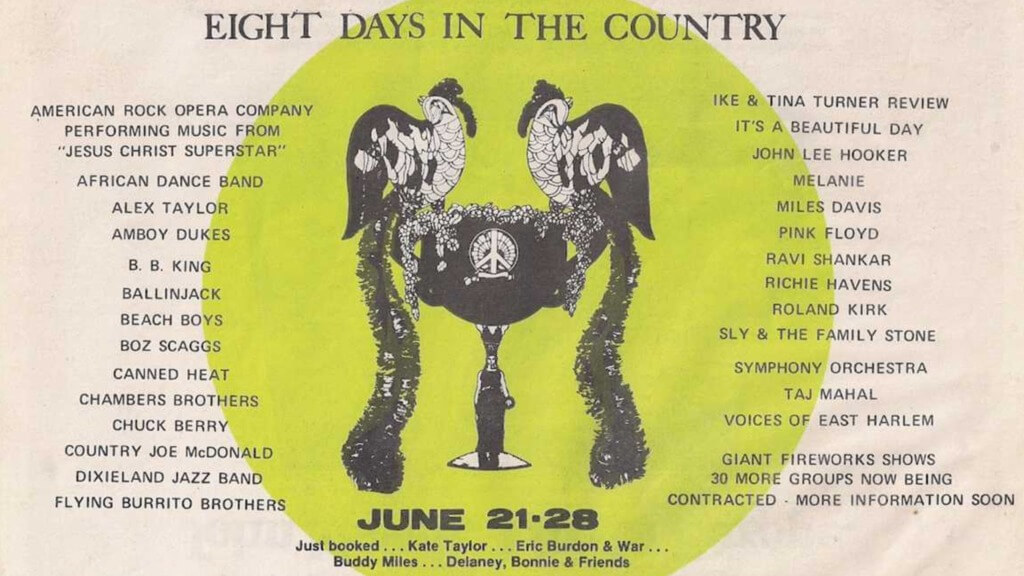
It was supposed to be great. The first major word of the festival came via an ad in a May 1971 issue of Rolling Stone, which billed the event as “eight days in the country.” The lineup was fantastic: B.B. King, Beach Boys, Boz Scaggs, Chuck Berry, Ike and Tina Turner, Miles Davis, Pink Floyd, Sly & The Family Stone, and others, including “30 more groups now being contracted.”
There was a spiritual, worldly angle, too. The ad read: “The spirit of celebration is man: his relationship with nature and his fellow man. A large spiritual center will be established at Celebration of Life. Teachers from all over the world are being invited to participate. A seminar of holy leaders will consider the topic ‘How to raise the level of consciousness in our society.’ Meditation tents, sitar jams, chanting, exercises, and special programs every sunrise will be offered for all who are interested. Let Celebration of Life be a time for you to learn about yourself and your environment.” It was published just a month before the festival was set to begin on June 21, running for eight days. Even at that point, there was still the matter of the venue to sort out.
Initially, it was supposed to take place on an undisclosed island in the Mississippi River. The secrecy was allegedly an attempt to prevent gate-crashers, as Rolling Stone noted in a 1971 report. In early June, organizers zagged and were instead looking at potential venues in Lamar County, Mississippi. The day after that announcement, though, county officials banned the festival from taking place there, despite preliminary construction on two of the sites already underway.
Just four days before the intended June 21 start date, a new 500-acre site was leased, the Cypress Pointe Plantation in McCrea. On the 21st, instead of launching the festival, organizers were in a Baton Rouge courthouse with county officials and a judge for a hearing. They were there to plead their case for the fest, which had not yet been formally approved. As they met, more than thirty thousand people had already descended upon the area, camping out on the side of the road and any other open piece of land they could find.
The big issue was festival ground logistics. The state health department’s bureau of environmental health said it didn’t know enough about the festival organizers’ plans for handling sanitation, water supply, and related matters. The judge said that if the two sides came to an agreement, the festival could proceed. On June 23, health department officials, festival organizers, and the county sheriff inspected the site, and, at 10 a.m., the health department gave its final clearance.
Festivalgoers eagerly rushed the grounds, but not everybody was happy. Walter H. Claiborne, president of the Pointe Coupee Parish Police Jury, released a statement that partly said, “We have great sympathy for the young people who paid to attend this festival. They have been exploited by promoters of a multi-million dollar enterprise which had no site or permit when tickets were sold. No contact was made with this governing body and a fast move was made to McCrea. The almighty dollar prevails. The situation is now out of our jurisdiction.”
It seemed the festival was outside everyone’s jurisdiction. It was madness. A July 1971 report from The Sydney Morning Herald described an event filled with “horror stories of drug overdoses, drownings, food shortages and squalor,” as well as security that “was inexplicably put in the hands of local motor bike gangs, who worked out their personal frustrations by hitting members of the audience with chains and truncheons.” Specifically, there were three Louisiana motorcycle clubs led by the Galloping Gooses of New Orleans. Rolling Stone put the event into even more focus: “Kids were shaken down for money, food and dope, skinnydippers were beaten with chains, the bikers fought among themselves, and finally tussled with the state police as well.”
Dr. William Abruzzi was in charge of the on-site medical facilities. “Kids were walking in here—literally—with their teeth in their hands,” he told Rolling Stone. “The confrontations between the kids and the ‘security forces’—I’ve never seen it before at any festivals. The people were treated in a very, very physical and punitive way. They were threatened with shotguns. They were hit with chains, machetes, and clubs.” He also recounted, “We had the unbelievable situation of the stage prestructures being built without the metal bars being pinned down. The kids were working on them in a storm and down it came. I can’t forget the scene: the rain was coming down and there was a boy with two of the pipes run through him. We had to hold the pipes steady all the way to the hospital at Baton Rouge so they wouldn’t move. You’d think by now I’d be objective about all this. I wasn’t. I cried all the way back.”
As the Celebration of Life festival was unfolding, a TV news reporter on site asked one attendee if they were having a good time, and he responded, “Not really.” As the young man scooped out a watermelon’s insides with a spoon, he clarified, “They can’t get anything together. […] The musicians are really for it, they just can’t get any of the equipment working right. Because of the difficulty with getting this thing going, they didn’t have time to get everything set up. Everybody was here before they knew what was going on.”
There were issues with essentially every element of the festival. The Louisiana summer was dangerously hot; there were food and water shortages, drugs were rampant, and multiple people drowned in the rapidly flowing Atchafalaya River nearby. Rolling Stone also described attendees looting concession stands after vendors had jacked up prices, as well as other similarly unhinged scenes that further paint a hectic picture. Most of the musicians didn’t even make it to the stage. Artists had other performance obligations to tend to and didn’t have time to wait for the unpredictable festival to get into gear. Most of the big acts never played, but the fest still saw performances from Stephen Stills, Chuck Berry, Boz Scaggs, and some others.
There are a few videos of and about the festival on YouTube, and commenters who claim to have attended have mixed memories. (There’s also a documentary, McCrea 1971, that serves as the definitive document of the event.) One user wrote, “We left a day early because the Galloping gooses were taking over the whole event. We left just in time lack of water and food it was complete disaster.” Another said, “The cops grabbed one guy who had given acid-laced oranges to kids there. (What kind of parent brings a child to such an event?!) Anyway, the cops, my dad included, beat him senseless and threw him into the water. Who knows if the guy drowned.”
Even some of those who emerged mostly unscathed and remember having fun still had complaints about their experience. Another user recounted, “4 of us traveled from Chesapeake, Va. We took PB&J sandwiches, food, lots of tapes, and stayed at a state park that had camping right near the festival. Very hot. Sunbathed nude on rafts we took on the river…over 100 degrees as I recall. Boaters pulled over and gave us mint julips. I have great memories of this weekend…except for the heat. Saw a dead cow floating down the river.”
These comments seem to be a fitting summary of the situation: it was an event that was supposed to be grand and even had its moments here and there, but it was overwhelmingly covered by a dark shadow. “Celebration of Life” actually turned out to be a fitting name for the festival, but less for the fun, spiritual awakening that was promised and more like a memorial service after a tragic, unexpected death.
Derrick Rossignol is a writer and editor whose work covering music, video games, and other areas of pop culture has appeared in publications like The A.V. Club, The Boston Globe, CBR, The Guardian, Nintendo Life, and Uproxx.
 Keep scrolling for more great stories.