
Downtown Boys are fighting for everything for everyone
Paste Q&A: Joey La Neve DeFrancesco and Victoria Marie sit down for a long talk about Public Luxury, the communal experience of concert-going, pandemic politics, the role music plays in organizing, fighting for a free Palestine, and finding hope in hopeless times.
Photo by Naomi Yang
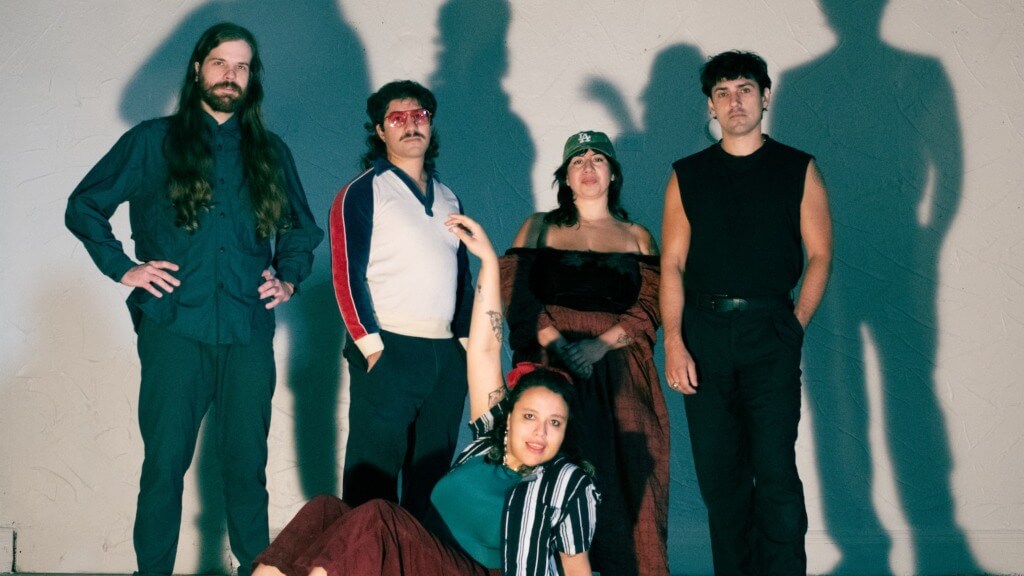
Fourteen years ago, Joey La Neve DeFrancesco marched into the Providence Renaissance, the union-busting hotel he had labored in for the past three years, and declared his resignation—with a full, joyous marching band blaring off behind him (his own marching band, the What Cheer? Brigade). A video of it went viral, amassing nearly 10 million views. But it was never intended as internet bait or a TikTok-esque prank; to quote the YouTube video’s caption: “This is a video about supporting unions and workers’ rights.”
When it comes to activism and organizing, a lot of bands talk the talk, but very few walk the walk quite like Downtown Boys. They’ve always been led by their political ethos, but they’ve been especially busy since their last record, 2017’s Cost of Living: guitarist Joey La Neve DeFrancesco, for instance, founded the Union of Musicians and Allied Workers (UMAW) in 2020, which quickly became one of the most politically and culturally important forces pushing back against the capitalistic, imperialist whims suffocating the music industry.
On Public Luxury, the band slams back into place almost as if it had never stepped away from the limelight—almost, because the world has gotten even worse and worse in the interim, and Downtown Boys have adjusted accordingly. The resulting album is 34 minutes of unbridled (and very deserved) anger translated into sludge and grit and endlessly shredding guitar. And whether it’s 2012 or 2026, there’s still no one who can scream a furious rallying cry better than Victoria Marie—who first knew DeFrancesco as a coworker at the Providence Renaissance and the organizer of the hotel’s union-to-be.
Downtown Boys have heard the siren’s call (to action)—literally, on “Sirena,” a tribute to Marie’s late grandmother and the notion of a siren’s song that pushes you to interface with the horrors of the world—and they’re swimming full-force towards it, never mind the choppy waves that lie ahead. Opener “No Me Jodas” (aka “don’t fuck with me”) rails against our corrupt legal system, “Yellow Sun” is an ode to Lebanon in the face of Israeli occupation, “You’re A Ghost” lambasts the panopticon of the state.
But there’s joy in there, too; a celebration of community and communality, of the people that made you and the people that will come after, of the power that can be found in a group of people dedicated to the same cause, sharing the same heart. Marie shouts on “Viva La Rosa”: “Todavia creo un future / Todavia veo nuestros muertos.” I still believe in a future / I still see our dead. Downtown Boys know that grief and hope are not opposites but instruments, twin tools that, handled with skill, become the engines of our refusal—both the reason we fight and the weapons we fight with.
Last month, I hopped on a Zoom call with DeFrancesco and Marie to talk about Public Luxury, the communal experience of concert-going, pandemic politics, the role music plays in organizing, fighting for a free Palestine, and finding hope in hopeless times.
Paste Magazine: Downtown Boys has always been so inextricably tied to politics and organizing. I’m curious, even before the band began, what was the relationship between music and politics for both of you? Was your initial interest in music itself also tied to organizing? If not, what drove you to create music?
Victoria Marie: They really were inextricable—the way I got involved in music was literally through organizing.
Joey La Neve DeFrancesco: Yeah, they’ve definitely always been linked. I used to play in this, like, brass street-band protest-band thing before Downtown Boys, and a lot of the goal there was maximalism and emotional intensity and really trying to make the audience feel and engage with you. That’s always been what I’ve strived for since.
Marie: But going back to the very beginning, music was always really special for me. My grandma was illiterate, but she literally learned English from music. You could speak to her in either Spanish or English; she was completely 100% fluent, yet she didn’t read or write. But growing up, I really wasn’t in a scene or anything like that. In high school, I was definitely one of those kids that was really overprotected. [laughs] Then I went to college in New York and I really loved it, finally getting to be in a music scene—but the recession hit when I was a senior, and it was so bad. I remember going to Wall Street with my friends to buy used espresso machines and computers from all the places that were closing. I didn’t even try to get a job in New York after graduation; I knew I wouldn’t be able to.
So I ended up moving to Providence in 2010 right after college. The cost of living there was so low, so much lower than it is now—probably, in part, because of the recession. I rented a beautiful house there for, like, $300 and got a job at the hotel that Joey was working at. He was already organizing, doing a public union effort there. And when I got involved in that, I fell so in love with the punk scene in Providence. There were still a lot of DIY shows and DIY venues at that time. It felt like the beginning of a new era for me.
At that point, Joey had just started Downtown Boys, and I had seen a few shows of theirs and found them just really inspiring, already singing about such political things. So then one morning I texted Joey and asked if he could help me join a band—which, in retrospect, is such a crazy, selfish thing to ask! That’s how naive I was to the whole thing. But he was like, “Yeah, you should just be in this one.”
DeFrancesco: That’s not a selfish question! That’s a great question. That’s how everyone joins bands.
Victoria, how’d you acclimate to being the vocalist of a punk band? It’s got to take a toll on the vocal cords, I’m sure.
Marie: You know, right now I have asthma. [laughs] But there was a really cool punk hardcore band called Whore Paint, and the singer in that band, Reba [Mitchell], gave me lessons pretty early on. It’s a lot of just, like, repair, you know? Trying not to scream and yell after you sing, doing vocal exercises and humming.
Recording Public Luxury, we did want to get closer to a live sound, so Seth Manchester had this idea to do these longer vocal takes. There’s not very many vocal punches. Some of the takes you’re hearing, I only did once or twice. I would blow out my voice, repair it, and then it would still be warm, and we’d do these long takes until I burnt out again and then repaired it again. But no, I remember hearing early on, like, “Oh, hardcore singers can only do it for a few years before they totally kind of combust.”
And you’ve been doing it for fourteen years.
Marie: Exactly. Maybe it helps that I’m just always talking. I just talk all the time. [laughs]
You’ve got to keep the voice warm! But speaking of Public Luxury, it’s obviously your first record since 2017’s Cost of Living. What made now the right time for a follow-up?
DeFrancesco: I think it just took a while, with COVID and everything. We toured nonstop for a couple of years on that last one, plus we’ve all had day jobs the entire duration of this band, and we’re also always busy with organizing. So after a couple of years of touring on that last record really hard, we were already planning on taking a break. Then COVID happened and really shut down everything. We never really stopped playing music, though: we played shows, did the soundtrack for a movie called Miss Marx, all that. But we started getting more serious about writing new songs in, like, 2023, 2024; it took a bit to kick things in gear again.
I think “Sirena” was the first song to take shape; I remember writing the music for it while listening to the band Fucked Up a lot and taking inspiration from that. Then some of the more electronic stuff came after a phase of listening to a lot of digital hardcore and industrial music—Atari Teenage Riots and Nine Inch Nails and Coil—and wanting to find ways to incorporate that. And, of course, once we found out we were working with Seth Manchester—who has worked on a lot of records we’re super into, like the Model/Actriz and the Lambrini Girls records; the Mdou Moctar records, which I’ve listened to pretty obsessively over the last five years—that definitely had an impact on the sound we were going for and a lot of the elements in the process.
But yeah, when we decided to do the album, things sped up quickly. It’s kind of like having a deadline, because once you realize you’re actually making a record, the songwriting rapidly accelerates, and you’re like “shit, shit shit.” [laughs] I think “Enemy Without” was the last written song; that was like a month before we recorded because we felt we needed one more song there; we needed ten songs. Ironically, it ended up being eleven because we put something at the end there—the title track, actually. It was a piano idea I had, like, two apartments ago, and we brought it back for the album.
Victoria, you said earlier that Public Luxury was designed to recreate the feeling of live shows. How do you guys try to translate the communal experience of a concert into such a different medium—one where, obviously, people will be listening to it alone in a room?
DeFrancesco: That’s a really good question. At a live show, I think part of the way you get to the communal feeling is making the show space a bit disorienting in a positive sense—something different from the outside world, so it feels like you’ve created this special space and special moment together. We try to make that happen sonically by combining chaotic elements in unusual ways: saxophones and synthesizers and multiple voices going on at the same time. Victoria often involves the audience in singing, too. That’s hard to recreate on the recording. So it’s really that depth of sound that we’re trying to go for on this record, especially in how we mixed it. It’s wider and deeper than anything we’ve done before. The drums are much more present and bigger in the mix. We’re playing with vocal effects more than ever before. We have more synthesizers, more sub-bass stuff going on, more saxophones—like on the intro to “No Me Jodas,” for example. So hopefully the overall effect captures some of the catharsis and emotion and energy of that live experience even in the recording.
You mentioned catharsis just now—what role does catharsis play in music for you? Is it the goal, a byproduct, something else entirely?
DeFrancesco: Also a very good question. Yeah, I mean, I think it’s not, like, a goal, you know? I think it would be very difficult to write something where that’s the goal.
“Everyone feel a release, right now!”
DeFrancesco: [laughs] Yeah, exactly. “I’m gonna need you to all get really emotional right now.” But it’s true that nonchalance is “in” right now, and that transfers to music. I feel like every music video I see of some new viral band is just totally flat—dead expressions and mumbling and all of this stuff. Obviously, that’s very much not what we do. Emotional intensity has explicitly been something we’ve done as a band from the beginning. That’s the Providence influence coming out, I think. But as we’ve developed as a band, the songwriting’s developed too. We’ve tried to keep some of that raw noise rock energy from playing those basement shows in Providence, but we’ve also learned more about how to compose—and how to write lyrics as well, as the words themselves have always been really important for getting to that emotional place.
So what is your typical songwriting process, then?
Marie: I have a bunch of different approaches, but on Public Luxury, Joey wrote the music, and then I sent him various documents of just, like, different lyric ideas in English and Spanish. I think the lyrics of mine that ended up being chosen for Public Luxury ended up being mostly in Spanish, while Joey wrote a lot of the English lyrics. Mine were all definitely influenced by my grandma and a lot of Mexican ballad songs. She was really sick over the past few years, and I was spending a significant amount of any sort of non-paid work time traveling to go see her, so I got to listen to all her music and just hear her speak—she always spoke very poetically.
DeFrancesco: For me, a lot of the songwriting process for me happens over a longer time span. With a song like “Enemy Without,” that one started with the words more, and then we added music to it. Sometimes it’s more of a collage process with the poetry, with melodies—“Yellow Sun” was taken from some of my own lyrics and then also pieces of poems by Etel Adnan, all put together over a year or something.
Marie: We’ve also been influenced by a lot of writing about war and the genocide in Palestine right now. “Enemy Without” was greatly influenced by the writing of Leila Khaled. Viva La Rosa” is influenced by Pablo Neruda. I feel like we’ve brought in a lot of these teachings that we’ve been able to collect, and I think that’s really special—especially because we often get pinned as sort of this, like, political punk band, and people think we’re just going to like go up there and be like, “Fuck the police! Fuck the police!” And like, yeah, that’s always the message. But there are ways to say that, to give context for why we have a critique and an analysis of the status quo.
I think that’s very true. A lot of the time political bands are kind of pigeonholed into this strange little box of sloganism, even though actual songs are being written. Otherwise they’d just be protest chants.
Marie: Yeah, exactly. I feel like we specifically also tend to get boxed into a certain identity because our songs are bilingual. So much of the American population doesn’t speak English—or, more specifically, does speak Spanish as their first language—but non-citizens are treated so brokenly in our country, and that’s part of the reason why. But Sub Pop has done a really great job with that—making sure that the lyrics, if you ask the publicists for them, will be translated too. They’ve been doing videos for us where they’ll do it in both English and Spanish. I think it’s really political to do that, to have that kind of language access.
And at live shows, you can really see the impact of that. We got to play in Mexico on one of our more recent tours, and hearing people sing “a wall is a wall”—“wall” is such a hard word to actually pronounce in Spanish—was just incredible. We have this other song called “100% Inheritance Tax,” and we always try to get people to sing the “one-zero-zero” part. I would always try to sing it as “uno-cero-cero” when we played in Spanish places, but everyone just wanted to do it as “one-zero-zero” instead. And then “Somos Chules (No Somos Pendejas),” people love singing that in Spanish. It’s really special.
DeFrancesco: Yeah. I don’t know how common an experience this is, but I definitely picture a song working live when I’m writing—that’s what makes me get excited about something that I’m working on. It’s part of our songwriting process, too; seeing what works and what doesn’t. That was also some of the difficulty during COVID, where it was like “Okay, are we just never playing live music again? What’s the point in doing any of this anymore?”
For sure. I feel like the pandemic had such a huge impact not only on the music space but also on, like, live, in-person interaction. We, as a society, don’t really engage the way we used to—with art, with other people, with whatever we’re experiencing in the moment. Coming back from lockdown, have you noticed any changes in your audiences or in your live shows?
Marie: Definitely. One of the shorter tours we did recently, we got to play in Charlottesville, Virginia, and it took me back to pre-COVID days: that sheer energy you had to build, the way people had to get close to each other, the fact that everyone was there because they heard of your music through a random way and not just because there was some cool promoter in town or whatever.
New York itself feels different now, though. Like, is it even a 24/7 city anymore? And any time I hear about a show now that’s under $20, I buy a ticket immediately because shows are just so expensive. We’re losing a lot of music spaces, and a lot of that is capitalism. UMAW and other people have done such a good job organizing against LiveNation and these big conglomerates that are taking over a lot of the music space, but it’s such an uphill battle.
DeFrancesco: The music industry is so monopolized right now; it’s gotten more and more so every year, and that’s been made very evident for us by the process of putting out this record. The difference from Cost of Living ten years ago is stark: how much more important algorithms are; the fewer number of journalists and websites and venues and local bands… It’s all very grim.
Marie: During and after the pandemic, so many musicians were fighting to just stay a band, to keep it going. So much organizing came out of that. Bandcamp Fridays came out of the pandemic. UMAW [United Musicians and Allied Workers] was created literally because we suddenly had the time to, like, be on a lot of Zooms. Culture and art always push holes of light through the walls that get put down in human history, and I think we saw that there.
It’s interesting that the pandemic, weirdly enough, facilitated organizing in some ways; I’ve always thought of it as an inhibitor more than anything else, since in-person interaction was cut off entirely.
DeFrancesco: I mean, when COVID hit, all artists were suddenly out of work. We all had more time. I also, at that point, lost my other day job, so I really had more time. I know some people were really musically productive during COVID, but for me, it was difficult to do anything other than organize and respond to the crisis. So I and a lot of angry artists just started meeting online, talking about things that could be done. It was a bunch of us who had done previous organizing in music before: we won against SXSW in 2017 when we urged them to stop threatening to deport foreign artists at the fest, and I think that proved that artists acting as a collective can do something—that you can get these real victories over these seemingly all-powerful corporations.
The principle from the beginning with UMAW was always to expand political possibilities for musicians and our collective power as artists. With UMAW, the first effort was to add artists to this kind of mass of freelance workers who were demanding unemployment benefits during COVID, and then it morphed into also doing these campaigns against Spotify, doing a bunch of BDS work, the No Warmongers at South by Southwest campaign. There’s a new campaign about merch cuts that’s about to come out—the whole pay-to-play at venues thing is one of the worst practices at the more exploitative places. UMAW has also been, I think, the first time a lot of artists have really gotten involved in organizing, which is very meaningful. Musicians are typically not the sort of people who organize. It’s a lot to do that while also touring and putting out records. But tens of thousands of artists are acting collectively to try to push against all of this. We’ve haven’t seen that since, like, the American Federation of Musicians strikes in the 1940s. And so much of it has been in solidarity with Palestine, too; not since the anti-apartheid fights in South Africa in the eighties have we seen artists come together for an international cause in such a powerful way.
I know, Victoria, you’ve had a rough few years after that out-of-context video of you tearing down posters that Zionist agitators put up in the middle of a vigil for Palestine went viral. What has it been like continuing to organize and make music in the wake of that?
Marie: Well, I was really appreciative to everybody who saw what actually was happening, which is what you just said. As I’ve said publicly, it was a vigil where we were literally reading the names of children who had been bombed, and there was a group of hecklers putting up these things with just historically inaccurate information.
I think the worst part is that, even now, nothing’s changed. It’s been pretty devastating to see how the message for people’s freedom and for people to not have to live under genocide has been thwarted. The rise in Islamophobia, the rise in anti-Palestine rhetoric and actions, the rise in antisemitism; AIPAC just thwarting anything and everything to continue their project; the events on college campuses… We’re already dealing with the consolidation of journalism and information in the media, so to then see the universities—the only things in the United States that, at one point, were maybe spaces that were beacons for protests, for student movements against war and fascism—to see them overtaken by corporate and AIPAC interests has been gutting. All the while, we continue to see a genocide either streamed on our phones or, for some people, directly into phone calls with their family or text messages. All that to say, it only made me feel so much love and passion and determination for there to be a free Palestine and for my country to pull out of acts of war, aggression, and genocide.
I do have hope, though. I mean, with the attacks on civil liberties and the attacks on the humanities, it’s pretty crazy that we get to do an interview like this at all—that the Strokes can go onstage at Coachella and say to stop bombing Iran and stop bombing Lebanon and stop bombing Palestine. Last time we had the pleasure of getting to talk to journalists, nine years ago, it felt like we had to explain, like, why to be political. Now that’s never in question. People literally see ICE in their communities, see them driving around. The urgency is so intense. And the people at the top are using their platforms, so getting to be a musician right now—which is absolutely a privilege—means we have to use any baby platform that we might have to speak out.
DeFrancesco: And it’s a ripple effect all over the world, right? Bands Boycott Barclays, the ongoing boycotts of Superstruct, the No Music for Genocide movement. There’s so many examples right now, to the point where it can kind of seem like it’s just always been there, but it hasn’t, at least not to that scale.
Marie: Outside of music, too. The intergenerational organizing being done with socialism in America right now hasn’t happened before in my lifetime. The son of Mahmood Mamdani is the mayor of New York. There are congressional candidates who were artists, who had low-wage jobs; there are women of color running for Congress on “Abolish ICE, free Palestine.” I don’t know. Like, I don’t believe a lot in electoral politics because I have been so damned by it. But that stuff is so hopeful.
And most importantly, people are hitting the ground. When Renee Nicole Good was shot, I came downtown in New York, and there were just so many people. When people were getting abducted from the immigration building in downtown Manhattan from 26 Federal Plaza, I saw so many people going into the building to be shields, to put their bodies on the line for people. That’s what will change the world, more than anything.
To know that music—and specifically punk culture—is a part of that, too, after having such a long history of wanting to be, is exciting. It’s amazing that there is still live music, that we get to be a band that will get to say messages of support to the people’s movement. And to have the support of a label behind that is incredible. Our “No Me Jodas” video was very much around this, like, proletariat-meets-punk-meets-party-meets-memoriam message, and Sub Pop was very supportive. Our music videos for “Ghost” and “Yellow Sun” were both designed by Lebanese artists—Khalil and Romy Matar, respectively. And “Sirena” was created by Sarah Elawad, who has done so much for bringing messages on the meaning of diaspora and for women of color into these beautiful moments for culture. We couldn’t do any of this if Sub Pop wasn’t helping. I hope that more people put themselves out there to do these kinds of collaborations and support artists, because that’s what’s going to help us actually win public luxury one day, especially in art and culture.
DeFrancesco: That’s what the album title is about, really. The refrain “public works, public luxury” on the last two songs of the record is, like, the theme for us of being able to produce a record right now at all. There’s a focus throughout our discography on fully recognizing the horrors in the world and particularly the horrors of the last three years, but still insisting—even when you feel extremely nihilistic and hopeless—on fighting and resisting and believing there can be something created out of our political project. So in my imagination, the “public works” part is the insistence and acknowledgement of the responsibility to keep fighting, particularly if you’re a person in this country facing the deep complicity of our government in Israel’s genocide and Palestine, in horrors around the world—we have a responsibility to keep resisting and keep fighting. So “public luxury,” for me, is the act of still believing in that better world, still believing in everything for everyone at the end of it.
Public Luxury is out now on Sub Pop.
Casey Epstein-Gross is Associate Editor at Paste and is based in New York City. Follow her on X (@epsteingross) or email her at [email protected].
 Keep scrolling for more great stories.