
Could concert-based social media be the next big thing in live music?
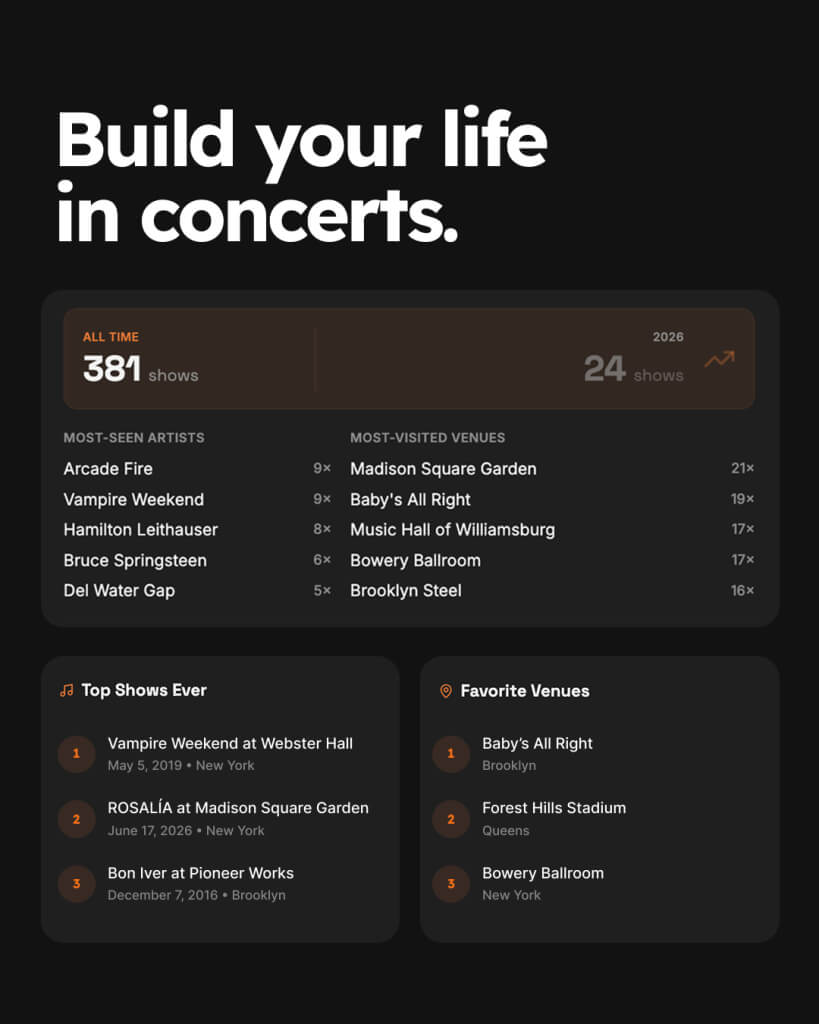
Adam Offitzer has just launched Encore: a social cataloging site where users can log live shows they’ve attended, share their favorite artists and venues, discover upcoming shows in their area, and link to related writing, photos, and videos.
Photos courtesy of Encore
I would consider myself someone who sees a lot of live music. I average about six shows a month, which, to my friends who regularly go to that many in a single week, probably doesn’t seem like much. At the beginning of this year, I started keeping a spreadsheet of every live show I attended, documenting the date, venue, and lineup of each one, as well as any notes I might have from it (the notes section of the YHWH Nailgun show I attended last month at a German beer hall in Ridgewood that was also showing Game 4 of the NBA Championship simply reads: “KNICKS IN FIVE”). I know a lot of music fans who also keep running lists of every show they attend. So much of my socializing with other music-minded friends takes the form of an informal live-show roundtable, whether that’s in the replies to a clip from one of our Instagram stories, in a group chat, or gathered on the sidewalk outside the concert venue itself.
Marketer and writer Adam Offitzer is one of these music-minded people. Offitzer spent his high school and college years writing for the now-defunct music blog Pretty Much Amazing. He majored in journalism at the University of Maryland with hopes of being a music writer but ended up going the marketing route, doing b2b digital content strategy for CodeWord and later Spotify, where he worked until 2022. He’s a self-professed music nerd who proposed to his wife at the beloved Brooklyn concert venue Baby’s All Right (“They let me use the main room on a Sunday morning,” he tells me. “I’m eternally grateful to them for that.”). He’s kept a Google Doc of a decade’s worth of shows he’s been to. That document would turn out to be the precursor to Offitzer’s years-in-the-making passion project: a brand new social media platform for live music enthusiasts. He’s just launched Encore, a social cataloging site where users can log live shows they’ve attended, share their favorite artists and venues, discover upcoming shows in their area, and link to related writing, photos, and videos.
“Letterboxd for concerts” is a succinct and convenient elevator pitch for Encore, but Offitzer also envisions the platform functioning similarly to Wikipedia or IMDB. When Offitzer and I meet up to discuss this endeavor, he says that he envisions Encore and the “nu-internet” as a whole as being “closer to the Wikipedias, the Reddits, the Blueskys of the world, even the pre-Elon Twitters of the world, which I do think was kind of a beautiful place.” New York-based NME features editor Erica Campbell echoes this sentiment when I ask about her experiences on the beta version of the platform, saying that “having a social platform where I can see who shares my taste in music and has attended the same shows feels a bit like Tumblr, or maybe even Twitter before Elon ruined it.”
None of these platforms are perfect, but there is a distinct sense of curation and intentionality missing from the current-day social media landscape. Streaming platforms like Spotify offer the mere illusion of music discovery. X (formerly Twitter) buries external links and clogs your feed with ads and AI slop. The search and tagging functions on X, TikTok, and Instagram are imprecise and not conducive to a tailored, community-oriented online experience. These platforms often feel wholly detached from the outside world.
The internet of the late-2010s and 2020s has become more algorithmically jumbled and less nurturing to subcultures that once thrived online. “Bon Iver played this awesome Forest Hills stadium show,” Offitzer says. “But the next day, what do you do if you want to relive that show? You can go to Setlist FM and see what he played and make a playlist of the setlist; that’s kind of your limit there. You can go to Instagram or TikTok and search ‘Bon Iver Forest Hills,’ but it’s kind of hard to navigate to the most recent posts tagged ‘@ Forest Hills’ and hope people have it public; it’s not super intuitive to get there.” Especially with his points about TikTok and Instagram, Offitzer is articulating something that most dominant social media platforms lack: a built-in designated purpose beyond the vague umbrella act of “posting.” With a site like Encore, there’s an immediate common ground or theme that unites users.
It’s just as easy to log and search for a punk show in a tiny DIY venue as it is to do the same for a massive stadium concert. Offitzer says that Phoebe Bridgers’ Madison Square Garden show has “the best page on Encore right now”; it’s a photo-free blogroll-type collection of writing done about the show, most of it from memory (or illegally smuggled pens and paper). “I think a phone-free tour is awesome, I hope more artists do it,” he says. “That makes a site like Encore even more valuable. There doesn’t need to be photos or videos from it.” Concert photos and videos are welcome on Encore, and if and when professional video footage from the phoneless Phoebe Bridgers tour gets released, Offitzer plans to pin it to the tour’s corresponding show pages, but as of now, the Phoebe Bridgers MSG concert page embodies one of the most magical parts of the phone-free show: trying to piece together a collective memory of the experience through shared post-show thoughts from friends (or, if you’re a chronic eavesdropper like me, complete strangers).
Encore also offers a way to stay tapped into shows and scenes from afar. I’ve shared the platform’s invite links with long-distance friends, including ones who live in places where I once lived, and seeing them log shows at my old haunts makes me feel just a little bit more in touch with the people and places that I love. There’s also the added bonus of exposure to regional scenes and artists that might not otherwise be on the radar of non-locals, and the opportunity to follow the story of a specific tour through other people’s recounting of it.
“I was so excited for Rosalía at MSG and I was curious what people thought of her show, where the orchestra was positioned so I could know where I should try to get my seats at MSG,” says Offitzer. It’s one of many times he brings up this Rosalía show during our conversation (I can’t blame him, her tour looks incredible). “She was touring Europe, and I didn’t know the places to go for coverage, so I was mostly following it through her Reddit page. But how cool would it be to have those dispatches that are now living on anonymous accounts on Reddit coming into Europe and outside-of-the-US Encore pages?”
Offitzer explains that his vision is for Encore to embody “the spirit of peer review,” inspired by the annotated entries on Wikipedia, Genius, and Setlist FM (if a show has an official concert setlist available on Setlist FM, a link to it will be featured at the top of its Encore show page). The goal is for each of these show pages to be a collective living document/message board. One way Offitzer has already done this is by designing the site with an emphasis on curation, critique, and tastemaking.
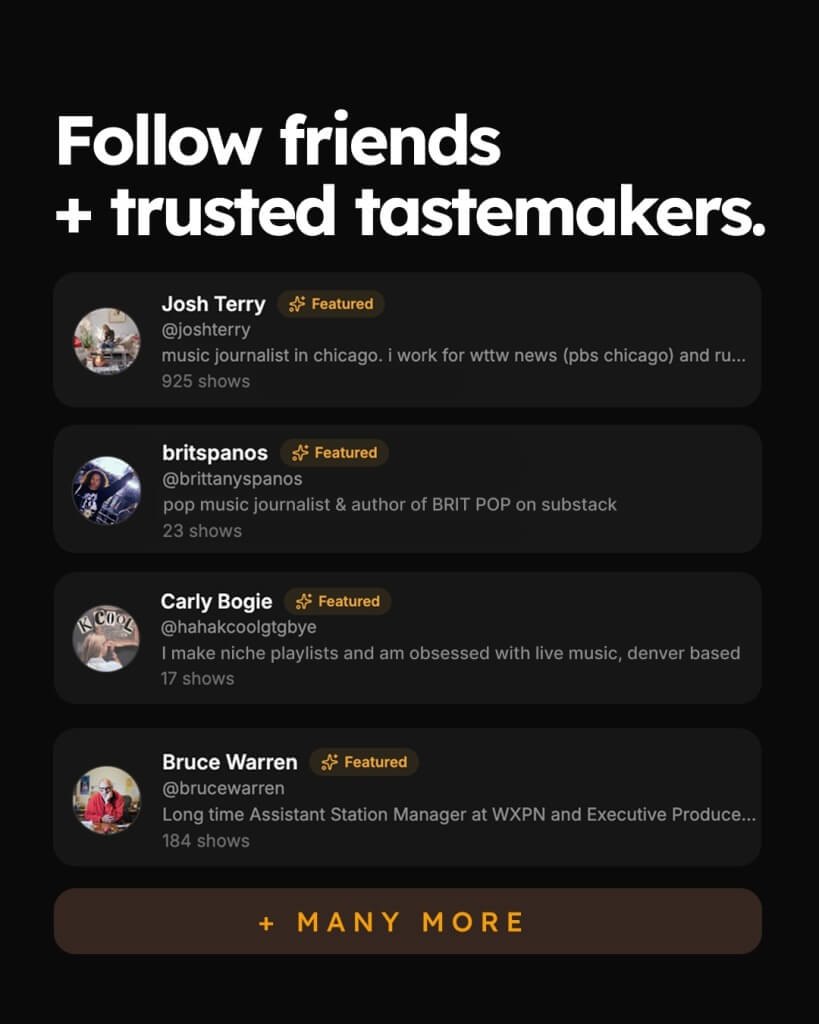
“It’s becoming, like, a clichéd VC tech bro thing to be like, ‘Taste matters! Taste is important!’” Offitzer jokes. But when he talks about the role taste plays in how Encore functions, it doesn’t feel commodified, and it doesn’t smack of the superficial “taste peacocking” that Slayyyter recently criticized. In this context, taste has more to do with curiosity and intention. Offitzer, an avid reader of music writing, invited some of his favorite music writers (including, in the spirit of transparency, yours truly) to the beta version of Encore, and has chosen to feature their profiles and work, as well as that of certain concert photographers and poster artists. When logging a show on your profile—or, as it’s called on Encore, your “diary”—there’s an option to link to related documentation, such as scene reports or photo albums.
“The secret sauce of Encore will be tastemakers, both associated with the clout and reputation of a publication or independent, maybe names who we haven’t heard of yet,” Offitzer says, making the platform beneficial to up-and-coming artists and writers. The featured links section on the Encore show page might lead you to the work of a staff writer at a major music publication, but it might also put you on to the talents of those at a local radio station or college newspaper that you wouldn’t have otherwise discovered.
Offitzer mentions Letterboxd again, saying that although he follows many of his favorite film critics on the platform, it took some digging to find their profiles, and that there’s no designated verification system or “prime real estate” for professionals. Encore has verified artist and venue pages that feature links to newsletters and upcoming show dates, as well as a set of “featured” music critics, journalists, and photographers. “I want to imitate Letterboxd in a lot of ways, but one way I want to iterate on what they’ve done is by giving these writers and journalists and tastemakers some prominence and still let other people organically elevate by writing great reviews.”
It feels like a rare instance of symbiosis between the world of music criticism and the comment section-as-entire-internet, at a time when the two often seem at odds. Streaming has made the “try it before you buy it” aspect of review-based journalism in film and music all but obsolete, and the internet is structured in ways that favor grabby, short-form “takes” over less-democratized, usually more deeply engaged analysis.
When Pitchfork announced that they would be adding a comments section for the first time in their 30-year history, as well as allowing users to vote on scores and displaying an aggregated “user score” alongside the canonical one, many feared it would undercut both the website and the individual critic’s authority. It hasn’t been quite as disastrous as people feared—as with almost every established music publication with a comments section, the brand recognition and legacy are strong enough to withstand a spirited public forum. And, at the end of the day, it’s one person’s name, score, and words that appear on the page before anything else.
Encore splits the difference, fashioning itself as a digital town square where the featured writers are its town criers, but anyone who feels moved to speak is free to do so. Each show page is meant to be not a means to an end, but a jumping-off point for further reading. Much like its inspirations in Reddit, IMDB, and Wikipedia, it encourages research and rabbit holes.
Offitzer wants the platform to be by and for people who are passionate about live music. Right now it’s a passion project with very few hands in the pot, but his first hire is Khadija “Deej” Aslam, an engineer who plays in the band Sledding. Aslam recently built a platform called Backline NYC, on which musicians can find and offer equipment and services—for example, a band can post about needing to borrow an amp, and someone can offer themselves as a live sound engineer or a session player. Offitzer met Aslam through the New York music scene and liked the idea of employing someone who knew the industry firsthand from a variety of vantage points.
My Encore research leads me to a similar platform that is still in its beta stage. While talking about Encore with Chicago-based writer Josh Terry, who works as a newsletter producer for WTTW News and runs the Substack No Expectations, he puts me onto Song Beacon, the brainchild of Fire Talk Records founder Trevor Peterson.
During our phone call, Peterson describes Song Beacon as “a new way to discover, rate, and review shows” that prioritizes independent artists and labels—a perspective informed by his experience as the head of one such label. He sees Song Beacon as a means of making fans, artists, and music industry workers less reliant on algorithms. While Encore is more similar to Letterboxd or Goodreads, Song Beacon shares more in common with a platform like Dice, Bandsintown, or OhMyRockness, but with an added social element. The two sites are similar in their broader mission of creating a non-algorithmic, live music-based social media platform that benefits both performers and audiences, and the primary divide in emphasis comes down to the before-and-after of the shows themselves. “At its core it’s a concert discovery app,” says Peterson. “You have to be able to find the shows before you can rate and review them.” At the moment, Song Beacon is based solely in New York, but Peterson hopes to gradually expand its reach one city at a time, letting user input inform its rollout. “Right now it’s more about just seeing if people can find this useful and being open to feedback,” Peterson explains.
There’s clearly demand for platforms like these. Brittany Spanos, a New York-based former Rolling Stone staff writer who now runs a music newsletter called BRIT POP, tells me that she attends “nearly 100 shows a year” and has been waiting for “a more streamlined way to log what I’ve seen.” She likes having a living digital document of the shows she’s been to and a place to share that with her friends: “It’s been a great reminder of my favorite live music memories as well as a fresh way to discover what to catch next.”
There’s one thing that differentiates these platforms from other social cataloging sites: the very form they’re documenting. You can read a book alone at home. You can watch a film alone in your house. You can listen to an album alone at home. Live music is, by definition, social. Even if you’re attending a concert by yourself, you’re still required to interact with the showgoing public, and because of this, Encore is necessarily social in a way that other review-based social media platforms aren’t. It’s a digital community hub that cannot exist without its non-digital, in-person counterpart. The platform itself is not a means to an end. When I think about my own online upbringing as a music-hungry teen poring over sites like Tumblr, Bandcamp, 8tracks, and OhMyRockness, I sometimes find myself believing that that was the last era in which online subcultures were still tethered to something social and tangible. These new live music platforms just might prove me wrong.
Grace Robins-Somerville is a writer from Brooklyn. Her work has appeared in Pitchfork, Stereogum, The Alternative, ANTICS, Marvin, Swim Into The Sound, and her “mostly about music” newsletter, Our Band Could Be Your Wife.
 Keep scrolling for more great stories.