
IAN SWEET is taking her blinders off
Paste Q&A: After a decade of tunnel vision, Jilian Medford discusses the self-reckoning at the center of Shiverstruck, finding happiness as a quote-unquote “sad girl,” and learning to trust her own voice.
Photo by Wrenne Evans
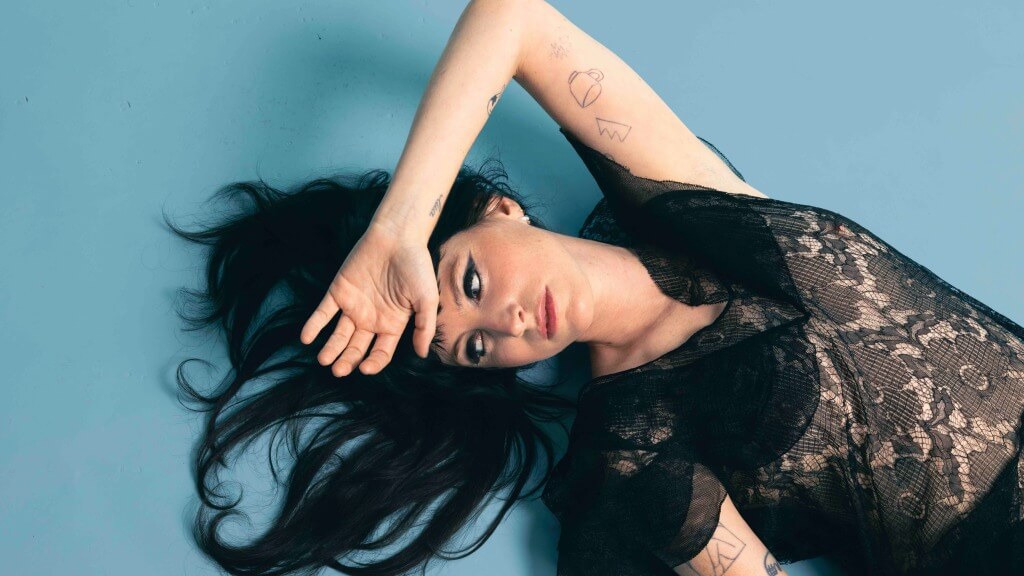
When Jilian Medford—or, as listeners might know her, IAN SWEET—slides into the booth across from me, she’s absolutely buzzing. She bumped into a friend on the way here, it’s 78°F without a cloud in the sky, the Knicks just won the NBA finals, a dog named Larry has padded across the bench to nose at her lap, and her latest album Shiverstruck is just a month out from release; the world is, at times, a beautiful place. We’re outside at Dimes on the Lower East Side for a late lunch (egg tacos with mango salsa for her, a breakfast sandwich for me), commiserating about our mutually formative experiences at the kind of college-run teen summer programs that inevitably end up defined not by educational merit but unfettered nerd horniness. She’s in the city for the first time since unexpectedly moving back to L.A. six months prior, and is trying to fit as much as humanly possible into a single week: a friend’s wedding, a photoshoot, multiple interviews, and innumerable catch-ups.
“There’s nowhere like New York,” she gushes, cackling as she tells me about an incident she witnessed the day before. “I saw this lady crying, like softly crying, on the street, and then this guy in a suit holding flowers—for his wife or something—came up to her. He didn’t know her, but he was clearly trying to make her feel better, so he offered her the flowers. And she slapped them right out of his hand. God. New York is such a special place.”
Talking to Medford feels like talking to an old friend: she’s warm and affable, always laughing and leaning closer and hammering words in for emphasis. She eagerly whips out her phone to show me photos of her dog, Blueberry (“He’s a Jack Russell Chihuahua mix and he’s my whooooole world. I’m obsessed with him. He’s like a little man!”) or share the half-formed thoughts making up her Notes app: an incomplete Letterboxd top four (some combination of The Wedding Singer, Ratatouille, Kiki’s Delivery Service, In the Mood for Love, and Night on Earth), a vow to perform Keane’s “Somewhere Only We Know” next time she does karaoke, a made-up emoji tipping a fedora as if to say “m’lady.”
You wouldn’t know it from meeting Jilian Medford, but IAN SWEET has spent a decade being filed under “sad girl.” Look up “sad girl music” on Spotify and chances are you’ll find playlists decked out with “#23,” “Dumb Driver,” “Drink the Lake”; you name it. Her 2023 record Sucker was dubbed “an album of glorious sad girl synth pop.” Medford never protested much. The sad girl is a useful costume: it comes with interiority built in, the implication that whoever’s wearing it has been somewhere the rest of us haven’t. Sorrow reads as substance. The trouble is that the label tends to fuse to the skin. If unhappiness is what people show up for, a good day starts to feel like a betrayal of the brand—or worse, like evidence you’ve stopped being interesting.
But while being a “sad girl” might be enough for a persona, it’s not for a person. Medford’s spent the last three years and change investigating the blurry line between IAN and Jilian, and Shiverstruck is the conclusion drawn. She started writing it at the top of 2025 and cut it in Atlanta with producer Ben Allen last June, in a heat so thick she and Blueberry mostly commuted the ten minutes between Airbnb and studio and stayed put. What she didn’t know at the time was that she was writing her way out of a relationship. There’s no breakup song on the record, no smoking gun; just, as she puts it, “little pockets” she can only read in hindsight. By the time the mixes were done, so was the relationship. “In a way, the album sort of manifested the end of it without me noticing,” she says.
Self and relationship she could at least examine on her own terms. The third front—the career, the industry, the machinery around all of it—kept arriving uninvited. Last year, one of her songs was used in a movie trailer without permission or payment, and when she reached out to the production company, they basically told her that she should be “happy for the exposure” and tried to make her sign an NDA. She refused. Around the same time, AI-generated IAN SWEET soundalikes started cropping up on streaming platforms, releasing fake music under her name: “I just woke up one day and it was there. It took Spotify such a long time to even take it down,” she tells me through a bite of taco. “It sounded like a Russian circus jig. That was almost the most offensive part—if you’re going to impersonate me, at least make it sound like me! It was so absurd that it was kind of more funny than anything else, but it’s really disturbing that it’s happening at all. It’s scary, not knowing where your work is going or what’s being done with it.”
This interview has been edited for length and clarity.

Paste Magazine: I know you have a complicated relationship with New York, so what’s it like being back in the city?
IAN SWEET: Well, I’ll always have a fondness for New York. I even lived here right after college. I went to school in Boston to study songwriting and then I moved here right after graduating—and ran away screaming that time. There’s something about this city that feels like you’re surrounded by people constantly, and it’s almost impossible to get that space to just sit with yourself and check in. So I went back to L.A., and then I think I got bored in L.A., so I moved back to New York in 2023. [laughs] I was really pinballing back and forth. And I wasn’t necessarily planning to move back to L.A. when I did go back at the end of last year. I went for Christmas to spend at least a month there to be out of the psycho New York winter and stuff. And then my boyfriend and I broke up. So I was like… “Welllll! I don’t want to go back right now.”
I had started writing Shiverstruck at the beginning of 2025. And in the process of recording and making the album, I looked back on the songs a lot, and realized that maybe I didn’t want to admit that I was struggling in the relationship—much less that I was writing about it. There were just these moments on the album where it made me realize, like, “Oh, I see this now. I put that in there.” These ideas were coming through almost subconsciously. And then as the record was being finished up and the mixing was ending and the album was beginning to find its life in the outside world, I ended up closing the door on the relationship. End of a chapter. It was a tough thing, you know? It wasn’t dramatic or anything; not everything’s, like, “He cheated on you!” It was an interesting place to write from because of that: usually, I’m writing from the perspective of, like, a devastated girl going through a breakup and feeling very [fake sob voice] “I’ll never be okay again,” “I’ll never find love again.”
But sometimes it simply doesn’t work out. I think that can be almost harder to deal with because it’s like… Nothing’s wrong, exactly, so should you fight for it?
That’s so true. It was so, so hard. And I am someone who wants to make things work; I always try as hard as I can. But you have to learn to sometimes just be, like, “It’s okay” and let it go. I think it was through writing the record that I realized those things. Which is really—It’s weird. Sometimes I don’t give songwriting the credit I should. Like, you don’t realize how powerful writing a song really is as a means of processing your emotions.
In part because it’s also your livelihood, I’d imagine.
Right! I think with this one, I really tried to not think at all about what would be the outcome of it. I knew I sort of needed to make a change in the way I approached music. I mean, this is my fifth record. And that’s exciting! But, for my own sake, I needed to find a way to not be so hard on myself about it—to let things come and not be so, like, “Well, this exact lyric isn’t what I want it to be.” Obviously, you know, I still festered over it and nitpicked at it, but I was trying to just let things happen more, let it kind of take on its own identity. You don’t want to put up these walls and boundaries around the songs just because you’re afraid people aren’t going to like them, or because some formula seems to be more successful. You need to do it just for yourself. And I kind of realized, like, I really hadn’t done things for myself in a long time. I think through writing this record, I was like “Okay, I’m going to be intentional about taking care of myself.”
And that is difficult to do! Especially, I’m sure, for someone whose public persona has been based on being a quote-unquote “sad girl” who makes “sad girl music.” If your career feels based on your unhappiness, how do you allow yourself to be happy?
It can be really difficult. There are so many layers to me, and IAN SWEET is just part of that. The person I am with my friends and my people is very different, you know? If you’re listening to the music, you’re like “Oh, she’s going through it.” But I feel like I’m a very bubbly person—I’m just chaotic and messy and crazy and strange. Not put together whatsoever. I’m so Type B that I’m probably more, like, Type Z. And a lot of people don’t know that side of me at all.
I know you’ve had a long history of trying to figure out where the line is between Jilian and IAN. These days, do you know where one starts and the other ends?
I think, for a long time, I was always trying to create a divide between the two of them. Like, if I wasn’t in the headspace to start thinking about IAN SWEET and it crept in, or vice versa, it’d freak me out a bit. I was really set on keeping things separate. I don’t think I need to do that anymore.
I’ve been trying to be less precious about how I present myself, and that’s helped my mindset a lot. My life doesn’t need to be so curated or methodical. Every side of myself deserves to be shown, and that was something I really wanted to do with this album—to showcase, like, all that goes into being me. It’s taken a long time to have love and understanding for all versions of myself, down to the, like, nerdy ass weird ugly fifteen-year-old who was obsessed with Coldplay and wore tutus and ties to school like Avril Lavigne.
As I’ve come into my own and matured—and as IAN SWEET has become more of a solo effort—I’ve learned to trust my own instincts a lot more. I started out playing solo, just at Boston house shows or whatever. But when I started playing with my first bandmates, I didn’t realize it, but I was being sort of molded and manipulated by the drummer and his taste. He was just super into math-rock, so everything kind of became a math-rock song. Like our songs were in ⅞ and crazy time signatures. It was cool, but it wasn’t necessarily my voice.
Yeah, at that age, you can’t even hear your own voice because you don’t know what it sounds like yet, so it’s so easy for it to be overpowered by other people in the room.
One hundred percent. It was a really difficult journey for me, to be honest. But things have definitely changed and calmed down as I’ve grown up. It’s awesome to get older and find your voice and be more confident—to not shy away from telling people no or that things make you uncomfortable. That’s when I feel the most powerful, and also the closest to myself: when I’m being honest.
In some of the press materials, you talked a lot about how the lyricism was much more foregrounded this time around than for previous records. What did that actually look like for you in practice?
Honestly, I just worked and reworked the lyrics and got them to the place I wanted them to be at through weeks and weeks of revision. Months of changes. I listened to the songs probably hundreds of times. I was even reworking the lyrics up until stepping into the booth. Sometimes I even change lyrics live, at shows. I come up with them on the spot. That hasn’t happened yet for Shiverstruck, but I’m sure it will when I go on tour. Or maybe not? I don’t know. Maybe I’ve always changed lyrics live on past records because I’ve never felt comfortable, or I didn’t feel completely like I hit the nail on the head of what I wanted to say. And maybe it says something that, for Shiverstruck, I haven’t felt that yet at all.
I feel like this is the album I’ve taken the most time and consideration with. Although I did write the first song, “La La Love,” in the back of the tour van. I did the most chaotic sample—I couldn’t do a proper one because I was literally in the van, but I found a guitar sample that was the two chords I wanted and made the most bonked demo in the back of the car. I re-recorded the instruments when I got home. But I think the album didn’t really start to come together until I had five or six demos in hand—“La La Love,” “Silver Screen,” “Wild Heart,” “Criminal Kissing.” “Jilian” came more towards the middle, but that was a turning point, too
To be honest, I didn’t want to put “Jilian” on the record at first. I’d never written a song like that before. I’d never tapped into that place of self-reflection. There’s a bit of a cheeky knowingness to it—not like I’m making fun of myself, exactly. The song is just very self-aware about my patterns and behavior and what’s contributing to my feeling unhappy or unsatisfied.
And it can be really hard to acknowledge that the problem is you, y’know? I know I spent most of my high school and college years being like, “Oh, I’m just in the wrong place.” I kept moving to new places, but no matter where I went or how much I thought it would fix me, I just kept feeling the same. You eventually get to a point where you have to come to terms with the fact that you’re searching for something you can’t find because it’s in you, and that’s a hard pill to swallow.
Oh my god, yes! I really relate to this. That’s why I kept moving back and forth between New York and L.A. I think I’ve relied on relationships in order to try to find that as well, so this breakup was like, “I’m not finding that within anyone else. I can’t. I need to find that from within first.” And “Jilian” helped me recognize that. It was really, really healing for me—just to be more aware of my behaviors, to what has contributed to these blips in my life and bouts of depression. Like, you can’t blame it on everyone else. It’s only you, girl. It’s scary to say it out loud, because it feels like if you name it, it becomes true, and everyone can see it. That’s why I was afraid to put the song on the album. But I knew I had to—it tells a story about the record as a whole. It feels almost like a thesis. This record really is the most personal and bare I’ve probably ever been. That’s why I really wanted my voice to be in the forefront.
The album really kicks off that way too, with “987” as the opener.
Yes! I think “987” is kind of adjacent to “Jilian”—like, you’re the one creating the chaos, burning it all down, and you’re still expecting everybody to be there for you and support you and love you unconditionally in the aftermath. But that was actually the absolute dead last song I wrote. I recorded the album in Atlanta, but when I came home, I felt like something was missing, so I just sat down and wrote that. I really wanted something absolutely bare-bones with almost no production, just something that I felt. So I just hit record on my laptop, recorded it into my fucking wired headphones. It was really, really roots. Very much no frills, no nothing. And I do feel that’s something the album has as a whole—like, I don’t feel like there’s a lot of crazy production—but it’s just concentrated really strongly here.
I know that, since those early math-rock band days, you’ve had to work through some trauma around inviting people into that very sacred creative space. What was it like working together with Ben Allen down in Atlanta this time around?
I had the best time ever in Atlanta. Like, I absolutely fell in love with Atlanta and with Ben—and his engineer, who is also named Ben. I don’t think I’d ever gotten out of, like, the normal music pockets; I’ve always recorded in New York or in L.A. or upstate. It really was a beautiful experience. You know, I like collaborating, I do, but I have to really, really trust the people. I’ve been lucky enough over the years to find those people, and to realize when something isn’t the right fit. I mean, I get along with everyone; I really do think that about myself. Every time I meet anyone, I’m like, “We’re going to be friends.” But music is just a very, very, very personal experience. Like, you have to bare your fucking soul. So you need to find the people who want to be on that journey with you—who want to elevate your voice rather than try to change or manipulate it to fit into their own mold. And that’s what I really love about Ben; he’s worked with so many different types of musicians: Lil’ Kim, Animal Collective, Deerhunter, Soccer Mommy, he’s done it all. So he’s not, like, the type of producer that works on one type of genre and makes it sound the way they want it to. He truly does take your vision and bring it to life.
When you’re thinking back to the Jilian of Shapeshifter, how do you think that younger version of yourself would feel if she were to hear this new album?
I definitely don’t think she’d expect that I’d ever be this honest and vulnerable. Like, a lot of the lyrics on Shapeshifter were just sugar-coated, crazy, random shit. And then, you know, the math-rock of it all. [laughs] But I’ve always, always loved strong, textured music and songwriting: Neko Case, Broken Social Scene, PJ Harvey, Sharon Van Etten. The kind of music you feel in your chest. I think I was striving to make that, too, when I was younger. And Shiverstruck feels like that thing I was always trying to make. So yeah, I really do feel like she’d be stoked on it. But I also think it was waiting to come out at the right time—it’s not an album I could’ve made earlier. So much growth had to happen in order for it to even exist. I truly believe every single song has led me to Shiverstruck. I don’t know what I’ll do next, though. I’m having some wild thoughts about music and the music industry these days.
In what way?
I don’t know. I feel a little down about it. Okay, not even a little down; very down. [laughs] I have a complicated relationship with doing music. It’s all I fucking want to do. It’s the only thing that matters to me. But it’s just a difficult career path to have chosen. And it’s only gotten harder as time has gone on—because the more music you put out and the more money you spend and the more time and energy you invest, the more that’s on the line.
Like, when I put out Shapeshifter or any of the early stuff, it was just like “Woo! I’m gonna tour! I’m gonna sleep on floors and practice in vans!” It didn’t matter. That was such a beautiful time, the innocence and excitement of it. I was just astounded that it was happening at all. And I wanted to try to tap into that energy when making Shiverstruck—and now, I want to continue to have that energy when I go on tour.
You can just get really lost in the industry. I know I have at times. It’s not like I feel like I’m on a hamster wheel or anything; I’m lucky to be surrounded by people who give me my time and my space, and aren’t just like “Release an album go go go!” But I can put that pressure on myself a lot. So making this record, I wanted to find why I love doing this again. I didn’t want to put pressure on myself to finish it within a specific time frame. I was like, “I’m not going to step foot in that studio until I’m really happy with it.”
You had a job recently where you played music to children—did seeing how the music resonated with children help reignite the flame for you?
Absolutely. The pure joy that music brings children… It’s really, really a beautiful thing. It’s such a meaningful reminder that the music itself does something beyond all the things we’ve attached to it. Like, even when I’d wake up grumpy in the morning and groan at the thought of having to put on a smile and sing tunes to babies—even just the act of forcing yourself to do that, you end up naturally becoming it. So I’m taking on that energy of trying to embrace that, even if it’s a struggle. I really want to be more present.
Same. I’m notoriously bad at staying present, but I feel like right now, you kind of have to? I mean, everything feels like it’s crumbling in every industry. We’re all experts in dying fields here. Like, I can’t plan ahead for my career because I’m a music writer, and in five years, it’s very possible that no one will be reading anything at all. It’s hard to think about the future when so little of it feels guaranteed.
I think that’s really, really true. Even music is becoming less about music. Like, I’m so proud of this record, and I was so excited before I started rolling it out. But the rollout phase can be so devastating. It’s a complicated feeling, because it’s so wonderful to have your music out in the world, but it can be so hard when it feels like no one wants to engage with anything beyond, like, fifteen-second jokes.
But, I mean, people are always going to create. There cannot be a world without self-expression. I genuinely think people would die. I’ve definitely struggled with my fair share of mental health things, and if I didn’t write songs or play those songs, I don’t know where I’d be. That must be a universal experience, at least to some extent. So I think we’ll always have that.
More personally, though, music has just been my life. I have been tunnel-vision-focused on only this for over ten years now. Like, I’m in my thirties now. That shit hits you. And I think as I’m getting older, I’m not sure I can—or should—continue with the blinders on like that. There are other things in my life that I need to start bringing in and embracing more of in order to find some sort of stable happiness. Don’t get me wrong, I want to do music for the rest of my life. But I think there has to be a way not to have the band be such a detrimental do-or-die thing—like, “If I don’t ‘make it’ as IAN SWEET, I’ve failed.” It can’t be that black and white. I have a lot of amazing fans, and I have built something. I need to keep that in mind and not judge it based on how other people’s successes look from the outside.
I really do feel that. Everything is so metrics-based these days, and it’s hard to feel like you’re doing good work when everything just disappears into the internet void. And when so much of the world is measuring success not by the quality of the art but by the quantity of IP addresses that interact with it, it’s really difficult to stop yourself from weighing your own work on that same scale.
Yeah. I really, really, really try to check myself and just be, like, “You can still be proud of it, even if you don’t ‘make it.’”
I think the thing about “making it” is that… People treat it like a race, but they don’t seem to realize there isn’t actually a finish line—by which I mean, like, there’s no objective endpoint or goal, so you’ll never actually feel satisfied. The goalpost moves with you. It moves further away the closer you try to get to it.
Exactly. And that’s why, for me, success is just getting to play my songs live. Playing live is everything to me. Like, as terrible as things can be sometimes, I’d do it all again and again just to play live. I think that’s part of why things felt so grim for a bit: there was a period where I hadn’t been able to go to as many concerts and I really started missing the music scene. So when I started writing this album, I was just trying to get out there more and be around friends and musicians—the part of the music world that’s about the music first and foremost. It really is just so incredible to have people interact with your music in that setting, rather than through a divider. You get to see that it does mean something to people, and as cheesy as it sounds, that does make it all worth it.
Shiverstruck is out July 24 on Polyvinyl.
Casey Epstein-Gross is Associate Editor at Paste and is based in New York City. Follow her on X (@epsteingross) or email her at [email protected].
 Keep scrolling for more great stories.