
David Bowie helped transform Labyrinth into an unexpected psychological thriller
Time Capsule: In 1986, composer Trevor Jones and our favorite starman helped turn Jim Henson’s fairytale adventure into a teenager’s tormented personal struggle to leave childhood behind, a fantastical coming-of-age tale that has charmed audiences and fueled fan theories ever since.
Image courtesy of Tri-Star Pictures
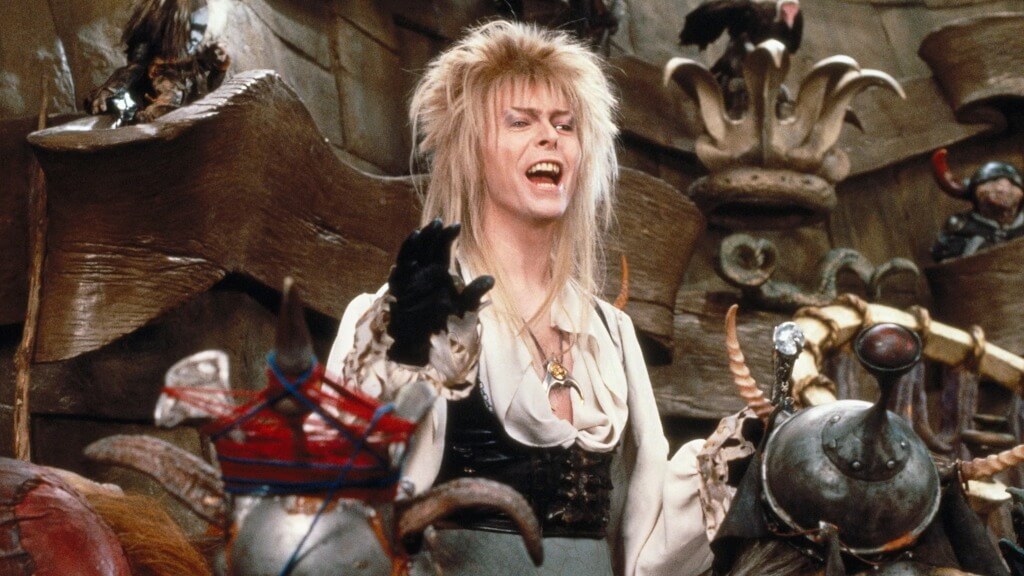
Jim Henson found himself at a creative crossroads after completing 1982’s The Dark Crystal. The experimental, all-puppet dark fantasy—now viewed as a monumental achievement in worldbuilding and technical filmmaking—had failed to capture public imagination the way Henson had hoped. Eager to prove that he could still innovate and entertain without leaning on his classic Muppet characters, Henson began working with Dark Crystal conceptual designer Brian Froud on another foray into the realm of fantasy. Other notable collaborators, including Star Wars creator George Lucas and Monty Python writer Terry Jones, would help Henson navigate the long and twisting process that eventually led to 1986’s Labyrinth. The resulting production would be a more lighthearted, accessible adventure than The Dark Crystal. Human actors would now share the dramatic load alongside Henson’s fantastical puppets, and the film would feature several visually stunning musical performances. Labyrinth would be a very different kind of fairytale, one that required a new type of soundtrack, and, of course, the perfect musical villain.
Henson had been courting rock icon David Bowie to play the antagonist role of Jareth the Goblin King since the early days of the project. Once he dismissed the idea of Jareth being a puppet, Henson latched on to the idea of casting a rock star in the role. Names like Mick Jagger, Prince, and Sting were suggested, but Henson’s own kids convinced him that Bowie would be the best option to rock a shag mullet and codpiece. Bowie, like Henson, was going through a difficult creative patch at the time, feeling alienated from his audience and dissatisfied with recent studio output. The chance to once again create a dynamic, complex character while also writing and performing original songs proved a tempting proposition. After flirting with the role through several script overhauls and conceptual changes—even threatening at one point to leave the project altogether—Bowie eventually agreed to play Jareth. Henson had landed his rock star goblin king.
On the surface, Labyrinth follows the textbook hero’s journey of teenager Sarah Williams (Jennifer Connelly) as she races against time to rescue her baby brother, Toby, from Jareth’s clutches. At the risk of being cast into the flatulent Bog of Eternal Stench by a rabid fanbase that has spent four decades debating the true nature of Sarah’s quest and her relationship with Jareth, we can at least agree that her adventures are fueled by her own imagination. A quick pan across Sarah’s bedroom at the beginning of the film—from her toys and storybooks to her decor and photographs—foreshadows both the creatures she’ll meet and the perils she’ll face while solving Jareth’s labyrinth. Henson himself has described Labyrinth’s story as taking place where the “elements of Sarah’s real life” meet “the grid of her imagination.” It’s a very personal fantasy curated to her own taste, a psychological wonderland where the greatest foe she’ll face (sorry, Jareth) is her own childish hang-ups as she negotiates her first confusing steps toward adulthood. When we reframe Sarah’s journey, and the labyrinth itself, as an internal struggle rather than merely a fantasy adventure in a far-off land, the film’s soundtrack, including Bowie’s songs, takes on an entirely new magic.
Composer Trevor Jones came aboard the Labyrinth team after having scored The Dark Crystal. He immediately recognized that composing for this new project would be a different undertaking. On The Dark Crystal, Jones’ score had been tasked with helping to explain, as the film’s promotional materials boasted, “Another world, another time… in the Age of Wonder.” Each piece of music needed to speak to the very nature of the world of Thra, its mystical lifeforms, and the laws governing their existence. That’s not to say that goblins or teenage girls are simple creatures, but they also aren’t Skeksis or Gelflings. For Labyrinth, Jones’ work, an unnerving mix of eighties synth and timeless orchestral instruments, instead focuses on Sarah’s emotional state. On “Into the Labyrinth,” for instance, we can feel the pang of frustration set in as Sarah senses just how hopeless her endeavor appears, the layers of synth intensifying like time running short to clear a video game level. Jones casts a wider emotional net on “Sarah,” delicate keys fraught with a young heroine’s insecurities shrinking beneath looming medieval horns. The track ebbs and flows, torn, like Sarah, between the indulgences of childhood and the daunting responsibilities that lie ahead.
Jones was also the voice who nudged Henson toward the idea that rock music could work alongside an orchestral score. That might well be why Jones’ pieces complement Bowie’s pop songs so well, never once sounding like they originated in different musical realms. Often, their work feeds into one another’s. It’s the poison peach-induced synths and wailing saxophone of “Hallucination” that escort Sarah to Jareth’s deceitful soap-bubble masquerade (“As the World Falls Down”) and the goblin king’s final, self-nullifying exhale (“Within You”) that summons the illusion-demolishing tremors of “Thirteen O’Clock.” Of course, nowhere do their worlds collide more crystallinely than during the opening titles, the first part of Bowie’s “Underground” tucked neatly in the middle. Jones’ part hints at the magical adventure to come while Bowie’s commiserating interjection (“No one can blame you / For walking away”) delivers Jareth’s first overture to Sarah, promising her an alluring alternative (“A land serene / A crystal moon”) to a mundane life burdened by demanding stepmothers, tedious babysitting duties, and intrusions on her privacy.
The labyrinth looming between Sarah and Toby’s rescue brims with the types of riddles, distractions, and storybook elements with which she fills her playtime. She meets memorable creatures along her journey—like Ludo, the lovable lummox; Hoggle, the self-doubting dwarf; and Sir Didymus, a comically quixotic fox terrier—all of whom help her tick crucial boxes on her perplexing path towards maturity. Amid epiphanies about the unfairness of life and chances to practice forgiveness and place childish trinkets in perspective, Sarah stumbles upon the kooky musical stylings of the Fierys, a zany bunch of characters so detached from everyday concerns that their heads and limbs pop right off at will. Their cautionary boast, “Chilly Down,” highlights Bowie’s ability to write beyond the Jareth character. Bowie doesn’t lend vocals to the funky, almost tropical arrangement, instead letting the performers (including Kevin Clash in an Elmo-adjacent voice) dabble in their own brand of mayhem as they serenade Sarah with the benefits of shirking all responsibilities in favor of a fun time. She’s wise enough to keep a good head on her shoulders and escapes with the help of Hoggle before she loses that head altogether. The scene might feel like comic relief (or even nightmare fuel to some), but it’s a musical moment that suggests that Sarah’s ready for the darker challenges to come.
A restless Jareth has plenty of time to kill as Sarah contends with his labyrinth’s cruel tricks. Perhaps as much a babysitter as a kidnapper, he entertains young Toby with the nursery rhyme-inspired “Magic Dance.” In the movie’s most iconic scene, Jareth and a chamber full of goblin puppets put on a full production number, the goblin king strutting and singing into his cane like a hairbrush at a sleepover. It seems like a bit of silliness (more so when we learn Bowie actually voiced Toby’s gurgles), but the bopping villain number also portends the danger Sarah will soon find herself in. She’s created Jareth—not to mention made him fall in love with her—to be theatrical, charismatic, and, as we witness here, a manipulative showman. If we rewind the film and pause at the earlier scene with Sarah sitting in her bedroom, we’ll see from a photo affixed to her vanity mirror that she’s dreamed up Jareth in the image of her actress mother’s leading man and romantic interest. As Jareth tosses Toby disturbingly high into the air and the sing-along hijinks of “Magic Dance” fade out, we might consider that Sarah’s fantasy of having a powerful admirer to do her every bidding could have negative consequences that a young girl might not foresee. However, in fairness to Sarah, she wouldn’t be the first teenager to fall for a bad boy with guyliner and an impressive set of pipes.
Indeed, Jareth’s trick to make Sarah forget about rescuing Toby casts her in a romantic role that she’s not quite ready to take on. After taking a bite of Hoggle’s peach, she’s whisked away to a fancy dress party inside a crystal ball. It’s the stuff of girlish fantasy, a glass slipper toe-dip into a world of complicated adult feelings as Bowie’s “As the World Falls Down,” based on the tune from her ballerina toy, drifts into the scene. “I’ll place the moon within your heart,” sings Jareth, in a series of impossible romantic gestures that promise to ease her pain and fulfill the longing she’s just beginning to feel as a young woman. It’s not as simple as giving in to Jareth’s pursuits or penetrating gaze, of course. She’s the only child—dressed as a princess but made up to look much older—in a room full of hedonistic adults masquerading as goblins and growing more grotesque by the moment (the password “Fidelio” comes to mind). As her confusion thickens and Jareth’s serenade crumbles, she recoils from his arms and uses a chair to shatter both the crystal ballroom and the illusion he’s created for her. While it could be argued that Sarah has failed in her first attempt to follow her heart in an adult manner, this memorable scene also demonstrates that she now possesses the maturity and wisdom to step back when a situation grows too uncomfortable.
Sarah’s final confrontation with Jareth takes place in a dizzying maze of disorienting staircases inspired by the M.C. Escher poster in her bedroom. As she pursues Toby, always just out of reach, Jareth makes his last-ditch effort to win her heart and secure his existence. Bowie’s showdown composition (“Within You”) pits Jareth in the role of spurned lover, the song’s tone shifting from exasperated and manipulative to pleading and dejected across a few short lines. “Live without your sunlight / Love without your heartbeat,” a crushed Jareth sings before his final lament: “I can’t live within you.” Over the course of her fantasy, he’s played the part of accomplice, antagonist, and even a romantic admirer. And yet, if Sarah takes that final leap into adulthood, choosing the lessons she’s learned over the fancies of her girlhood imagination, Jareth will have nowhere to remain. It’s an inevitable step, one she’s insisted to Jareth several times that she must take and one she’s rehearsed time and time again. When she finally remembers and delivers the line “You have no power over me,” we see the impulsive, selfish girl make the decision to become a young woman and all that entails.
As Sarah “returns” home from her adventures, Jones’ gentle “Home at Last” welcomes her with lingering sounds from her journey. Sarah hands down her favorite teddy bear, Lancelot, to Toby, safely asleep in his crib, and begins packing away bits of her childhood, including the publicity photo of her mother and her co-star. When she sees Ludo, Sir Didymus, and Hoggle appear in her vanity mirror, she admits to still needing them from time to time. She then turns to find them actually present, and a dance party set to “Magic Dance” ensues as Jareth watches in white owl form from outside her window. While some may see the ending as a retreat towards childhood, Sarah has actually discovered that growing up doesn’t mean totally abandoning that special time in life that passes all too quickly yet informs the rest of our days. As the credits roll, we’re treated to the full version of Bowie’s “Underground,” a mix of pop and gospel with blues legend Albert Collins on guitar and emphatic, celebratory backing from Luther Vandross, Chaka Khan, and a Baptist choir. What might’ve felt like wishful fleeing at the film’s beginning now sounds like the type of respite that Sarah, or any of us, could use now and again when our lives start to overwhelm us.
Such a pity, as Jareth might say, that Labyrinth failed to cast its wondrous spell on audiences during its initial theatrical run. Its failure at the box office devastated Henson in particular because he thought he had made the accessible, relatable dark fairytale that moviegoers would appreciate. Fortunately, like The Dark Crystal, home video and television airings gave the film a thirteenth hour and the chance to become a cult classic beloved by multiple generations of children and fantasy fans. That renewed interest has also caused more and more listeners to revisit Jones’ magical score and consider where Bowie’s reign as the goblin king fits into a long career of complicated characters and otherworldly songs. Just as Sarah learned that she could grow up without entirely leaving childhood behind, Labyrinth’s ongoing popularity ensures that both the film and its soundtrack will always be there, should we need them. Tallyho!
 Keep scrolling for more great stories.