
Miles Davis made changing music look easy
What made the jazz trumpeter a pioneer in every sense of the word was that nothing was off the table. In that most noble pursuit, his chasing of musical sweetness, there were no rules he would not break.
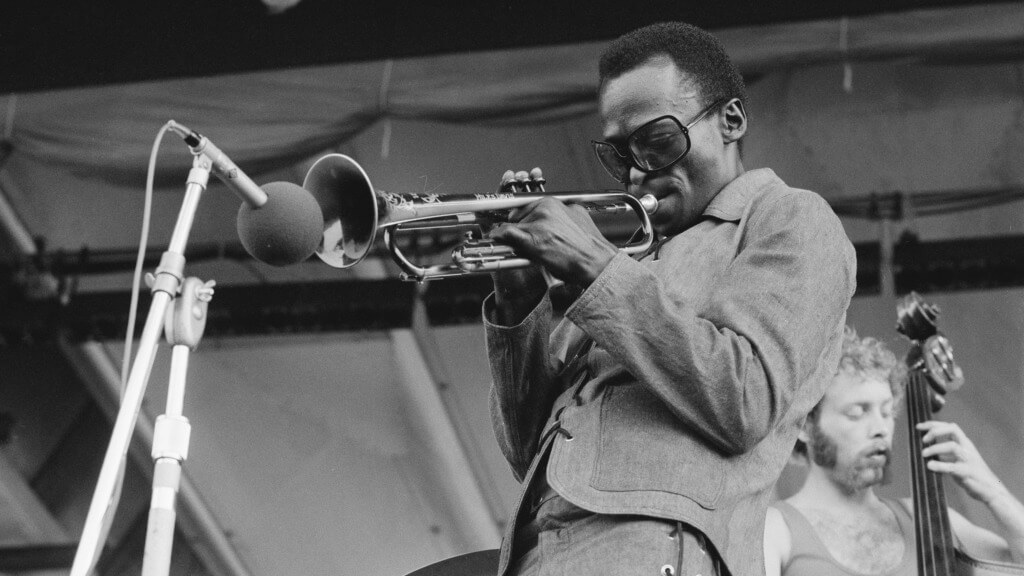
Photo by David Redfern/Redferns/Getty Images
In the summer of 2015, I, like every British teenager in the country, was sitting my first public exams. This was a rite of passage, and it still is: a two-month hellscape of day after day spent sitting in your school sports hall, answering questions on just about any subject you can think of. Around this time, over ten years ago, just as many teenagers will do this year, I took my GCSE Music exam. Even though the test’s format was totally predictable, its final section loomed large in my mind. I would be given a choice of two questions on any of my set pieces and asked to write an essay on them. Some were far less appealing than others, of course. An essay on Jeff Buckley’s Grace, for instance, was a breeze; one on Steve Reich or Handel, though, was not only more difficult but more boring—to a teenager, at any rate. My music teacher had his own prediction of what would come up. “They alternate every year,” he told our class very seriously in the preceding weeks. “And in all likelihood, you’re looking at a Miles essay question. That’s your dream scenario. Because ‘All Blues’ is piss-easy.”
A dream scenario it was, and it came true. I eased through a rote essay commenting on Miles Davis’ use of melody, harmony, tonality, rhythm, texture, and structure without batting an eyelid. On results day, an A* certificate was duly handed to me, and onwards into the next stage of my education I went. I think about that exam often—primarily because it was one of the only times I can think of that I’ve felt actively nervous while listening to the first movement of Mozart’s Symphony No. 40. More recently, though, I’ve been thinking about “All Blues,” and especially about how it’s piss-easy.
Miles Davis was born a hundred years ago. It’s near impossible to talk about a great or a “greatest of all time,” in part because it always feels like everything there is to say about them has already been said, and also because it’s harder than you might think to get everyone to agree that anyone is a great. Years after I had written my incredibly boring essay on “All Blues” under timed conditions, I inadvisably got into an argument with a trumpet player about the best jazz trumpeter of all time.
“It’s probably Dizzy Gillespie,” she told me thoughtfully. “Maybe Wynton Marsalis.”
I blinked in horror. “Not Miles?” I asked.
She snorted. “No way.”
“But it’s Miles Davis,” I insisted, childishly.
“Dizzy,” she repeated, more firmly this time. “Like, maybe Clifford Brown.”
Defeated, I changed the subject. But later that night, I lay in bed trying to square the whole discussion in my head. “What do you mean, ‘No way’?!” I thought to myself in outrage, though I have never played the trumpet in my life. “It’s Miles Davis! The man’s a genius!” But, in all honesty and on technique alone, Miles isn’t my first pick either. Dizzy’s got the firepower and the speed; Chet Baker’s got that sweet tone. Wynton Marsalis wins for versatility. And Louis Armstrong plays that thing as if he invented it, which he kind of did.
When I think about Miles Davis, I don’t necessarily think about his trumpet playing. But perhaps that is the point. To be clear, he was a remarkable trumpeter—because, like all the best musicians, he knew what he couldn’t do. When he was nineteen years old, he realized that he didn’t have a hope of reaching Dizzy Gillespie’s dexterity and aggressive speed, so he did something radical instead: he shoved his trumpet into the microphone and played it so it sounded like it was right in your ear, whispering and bubbling and murmuring with a spare, intimate magic. More than that, he didn’t care to show off. Music, for him, was not about what was played but what wasn’t played; often he asked his bandmates to play around sound, to think about the sounds they weren’t making.
And that, if I may be so bold, is what still makes Miles the coolest cat around. Not because he gave literal birth to cool, or because he was a style icon of his time, or even because he was a musician who saw jazz for what it is: a living, breathing thing; a sea that ebbs and flows; a tide that moves on without you if you don’t go with it. Miles Davis is Miles Davis because a sixteen-year-old with a frankly tenuous grasp of music theory could, and still can, listen to a piece of his work that is universally recognized for its groundbreaking modal composition, its complex chord progressions, its mind-blowing demonstration of improvisational skill, and think, “Oh, yeah, piss-easy.”
To try to place Miles in any one musical space or genre inevitably prevents an understanding of the full breadth of his work, but one thing that really marks out his music is his ear for a tune. “Bird [Charlie Parker] and Diz [Dizzy Gillespie] play this hip, real fast thing, and if you weren’t a fast listener, you couldn’t catch the humor or the feeling in their music,” he wrote in his autobiography. “Their musical sound wasn’t sweet… it didn’t have harmonic lines that you could easily hum out on the street with your girlfriend trying to get over with a kiss… Bird and Diz were great, fantastic, challenging—but they weren’t sweet.”
It is that concern which guides Miles’ output, both audibly and tangibly—his pursuit of sweetness, that most delicious and human part of music. Sweetness is the desperate need to wind a song back a few seconds so you can hear that chromatic chord over and over again, bursting into tears on the train or on your walk home because the orchestra bloomed into a crescendo, finding the tinge in a voice that makes it sound lonely or jubilant or furious. That’s the part of a song that you play once and then catch your friend or your parent or your lover humming to themselves a few days later, without even knowing it, catching it from you like the world’s best bout of flu. Sweetness is common to music, and Miles Davis did not invent it. More than anyone, though, he knew how to find it. The question of how he did so comes down to three things: he played what he liked, he found others who could follow him wherever he wanted to go—in their own distinct ways—and he refused to be left behind.
Miles’ origins were not remarkable, and a significant part of his life story follows the same beats as his peers. He got his early breaks, as a lot of musicians did in that period, by showing up to enough concerts that his idols, Charlie Parker and Dizzy Gillespie, noticed him and gave him opportunities to perform alongside them. When the epidemic of heroin addiction swept through his circles, he fell victim to it, just like Parker, John Coltrane, Bill Evans, and Philly Joe Jones did. It ruined his life, just as it did theirs—though he was lucky enough to survive his addiction and get clean when many of his friends did not (even this is a familiar idea; Coltrane, too, got clean and went on to create the best music of his career).
Then Miles built himself back up, formed the most powerful quintet in jazz history—not once but twice—and became absolutely filthy rich, garnering critical and commercial success throughout his lifetime (though not always both). These events are historical and well-documented. Reading about them isn’t as exciting as something else you could do right now, which is queue up “Round Midnight,” “Concerto de Aranjuez,” “So What,” “Shhh/Peaceful,” and “Pharaoh’s Dance,” then try to find anything that these pieces have in common, before realizing that there’s only two—they’re all by the same artist, and they all sound spectacular.
On each of these tracks, we can find once again that essence of “sweetness”—a musicality and favoring of melody and harmony, as well as a gut-wrenching beauty, though this quality does not always appear in the same guise. The earlier tracks, for example, are more evident examples of sheer melodic dexterity. On “Round Midnight,” there is the best and brightest iteration of the legendary sparring matches between Miles’ cool, sexily muted trumpet and the broad, sprawling sound of John Coltrane’s tenor saxophone. Miles eases through Thelonious Monk’s classic standard with the spare, smoky coolness that drove people crazy at Newport in 1955. It seems that it will begin and end as a quiet, contemplative track; then, suddenly, almost exactly halfway through, comes an eruption of brass. There are a few bars of short, sharp stabs of sound before Coltrane explodes onto the track, poking his saxophone into every harmonic crevice he can find. The two bounce off of each other with the faith and whiff of competition that only real equals can have, and the result is a piece of brooding beauty.
Another of Miles’ strongest partnerships is on “Concerto de Aranjuez (Adagio),” this time with arranger Gil Evans, who, in much the same way as George Gershwin years before, had the excellent notion that traditionally “classical” music and jazz did not need to be mutually exclusive. He introduced Miles to this worldview and got him to play through staggeringly complex arrangements of already notable compositions against the backdrop of a full orchestra—sometimes on trumpet, and sometimes on flugelhorn. The arrangement of the second movement of Joaquín Rodrigo Vidre’s concerto, originally written for classical guitar and orchestra, is ridiculously imaginative in its scope, and the album it appears on (Sketches of Spain) is a feat of intellectual skill as well as musical. Miles’ characteristic restraint allows the melody to bloom, delicately, of its own accord. He noted, quite rightly, that “the softer you play [the melody] the stronger it gets, and the stronger you play it, the weaker it gets.”
Again, it was the ease with which Miles approached melody—coaxing it out, gently, in much the same way one might a wild animal—that lent it its tenderness, and served to obfuscate somewhat just how imaginative he could be with his musicality. “So What,” the best track on the best jazz album ever recorded, is a further testament to this. Its opening thirty seconds—also the first thirty seconds of the album—don’t just sound beautiful; they are intensely, madly clever, without ever laboring their intelligence. On the piano, Bill Evans’ voicings make him sound like more of a painter than a musician, ghosting in and out of the Dorian mode that the piece is built on, as though he were just tinkering at the piano rather than building a rigorous framework for himself and the rest of the players (moderate tempo, Dorian mode only, forget about tonal centres, and make the most delicate, lovely sounds you can). Davis and his sidemen follow Evans’s lead, and what ensues is nine minutes of perfection, what Chick Corea described as the creation of a whole new musical language, one that every artist from Q-Tip to Quincy Jones to Pink Floyd has tried to speak.
But Kind of Blue is only one peak (though probably the highest) in the mountain range of Davis’ work. When music started to move towards electric instrumentation, he didn’t double down—much to the consternation of traditionalists like Wynton Marsalis—but moved with it, and the results were yet another sea change, this time toward jazz fusion. “Shhh/Peaceful” on 1969’s A Silent Way sounds, in some ways, like a farewell; it maintains an ethereal, resigned quality—a willingness to move towards the new, and in doing so, release the old. John McLaughlin’s guitar twangs and picks across the organ of Joe Zawinul, giving that same Miles Davis feeling of control and simplicity, before his trumpet announces itself with piercing clarity, leaving behind the muted tones that characterized so much of his modal jazz playing. Only a year later, Davis moved into even weirder, more provocative pastures, this time with Bitches Brew, and made jazz fusion a reality in the process. “Pharaoh’s Dance” squawks, whines, moans, cavorts onto a psychedelic plane; when the piece hits its groove, it whacks you in the face with its funkiness.
In much the same way as he could hunt down a tune, Miles had an extraordinary skill for finding the collaborators who could best elevate his work. They weren’t always the ones that other people thought were a good fit—John Coltrane had no credits of note when he first started working with Miles, and Bill Evans was just a white boy playing Black music—but they were the ones who thought as expansively as he did. They didn’t just meet him where he was—they were already somewhere else, and they wanted to take him with them. They could make his ideas bigger, better, brighter, and they could find their own ways of making them significant.
As a result, Davis’ discography feels like transformation after transformation after transformation in the musical landscape he existed in. It would be stretching it to say that he instigated them all, but not totally inaccurate. If he didn’t start a wave, he sure as hell rode it to its crest. Sometimes the wave was cynical; Davis was acutely aware of social capital and never made a secret of wanting to preserve his own. But what made Davis a pioneer in every sense of the word was that nothing was off the table. In that most noble pursuit, his chasing of musical sweetness, there were no rules he would not break. He was willing to do anything to give you a tune to hum or a note that would lodge itself in your chest. Nothing was a given. Always, his work showed a visceral willingness to roll up his sleeves and dig into the very innards of music, picking out the bits he liked best. Then he would serve it up to you so simply, so guilelessly, that you’d think it was easy. In so doing, he changed everything we understood about music. Then he changed it again, and again, and again.
“All Blues” isn’t on the syllabus of that GCSE music paper anymore. In 2016, a year after I sat it, the old paper was phased out, and Miles Davis was replaced, rather delightfully, by Esperanza Spalding’s rendition of “Samba em Prelúdio.” I can’t ask Miles what he thinks of this, and he probably wouldn’t care anyway, so I’ve decided he’d be alright with it. It was, after all, his superpower. When the times would change, he’d change with them. And he never looked back. Music, for him, was an ephemeral thing. Staying static was anathema. His recordings were done in their era, in “the right hour, the right day,” as he said to Ben Sidran in 1986, and then they were over. When Shirley Horn, a year before Miles died, suggested that he go back to performing the tunes on Kind of Blue, still regarded as some of the greatest music ever recorded, he wasn’t interested. “Nah,” he said. “It hurts my lip.”
Mariam Abdel-Razek is a writer and critic based in London. Her writing has previously appeared in The Line of Best Fit, The Tonearm, and Varsity.
 Keep scrolling for more great stories.