
Cardboard and tinfoil: Muse’s Black Holes and Revelations twenty years later
On July 3, 2006, Muse released their last great album and put me on the path to prog rock hubris.
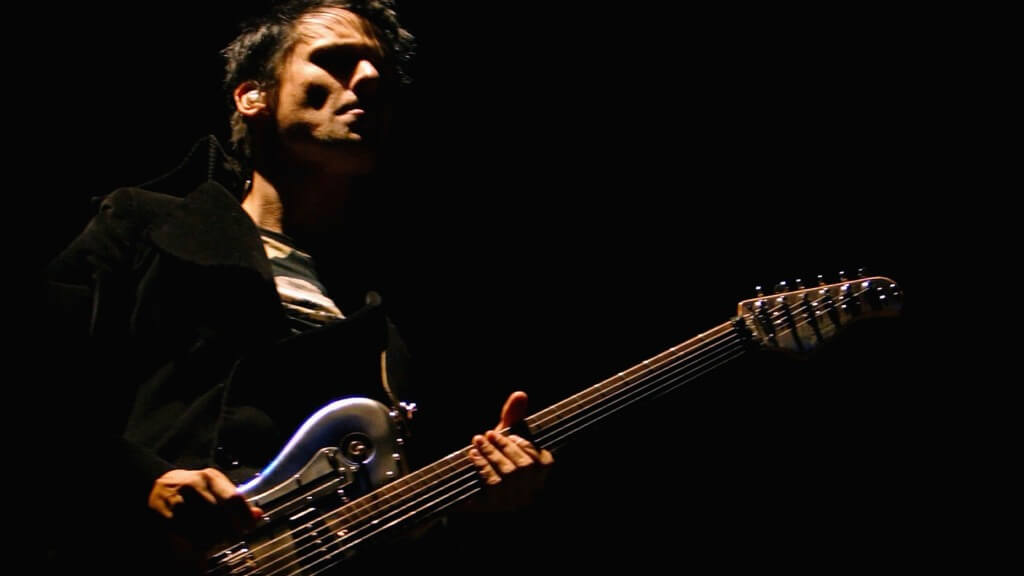
Photo by Bruno Vincent/Getty Images
Listen, the move worked in rehearsal, and it was the sound guy’s idea. When my teenage garage band set up for a show in a local high school auditorium, he said I looked awkward because I was only strumming my guitar for the first minute of our song, “Children of the Rift.” I usually just sang, but I wrote the intro of that song specifically so I could use the built-in phaser and delay effects on my practice amp. The sound guy said that after that part, I should swing my guitar around by the strap so it would hang on my back in rock-star fashion. It looked so cool during soundcheck that, I kid you not, he turned and high-fived the closest bystander. Then came the performance itself—I summoned the spacy sound effects and swung my Epiphone semi-hollow over my shoulder, but this time, the strap came loose and the guitar abandoned me, crashing down onto the stage. It might have been embarrassing, but I don’t think the dozen or so audience members were even watching me. They were probably looking at the other side of the stage, where our guitarist’s friend was pelvic-thrusting in a robot costume made of cardboard, foil, and flexible ducts.
There are so many people—so many bands—I could blame for this incident. I’ve landed on English prog rock trio Muse, in honor of their album Black Holes and Revelations and its twentieth anniversary. In 2007, at the age of twelve, I heard the epic six-minute space/surf-rock album closer “Knights of Cydonia” in Guitar Hero III, and I’m pretty sure it melted my brain. Now, when I hear the end of the opening fanfare, where the wailing vocals cut out and the tremolo guitar slides down into the verse riff, I think I can actually hear my pre-teen brain melting and re-solidifying into the shape of that riff. Is it any wonder that four years later, I’d jam out my best imitation, call it “Children of the Rift,” and teach it to my friends? Was it possible to avoid a future where I’d stand on an auditorium stage and sneer about propaganda next to a dancing robot?
All I can say for myself is that as a young musician, I drank from a dangerous cocktail of influences: old science-fiction novels I grabbed off my dad’s bookshelf (Isaac Asimov et al.); Ray Kurzweil’s writing on the technological singularity, which I must have grabbed off the internet; and a healthy draught of high school malaise. All of it harmonized beautifully with Muse’s paranoid angst. In the 10th grade, I started a band called Revolution Imminent with some friends in my AP European History class. Then, after about a year of playing Green Day-influenced pop punk songs, I resolved to write my own American Idiot, only it would be a sci-fi rock opera about a war between humanity and machines. It would be deep and loud, and it would satisfy the part of my brain that needed to make something of my anxiety about the future. I would have identified with Bob Dylan’s famous line that “he not busy being born is busy dying,” but Bob Dylan never sang about spaceships or supermassive black holes, so I didn’t have much use for him. Instead, I had Muse singer/guitarist Matt Bellamy, who said: “Don’t waste your time, or time will waste you.”
For me, Black Holes and Revelations was the album by which prog rock made first contact. Released in 2006, it was Muse’s fourth full-length LP and the realization of their destiny to seize the world’s attention with hard-rock riffs, classical drama, and a synthy, space-operatic spirit. As their first release on Warner Records, it has the aura of a major-label debut, but Muse had been courting global superstardom for years. After the trio—Bellamy, bassist Chris Wolstenholme, and drummer Dominic Howard—released their self-titled debut EP in 1998, they played label showcases in the U.S., which led to a short-lived deal with Maverick Records (Madonna’s label) for stateside service. The relationship broke down in the making of Muse’s sophomore album Origin of Symmetry, when the label asked Bellamy to tone down his falsetto on the warp drive baroque rocker “Plug in Baby.” (A bit like asking Claude Monet to paint indoors, innit?)
Maverick’s parent label, Warner, had more sense; they signed Muse after the band’s third album Absolution and set them up with their own sub-label, Helium 3. The breakup with Maverick had slowed their ascent across the Atlantic, such that in 2004, they headlined Glastonbury but were still playing thousand-cap clubs in North America. That year, an NME writer described their arena-sized theatrics in a Toronto club: Bellamy pointed his guitar “rocket launcher-like, towards the crowd, thrusting his fist in the air,” and he had a habit of throwing instruments around (I should definitely have played off my failed rock pose like I meant to throw the guitar).
But forget international; when Muse made Black Holes, they were ready to go interstellar. In “Starlight” and its crystalline piano hook, they found their friendliest single ever. In “Assassin,” they had riffs made for migraine-inducing strobe light shows. And if the band’s prog pedigree wasn’t obvious from the first coruscating synth arpeggios of “Take a Bow,” Black Holes (like Absolution before it) had an album cover by Storm Thorgerson, known for Pink Floyd classics like Wish You Were Here. Black Holes embodied all of Muse’s best qualities and propelled them to their first show at Madison Square Garden in 2007. It remains their most accomplished album for the way it balances their pop and their conceptual ambitions while keeping them within somewhat reasonable limits (they would pull too far in both directions on 2009’s The Resistance, an overblown adaptation of George Orwell’s 1984 that also included “Uprising,” their only foray into the Billboard Hot 100).
Black Holes and Revelations wasn’t a concept album, even on the sub-prog level of the Killers’ Sam’s Town or My Chemical Romance’s The Black Parade, which came out the same year. But the grandeur of Muse’s orchestrations—paired with Bellamy’s non-negotiable falsetto—elevated everything they did to operatic heights. In my mind’s eye, the album never conjured three guys in a studio in France, Italy, New York, or London (not to mention the small army of string players, conductors, and engineers involved). Instead, I saw attack ships on fire off the shoulder of Orion and watched C-beams glitter in the dark near the Tannhäuser gate. Even on a love ballad like “Invincible,” the narrator couldn’t be Bellamy himself; it had to be some space cowboy tipping his hat under a binary sunset. This is peak music for daydreaming about fictional characters, and to prove it, I’ll give my pay for this essay to the first person who gives me an AMV combining “Map of the Problematique” (particularly Howard’s machine gun drumming) with footage from Trigun Stampede.
But of course, Muse proved it themselves in the batshit video for “Knights of Cydonia,” as they perform the song through a holographic jukebox in an old west frontier town—in which a kung-fu cowboy and a damsel in distress mouth along to the lyrics before a laser gun shootout with the sheriff. It all goes down in a campy film-grain dreamscape with appearances by a unicorn and a robot (I don’t even think my band was intentionally referencing that; it just happened). Goofiness aside, the video runs with the song’s open-ended possibilities—the title alone offers a beautiful tableau of conceptual nonsense to play with. Cydonia is a region on Mars, as anyone who’s Googled the song after hearing it knows. “Knights of” implies epic mythology, and you can work out what that entails around the school lunch table, because the song isn’t going to explain it. Together with the galloping drums and Bellamy’s crooning invitation: “Come, ride with me / through the veins of history,” it suggests something impossibly cool, then leaves you free to dream through its six minutes of solos, horns, and wailing harmonies that push the boundaries of human hearing.
This is how the prog rock portal was opened to me through Muse. Not in the practical sense, because with my self-taught repertoire of basic chords and single-string riffs, I knew better than to try to cover their songs. (Honestly, I even shied away from “Assassin” when Guitar Hero World Tour came out). But by expanding what I knew was possible in rock music, they made room for whatever I could think up myself. “Knights of Cydonia” may be on the sillier side, but almost all of Muse’s early songs have this evocative yet oblique quality that activates the imagination. (Or if not, they were just obscure enough; before Genius.com, I would never have caught the specific UFO conspiracy theory references on “Exo-Politics.”) Need I remind anyone that Stephenie Meyer thanked Muse in the acknowledgments for New Moon and Eclipse, then the dedication of Breaking Dawn? Of course I need not, because if you’re thirty years old and you didn’t first hear Muse in Guitar Hero, you probably heard them in the vampire baseball scene set to “Supermassive Black Hole.”
For as big as they got, though, Muse didn’t spawn a lot of direct musical descendants—maybe for the same reason I never tried to cover them. You can hear echoes of their ambition in acts like Royal Blood, Nothing But Thieves, or the Warning, but nowadays, if I want the specific mix of concept, camp, and catharsis I got from Black Holes, I have to cobble it together from different sources. Clipping has sci-fi substance. The Last Dinner Party has panache. King Gizzard and the Lizard Wizard has heavy riffs and arpeggiated synths, just with a little too much tongue in cheek. Honestly, Ghost is pretty close, but they haven’t gone to space. I suspect fewer bands get the chance to make records this big since the collapse of CD sales, but even among Muse’s contemporaries—Coheed and Cambria, the Mars Volta, Tool—nobody was really doing this to begin with.
I’d like to say that I did my part. When my band’s guitarist invited me over to mess around with his MIDI keyboard, we ran it through an arpeggiator in Pro Tools and jammed out our answer to “Take a Bow.” When we piled into our other guitarist’s car and drove to Taco Bell from the basement where we rehearsed, we’d have our own Wayne’s World “Bohemian Rhapsody” moment, headbanging to “Knights of Cydonia.” Once we’d all graduated and gone our separate ways, I’d finally teach myself to sing vibrato and falsetto by imitating… just about every song on the album, now that I think about it. In just the last year, I caught myself unconsciously recreating the riff from “Exo-Politics” in a guitar jam session.
But as you may now have realized, I never finished my rock opera, outside of the one song and a handful of riff ideas. There are so many things I could blame for this: a lack of music composition experience, a lack of discipline, or a lack of time between Team Fortress 2 matches with my bandmates. Instead, I’ve decided to see it as a blessing. Since high school, I’ve developed a slightly more nuanced appreciation for humanity’s relationship to technology (fuck generative AI for real, though), and a love of indie rock, where songs don’t have to change the world to be worth writing.
But also, considering Muse’s later work, concepts are often better in theory than in full-length execution. After Black Holes and Revelations, they stopped making albums about abstract, metaphysical ideas like Symmetry or Absolution. Writing explicitly about climate change and drone warfare cost them a lot of lyrical subtlety—the only kind of subtlety Muse had to begin with. But I would have done exactly the same thing, if only I’d had the major label resources. As it is, I never had more fun making music with my friends than I did on that high school auditorium stage, scuffing my guitar in front of fewer people than Muse probably pays to set up for them on tour. The important thing was the ambition; to have a dream to strive for, to share, and to exorcise my existential angst. The poet Robert Browning once said, “A man’s reach should exceed his grasp, or what’s a heaven for?” But Browning never went ham on a Steinway like Matt Bellamy, who said, “I will be chasing a starlight until the end of my life.”
Taylor Ruckle is an Arlington, Virginia-based music writer for publications like Post-Trash, FLOOD Magazine, and Washington City Paper. Find him at @TaylorRuckle on X, or on the balcony at the 9:30 Club.
 Keep scrolling for more great stories.