
Namasenda is ready to meet you at her realest
The Swedish pop star and PC Music alum gets personal on her debut album Limbo, exploring body image, love, and insecurity through a treasure trove of pop culture references and strobe-lit club pop.
Photo by Clement Mogensen
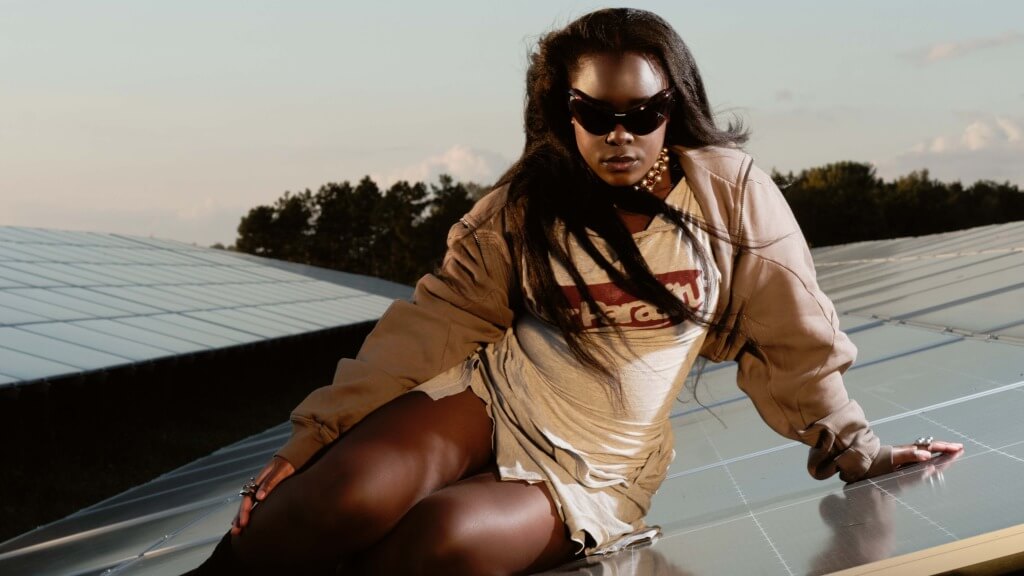
“This sounds so random but I am very, very scared of death,” Swedish pop star Namasenda suddenly confesses near the end of our Zoom. The statement smacks of a certain Scandinavian despair—for a split second, I imagine her as a tortured Bergman character, wandering alone through a desolate landscape while riffing on the soul and our collective mortality—but in all actuality, it’s probably more practical than tragic. In Namasenda’s telling, this fear gave her the immediate push to get out to the studio and finish Limbo, her upcoming debut album.
Despite being a pop maven best known for her slick, glossy hyperpop fit to soundtrack the nighttime escapades of a yassified Bruce Willis, Namasenda began inching unexpectedly toward the terrain of the personal on Limbo: a diary of a life in flux. Around the time of Limbo, Namasenda found herself in an uncomfortable transitional period. She’d left her previous label, the pioneering London-based PC Music, where she’d been a pivotal part of the 2020’s hyperpop era, releasing her canonic 2021 mixtape Unlimited Ammo and working alongside producers like A.G. Cook and umru and artists like oklou. She signed with Stockholm-based Year0001 in 2023, but she was uncertain of the move and her career at large: “I didn’t really know what was going on with my life, who am I, should I even be making music,” says Namasenda. “I felt like my career was at a standstill. It kind of felt like it was like the end of my career before it had even begun.”
Limbo, then, is easily Namasenda’s most honest work to date, grappling head-on with all her insecurities and uncertainties from within this liminal moment. She won’t shy away from sharing that she was depressed while working on the album, and the cover, shot by frequent collaborator and PC Music alum Hannah Diamond, shows Namasenda literally “bedrotting” while dressed in a thermal top and underwear. “I really wanted it to be pure,” explains Namasenda, pointing out the cover’s monochromatic, blazing-white color scheme. “I just saw white, I saw clouds.” It can be strange to associate bedrotting with purity—I personally picture grease-stained sheets and the hypno-psychedelic swirl of TikTok—but perhaps what becomes pure is the level of honesty accessed when you’re at your most vulnerable state, when all guards have finally been lowered.
Chief amongst Limbo’s concerns is body image, on which Namasenda is refreshingly frank. A large part of the album is devoted to “me trying to figure out where I stand in the beauty culture and the way that I see myself and the way that I see my body,” says Namasenda. Songs like “Alright” address how body insecurity crops up in romantic relationships (“I suppress my appetite to be your type”), and Namasenda calls “Heaven” a straight-up “looksmaxxing anthem.” “At the time when I wrote it, I didn’t feel beautiful at all,” she confesses. “I was just trying to manifest this other person that I was gonna be when the album came out. I would be, like, skinny and cute and have all these cute clothes and everyone would love me.”
“Coquette,” too, charts Namasenda’s complicated feelings about her own body. It’s a shimmery pop banger that races with the giddy, uninhibited adrenaline of three Cosmopolitans; its ecstatic chorus is simply begging to be belted on the dancefloor, yet behind its sheer energy lies Namasenda’s jealousy towards the titular coquette with the “super flex” silhouette. Namasenda describes it as a song about “looking at this perfect woman and not feeling like you could ever be viewed as the perfect woman.” “I feel like this is something that most women think about,” she adds.
This candor is applied equally to love. On Limbo, Namasenda is unflinching about all the ugly parts of love: jealousy, insecurity, unhealthy obsessions, fuck-ups. “Cola,” with its stuttering bass and whispery chopped vocals, captures the destabilizing personhood of someone willing to change themselves just for love (“I perform less like me, more what you want”). “Bad Love” chronicles a passionate but toxic situationship. “Romeo Must Die,” meanwhile, is a song about having standards; its stuttering garage-inflected breakbeats sound deceptively like butterflies racing through your stomach until you stop to actually listen to the lyrics: “If this is love, think I’m alright.” (Fans will see the track as a spiritual successor to her 2021 single “Finish Him,” which is about kicking a lying, cheating loser scrub to the curb.) “I mean, I think you can have self-doubt and you can be down bad, but we gotta have standards,” says Namasenda.
Say what you want about Limbo’s themes and Namasenda’s headspace during the album’s creation—mired in Swedish existentialism, riddled with insecurity and self-doubt, and so on—but you have to remember, this is still Namasenda we’re talking about. This is music you’re going to want to fucking dance to: all heart-racing synths and bright, chewy vocals and strobe-lit club beats. It’s pop that’s heaven-bound, always soaring towards a euphoric above, flying out of your body on the floor. When it comes to working with producers, Namasenda sees the whole process like dating—“Sometimes you have chemistry, and sometimes you don’t”—and with Medium, the Swedish duo of Hannes Roovers and Isac Hördegård that she collaborated with for Limbo, there was an instant spark. She likes being able to speak and work in her native language, and crucially, she appreciates that Roovers and Hördegård always push and encourage her “perfectionist” streak. “Some of the songs I re-recorded, like, fifteen times. The guys were like, ‘Yeah, sure, let’s do it,’” she says. “We really went into so many details, and they allowed me to. I didn’t feel like a pain in the ass.”
Namasenda is also a self-professed “chronically-online” pop culture junkie; film and TV references pop up regularly in her music. (When we speak, I ask about her daily screen time: “I mean, it’s not that bad. It’s like eight hours. Is that bad?”) But if Unlimited Ammo looked more towards the gun-toting, leather duster-wearing, Volvo-driving protagonists of Die Hard and The Matrix, Limbo trains its gaze instead on Love Island bimbos, Tumblr coquettes, the Clermont Twins, the Madonna/whore complex, and Romeo Must Die, wielding these complicated tropes and heroines to explore femininity, bodies, and love. Namasenda attributes her ability to synthesize massive Rolodexes of pop culture to essentially having an “iPad baby brain”: “It’s just all these memes and all these words and TV shows in a mush in my head.”
Namasenda hopes that Limbo’s rawness will let listeners finally see a new side to her. “I think that maybe the way people view me online is that I’m this girl who doesn’t give a fuck, but I mean, when I go to bed at night, I still think about, like, Oh why didn’t this person reply, or, Am I a bad person, you know?”
All the same, you won’t be blamed if you’re surprised to hear that Namasenda experiences this self-doubt, especially when you consider many of the fiercely bold, independent leaps she’s taken for her career in the past. Naomi Namasenda was born to Ugandan parents in Veberöd, Sweden, a small town of just over five-thousand people that was “boring as hell.” She describes feeling “lonely and weird” during her childhood; she didn’t have many friends and spent most of her time holed up at her local library, reading. “I didn’t even have to bring my library card,” she says. “Like, they knew me.”
Still, she’d always understood, with both childlike and clairvoyant certainty, that she wanted to make music. At twelve, she started a punk band with her friends, playing in shows and festivals across Sweden. Soon enough, though, she found herself drifting towards pop and electronic. At the beginning of high school, she met two producers at a festival and began working with them on electronic music. Around this time, too, the Black Eyed Peas released The E.N.D., and the trio was obsessed with the album’s dancefloor euphoria: “We were like, ‘Oh my god, this is so cool, this is club music,’” she says. “I had never been to a club. But I was like, ‘Oh my god, I can’t wait until I get to go to the club.’”
At eighteen, Namasenda moved halfway across the world to Los Angeles, hoping to escape stifling small-town Sweden and break into the music industry. “I’ve always yearned for more. I’ve always wanted to see the world,” she says. “And obviously, I grew up when The Hills was on TV.” The desert city, however, turned out to be the wrong move for the young Swede: L.A. was hot, blistering, and overwhelming. Namasenda realized that, despite her intentions, she was barely making music out West. “I don’t even know what the fuck I was doing. I was hanging out at strip clubs. I was partying, doing fuck-all,” she says. “And then after a while, I was like, I’m not sure if this is what’s gonna get me where I need to be.”
She eventually left L.A., following up with a brief stint in London before finally settling in Stockholm. Back in Sweden, she began working with a new producer. She released her 2017 EP hot_babe_93, which featured her breakout hit “Donuts,” a high-octane ode to the rubber-burning thrill of doing donuts in the parking lot. The track’s helium-pumped vocals and euphoric, maximalist heaven-racing production marked Namasenda as a stylistic twin flame to the then-emerging hyperpop movement, and two years later, she signed to PC Music, becoming the first Black artist on its roster. (With characteristic verve, she’d initially connected with label founder A.G. Cook after impulsively drunk DMing him on Instagram one night.) She looks back on her years with PC Music—where she released Unlimited Ammo, as well as singles like “24/7” and “Wanted”—as “fun” and crucial in her artistic development: “A.G. was the first person that has ever been interested in hearing my ideas. Working with him made me trust myself more,” she says.
Looking back, her path has been a wild and bumpy one, and Namasenda readily admits that she’s pretty much been winging it since day one. “I feel like I haven’t known what the fuck I’m doing up until, like, two years ago or a year ago,” she says at one point during our conversation. Then she corrects herself: “Maybe I still don’t know what I’m doing.” When Namasenda was younger, her mother used to give her the advice to “just do it scared.” “So that’s what I’ve been doing,” she says. “I’ve been super scared, but I’ve done it anyways. I think the sexiest thing you can do is try.”
And there’s still a lot Namasenda wants to try. She’s looking forward to upcoming release shows in Paris, London, and Berlin, as well as festival slots including Sónar. There are plans for a Limbo tour. And in the meantime, she’s plugging away at new music. “I just want to live my life to the fullest, and I want to do as many things as possible,” she says. “I want so much in my life.”
This longing—a tingling desire, a limitless quest for more—has followed Namasenda throughout her life. In fact, it’s in large part the genesis for Limbo. “I kind of feel like I’ve been in limbo for quite a while,” she reflects, mulling over her life and musical career. “Ever since I was little, I had this idea that when I got older, all these things were going to happen. But I’m still waiting for this major thing that’s going to happen. And this major thing is nothing specific. It’s just a feeling that I’m chasing.”
limbo is out May 8 on YEAR0001.
Lydia Wei is a writer based in DC. Her work has appeared in The Guardian, Pitchfork, Washingtonian, Washington City Paper, and elsewhere. Find her online at lydia-wei.com.
 Keep scrolling for more great stories.