
COVER STORY | Neko Case Won’t Be Tamed
On Neon Grey Midnight Green, the folk-rock icon insists that grief sharpens rather than clouds reality, and that connection—human and animal alike—is the antidote to dread.
Photos by Ebru Yildiz
By the mid-1800s, Victorian cultural critic John Ruskin decided he’d had enough of the Romantic penchant for sentimentality. He believed that all art ought to strive to capture nature as accurately as possible, and the poets of the era were spitting on that noble pursuit with every ridiculous metaphor they penned. In response to a line from Charles Kingsley’s “The Sands of Dee” that described sea foam as “cruel” and “crawling,” Ruskin scoffed: “The foam is not cruel, neither does it crawl. The state of mind which attributes to it these characters of a living creature is one in which the reason is unhinged by grief. All violent feelings have the same effect. They produce in us a falseness in all our impressions of external things.” He dubbed this literary phenomenon the “pathetic fallacy,” and derided those who fell prey to it for being weak in mind, body, and spirit—so weak, in fact, that their inability to resist being “borne away, or over-clouded, or over-dazzled by emotion” left them forever blind to the reality of the world around them.
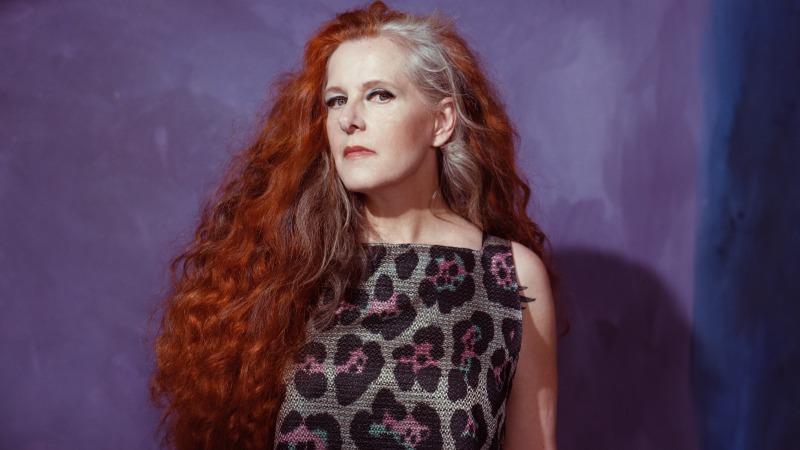
By 2025, defining voice of folk, alt-country, and indie rock Neko Case has long since decided she’s had enough of this old-fashioned fascistic insistence on repression. “I just want for people to regain their connection with their animal nature and with nature in general so badly,” she tells me over Zoom, clenching her fists for emphasis. Case, fifty-four, is currently sprawled out on a blue couch, embroidery materials scattered on the table in front of her, her face wildly emotive and her now-white-streaked red mane bright even through my laptop screen. “We need to get back to our instincts, which we have worked so hard to suppress since the Victorian era.” A guttural sigh of frustration rips its way from her throat as she leans her head back in exaggerated anger. “God, fucking Queen Victoria was such a fucking asshole. Don’t even get me started. If only she didn’t hate women and also literally everyone else.”
It’s probably for the best that Ruskin isn’t alive to hear Case’s blasphemies—her distaste for his monarch, yes, but also her latest record, Neon Grey Midnight Green, which spends its twelve songs doing exactly what he condemned: being borne away, over-clouded, over-dazzled by emotion. As it turns out, Ruskin’s fallacy was itself fallacious. The album is the most clear-eyed Case has ever been. Neither awe nor grief, it seems, unmake reality. On the contrary, they color it.
“I want people to remember that they’re animals and that is not wrong. We are of this world, we are of this Earth, and it is beautiful. We are not separate,” she says towards the end of our call, but this is the fourth time she’s emphasized the sentiment in less than an hour. Ruskin’s whole critique depends on hard borders—between human and nature, reason and grief, logic and emotion. Unfortunately for whatever ghost of him still lingers, Case has been steadily dissolving those borders her entire career. Her music insists that animal, human, wilderness, and instinct aren’t separate categories but a single system, one where emotion and instinct aren’t errors in perception, but sharpenings of it.
Neon Grey Midnight Green crystallizes that philosophy in part by foregrounding grief itself, the very “unhinger of reason” Ruskin feared. But here, instead of clouding one’s vision, grief illuminates it. “If you look death and grief in the face, and you say ‘This is where we are,’ grief will give you such incredible gifts,” Case says. “It has the most exquisite gifts to give you, and most people spend their time avoiding it, so they miss out on these incredible things that happen, and these insights that come to you.” In a way, the real fallacy isn’t projecting human instinct onto the natural world, but suppressing the role the natural world—our base animal nature, emotional and desperate and awe-filled—plays in human instinct.
This record, Case’s eighth (at least, her eighth solo; including her work with beloved indie supergroup the New Pornographers, that number crawls well into the double digits), lands seven years after Hell-On, the longest break of her career, and it arrives in a different world entirely. After all, since 2018, Case has rebuilt after the house fire that gutted her home just before Hell-On, weathered a global pandemic, published a best-selling memoir, released two more albums with the New Pornographers, started work on a Thelma & Louise musical, and watched as friend after friend passed away. The record doesn’t skirt any of that; it folds grief, survival, and joy into its very architecture. It’s orchestrated and expansive, but not for grandeur’s sake—the orchestra is there to hold reverence and devastation in the same frame, to make space for both. Ruskin might have been too Victorian and repressed to understand this (fucking Queen Victoria, man) but Case does, more than most: Paying attention—not passively, but actively; as an invested participant in your own life, community, world—is the sole antidote to the ever-present, always-encroaching dread that, more and more these days, feels on the brink of consuming us. That’s the real truth at the heart of Neon Grey Midnight Blue. In our digital era, it’s connection that saves us. With everything being subsumed by technology, it’s time to return to nature, to music, to each other.
“When I think about who I am,” Case tells me, “I think more in visuals than I do in words.” And there are countless images that come to mind when you think of Neko Case: her signature shock of red hair, her Olympic White 1960 Fender Jazzmaster, her smudged black eyeliner. Her onstage at a solo show, her surrounded by her New Pornographers peers on tour, her Grammy nomination photos from 2010 and 2014. Her in a bra onstage at the Grand Ole Opry in 2001 when heatstroke threatened to take her out entirely, an act she was subsequently blacklisted from the venue for, despite the fact that men perform shirtless all the time and no one bats an eye. Her as the metaphorical poster girl for alt-country at the turn of the century, baroque folk maximalism come the mid-2000s and records like Fox Confessor Brings the Flood, and indie-rock-folk-country-every-genre-in-the-kitchen-sink excellency by the 2010s. Her standing on a car while brandishing a sword (genuinely the coolest anyone has ever looked) on the cover of Middle Cyclone, her crowned in a laurel of cigarettes with Hell-On burning into her collarbones (a close second). Her flocked by any number or kind of animals (she does live on a farm, after all): a chicken on the arm of her chair, a bird on her finger, a wide-eyed mob of deer crowded behind her like a willing army she commands. Her in an orange-and-white plaid flannel sitting on a couch in some conference room across the country, her voice tinny through the poor connection of my laptop.
There are also the images that don’t, the images that never were: her holding that aforementioned Grammy (she lost to Ray LaMontagne and Vampire Weekend respectively—although she’s actually less angry about that than she is the fact that Angel Olsen’s Big Time was never even nominated). Her naked on that 2003 Playboy cover she was “granted” after being voted the “Sexiest Babe of Indie Rock” that she thankfully never posed for on matters of principle. (“I didn’t want to be the girl who posed in Playboy and then—by the way—made some music,” she told Entertainment Weekly at the time. “I would be really fucking irritated if after a show somebody came up to me and handed me some naked picture of myself and wanted me to sign it instead of my CD.”) Even her 2014 tweet (a screenshot, I know, but still an image nonetheless!) calling out Playboy’s continued bullshit: they claimed she was “breaking the mold of what women in the music industry should be,” she rightfully responded “Am I? IM NOT A FUCKING ‘WOMAN IN MUSIC,’ IM A FUCKING MUSICIAN IN MUSIC!’”
Then there are are the mental images evoked by her memoir released earlier this year, The Harder I Fight the More I Love You (named after the album she received that 2014 Grammy nom for): a young girl in a bandana standing on a toilet seat in the moment she realizes her mother’s love is all too conditional, or on a porch in Tacoma, Washington, wishing to see horses so hard they appeared on the opposite side of the street, or in the car as her father informs her that her mother had died from cancer. A slightly older girl in the same car, her father now informing her that her mother is actually still alive and has a new boyfriend and also she’s at the house right now, we’re going to see her, come on. A woman in the changing kiosk of a doctor’s office realizing that her mother likely never had cancer at all, and probably faked the whole thing as a means to get away from her.
But none of that is what Case herself pictures. “When I close my eyes and try to think ‘Who am I?,’ I first see the skies from when I was a kid,” she says. “It’s like my picture dictionary go-to image of what a sky is. In the Pacific Northwest, we have this low ceiling most of the time, which honestly made me feel more comfortable and free to live in my mind than anything else, because that meant it wasn’t like the sun was shining and I should be outside enjoying the day. And that low ceiling results in this neon grey in the sky. At the edges of that, as it gets darker, the blues have an edge to them—that’s the midnight green. It’s kind of a cautionary color, but it’s also a really hungry and beautiful color.” Hence the name: Neon Grey, Midnight Green.
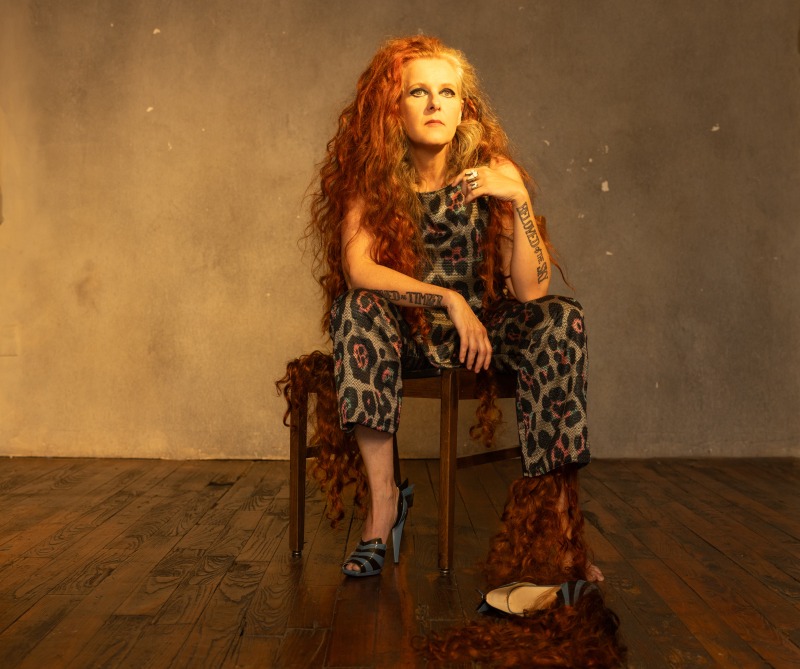
IN SEPTEMBER 2017, CASE’S Barnet, Vermont farmhouse burned down while she herself was in Sweden finishing Hell-On. The cause seems to be largely unknown to this day: maybe faulty wiring in the barn sparked into a blaze, maybe her horses’ hay spontaneously combusted because that is apparently a thing that can happen. Thankfully, both her loved ones—including her partner, or as she calls him, her man-friend (on her Substack you’ll just see him referred to as ManFriendJeff, all one word)—and her animals made it out unscathed. But even seven years later, the damage is still felt: the project of rebuilding her house still has a ways to go, at least as of this January, leaving her feeling untethered, unmoored. The financial impact, too, remains brutal to this day, particularly because COVID followed so closely on its heels. Yet when I bring it up, Case mostly waves it off: “Yeah, it’s been rough. It’s been really rough. But I don’t have it any rougher than most people, you know? It wasn’t really a tragedy; it was just a natural event. Nature does what nature does. I mean Houston had just suffered incredible, horrible floods; Puerto Rico was underwater at the time. It was obvious that my partner and I got off easy. The things that have followed have been pretty disheartening, but the actual event itself, it’s not something you take personally.”
She’s not kidding about the “disheartening” things that followed. Between the unimaginably slow-going and expensive process of rebuilding her home, the onslaught of COVID and the financial burden it placed on artists who relied on touring to pay their bills, the ever-worsening relationship between streaming services and musicians, the state of the country at large, and the sudden and inexplicable run of Case’s beloved friends, mentors, and idols passing one-by-one in the midst of everything else, it’s fair to say that the seven years between Hell-On and Neon Grey Midnight Green have not been particularly easy ones.
“I have lost a massive stream of revenue in royalties—although it wasn’t exactly a massive stream to begin with—and that coming at the beginning of COVID was really a harsh awakening that put me in a very, very bad, indebted financial position that I’m still not out of,” she admits. The lack of solid income makes it all the harder to push back against the increasingly techno-fascist vice-grip musicians are being trapped in. Case tells me she wishes greatly that she could leave Spotify, and the only thing keeping her in place is her love for her label, ANTI- Records. “I am 1,000% not okay with the money Daniel Ek is stealing from our music being used to fund killing machines, but I have a 50/50 relationship with my label, and they’re all wonderful people who have put a lot on the line for me, so I will not leave until they give me their blessing, because I don’t want to kneecap them either. And, well, I guess if it were the only avenue of my money being stolen to kill people, it would be one thing, but I pay my taxes and that contributes to genocide as well, so I don’t really know how to maneuver yet. But I’m not giving up.”
This financial rock-and-hard-place situation was bad enough as it was, but when COVID hit, it became a genuine threat. Case needed a new source of revenue, bad—and then Hachette offered to pay her for a memoir. Really, she had wanted to write a novel, but times were tough, so fuck it, she thought, memoir it is. The result was The Harder I Fight, The More I Love You, an unflinchingly vulnerable and honest New York Times bestseller. It was a long, arduous process to get there, but not for the reasons most people seem to think. “You know, a lot of people ask me if it was cathartic or if it was hard,” Case says when I ask if she’s experienced different responses to her memoir versus her music. “It wasn’t hard, because I got a huge mouth and I talk to my friends a lot, so these are stories that my friends know. I’ve done a lot of talk therapy in my life, so there was nothing that surprised me. Really, the hard part was going, ‘Okay, this is a story. How do I make this not fucking boring?’”
It’s hard not to find that a little funny considering the life she put on the page: parents who abandoned her, a mother who faked her own death, abuses and assaults that rippled across generations. Honestly, if Ruskin thought grief unhinged reason and left people weak, maybe all that’s needed to disprove him is the mere fact of Case’s continued existence. Weakness doesn’t walk out of that wreckage with a steely, level gaze and a warm grin—with sanity fully intact. Yet talking to Case today, she tells me that despite the many struggles of both recent and distant times, she is in the middle of her happiest, most vital, most confident years yet. Why? Well—in part, because of going through menopause.
“There’s a point in menopause where it’s like adolescence,” she says. “You don’t recognize yourself anymore, and it’s scary. It’s like being thirteen or fourteen, and you’re in this cocoon and you’re illiquid; you’re like ‘When the fuck do I get out of here, because this fucking sucks!’ But now here I am, and not only did the brain fog of that clear, but my generative brain, my creative brain, is much stronger and much more nimble than it used to be, and there’s a strong confidence that comes with that. And the really exciting part for me, being fifty-four, is that I’m watching women take on new careers in their fifties. Going back to school, and absolutely breaking the stereotype of ‘we’re done in our fifties—and not just women, but anybody.”
The belief that life does not end after your thirties is frustratingly rare in Hollywood and in the music industry, with pop stars and actors trending younger and younger, and more mature celebrities—especially female ones—forced into retirement earlier and earlier. It’s ridiculous: the body is natural, animal; how could it be wrong? This ageism is not just on the screens or in our playlists, either; it takes its toll in every walk of life. Case, of all people, would know: “My dad killed himself around the age I am now, because he couldn’t keep his job and he felt like he had no use and it broke him. There was absolutely no reason why he should have been cast aside, considering that he could do the analog version of the job and the new computer version of the job. It was just because he was older. So I’m just hoping that this tide of women—and men!—doing these things, going back to school and becoming lawyers and psychiatrists and all of that, really changes the future for people. You really do not have to get it all done in your twenties and thirties.” Her eyes then train on me—a very obvious anxious twenty-something—through the screen, warm and knowing. “There’s so much excitement coming, and it’s so awesome for you. I mean it.” Then she laughs—or snorts, kind of. “Yeah. No, I would never go back.”
This newfound self-assuredness is evident even in the small shifts she’s made to her public persona—less a change in her own life or character than a pointed alteration of terminology. For one thing, Neon Grey Midnight Green is the first time Case has listed herself as the sole producer of a record, despite having been the main force behind her production for years and years now. Her previous reticence to say as much in an official capacity was less rooted in some sort of insecurity or uncertainty than it was a desire to honor the collaborative process behind any and all records—but it’s 2025, and things are bad, so if you have a platform, you might as well use it. “I thought it was time to say that it’s me, because there are not a lot of women or gender non-conforming people out there who are producers,” Case explains. She also points out that the record was recorded at her own studio—which is more of a feat than it should be, because while it shouldn’t be that rare, Case cites that only 0.03% of studios are owned by women and gender non-conforming people. “I just… I don’t want people to forget. It’s easy to forget. I mean, even in my own mind, when I think of ‘Oh, we need a producer,’ I immediately think of a man. It’s just an unspoken default that doesn’t represent what is actually true. So this really isn’t some”—here she twists her face into a mock-accusatory frown and jabs a finger at my screen—”’Hey you, not labeling shit right, you asshole!’ It’s like… Even I forget. So let’s not forget.”
Oddly enough, her experience with labeling herself as the album’s producer has a near exact parallel with her experience with labeling her own gender identity. She laughs as she tries to explain what she means: “Like. Production—I’ve started saying this, but I’m not sure if people understand what I mean—it’s very much like gender. It’s a spectrum.” Or, at least, it has been for Case. Because just as she’s been the producer for a long time despite only now labeling it in an official capacity, Case has long refused to fit within the strict categorizations of “man” and “woman,” but it’s only this year she’s come out as genderfluid. This has, honestly, been a long time coming: as early as 2013, she told NPR, “I don’t really think of myself specifically as a woman, you know? I’m kind of a critter. I’m an animal. Everyone’s an animal.” The same year, she released The Worse Things Get… which includes lines like “I’m a man / There’s innocence in all mankind / It’s what kind of animal I am / It’s that simple” and “I was surprised / When you called me a lady / ‘Cause I’m still not so sure that that’s what I wanna [be].” To Pitchfork, in 2018: “I don’t know if I would even identify as a woman if they didn’t fucking hate us so much. I’d love to not even think about it, but I can’t abandon my post.” But it wasn’t until speaking with PBS NewsHour to promote her memoir earlier this year that she officially came out as genderfluid. The timing tracks, too, considering her memoir concludes with the following (partially excerpted) paragraph:
“I am a person who is not quite a woman, not quite a man. […] Someone with werewolf tufts who sometimes turns inside out. Perhaps this is true for you, too—a feeling of being a little bit strange, of having some fur and teeth, and shadows of the forest flickering across the back of your eyelids. […] I wish you freedom and the knowledge of being a part of the world’s tenderness. I hope whenever the chance comes you will take it and feel your heartbeat along its true, original course—down the ever-changing river of you.”
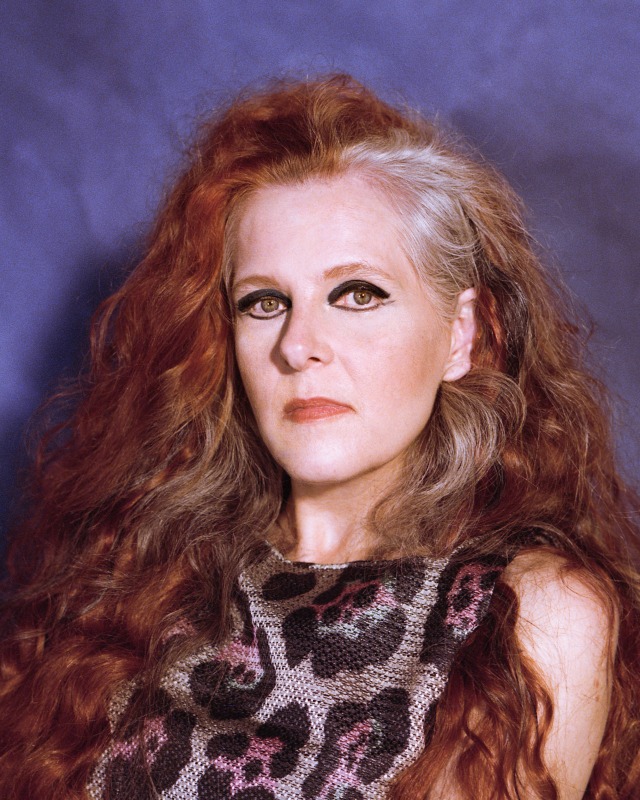
DURING THE MAKING OF Neon Grey Midnight Green, over half a dozen of Case’s inspirations and loved ones died, one after the next. Skylark’s Donny Gerard, the Sadies’ Dallas Good, the Muffs’ Kim Shattuck, Flat Duo Jets’ Dexter Romweber. Garth and Maud Hudson of The Band, painter Angel Alonso, director David Lynch. Peter Moore, who mastered all of Case’s albums. Her friend Diane Butler, who loved listening to Case’s music nearly as much as Case loved making it. The record is, in part, an ode to them and their art—and to grief itself. “Grief, like love, is not a one sided coin, or even a flat surface. It is a universe,” she says. “It is such a rich place, and should not be ignored or taken for granted. It should be experienced and respected. There are gifts that come to you—not that that’s why you do things! But some of the things that land with you are so comforting they can put out embers of things that you’ve worried about for twenty-five years, that contribute to trauma around you. It’s just such a complicated yet simple [experience]. I can’t pretend it isn’t happening or look away. And why would I look away from someone’s death? It’s too important.”
Take “Winchester Mansion of Sound,” a gorgeous elegy to Dexter Romweber and the impact his music had on Case’s life—which, if you’ve read her memoir, truly could not be overstated. (Some lines in the song might even ring familiar with the original text: When she sings “You’re too much life for just one body,” you might remember her describing Romweber in the book as having “a force of something too big to contain in [his] body.” Then there’s the lyric “If you think I’m talkin’ ‘bout romance / You’re not listening” and the sentence in her memoir about hearing Romweber’s music for the first time, “This was a new kind of love that hit me like a lightning bolt from the sky. Not a romantic one, but an all-consuming one.”)
In the myth of the Winchester Mystery House, construction could never stop—because if it did, the widow inside would die. Case’s song takes that superstition and makes it personal: here, music is the house, and stopping would mean losing the life and memory inside it. The song builds like an endless, looping architecture—bright, prismatic piano notes and spare chords opening into new rooms, each one holding a fragment of a life. Her voice moves deliberately through them, sometimes steady, sometimes catching on the air, always finding another hallway. When, nearly four minutes in, she pivots into the sing-song “Down down, baby, down by the roller coaster,” it’s not a break but an extension—the house adding another wing overnight, keeping the sound going so the loss doesn’t turn final. If you keep playing, the music says, you keep the person alive. We might be mortal, but our songs are not. “Only music is forever,” she sings. “You’re a Winchester Mansion of sound.”
Album closer “Match-Lit” is another ode to a recently deceased friend: Dallas Good, whose sudden 2022 passing came as an unimaginable shock. Once more, the song reprises the memoir: a strange verse in the second half of the song describes a dream in which the speaker sees a late friend “match-lit / With mischief and laughing, ‘Watch this!’” as they then zip themselves up inside of a cactus, yet that abstraction (which is evocative enough on its own, in the context of the song) is rendered doubly intelligible by an extended passage towards the end of her book. The dream she sings about here was one she very much had, and it was the only thing that ended up mollifying the misery she felt in his wake. It was, in her words, one of those aforementioned gifts that grief brought her: dreams, moments “when the past returned, but this time brought with it something sweeter.” The song is set to what sounds like the ticking of a clock, seemingly some metaphor for the perpetual threat of time weighing on us all, but that is not, in fact, what’s going on. In reality, that metronomic clock noise comes from a solar-powered Japanese toy that has two cats nodding back and forth (hence the clicking sound), because Good loved cats, and Case knows he really would’ve loved a cat toy serving as percussion. There’s something so unintentionally apt about the chasm between the assumption versus the reality of that background instrumentation: as it turns out, that ticking is not a reminder of time bearing down on our short mortal lives, but a means of immortalizing the joy of a late loved one in song. Music is forever, after all.
If grief is a gift, then music is a little like the ribbon tied around it: keeping it whole, safe, intact, beautifully and intentionally presented, all the while removing the danger of it falling apart in your hands then leaving you to pick up the pieces. Music is, more than anything, a medium: for grief, for awe, for connection. “The magnificent natural piece of music isn’t just about the musician,” Case says. “It’s the people taking in the music and returning the feeling, amplifying the feeling. That is the circuit that connects us. It’s one we make together. There are no bystanders in the circuit.”
She continues: “If we were to watch a David Attenborough special about humans, one of the things he would cover was the fact that we sing. That we communicate orally or verbally. That we can harmonize. And when we sing as a group, even if a group of people who are tone deaf all sing together, it hits you somewhere under your clavicle and under your sternum, and you can start to cry because it is such a powerful sound. A synchronized singing of a bunch of people, even if it’s not perfect, is still perfect. It would be our version of the cheetah in slow motion running for prey, where you just watch his body undulate forward and your mouth is opening, you can feel it in your own body.” And it’s true: when the harmonies on Neon Grey Midnight Green kick into full gear, the swell of the PlainsSong orchestra buoying them, you feel it in your own body, like a phantom limb or a second heart. The communal emotion is what makes them somatic, real. It’s not a fallacy; it’s the most basic truth of being alive.
Even when describing what it is that makes music a uniquely human skill, and how humans are made uniquely meaningful by music in turn, the language and framing Case uses is one of nature, of animals, of David Attenborough’s Planet Earth voiceovers, because of course it is. Singing is, to her, one of the most animalistic, bodily actions a human could take. “The voice is an unbelievably physical instrument. I have, like, weird injuries and crazy stuff I go to physical therapy for that have absolutely nothing to do with what your average life as a human being should be—like, cramping in this position,”—she contorts her body here in a remarkably painful looking way—”because I’m trying to open my throat and hold the guitar at the same time. The unnatural, bizarre things that you do to get the sound out and to make a sound different are all so intensely physical, and I want that to be honored. I just want to feel it when I hear it.”
That’s why it’s so important to Case to “leave in the human feeling of recording” in all of her albums. In the case of Neon Grey Midnight Green, this meant “using way more bed tracks—using more first vocal live-off-the-floor takes than I ever have. Some shirt sleeves stayed that might not have, you know? I just wanted that ‘humans were here’ feeling.” Humans, yes, but by extension, animals too. “If somebody is a really great singer, hearing them take a breath is one of the great pleasures. It’s like—again—watching a cheetah run in slow motion, watching their chest expand and watching how they breathe.”
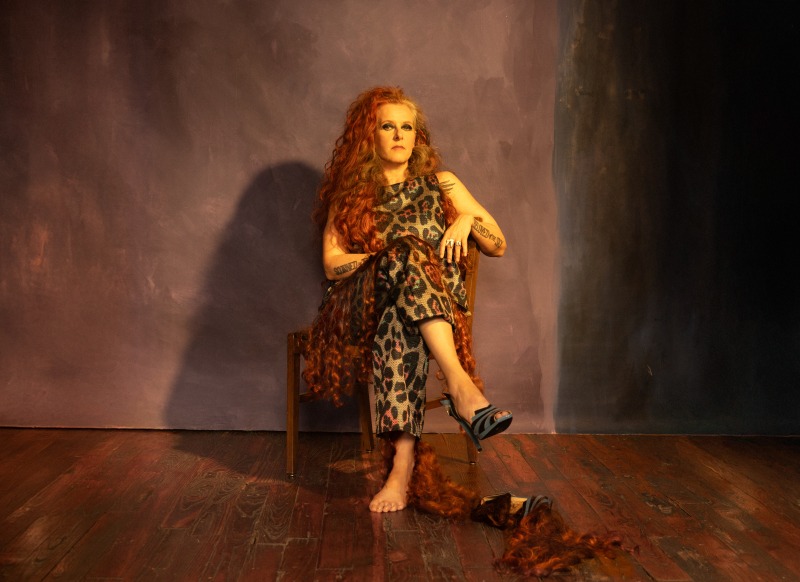
NATURALLY, CASE’S PENCHANT for writing about animals and the natural world is well-known, and even well-documented. But it’s not just that she writes about nature, but rather that she writes from it, through it—as if she feels more comfortable examining certain facets of human life when filtered through an animal, natural lens; as if she views herself less as a human man or woman than an animal. That is, again, probably because she does (see: the earlier 2013 NPR quote about being a “critter”). In that sense, it’s not so much that she applies human feelings, thoughts, values, and descriptors to the natural world—a la Ruskin’s supposed pathetic fallacy—than it is the other way around; chremamorphism or zooism rather than anthropomorphism.
When you know to look for it, this thread crops up everywhere, on every album she’s released. In fact, on the very first track on her very first record (1998’s The Virginian, released under the name Neko Case & Her Boyfriends), she already saw herself as a felled tree: “Now I’m falling timber,” she sings, “Timber the falling tree.” One of her most popular songs is “I Wish I Was The Moon,” off 2002’s Blacklisted, and that one’s rather self-explanatory. So too is this line from 2006’s Fox Confessor Brings the Flood: “I’m just an animal and cannot explain a life.” That notion is taken even further on her next record, Middle Cyclone, which features the song “I’m An Animal” (and also another of her most beloved tracks, “This Tornado Loves You,” which is, of course, a song embodying a tornado).
When the light hits her right on The Worse Things Get, The Harder I Fight, The Harder I Fight, The More I Love You, she becomes a whole horde of wild creatures, no longer a singular animal or natural entity but a community of them. This expansion reaches its pinnacle on the title track of 2018’s Hell-On, which sees her declare herself to be “wilderness” itself, “the undiscovered continent for you to undress.” It’s the logical culmination of an unintentional arc that began twenty years prior, with her described as a lone tree. But, as she warns on “Hell-On,” that does not mean she will be colonized: “But you’ll not be my master / You’re barely my guest / You don’t have permission / To take any pictures / Be careful of the natural world.” Each of these images refuse that hard border between the human and the natural; in Case’s music, animals and emotions are not metaphors gone astray, but evidence of how perception and reality actually work.
“I think we lost something when wildness, wilderness, started to be used as negatives,” she tells me now. “It’s a very colonial idea, this framing of wilderness being an unknown, dark, savage place, when actually the wilderness is what’s right. We are part of the wilderness, and have a lot to learn from the wilderness. We desperately need to let wilderness and wildness resume its rightful place as the great teacher, the great comfort, the big protector and cornucopia and kitchen and everything else that it is—that’s what’s important to me.”
Unsurprisingly, that is precisely what Neon Grey Midnight Green does. So much of the album returns to this craving for wildness: “Destination,” one of the best openers to any album I’ve heard this year, begs to “live a real life / With blood and dirt / And the subway for dessert and more!” It’s an ode to the women and gender non-conforming artists and individuals who refuse to follow the patriarchal norms of formality and stoicism, instead living “in the gutter / Mingling with the slurry” and being always “more than a housewife, a has-been, or just somebody’s lover.” The experimental, addictive follow-up, “Tomboy Gold,” takes a more mechanical, methodical approach to this wildness, all discordant jazz as Case sings about hip-checking her way through a crowd with no thought to potential bruising of skin or ego, her only aim to reach the center, the question “Where is my heart?!” echoing through the chamber of the song all the while.
“Wreck” turns the speaker into “a solar system / […] An eruption / A wreck of possibilities / A volatility of stars.” The brutal, heartrending “An Ice Age” (made all the more painful with the knowledge imparted by Case’s memoir) sings of swimming in high tide “‘Til you see your mother in the brine / Of oily slick communion waves / Screaming something she can’t say.” The tide, the ocean, the natural world, is not framed as the danger here; that dubious honor goes to the sickly tar of humankind’s assault upon nature’s agency. The title track yearns painfully for freedom, the kind found in “driv[ing] barefooted / To live the ecstasy of animal speed,” in climbing “a tempest / To feel the strangle of my rage release.” “Baby I’m Not (A Werewolf)” returns to that same werewolf-as-gender-identity motif seen at the end of Case’s memoir, but expands beyond it, clawing and biting its way out of myth-making and into the real world: “I ate every story, I ate every myth / And when I finished with the minotaur / I ate the Labyrinth.”
On top of all those line-by-line references to wildness and wilderness, there’s “Little Gears,” a song that chronicles the envy that bubbles up inside Case as she sees how quickly and easily a spider creates its intricate, fragile web: “I’d assumed it was a three day event,” she sings. “But she finished it in less than an hour / I felt cheated by how easy it was!” It’s funny: Ruskin would ask us to observe a spider building its web with cold objectivity, arguing that the attachment of any emotion or moral charge towards the act would be little more than the remnants of oversized ego and human sentiment getting caught in those silk threads like thrashing prey. Case would, quite frankly, think that’s fucking stupid. Watching in awe as the spider spins its web is not producing “a falseness in all our impressions of external things.” Falseness would be refusing to acknowledge the animal, natural miracle taking place in front of your eyes in the name of some skewed ideal of anthropocentric impartiality. If Ruskin warned against being ‘over-dazzled,’ Case insists that dazzlement is the only honest response to being here at all. As she sings towards the end of the track, “Why do people need to feel so special all the time? / So above it all? / We all crave some wildness / we cannot know.” (That includes you too, John).
That old Victorian warning said that violent feeling falsifies the world. Case would say the opposite: that numbness does. Her records keep the breath, her body keeps the score, her songs keep insisting we’re animals among animals—ravenous, aching, powerfully not alone. That togetherness is more important than ever now, in a world addicted to convenience and technology. “People are so powerful—so strong and weak and interesting—and not in relation to devices, or to the tiny universe that an algorithm is,” Case says, gesticulating for emphasis. “It’s such a small, small, small viewpoint, and yet we’re supposed to treat it like it’s something global, or universal. It’s not. Only human connection is, which is why it’s a muscle that we have to keep exercising.”
And then she says something that will probably stay with me for a very, very long time: “This is all we have—or, well, it might not be all we have, but it is all we can perceive right now. We are not waiting for a Christian fucking shuttle to come pick us up after we’re done throwing plastic all over the ground. So why would we just spend our lives like we’re waiting at a bus stop—and not just waiting, but destroying the bus stop, punishing the fuck out of the bus stop, while we wait? This is the heaven. And we have to start living like it.”
Neon Grey Midnight Green is out September 26 via ANTI- Records.
Casey Epstein-Gross is Assistant Music Editor at Paste and is based in New York City. Follow her on X (@epsteingross) or email her at [email protected].
 Keep scrolling for more great stories.