
Nirvanna the Band the Show the Movie the Moment
Both films underline not only how humiliating the impulse to make art can be, but how you have to always be promoting it, marketing it, reacting to it, figuring out new ways to sell it (and yourself) over and over again.
Image courtesy of NEON/Elevation Pictures
“If you’re gonna do it, you have to, like, do it.”
The most important line in Charli XCX’s mockumentary about the fictionalized rise and fall of “Brat Summer” is uttered by none other than Kylie Jenner. Charli and Kylie run into one another at a luxury spa in Ibiza where Charli has fled to escape the stress of her upcoming tour and concert film, only to end up even further troubled by the precarious position her career is in. Charli is visibly out-of-sorts—her hair fried with humidity, her skin red and irritated from a spa treatment gone wrong—while Kylie looks airbrushed and uncannily serene, speaking to Charli with a faux-polite condescension. Kylie only appears in a single scene, but her performance is essential to the tension and at times sheer terror of The Moment. She’s the embodiment of perfection and optimization, and she wields pop culture dominance with a perfectly-manicured iron fist. To play oneself on film is harder than it looks, but Kylie grew up on reality television—in some ways, she’s been playing a fictionalized version of herself for her entire life.
You know who else are no strangers to playing fictionalized versions of themselves? Lifelong best friends and collaborators Matt Johnson and Jay McCarol. In their 2007-2009 webseries, Nirvanna the Band the Show, and 2017-2018 Viceland sitcom of the same name, the two play a pair of bandmates also named Matt Johnson and Jay McCarol. Their band name might be Nirvanna the Band (no relation to Nirvana; in fact, the characters are canonically unaware of the seminal grunge band’s existence), but calling them a “band” is itself a bit of a misnomer; they’re an improvisational duo, with Jay playing piano and Matt coming up with on-the-spot interpretive songs, skits, and spoken-word pieces. More than anything, they’re hellbent on playing Toronto music venue the Rivoli. On its surface, the show is quite formulaic—each episode usually revolves around a harebrained, often questionably legal, and never successful scheme to book a show at the Rivoli. The series is largely unscripted; its structure contingent upon placing Matt and Jay in plot-generating scenarios and letting them riff on their surroundings. This often involves interactions with random members of the Toronto public who are unaware that they’re part of a TV show. Two in-universe camera operators are there to document Matt and Jay’s misadventures on their Sisyphean quest to play a show at the Rivoli—a goal that drives the recent film adaptation, Nirvanna the Band the Show the Movie.
I watched The Moment and Nirvanna the Band the Show the Movie within a few weeks of each other and have since been trying to make sense of the almost equal-opposite yin-yang reactions I’ve had to each of them and the parallels between the two—beyond just the detail that both films happen to include cameo appearances from Anthony Fantano.
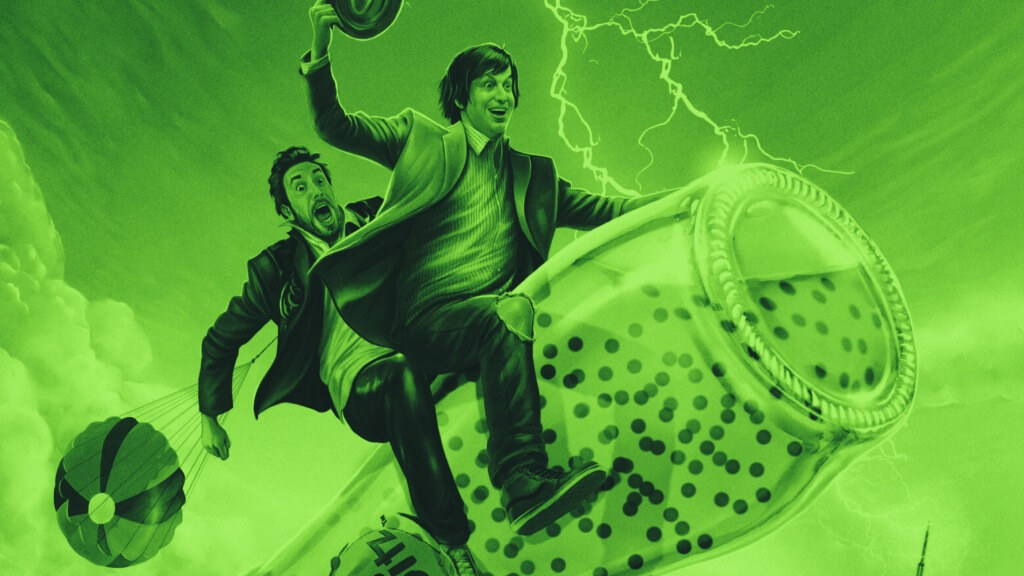
Neither film fits neatly into the mockumentary genre. Nirvanna incorporates a sci-fi element in the form of a Back to the Future parody plot, enabling meta-interactions between past and present versions of Matt and Jay by editing in decade-plus-old footage shot for the original webseries. Beyond the VFX and supernatural elements introduced to a fictional universe that formerly skewed more slice-of-life, the stunts they’re pulling in the film are more ambitious and grander in scale than anything they’ve done for the webseries or Viceland iterations of Nirvanna the Band, a true testament to Matt Johnson’s permits-be-damned, “ask for forgiveness, not permission” directorial approach. Their hijinks include acts like filming a crime scene outside Drake’s Toronto mansion, attempting to skydive off the CN Tower into the Skydome, and returning to the CN Tower to run an electrical cable from the top of it to a street-level power outlet.
In short, they’ve embodied Kylie Jenner’s words of wisdom: “If you’re gonna do it, you have to, like, do it.”
THE MOMENT IS CLEARLY in the same lineage as more straightforward parody rock-docs like This Is Spinal Tap, Walk Hard, and Popstar: Never Stop Never Stopping, with the real Charli XCX serving as the protagonist for a quasi-autofictional, alternate reality series of events following the real-life Brat Summer—though it’s decidedly darker in tone than its predecessors, taking on a horror movie quality. It commits to its biting satire of the music industry in individual beats: A major plot point involves Charli reluctantly partnering with a fictional bank to release limited-edition Brat-green credit cards, and the film’s villain comes in the form of Johannes Godwin (played by the scenery-gobbling Alexander Skarsgård), a director brought on by Atlantic Records to direct an Amazon-exclusive Brat concert film. Charli is hesitant to collaborate with Johannes at first, decrying his work with other female pop artists as, “Adverts for women…like the woman is the advert.” Her initial assessment of him proves correct: Johannes waters down Brat’s basement rave aesthetics into something more family-friendly and Eras Tour-esque (Taylor Swift’s presence hangs over The Moment as the pinnacle of commercialism and the antithesis of Brat; the film ruthlessly mocks her without ever mentioning her by name).
Despite her skepticism towards Johannes’ vision—and to an extent, the very idea of prolonging Brat Summer—Charli ends up capitulating to the demands of her record label and Johannes, ending her collaboration with her friend and longtime creative director, Celeste (Hailey Benton Gates). As the film closes with a hilarious and haunting, sanitized and Swiftified version of the Brat Tour, Charli delivers a monologue-via-voicemail to Celeste explaining her decision to relinquish ownership over her magnum opus, thus relieving herself of the pressure to be cool: “I’m doing this hideous fucking show not to keep Brat going, but to destroy it, to let it die.”
In some ways, The Moment feels like a defense of selling out—a concept that somehow feels both ubiquitous and nonexistent in an era in which adoring fans will comment “marketingggg!” on a promotional post for an album rollout or celebrate their favorite artist landing a brand deal in the same way they’d celebrate that artist winning a prestigious award. The Moment’s denouement, while funny and in some ways downright terrifying, comes across as real-life Charli’s way of using fictional Charli to remind the day-one fans—the angels who were bumping “Vroom Vroom” at warehouse parties back in 2017, those of us who had Sucker and True Romance on our iPod touches—that however cringeworthy they think her ascent to the mainstream has been, it could’ve been so much worse. It’s as if she’s saying, “You think I’m a sellout? I’ll show you what selling out looks like! I know you all cringed when a bunch of young professionals with coconuts in their social media bios declared themselves ‘So Julia’ and hung their Brat flags at half-mast when Kamala Harris lost the election, but at least I never strapped myself into a harness and flew around a stadium full of virgins in light-up bracelets!”
As a fictional broadcaster wonders aloud in a radio snippet, “Was [Brat] ever something purely devoid of commerciality, which supposedly killed it in the first place?” The Moment opens with a strobed-out close-up of Charli dancing to the “365” remix while brand names and logos flash across the screen—from Aperol to Bumble & Bumble to A24. Perhaps it’s her way of telling us that she’s been selling out all along.
Across the pond and in the Nirvanna universe, Jay McCarol is faced with his own “to sell out or not to sell out” dilemma. He’s already got a foot out the door after 17 years of going along with his best friend and bandmate’s elaborate, dubiously ethical plans that always end up failing. When he and Matt accidentally time travel to 2008 and then to an altered version of 2025, Jay finds himself in a timeline where he stopped being friends with Matt, quit the band, and went on to become a world-famous solo musician. Meanwhile, Matt is the drummer in a Jay McCarol cover band. It’s through Matt’s eyes that we watch a Jay McCarol stadium show, which feels akin to Charli’s post-Swiftification concert film—middlebrow, inoffensive, maximized for mass appeal, a little soulless, and necessitated by the abandonment of the star’s most trusted creative collaborator.
Jay’s brush with global fame proves to be unfulfilling and far more trouble than it’s worth. It’s only once he reconnects with his old friend when in need of Matt’s wild scheming that he realizes he was better off in the ordinary life that they shared. At the last minute, he chooses to restore the timeline and go back to improvising in anonymity with Matt.
THERE’S A SCENE IN The Moment where a brusque esthetician named Maria (Arielle Domabasle) chastises Charli for putting too much pressure on herself and her career. When Charli protests that she’s two weeks out from a world tour, Maria retorts, “So you need the entire world to know you’re an artist in order to make your art?” “No, I never said that,” Charli responds.
Part of what both of these films get at is just how humiliating the impulse to make art can be. From the outside looking in, the creative drive is not always an understandable one, the goals that come with it are seemingly arbitrary, and the artist’s rationale can often only be explained through the work. You care about something for however long—until the product of all that caring convinces other people to care as well. The process is rarely representative of the outcome. The humiliation doesn’t end until the art justifies itself, and even then, there’s no guarantee.
In a scene early on in The Moment, Charli’s van driver googles her name and watches the first result—the “Boom Clap” music video—on his phone and remarks how different Charli looked at the time (“It was for a movie about kids with cancer,” Charli mutters dryly from behind a massive pair of sunglasses). While sneaking into their old apartment, 2025 Matt and Jay end up hiding in a closet for fear of being noticed by 2008 Matt and Jay. What follows is a sequence in which the older Matt and Jay are trapped for hours listening to their younger selves rehearsing musical performances—which viewers of the original webseries will recognize as “The Can Opener” and “Update Day”—visibly annoyed and embarrassed. Each of these scenes is one of the funniest in their respective films, and each captures the humiliation of revisiting your older work—whether it exists in obscurity or not —and cringing at how much (or how little) it deviates from your current artistic identity. At the heart of the comedy of each of these scenes lies that hilarious, crucial, and terribly embarrassing kernel of self-recognition—the moment of “Oh my god, that’s me.”
Whether or not it’s intentional, both of these scenes also seem to poke fun at our current cultural obsession with artists explaining or reacting to their existing work and audiences’ appetite for endless contextualization—much of which works as fuel for the artist-as-influencer economy. It’s never enough to just create something, you have to always be promoting it, marketing it, reacting to it, figuring out new ways to sell it (and yourself) over and over again.
As fourth-wall-breaking pieces of what I’ve been loosely referring to as “Tryhard Cinema,” The Moment and Nirvanna the Band the Show the Movie are metatextually concerned with the concept of “cringe.” Charli wonders aloud throughout The Moment whether it’s “cringe” to continue capitalizing on Brat’s runaway success. In Nirvanna, the famous version of Jay initially distances himself from Matt, seeing the cringe aspects of his ex-best friend’s personality as a liability that would jeopardize his newfound celebrity status. Jay struggles to connect with his new entourage, revealing that the parts of Matt that he found embarrassing are within him as well, and that his own social ineptitude can’t be sloughed off by abandoning the one person he could be his uncool self around. It’s not until he comes running back to Matt (out of pure self-interest at first) that his love for making music—and his love for his friend—is reignited.
Charli’s embrace of cringe feels more sinister. “I’ve spent my whole life trying to get approval or something,” she tells Celeste after forgoing their original vision for the Brat Tour. “Trying to get in, trying to be cool.” She’s only able to accept the cringe when she can convince herself that it’s not her own, when she can pass off what she’s feeling as secondhand embarrassment rather than firsthand.
Part of what was so fascinating about Brat and the cultural phenomenon around it was that this was never designed to be the album that broke Charli through to the mainstream—in fact, it was almost the opposite. Her previous album, Crash, was created with a more commercial sound and visual aesthetic in mind. When that failed to cement Charli as a mainstream pop star, she embraced her cult classic status with Brat, only to transcend the niche that she’d carved out for herself.
In some ways, Nirvanna the Band the Show the Movie ended up being another unlikely case of pop culture containment breach. There’s even a scene in which Matt—in-character—calls the film “a copyright nightmare,” going so far as to doubt that it’ll ever get a proper release. “If you’re watching this in theaters, thank your lucky stars,” he says, staring directly into the camera. “Because this is gonna be the only screening of this ever.” A feature film adaptation of Nirvanna the Band had been in the works for over a decade, predating the Viceland show, and its funding only became possible after the success of Matt Johnson’s 2023 film BlackBerry—a movie noticeably more polished and less experimental that his other directorial works.
The characters of Matt and Jay earnestly believe that they’re destined for stardom (or at least, for a show at a 200-cap local venue), despite having no recorded music, no following, and the same name as one of the biggest bands of all time Their failure is necessary for the plot. Once Nirvanna the Band plays the Rivoli, it’s over. Ultimately, theirs is a story about the artistic necessity of failure and the value of making incomprehensible, unmarketable art with your friends—even if those friends happen to kind of suck sometimes, and even if the art kind of sucks sometimes too. Maybe a happy life is going nowhere, riffing in obscurity with someone who really gets you. One must imagine Sisyphus cringe but free.
Grace Robins-Somerville is a writer from Brooklyn. Her work has appeared in Pitchfork, Stereogum, The Alternative, ANTICS, Marvin, Swim Into The Sound and her “mostly about music” newsletter, Our Band Could Be Your Wife.
 Keep scrolling for more great stories.