
Those pristine days of Human Performance I recall so fondly
Ten years ago, Parquet Courts figured out what kind of band they actually were, which turned out to be a bigger, stranger, and more emotionally complicated kind than anyone—themselves included—had believed.
Photo by Tasos Katopodis/Getty Images
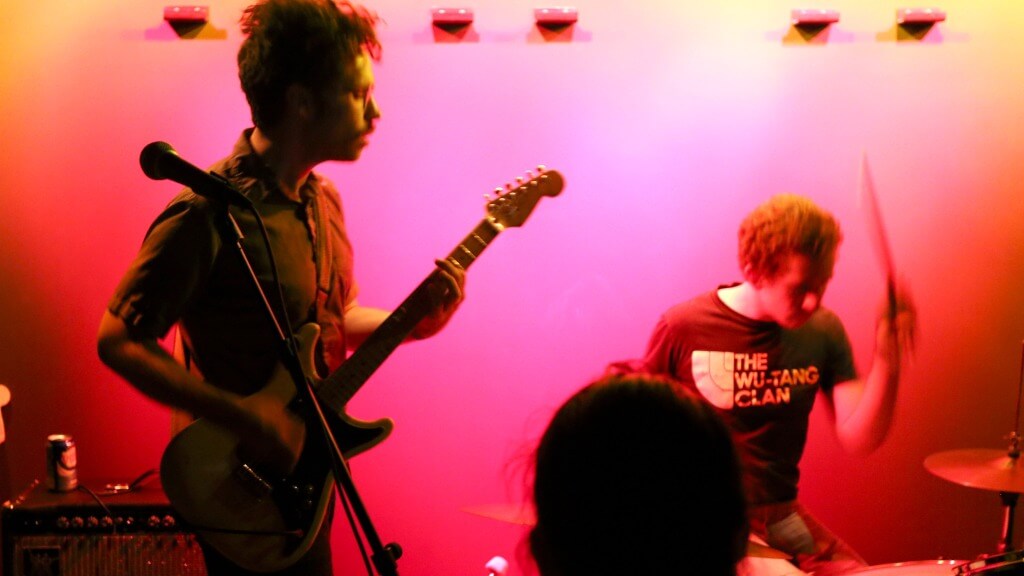
When I told my dad I was writing an anniversary piece about Parquet Courts’s Human Performance, which turned ten years old yesterday, he immediately scoffed. “That album came out yesterday,” he said, his voice tinny over the speakerphone. “It hasn’t aged at all. It’s way too soon to write an anniversary piece on it. Nothing has changed!”
On some level, he’s not wrong. The Brooklyn band’s third proper album (or fifth, if you count the limited release of American Specialties and Parkay Quartz’s Content Nausea) sounds like it could’ve come out last week. And, for a lot of people, it may as well have. In the grand scheme of things, ten years is nothing at all, hardly a blink of the eye. But this decade, I’d argue, feels more distinct than most. At the time of Human Performance’s release, Barack Obama was still president. Donald Trump had yet to step foot in the White House, and his candidacy still felt, largely, like a massive joke. The #MeToo movement had yet to materialize. Coronavirus wasn’t visible on even the most distant of horizons. In the past ten years, the world has ended and put itself back together again a half-dozen times.
Although Parquet Courts released Sympathy for Life just five years ago, it’s hard not to view them as a thoroughly 2010s band—not in the least because we haven’t heard so much as an inkling of new material from them since that album’s release (although, thankfully, frontman A. Savage’s solo projects have filled that void somewhat). Savage himself was a DIY kid from the word go, hopping from band to band in his hometown of Denton: Teenage Cool Kids, Fergus & Geronimo, Wiccans. He and his friends even built a home studio—the bedroom served as the control room, the detached garage the tracking room, with a snake of cables wound through the whole house. It wasn’t until he met fellow vocalist and guitarist Austin Brown, at a record club called Knights of the Round Turntable at the University of North Texas, that the groundwork for Parquet Courts was laid. When the pair moved to Brooklyn after graduating, they dragged Andrew’s drummer younger brother, Max, along with them, and joined up with Boston native and bassist Sean Yeaton, whom Andrew had met at a DIY venue back in Denton. Parquet Courts was off to the races.
The band started in 2010 and put out their debut, American Specialties, as a limited cassette release the following year, meaning it ended up largely unheard by most until Rough Trade reissued it in 2021. 2012’s searing art-punk record Light Up Gold is often considered their debut for that reason—it was, after all, the band’s breakthrough, with the slacker-rock scorcher “Stoned and Starving” becoming the quartet’s calling card. The twitchy but ever-literate Sunbathing Animal followed two years later, slowing things down into a moodier groove, although Savage and Brown released the harsher, weirder, punk-forward record Content Nausea under the semi-pseudonym Parkay Quarts the same year. They seemed to wear certain inspirations—Velvet Underground, Modern Lovers, Pavement (although they tend to deny this one), and the like—on their sleeve, much to the enthusiasm of hipster dads around the country who spent the 2000s spinning Slanted and Enchanted on repeat and yearning for the days of good ole guitar music to return. The 2010s heralded an indie-rock revival of sorts, with Malkmus sound-alikes and Talking Heads cover bands galore, but few acts brought that sound to life with as much fervor and verve as Parquet Courts. In other words: they weren’t the only ones to do it, but they did, perhaps, do it best. (As Brown once put it, “We’ve learned how to write a Parquet Courts song… And I think a lot of other bands have learned how to write a Parquet Courts song, too.”)
Being ceaselessly compared to some of the most beloved bands of the previous era was both a blessing and a curse, though. The band’s detractors used to scoff that they had little to offer beyond their influences, and the members themselves often rankled at being so pigeonholed. The similarities were self-evident, it’s true, but Parquet Courts was also downright weird (see: “Everyday It Starts” from Content Nausea), and their trajectory was perpetually unpredictable. A lot of the band’s quirks and idiosyncrasies were overlooked in favor of framing them as the sole reincarnation of ‘90s-esque indie rock.
This frustration was, perhaps, what brought about Monastic Living in 2015, the band’s “aggressively ambient” (to quote a review) instrumental EP. The reception to the quartet’s first Rough Trade release was, to put it mildly, rough. Pitchfork gave it a grim 4.9 (a far cry from the 8.0s and up their earlier records received), with reviewer Jazz Monroe lamenting the wordless songs as “tuneless.” But the band, for their part, could not have been more relieved. As Brown told The Skinny, “[I]t drew a really interesting line in between the fair weather indie rock fans and people who maybe understand us on a deeper level… The vitriol that was written about that record is really what defines it as a success for me.” Savage agreed, telling SPIN that Monastic Living is simply a record “that was not built for rapid critical consumption.” In Brown’s mind, it was an extremely crucial moment for the band’s trajectory, as it blew up the narrative surrounding them until that point. “I’m glad we had that experience because it helped define our group in ways that I didn’t realize [we] needed defining,” he said. “When people were taken aback by it, I realized that’s something we may not have translated as well. Then it became really important.”
Despite sounding nothing alike, Monastic Living was recorded during many of the same sessions as Human Performance. The two exist in relation to each other, two sides of the same strange coin—the band has compared it to the dynamic between American Specialties and Light Up Gold, with the first record of each pair serving as a palate cleanser before a new creative cycle. It was all part of the release strategy, in the end: “I think it would’ve been less interesting to have our first release on Rough Trade be Human Performance, instead of arguably our most challenging record to date,” Savage said. And perhaps that’s true. Monastic Living forced the public to undergo a year-long critical re-evaluation of the band’s identity—what kind of band even are they, really? Were their previous records a fluke?—before suddenly slamming right into Human Performance, the outfit’s biggest commercial success to date.
THE BAND UNDERWENT THEIR own redefinition process throughout the making of the album. In a sharp contrast to the breakneck pace of the recording process for every previous Parquet Courts record, Human Performance took a full year of work across three different studios. The band wrote around 30 songs, but only 13 of which were chosen for the record (or 14, if you count the digital bonus track “Already Dead,” which I do, because it rules). This was by design. As Brown told [sic] Magazine, “We wanted to take some time to get some perspective on our sound. Some perspective on our lives, and what’s going on, and ‘Who are we? What kind of music do we make? And what’s the next step for us?’”
This self-discovery journey, though, was not as monastic as the title of their previous EP might have implied. They worked with everyone from Wilco’s Jeff Tweedy to Spoon’s Jim Eno. The title track was shaped in Easthampton’s Sonelab studio with Justin Pizzoferrato and “Keep It Even” was guided by Tweedy in Chicago, but most of the record was done at Dreamland Recording Studios near Woodstock, New York. The band lived, breathed, ate, and slept in that church-turned-studio for a fortnight, waking up to stained glass windows and fast creative impulses. But in the end, the bulk of the work remained solely in-band, with Brown mixing the record himself (as he did Parquet Courts’ previous ones). It was undoubtedly the band’s most hi-fi work yet—it was, after all, their first-ever time recording with an actual budget—but that’s what made them so certain Brown needed to be the one making the final calls.
There was no hard-and-fast rule for what Parquet Courts wanted Human Performance to be, but there was a particular tightrope they walked: trying to find the sweet spot between “this sounds too much like us” and “this sounds nothing like us at all.” The goal was to land somewhere outside their comfort zone, but within, perhaps, the same area code. Risk was the name of the game. The songs that made the band nervous were the ones that ended up on the record—songs, Brown has said, like “Dust,” “Captive of the Sun,” “One Man No City,” “It’s Gonna Happen,” “Already Dead,” and “Steady On My Mind.”
Opener “Dust” discloses the differences from the get-go, a droning groover with twinkling keys, ambient sound design, honking horns, and even a guest feature from Tweedy himself. Above a single riff that locks in and rides for four minutes straight, Savage and Brown pontificate on the extremely-literal phenomenon of dust. “Dust is everywhere,” they chant, then command: “SWEEP!” (I always heard it as “Sweet!”, so it wasn’t until writing this piece that I learned that the song wasn’t about being repeatedly pleasantly surprised by the predominance of dust in the natural world. But considering there’s a broom sound effect layered in there, I really should’ve guessed the wording earlier on.) “Captive of the Sun” brings a Mellotron into the equation, creating a sonic world built on loops and warps alongside clanking bells and weighted percussion. Add to that Brown’s deadpan half-rap cadence, and there’s almost a hip-hop element to it, one only made clearer by a later remix featuring a legitimate rap verse from Bun B atop the instrumental.
Although Parquet Courts was already no stranger to longer tracks—what with Sunbathing Animal’s excellent “Instant Disassembly” and Content Nausea’s equally excellent “Uncast Shadow of a Southern Myth”—“One Man No City” certainly stands out as the only song on the record to go over the 4:15 mark, clocking in at 6.5 minutes of bongo-driven psych music drenched in David Byrne-isms all over, at least until its ambient coda kicks in. It worms its way into your head and won’t leave for about seven years, or maybe that’s just my experience because my dad used to play it in the car on repeat until we demanded he please, for the love of God, put on any other song.
Meanwhile, “Already Dead,” the bonus track that opens the digital edition, is four minutes of guided meditation, with a soothing female voice calmly instructing you to “take a moment to connect with where you are… feel your feet on the ground without looking at anything at all” over a riff that slowly dissolves into something translucent and strange. Despite the vague sense of distaste I have for all things zen (meditation itself most of all), I find myself charmed by “Already Dead” every time. “Steady On My Mind” is risky for a different reason entirely: it’s a genuine, unambiguous, no-caveat love song, Brown murmuring over a winding Velvet Underground guitar figure about learning to say hello as often as goodbye. He’d later admit that, before this record, he’d always hidden behind lyrical cleverness whenever a song veered toward real feeling, turning phrases “in a way that would make me seem a bit tough and nonchalant and arrogant.” Yet here he is, singing: “Wherever you may stay / There’s where I’ll return / I’ve never felt committed to much / But that don’t mean that I can’t learn.” Character growth, people.
But the song I’d call the biggest departure is closer “It’s Gonna Happen”—a fragile, semi-acoustic ballad chock full of swelling synths. It’s about as far from Parquet Courts’ standard M.O. as you could conceivably imagine. It is also horrendously underrated, with no small number of reviews snarking that a snoozer like this one should’ve been left off an otherwise-great record—a claim I find rather egregious, as the song has snuck its way onto my favorites playlist in recent years. There aren’t many Parquet Courts songs you can cry to, but I’m big enough to admit I’ve shed some tears to “It’s Gonna Happen.” It’s bittersweet and wistful, yearning for something unnameable. The whole thing is built on a single repeated line—”It’s gonna happen every single time, so rehearse with me in mind”—and it drifts in and out of existence, fading and then returning, like it can’t bring itself to end.
NONE OF THOSE GAMBLES would land the way they do if the rest of the record weren’t so sharp at being, well, a Parquet Courts record. The churning melodicism of the title track and the tuneful, Spaghetti-Western twang of “Berlin Got Blurry” make both tracks standouts among the band’s whole discography. “Pathos Prairie” bangs, even as it reminds us of our simultaneous desperation for and inability to handle change. “Paraphrased” is pure Light Up Gold-era motor-mouthed punk, Savage rapidly listing “para-” words and their definitions. The song quiets into a taut, syncopated bridge before eventually detonating into “sometimes my thoughts are infrequent explosions.” “Outside” is 100 seconds of bright guitars and odes to “everything I’ve harmed,” managing to find beauty in the process of self-betterment. “I Was Just Here” is a rare Yeaton cut, and it limps choppily atop a gnarled knot of atonal guitars for the bulk of its short runtime, although the last ten seconds burst into swift, furious strums as Yeaton shouts the titular line again and again. If there’s anything Parquet Courts is good at, it’s making a meal of repetition, and Human Performance is certainly no exception.
But no discussion of any Parquet Courts record is complete without some focus on the lyricism, which has always been one of the Brooklyn act’s strong suits, if not the strongest. They balance humor and malaise with ease, oscillating between the mundane, the absurd, and the universal so seamlessly you fail to notice a difference between them. They’re unfailingly literate, too; how many punk records would use the word “supine” when describing a glass of whiskey? Would quote Descartes in Latin as a lead-up to saying, essentially, “fuck it all”? Of all the bands that fall into the ‘90s indie-rock lineage, Parquet Courts are undoubtedly one of the most thoughtful—and I mean that literally, too, as in “full of thoughts.” Every lyric has a purpose, every song a story to tell.
There’s a line early in the title track—”Ashtray is crowded, bottle is empty / No music plays and nothing moves without drifting into a memory”—that could’ve come from a Raymond Carver story, all bare domestic surfaces concealing something gutted underneath. The song paints a picture of the specter of a relationship so vivid you can still feel its body heat, and you can’t help but feel as if the version of this band that wrote “Stoned and Starving” would’ve swerved away from that kind of exposure before it got within arm’s reach. Over on “Berlin Got Blurry,” the line that always wrecks me isn’t the one everyone quotes about feeling foreign (“Feels so effortless to be a stranger / But feeling foreign is such a lonely habit,” although, yes, that one too) but the throwaway about cell phone service: “Cell phone service is not that expensive / But that takes commitment and you just don’t have it.” Such a small, pathetic, modern admission—you can’t even commit to a monthly plan, let alone a person—and it says more about emotional paralysis than any amount of philosophizing could.
New York City is all over this record, not as a backdrop but as a character in its own right, almost an antagonistic one—as a place that keeps remaking itself faster than anyone living in it can process. “I Was Just Here” is the most literal version of that feeling: the vertigo of returning to a block you’ve walked a thousand times and finding it gutted and rebuilt while your back was turned, every landmark replaced by something sleeker and emptier. (Anyone who’s lived in a rapidly gentrifying neighborhood knows the particular vertigo of that, the way it makes you feel like your own memory is lying to you.) “Captive of the Sun” is the same city experienced from the inside of an apartment you can’t bring yourself to leave, Savage cataloging the sensory assault—garbage trucks, the neighbor’s stereo, the J train’s “skull-shaking cadence” repeating “like a pulse of defeat”—until it all congeals into “a melody abandoned in the key of New York,” nine words that contain an entire worldview. And “One Man No City” takes all of that displacement and runs it to the logical extreme: pure negation.”No town, no city, no identity… no thoughts, no feelings… no you, just me, I think.” It’s a city record in the way that Blonde on Blonde is a city record or Horses is a city record: not because it romanticizes the place but because it captures the particular strain of loneliness that comes from being surrounded by millions of people yet feeling certain none of them would notice if you disappeared.
While Human Performance as a whole is less overtly political than much of Parquet Courts’ discography—a turn inward after the anti-consumerist barbs of Content Nausea and ahead of Wide Awake!’s full-throated fury about the Trump-era normalization of state violence—it’s certainly not without its moments. “Two Dead Cops,” after all, was written after Savage witnessed the aftermath of two NYPD officers being shot and killed in his Bed-Stuy neighborhood in December 2014. “Protect you is what they say / But point and shoot is what they do” sits alongside images of Christmas commercials and “framed plant portraits on the wall,” the dumb persistence of normalcy on either side of a catastrophe that nobody can figure out how to mourn because it just keeps happening. But even apart from that song, politics are a felt presence throughout the record, having migrated from the soapbox to beneath the floorboards. Even Savage’s obsession with confinement—physical, spiritual, mental, the thread he’s traced through every Parquet Courts record—is a political observation dressed in personal clothing, because the things that trap people are rarely just interior.
Human Performance’s trick, in the end, is sequencing: the way all of these registers coexist not because of some grand unifying concept, but because that’s actually what being alive feels like. You sweep the dust in your apartment, mourn a relationship, curse the J train, watch your neighborhood convulse after a shooting, stumble through a foreign city with blurry eyes, and try to figure out whether you’re performing yourself or actually being yourself, and all of it happens in the same body during the same stretch of months. Human Performance is the rare album that sounds like what’s going on inside your head—not a statement about the human condition but the actual chaotic, contradictory, tedious, devastating experience of it.
A part of me will always be partial to the scrappier, weirder, less polished corners of the Parquet Courts catalogue; the oddities and the bruisers and the songs that feel like they were written, recorded, and discarded in a single caffeinated afternoon. And 2018’s Wide Awake! pushes further still, into dance-punk and funk and even more overtly political territory, and it’s probably their peak mainstream moment (and maybe the record of theirs closest to my heart, since it was the first album I got to anticipate as a fan). But Human Performance is the album where Parquet Courts figured out what kind of band they actually were, which turned out to be a bigger, stranger, and more emotionally complicated kind than anyone—themselves included—had believed.
Ten years is both a second and a lifetime. For me, as someone who was only 14 at the time of Human Performance’s release, it feels more like the latter. A lot has happened in the interim, globally, nationally, and personally. I live in New York now, for one thing, and that change alone is enough to make the record register differently in my mind—less an album I’d hear on the drive to school than a field guide to a city I’m still trying to figure out how to belong to. The dust comes through my window, too. Like Yeaton’s beloved Chinese restaurant in “I Was Just Here,” I discovered that my favorite Dominican place (their patacon was to die for) closed about two weeks ago, even though I had a lovely half-hour chat with the owner last month that raised no alarm bells whatsoever. The building is a Lululemon now. I’ve never been great with change to begin with, but this feeling of living inside a palimpsest that is perpetually rewritten in real time is a new one for me. I grew up in the Florida panhandle, and the greatest injustice I ever suffered there was when the Publix in one strip mall closed and moved to the next one two minutes down Thomasville Road (to be fair, I was five, and I did throw a tantrum about it). Now, walking through my current home feels like walking through sand at high tide: every few moments, a wave comes and washes away the footsteps you just left. It’s a disconcerting way to live. Our task as humans is to perform a life, but what good is a play that nobody remembers?
Casey Epstein-Gross is Associate Editor at Paste and is based in New York City. Follow her on X (@epsteingross) or email her at [email protected].
 Keep scrolling for more great stories.