
Do I believe in God? Do I believe in Prince?
Remembering the Purple One, who died 10 years ago today.
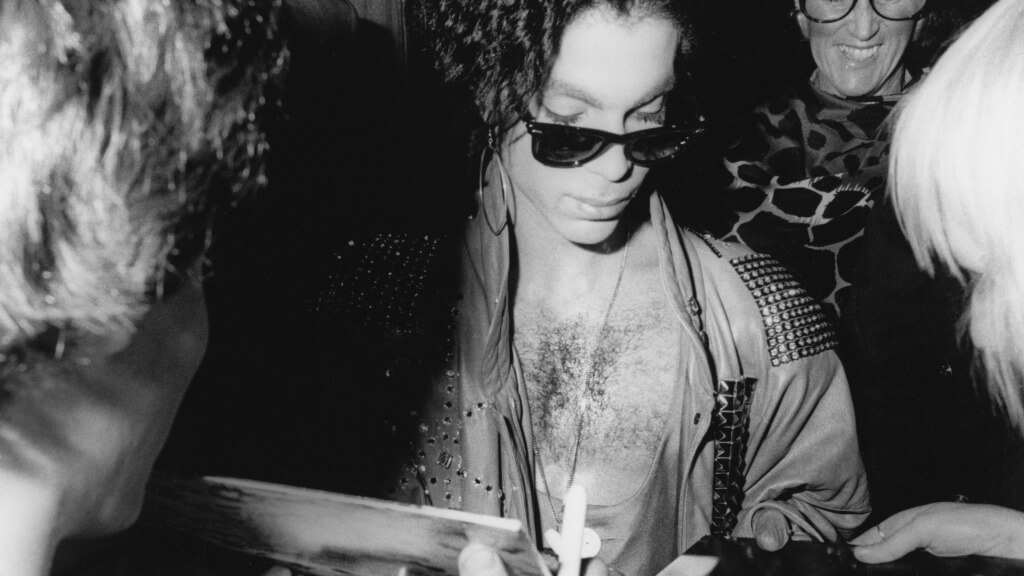
Photo by Vinnie Zuffante/Getty Images
Tattoos weren’t really a thing in my family. My grandfather and his Marine buddies all got one during or after World War II. My mother got a yellow rose and what she thought said “teacher” in Chinese lettering. As my 18th birthday neared, I spent months begging Mom to let me get my first. It was a no, then it was a maybe. I wanted my first tattoo to be Prince’s love symbol, because I liked the shape of his unpronounceable glyph: a cross, horns, and the male and female gender icons linked in purple. I could never get Mom on board with the symbol, not because she didn’t like Prince, but because she had a better idea. Her ultimatum: a semicolon on my wrist, or nothing at all. I just wanted ink, because no one else in my class had any.
C&L Tattoo was just a hair above somebody’s brother giving you a kitchen table tat, but my parents were poor, so we could only afford a poor tattoo. The shop was 70% flesh-tone curtains and reeked of hookah smoke. It was tucked into a strip of Mahoning Avenue that had everything: a family vet, a four-wheeler dealership, two Dollar Generals, a community college, an Arby’s with an express car wash in its parking lot, a place that sold headstones. The beverage tunnel next door drew lines that spilled into C&L’s parking lot. Across the street was a roller rink. All the girls I liked in high school went there on Fridays until it burned down before COVID.
I asked one of C&L’s artists, Chris (presumably the “C”), about doing Prince’s symbol. “I can only do it this big, or else it won’t look good,” he said, holding his hands the width of my forearm apart. Mom shook her head. He readied the semicolon stencil, told us it’d run $150. I was years away from my 50th tattoo, unfamiliar with shop-minimum politics. Here was a guy who took a smoke break before and after my 20-minute tattoo. Mom paid anyway. We didn’t know any better.
I didn’t want the semicolon tattoo. Mom had assigned it to me after my suicide attempt two years earlier, but it always seemed like the semicolon was for her coping instead of mine. Suddenly, her only child dying was possible and she needed it to be anything but. So she read about semicolon tattoos and thought its permanence would protect me like God. And, look, she meant well and I love her all the way for it, but when I spent a week at Buckeye Boys State in 2015, she redecorated my bedroom, replacing my LeBron James poster with “YOUR STORY ISN’T OVER YET” and a semicolon on one of the walls. I put a blade deep into my thigh and got live-laugh-loved.
26 days after my first tattoo, Prince was dead. It was a Thursday. My classmates and I had just returned from our senior trip to Orlando, where we lived on Wendy’s cheeseburgers, gas station cigarillos, Universal all-day passes, and Hooters drive-bys for 72 hours. We moved through the school with Florida tans and puffed-out chests, our drawstring bags jingling with theme-park trinkets we took when the cashiers weren’t looking. My high school sat in a cellular dead zone. No news, no social media, no texting. I never had the radio on in the car, either. Aux cord only, a playlist always queued. Dad was unemployed and usually home, but that week he was at the hospital with Mamaw. All the town criers were indisposed. Even now, I can’t pin down who gave the word. A Facebook friend, maybe, or the headline topping Rolling Stone.
But death felt different in April 2016. So did grief. Bowie had already died three months before. Mamaw was in week two of an ICU stay with pneumonia. Two months later, she’d pull her ventilator tube and die while our family parked the car outside. It all just seemed to pile on. The whole world stopped when Prince died. Now, loss just blurs into itself.
There was no connection between the Prince symbol and my own gender identity ten years ago. It would make a good story, especially had I been out of the closet when I discovered his Camille alter-ego, but it wasn’t that deep then. I knew what was happening inside of me, sure, but I was also tangled up in a relationship with a Christian girl who, while we were shopping for swim trunks at Kohl’s, said she wanted to marry me. I liked the spectacle of interstitial, androgynous filth, the idea that a girldick could be licked like the curves of Prince’s cloud guitar, and its bursting image of “I’m not a woman, I’m not a man, I am something that you’ll never understand.” But “non-binary” wasn’t even in my vocabulary. I was too busy trying to bargain my way out of teenage matrimony over a Chipotle lunch.
By that point, country music had spilled all around me, just as it spilled all around everyone else in my town. There were dissenters: transphobic metalheads, white-boy trap kids, Warped Tour evangelists, butt-rock worshipers. Folk music was practically forbidden in our zip code; the basketball players called us faggots behind our backs for liking Bob Dylan. But Prince’s ecstatic, throbbing-cock glam-funk music cut me loose from all that racket. Radio, MTV marathons, internet forums, and rock magazines made him seem like God and I’ve carried him and his Cab Calloway-meets-Sly Stone-meets-Jackie Shane getup with me ever since. I’ve heard his songs in every Walmart parking lot and hair salon chair in Northeast Ohio.
I was eight when Prince played the Super Bowl XLI halftime show and sang “Purple Rain” in a downpour. By then, his greatest hits CD was already crammed into my Durabrand portable for days at a time. I used to imagine what the Dirty Mind cover looked like past the crop. I was a hellacious nine-year-old singing the “Kiss” falsetto in the passenger seat. I’d spend hours on the living room computer playing Poptropica, “Jack U Off” tearing through headphones I boosted from the school’s computer lab. His VMAs performance of “Gett Off” stayed in rotation.
When I graduated from HRT gel to intramuscular injections in 11th grade, I’d rub lavender oil over my belly welts. Each time, I thought of how the smell of lavender appeared before Prince entered every room. Somewhere, there’s a Snapchat video of me and Josh doing kid voices and singing “raspberry beret, I think I love her” outside Jessi’s mom’s boyfriend’s house. His song “Controversy,” still my favorite, gave me, unconsciously, a lifeline the semicolon couldn’t. “Am I straight, or gay?” “Do I believe in God, do I believe in me?” “Was it good for you? Was I what you wanted me to be?”
In me, Prince supplied history, sexuality, ambition, and blown-open gender fences. Mom, maybe against Dad’s wishes, indulged my purple mania. The stereo volume in her Grand Am always got louder when “When Doves Cry” and “Little Red Corvette” came on the MIX 98.9 station. We made lists of what we wanted to do, who we wanted to see, where we wanted to go. At the top of every one: SEE PRINCE. She even used part of her National Honor Society advisor’s paycheck to buy me a first-pressing of Purple Rain for Christmas 2015.
Then he was gone. When Bowie died, Steven skipped three days of school. Prince’s death wept into the weekend, my Twitter, Facebook, and Instagram feeds draped in tribute posts. Everyone shared their story. A concert anecdote. A YouTube link, almost exclusively to the video of Prince playing the “While My Guitar Gently Weeps” solo at the Rock Hall. Suddenly, everybody I knew or followed had something to say about Prince. How he was without precedent, without comparison. What I recall best from that weekend was listening to “If I Was Your Girlfriend” on repeat, trying to imagine, like Prince, what silence looked like when everyone online was talking about him.
But we still talk about him. Stores play Prince songs like retail gospel. “1999” comes on in the car and Mom says, “I wish we could have seen him.” Stars could fall out of the sky and Prince covering “Creep” at Coachella would still feel unreal. Eventually, Mom and Dad moved out of my childhood home and the “YOUR STORY ISN’T OVER YET” wall got painted over by a new family. I still have the semicolon on my wrist, partly because I need the ink to fade more before I can actually cover it up. It’s somebody else’s punctuation, but I do think about its message occasionally: the sentence keeps going, there’s another page waiting. When Prince died, I changed my Facebook profile picture to the impermanent reminder of his purple glyph, far away from God.
Matt Mitchell is the editor of Paste. They live in Los Angeles.
 Keep scrolling for more great stories.