
Rhododendron is ready to ascend
One of Portland’s darkest, gnarliest young bands discusses Ascent Effort, its first album in five years.
Photo by Evan Mason-White
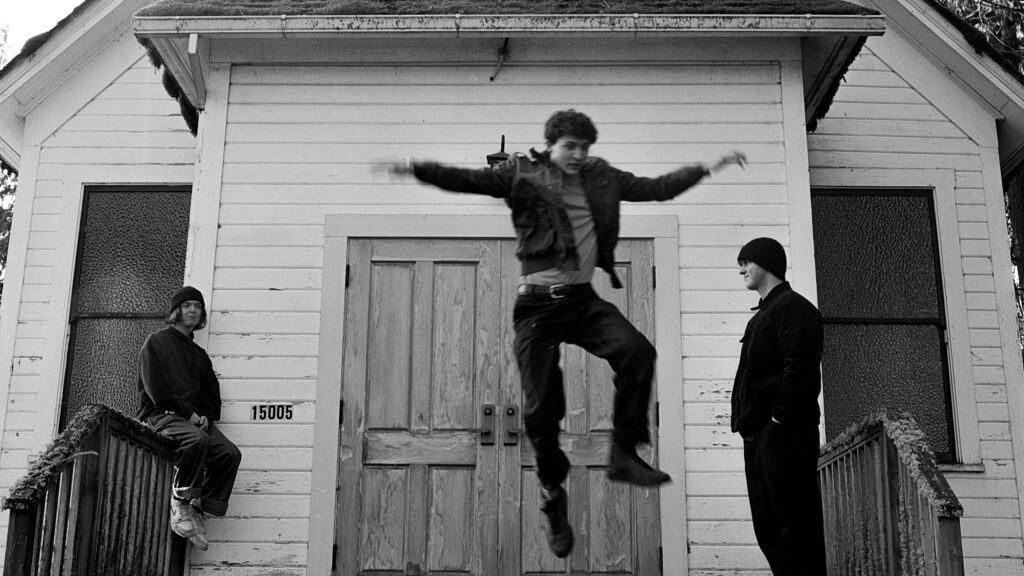
Something snapped in Portland in 2021: a release of live-band energy that propelled dozens of young bands to the forefront of the local consciousness, and a few of them into the lower rungs of the indie-rock zeitgeist. At a time when some people wondered whether live music would ever exist again, the resounding enthusiasm of the young Portland rock scene made clear not only that shows were coming back but that they remained a viable way for young punks to build community, share ideas, and maybe even scheme about how to get a bigger stage. For Rhododendron, whose debut album Protozoan Battle Hymns came out in May of that year, this was as much of a dream as a nightmare. “I was like nineteen,” singer-guitarist Ezra Chong says. “I was bitter about a lot of people coming into the local scene or DIY communities with a very self-serving mentality, and just kind of pushing themselves off and not really caring about the community or what came before them.”
Formed in 2019, Rhododendron was likely the gnarliest band of its local moment, tracing the edges of brutal prog, black metal, post-rock, and screamo with a crucial assist from jazz-trained drummer Noah Mortola. Despite that (or maybe because of it), they might be the band from that scene most positioned to straddle the current indie-rock zeitgeist. Their new album Ascent Effort is their first in nearly five years, and it comes through The Flenser, the San Francisco label whose catalog includes both indie classics (Have a Nice Life’s Deathconsciousness) and some of metal’s biggest recent crossover stories into un-kvlt realms (Ragana’s Desolation’s Flower, Agriculture’s The Spiritual Sound).
“Full disclosure,” Chong says. “We’ve been sitting on this record for like two years.”
“It’s like a bottle of the time,” bassist Gage Walker adds. “Speaking for myself, it doesn’t really relate to how I feel now.”
The Flenser was a long shot on the list of labels the band hoped to ink a deal with for Ascent Effort, but they had a crucial music-scene connection who helped them get the record to Flenser boss Jonathan Tute. It’s easy to see why The Flenser might be enamored with it: though usually pegged as a metal label, it claims to specialize in “dark music” more generally, and Ascent Effort is so dark that it felt strange, speaking over the phone with the members of Rhododendron from an Oakland parking lot, to hear the sound of a clown-horn passing by during our interview. (Some dogs started barking shortly thereafter, which fit the Rhododendron vibe a little better.)
It’s hard to tell what Chong is barking about when their strangled voice finally comes in after ten tortured minutes of instrumental dread on Ascent Effort, and there’s no lyric sheet to make things any clearer. “My vocal passages are inspired a lot by grindcore and powerviolence, because I really do love that kind of stuff,” they explain. “It lends it this harsh quality while also having it be recontextualized—our music is very much not grindcore or powerviolence.” Quite the opposite—this music moves at a tectonic crawl. It’s landscape music, the sound of forest-fire ash blowing over a blasted plain. It’s easy to compare this music to the dramatic, volcanic expanses of the Pacific Northwest that inspired labelmates Ragana and Drowse, and they recorded the record at the Unknown, the desanctified church in Anacortes, Wash., where Mount Eerie’s elemental bard Phil Elverum put many of his windswept poems to tape.
Chong freely admits that they write vocals “last-minute” and that the band’s focus is on its instrumentals. You can tell: this is a fearsomely technical band, though not in the blinding and overstimulating way of a death metal band so much as a jazz group responding to each other in real time and picking up on microscopic fluctuations in what the other members are playing. “I feel like ultimately how we operate as a band is fairly no-bells-and-whistles,” Chong says. “We just get on and play our music, no crazy light things. It’s not like we’re putting together a production or something.”
“We focus a lot on each other when we play live,” Walker explains. “So maybe we come across as pretty boring or stoic, but there is a lot of workshopping and a lot of attention you have to give to the moment of each song.”
Chong admits that in the past, “whenever we would play shows live, any minor mistake would really screw me up.” You’d think sharing stages with bands like their labelmates Agriculture and the legendary post-hardcore unit The Fall of Troy might be even more intimidating, but according to Chong, performing with these more “technical” artists freed them up to embrace a looser side of their own sound. “It made me feel a little better being like, wait, we can just play super raw,” they say. “It made me feel more confident in the fact that there was some amount of allure to what we were doing in comparison to these other bands.”
Walker says there’s more primordial energy. “As far as energy, it feels pretty basic, more emotive rather than just playing a lot for the sake of it. Not that any of the bands we play with do that—it’s just a risk you’ve got to check yourself on.” Playing bigger stages inspires many bands to switch up their sound and aim for a more anthemic or pop quality; even Britain’s caroline, a band a lot like Rhododendron in many ways, couldn’t resist collaborating with near-homonymous pop star Caroline Polachek once they had the clout. But though Rhododendron’s music certainly sounds big, they don’t really do the big-anthemic-moment thing; a Bandcamp press release accompanying Ascent Effort clarifies that the record doesn’t “offer catharsis in the traditional sense,” likely meaning the kind of swooning post-rock crescendos pioneered by bands like Godspeed You! Black Emperor and Mogwai and much imitated since.
Walker admits the better sound systems of the larger venues they’ve played since their scrappy house-show beginnings have helped them fine-tune their sound on the road a little more easily. But for the most part, Rhododendron is jamming the same way they’ve always jammed, testing their songs on the road and bringing them into the studio. They have quite a few songs in the tank at the moment, and you’ll likely hear them at their upcoming shows, including on May 30 at Portland’s Aladdin Theater, a substantially-sized local venue which will host emo legends American Football the week before. “It’s not like we graduated up to an arena, where the number of people is just melded into one unidentifiable number,” Walker says. “It’s not too much of a difference with us. It feels very gradual. It feels down-to-earth in a way that is enjoyable, especially if we’re opening for a larger band and people are, for the most part, waiting for something else to happen or someone else to play. I guess the most positive and most general response to us is a more objective response—just waiting to see what we can do.”
Daniel Bromfield is a writer, editor and musician from San Francisco, CA. He currently works as Calendar Editor at the Marin Independent Journal and is a prolific freelancer, with bylines at Pitchfork, Atlas Obscura, Resident Advisor and local media in the Bay Area. He runs the popular @RegionalUSFood Twitter account, highlighting obscure dishes from across the US. Find him on X at @bromf3.
 Keep scrolling for more great stories.