
runo plum is the best of what’s next
RIYL: jazz school dropouts, Soccer Mommy, gay breakup songs
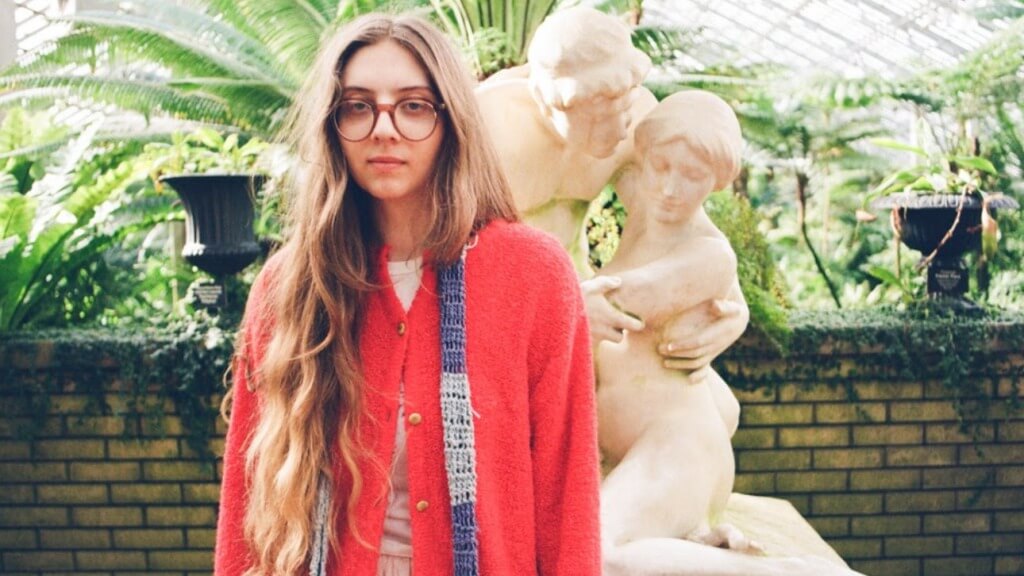
Photo by Alexa Viscius
It’s not often I’m entirely thrown in interviews. I like to think I’ve gotten relatively decent at the art of it by now: I usually overload on prep ahead of time, making massive research documents and writing far more questions than I could ever reasonably use. Even if I am caught off guard, I can often latch onto a word or phrase and work my way back toward my intended line of questioning.
Last month, I failed. runo plum completely wrong-footed me. The Minneapolis-based singer-songwriter’s upcoming EP, Bloom Again, is a sweet, swirling honeymoon phase, braiding post-breakup growth and the joy of a new love into six heady tracks. It’s the most hopeful step forward conceivable from the heartbreak of her debut record, patching. According to the press release, plum’s new girlfriend, instrumentalist Noa Francis, even contributed musically to the record—a union of both heart and sound. Naturally, a lot of my prep work revolved around that pervasive theme. So picture my surprise when, upon asking plum about the relationship’s role in the creation of the record, she cut her own stilted answer off with an awkward laugh partway through and said: “Yeah, sorry. This is so funny. Gay people are crazy. Life is crazy. We actually broke up last week. So I’m like… how do I answer this?”
Breakups are hard. This is a universal truth. But I have to imagine there is quite possibly no harder breakup than one that occurs mid-album rollout—and for an album about how in love you are with your now ex-partner, no less. I felt like a sadist for even continuing the interview, gulping as I rapidly ALT+SHIFT+5’d my way through my prep doc, crossing out a solid third of my questions. “It’s insane,” plum divulged, the sentences spilling out of her almost unbidden once the dam broke. “I feel insane. I just don’t know how to address it. It’s so awkward and painful. Literally, the day after she moved out, ‘Pink Moon’ came out.”
“Pink Moon,” the second Bloom Again single, is an almost unbelievably pure love song, spacious enough to encompass all that ineffable adoration and then some. “Freckles on your shoulders / Oh how I wanna kiss ‘em,” plum sings over softly picked acoustics, a bit of Adrianne Lenker in her double-tracked tone. “You’re glistening sun on the water / It feels impossible to look away.” And I imagine that, on the day of the song’s release, plum herself wanted nothing more than to look away—but because she had to promote “Pink Moon” itself, she had no choice but to stare right at those now-sour feelings for hours on end. The sugar-spun joy of the accompanying press release went down like a stone, landing in her gut with a thud. “It was so painful to read that,” she told me. Her relationship had been vaguely on the rocks for some time by then, she admitted, but that didn’t mean she was prepared for it to end so close to the EP’s release. She’s managed to keep a sense of humor about it, though: “It’s so painful that it just becomes funny at some point. It’s, like, what the fuck is happening? What are the odds of this? I don’t know. I just have to tell myself that, in a few years, it’s gonna be a really funny thing to look back on. I hope.”
runo plum has been spinning tunes from vulnerability since the word go, so at least that is nothing new. After all, the song that put her on the map, 2021’s “yin to yang,” opens with “I think too much, and I care too much.” That open, intimate honesty resonated with people, particularly girls on TikTok during quarantine. plum started posting videos of herself playing during COVID-19, and to this day, she credits the app—and the internet at large—for the foundation of her audience. “I always knew that social media was going to be my only option,” she says, sheepishly. “I’m so bad at the professionalism of, like, networking and emailing. I just can’t do it.”
Half the job of being a rising artist in the modern day takes place online. It’s not about getting discovered by a well-meaning record exec looking to take you to the top of the charts; it’s about getting discovered by a horde of well-meaning teens willing to make Heated Rivalry edits to your music. This hasn’t changed in the half-decade since plum started posting; if anything, it’s only intensified. But the effectiveness of it has, at least in her case. “TikTok feels so different these days,” she admits. “I don’t get the same engagement that I used to get—maybe because of the algorithm, now that America owns the app; maybe because I’m not posting as frequently. I guess I don’t really share songs like that anymore. It got hard, at a certain point, because you never know what people are gonna like.” She used to post constantly, sharing snippets of half-finished songs as she worked them out on the guitar. After a while, though, that only increased the pressure and made it harder to write: “It’s annoying to have only a verse written and then suddenly so many people want to hear all of it. It’s this extra pressure to get it done, and it doesn’t feel organic.”
That doesn’t mean plum is freed from the duty of posting altogether, though; it just happens once or twice a week now instead of once or twice a day, and more on Instagram than TikTok. She, like many of us, has a “love-hate relationship” with social media. “It can give you so many opportunities, but it’s also just so soul-sucking,” she says. “It makes me so upset that I have to do it. I envy artists who are at the stage of being able to post when they want. But, you know, what can you do? I think I’ve pretty much accepted that this is just the way that it is.”
THE BALANCE BETWEEN resentment and gratitude is hard to strike. runo plum has had, after all, an incredible few years, largely made possible by the same social media that feels like such a bane to artists’ existence. Since her songs gained traction online, she’s toured with Searows, Angel Olsen, and Hovvdy—the latter of which she collaborated with early last year on “Shooting Star,” the Austin band’s first new track since their critically acclaimed self-titled album from 2024. A few months later, she signed to Winspear; a month after that, her debut record, patching, was announced. It’s all been a dream come true in many ways; runo has been, in her own words, “obsessed with the idea of being a rock star” for as long as she can remember. Her first email address, she tells me, “was, like, ‘rock star underscore my initials.’”
Those initials, of course, are not actually RP—runo plum is a stage name, albeit one that’s become so enmeshed with her own life in recent years that the two are hard to separate. “It’s definitely intertwined as fuck,” she laughs. “Pretty much everyone in my life calls me runo, except for my family and a few older friends that have called me by my actual name for so long that it would feel awkward otherwise.” Why “runo plum”? Apparently, she liked the movie Juno so much that she wanted to steal its name, but felt weird hijacking it entirely; she ended up with “runo” because she was also obsessed with The Last Song, whose protagonist is named “Ronnie,” and it felt natural to combine the two. (She later learned that “runo” means “poem” in Finnish, and is considering maybe just telling people that’s the origin instead.) “Plum” came from her love for yet another female character, this time a real-life one: Fiona Apple. Now, runo plum has joined the long (read: short) lineage of artists with fruits for last names. But the name doesn’t feel like a persona to her; it’s just her.
plum grew up in rural Minnesota, surrounded by woods. Her introduction to music came through her local church, though she now has mixed feelings about the experience: “It was a good way to get used to being onstage, I just don’t feel very positively about the Church,” she shrugs. Despite wanting to be a rock star all her life, she didn’t start actively pursuing music “until 2019 or even 2020,” she says. “I was so late to the game.” I double-check my notes at this self-deprecation: did she not literally go to the McNally Smith College of Music for jazz? She did, but she doesn’t completely count it. The school shut down cold-turkey a year and a half into her time there. (“You would think you would get your money back, but you don’t,” she snipes. “I’m still paying it off, even though I obviously couldn’t get a degree or anything like that.”) She also, for what it’s worth, hated it there. “I wanted to be in New York so bad; I almost went to the New School, but I couldn’t afford it, so I just, like, settled for McNally. I was just, like: ‘Fuck this. Everyone here sucks. I hate this. I’m depressed.’ I was sort of the angsty person who didn’t want to be there.”
After the sudden closure of McNally, plum went to Canada to continue studying jazz, but found it even less fruitful than her first attempt at formal music education, which made her realize her distaste might lie with the infrastructure itself rather than personal gripes: “It’s just so pretentious. It’s such a strict way to think about music. And it’s also, like, so misogynistic. Toronto jazz was just a bunch of white men playing saxophone who thought they were the soul of the Earth or something. They didn’t respect me because I was a woman, and they didn’t respect me, especially since I was a woman there for singing, because they thought it was a lesser kind of music. There were just a lot of little microaggression type things that piled up.” So, she dipped.
You can take the girl out of jazz school, but you can’t take the jazz out of the girl. The influence still lies latent in runo plum’s music: in her rhythm and tone, her tenor and feel. It’s never overt; it’s in the skeleton of her songs, not tangible on the flesh. She chalks that up to the music she grew up listening to, rather than her time in classrooms and concert halls—though, really, she didn’t start listening to jazz until high school. Before that, it was all Sam Smith and High School Musical. Most audibly, though, her work lives in the same area code as Soccer Mommy, Snail Mail, and Clairo—that classic mid-to-late 2010s lo-fi bedroom-pop codex. She did more or less get her start in a literal bedroom, after all. It makes sense; those artists, she tells me, made her realize she could actually, like, do this in the first place.
But genre isn’t what defines runo plum for her—it’s something undefinable, really. “I don’t know if I can describe it in words,” she says when I ask her what makes a runo plum song a runo plum song. “It just feels like there’s some sort of sweet spot, this feeling of channeling a river flowing perfectly. Not all songs feel like that; it’s a serendipitous thing.” She pauses, deep in thought. “A song feels good to me when I’ve figured out how to describe what I’m experiencing in the most accurate way. A lot of writing for me is about feeling understood by myself, in a way that nobody can question, in a way that someone can easily understand.” And we’re right back to vulnerability once more.
patching came out last November with a self-painted butterfly on the cover, boasting twelve soft, beautiful songs of hurt and healing in the aftermath of heartbreak, all recorded alongside the producer Lutalo and plum’s then-girlfriend, Noa Francis. It’s chronological in its structure: it begins with pain and ends with hope. The songs all came to her in a rapid, feverish post-breakup burst. “You have to make a forcible disconnect between yourself and what you’re writing, sometimes,” she tells me, speaking about the album’s raw honesty. “Part of it is that I have to dissociate a little. If I think about it, then it’s too scary.” This was almost definitely the case for touring the record, considering plum’s previous ex-girlfriend—the one patching was about—both opened for and played with her throughout the tour. “We weren’t talking for a long time. I could have never imagined when I was writing patching that we would be friends, but here we are,” plum says.“I feel like people are always like, ‘You’re friends with your ex? What?’ But I don’t know. It just feels very normal to me.”
When plum first did press for the record, she spoke often about a “rage album” meant to follow the keening hurt of patching. As she put it then, patching “is the soft album. Well, it didn’t end up being as soft as I originally wrote it to be. The second one is more of the rage thing. But we’ll see what happens. Maybe I’ll just keep it in the vault. My ex is my friend now, and I’m like, ‘Do I really want to put out a rage album about them?’”
Bloom Again seems to answer that question with, at the very least, a “not yet.” This EP is decidedly not that rage album. It couldn’t be further from it, really. It’s warm and open-hearted, at once intimate and expansive—an extension of the patching world and narrative rather than a departure from it. It feels almost like a little coda—a sweet epilogue rewarding the listener for making it through the hard-won journey of patching. This was very much intentional, largely because the EP is mostly made up of “leftovers from patching,” plum says. “It’s sort of like a B-sides situation without calling it a B-sides.”
While all the songs were written during the patching era, some of them were recorded—or at least recorded upon—more recently. Some are voice memos layered atop one another; others, like opener “Butterflies,” feature contributions from plum’s friend, artist Philip Brooks, who helped produce and mix the whole EP. There are slight sonic differences, too—plum and Brooks worked to leave more negative space in Bloom Again, against plum’s own instincts. “I wanted to make it a little more stripped down, to leave more room for the song itself; that was a conscious thing this round. ‘Less is more,’ and all of that,” she says. “But it’s really hard, and it leaves you so vulnerable. I had to just remind myself that so many of my favorite songs sound like that. Adrianne Lenker has a lot of old songs with so little in them, and they’re beautiful, and it didn’t kill her. Other people do this, and they’re fine. I’ll be fine too.”
While Bloom Again is inarguably a love story, that doesn’t mean it’s without struggle; “Butterflies” transforms the cliche of butterflies in one’s stomach into something darker, heavier. “Now I don’t think I know what love is anymore,” she sings over warm acoustic strums. “Maybe it’s something I wasn’t made for.” But, much like patching, Bloom Again moves chronologically through healing—this time with the added benefit of new romance. “Salt and Soap” comes to terms with the end of the previous relationship, while “Be Gentle With Me (acoustic)” warns a new lover of the trust issues lingering in the fallout. But the last three songs are sheer adoration: “Pink Moon” is a straight-up ode; “Monarch” sings of wanting to rush into the relationship head-first but knowing it’s best to take one’s time; “Bloom Again” walks hand-in-hand with a partner down the path of growth.
This is all, of course, painful to listen to now, knowing plum’s relationship ended so recently. It will surely be songwriting fodder for her down the line, especially considering how her last breakup resulted in enough material for two albums—patching and the rage record—and an EP. Recording for the rage album begins this summer, and now plum will have the hurt of two breakups to pull from. But right now, staring down at the blank page with all this swirling in mind feels like staring bare-eyed at the sun. “I’ve tried a bunch,” she tells me. “I’ve been writing a lot of words, and while that’s a good step, putting them all together is too emotional for me right now. I’m too close to it. I need to process it more; it always helps when it’s more of a reflection than the actual unfiltered feeling. Otherwise it’s just like, ow!”
Soon, she’ll head out on the road to perform these songs live, reliving them night after night—an undoubtedly painful experience, made all the harder by the stage fright plum’s spent years learning to shake. Naturally, I had to ask: How will she bear it? “I’ve really spent a lot of time figuring out how I can think about these songs,” she said, thoughtful and honest. “The feelings are still there. The love is still there. I’m able to see the beginning, and I’m able to honor that, even as I can now recognize that this was just a representation of that honeymoon phase. I think two things can exist at once, you know? I’m trying to just feel as normal as I can about it.”
It was at this point in the conversation that an extraordinarily loud, dissonant noise barged into my AirPods. She groaned and asked if I had heard it. I told her I thought it was her cat—Petunia, adorable, sometimes wound around plum’s shoulders during our call—jumping on the piano behind her. It was not; it was instead the sound of workers drilling into her door, because, apparently, someone had broken into her apartment complex a few days before our call. (“Not our personal unit—which, I guess, is my unit now, not ours—but the building in general,” she clarified, a flinch embedded in the aside.) They stole all the keys to every apartment, so each unit needed new locks. She laughed. “God, I’m having a fucking week.”
Bloom Again is out May 8 on Winspear.
Casey Epstein-Gross is Associate Editor at Paste and is based in New York City. Follow her on X (@epsteingross) or email her at [email protected].
 Keep scrolling for more great stories.