
In an era of optimization, Wilco’s Solid Sound rewards curiosity
Wilco’s biennial weekend is an escape from festival culture and an invitation to explore.
Photos by Emilio Herce
North Adams is busy when we arrive. Parking lots are full, traffic lights are slow. Tessa and I are clueless but curious. How do locals feel about this biennial invasion of eight thousand (ex)hipsters? We park, met with a stare. Aviators and a white beard warn, “there’s a lot of other shit going on this weekend. Don’t park in front of a business. That’s just common courtesy.” Repark. Main street is full of cute antique shops and devoid of people. Crowds form and multiply the closer we get to Mass MoCA, the former factory-turned-contemporary art museum that now hosts Wilco’s yearly music festival, Solid Sound. Young parents with little kids, old parents with adult kids, couples, friends, solo attendants. A flood of Hokas and On sneakers. When did Tevas die?
My previous time in Western Massachusetts was brief and spent on a boarding school campus. I had a number of close day student friends, people who grew up in the Valley and moved through it while I only passed by. The closer we got, the more spots they showed me—diners, the best Cumbys, hidden trails, places their families frequented. I felt the New England warmth of strangers, learned the most beautiful smoke spots, fell in love with Western Mass. I also saw what it faced. Towns with high unemployment, a region holding the weight of the opioid epidemic, sitting alongside rich institutions with endless resources and no interest in sharing them. The landscape was impossible to hoard; it was there for everyone. I found refuge in it, as many do—comfort in the natural when cultural and social worlds feel reductive and restrictive. Rivers, dirt roads, and rolling hills became places of peace. Moments of freedom.
Those same hills stand before me now on Joe’s Field at Mass MoCA. The museum itself is a fossil from North Adams’ industrial past. I’m sitting on the bleachers facing the stage, feeling like I am in high school cheering on my friend’s team. Rather than a game in front of me, there are clusters of seats and islands of picnic blankets. Everyone is so relaxed, it feels more like a Fourth of July cookout than a music festival.
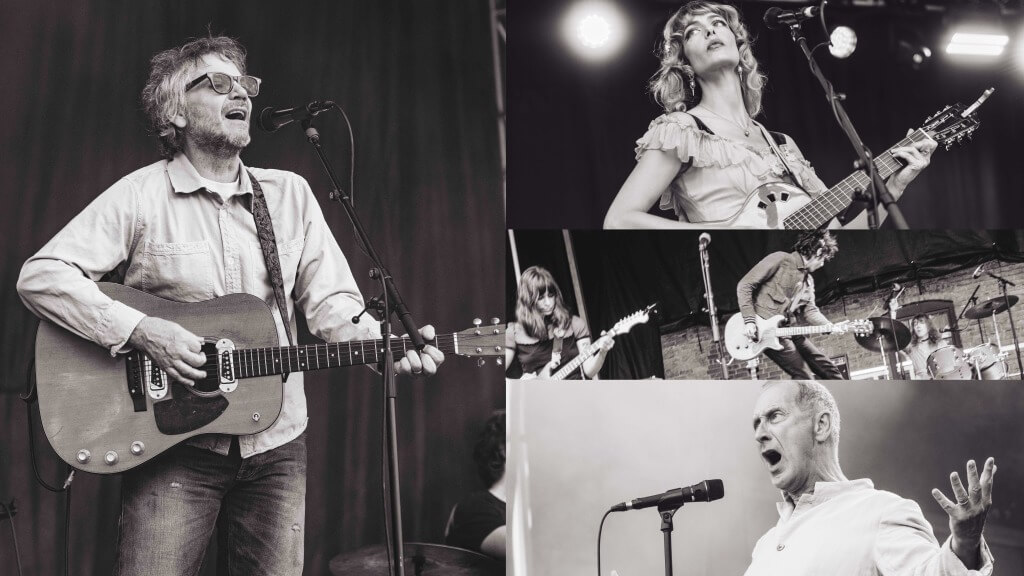
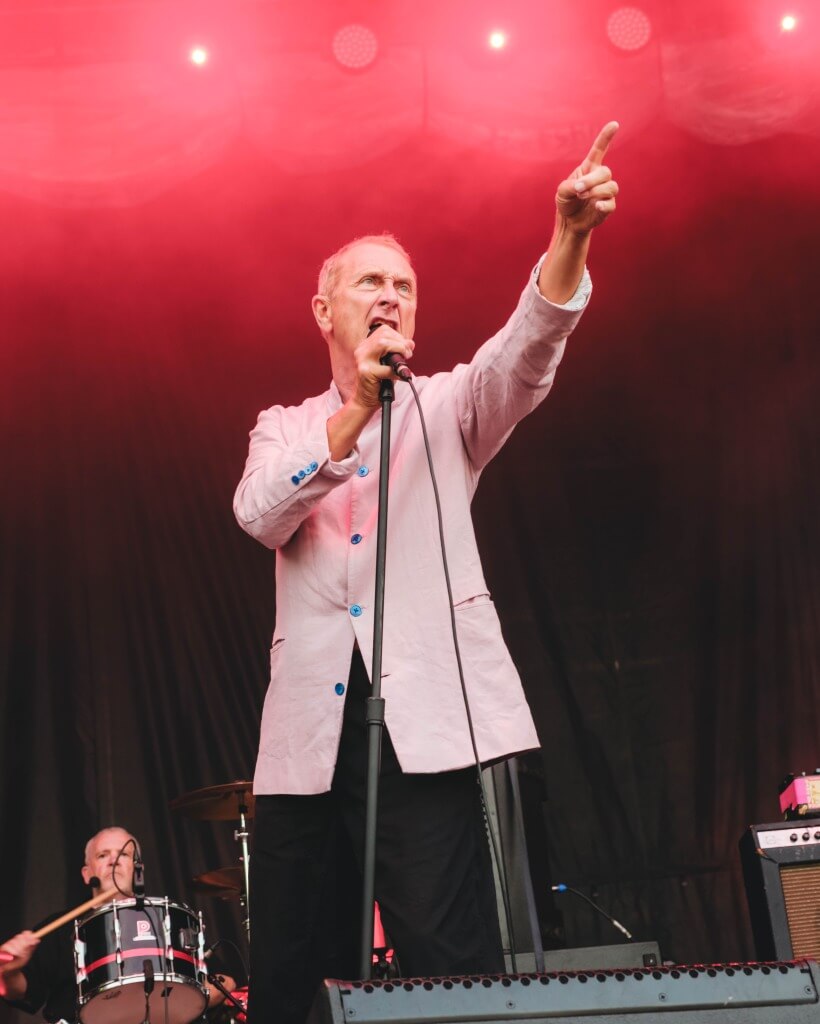
Then, the first chord reverberates out. There is a reckless abandonment in front of me. Hundreds of people stand and march towards the music, leaving behind a sea of lawn chairs. Gang of Four plays a set full of sharp, distorted notes and a distinctly British, inherently eighties voice. Jon King is a dramatist. They brought out some of the Mekons to do backing vocals for “I Love A Man in a Uniform,” and it was such a delight to see as a University of Leeds reunion in Berkshire County.
Mass MoCA changes the rhythm of an event like this. Many festivals are experienced by sprinting between stages, fighting through crowds, and missing half the shit you wanted to see. Solid Sound allows for drift. Movement feels nonlinear; there’s no conquering a schedule, just wandering through it. People move in and out of performance spaces with ease, often disappearing into galleries or book talks before re-emerging somewhere else entirely. The space turns escape into exploration.
With the music still booming, Tessa and I duck out of the crowd and into a deep pink cylinder, James Turrell’s C.A.V.U. Like one of those spinning fair rides, we sit along the structure’s circumference. Above us, the dome has a small circle cutout, revealing a peek at the sky. There’s a light show at every dawn and dusk; the room changes colors seamlessly, painting the sky a new hue with each transition. We run into Lily and Maddy while heading to Wilco. They are so excited, and it feels good to have real fans with us. I like Wilco, but I don’t know them like that. I love Billy Bragg and Woody Guthrie though, so I am excited to see Mermaid Avenue played in full, especially once I realize this is Bragg and Wilco’s first time ever performing the album.
There is obvious excitement both in the crowd and on the stage—a historic feeling all around. Jeff Tweedy and Billy Bragg hug after the first song, sharing a moment: “We’ve waited a long time for this.” Bragg’s punk edge and Wilco’s alt-country chug are harmonious, somehow creating the most intimate and earnest folk feeling. Closing my eyes, I’d guess I’m at a Sunday night Trad Session, not in a crowd of eight thousand. There’s a little boy on his dad’s shoulders behind us. He keeps screaming, “I love you!” over and over at full volume and intensity.
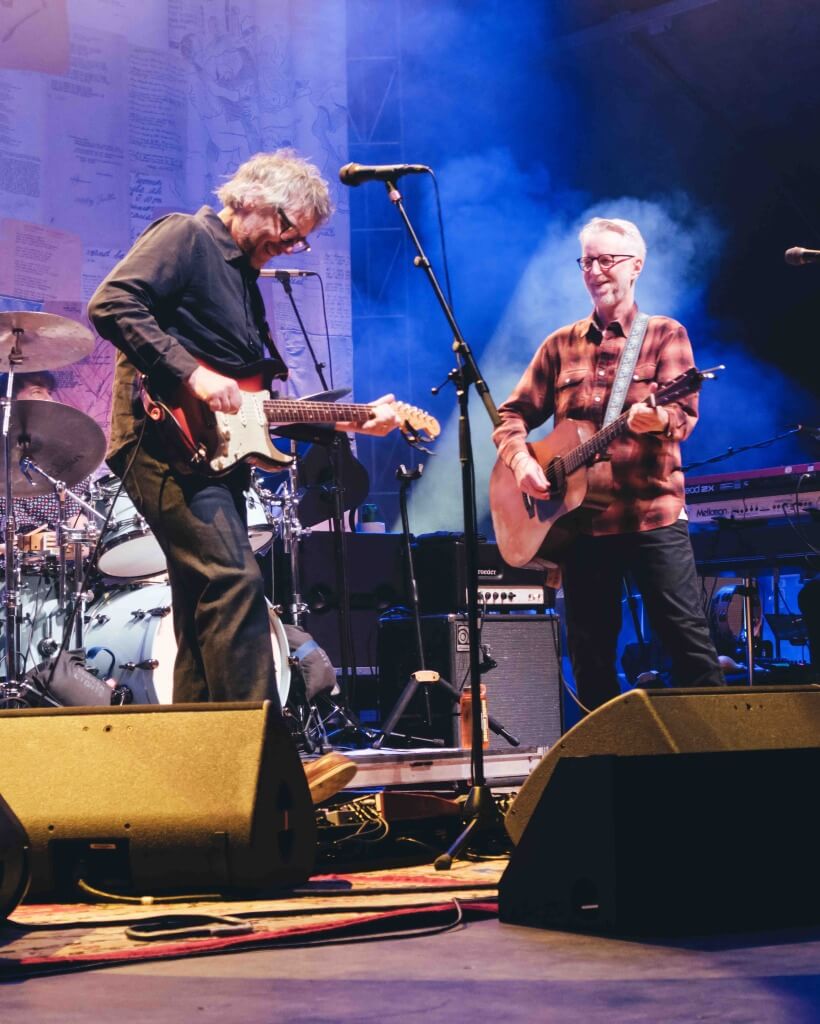
Tweedy and Bragg reminisce on Woody Guthrie: “He would have loved to be here. Actually, he’d be gone with your girlfriend if he was here!” I wonder how Nora Guthrie, who’s playing the cowbell on stage, feels hearing this. The crowd goes crazy when Natalie Merchant comes out. For the last song of the Mermaid Avenue set, the stage is totally full, entire bloodlines in front of the crowd, generations of Guthries. Nora stands tall. “This record came together twenty-eight years ago. I had blonde hair!” she says, stroking her grays. “Thank you for loving my dad.” Everyone breaks into “This Land Is Your Land.” It’s triumphant. Scanning the crowd from my seat, I can’t stop smiling, even if the guy standing next to me keeps staring like I’m taking a knee during the anthem.
There is a mass exodus after the Mermaid Avenue set, but we head to Courtyard D for one last performance: L’Rain, Taja Cheek’s experimental project, in which she draws from jazz, noise, R&B, and shoegaze. I saw more people of color at this set than I did the whole festival. Cheek is electric, screaming into the mic one moment and laughing into a sampler the next. Before their last song, Cheek tells the crowd, “It’s a pleasure to be here. This is such a special festival. I haven’t experienced something like this in a long time.” She brings out Nels Cline for the finale. The whole band looked starstruck and giddy playing with him.
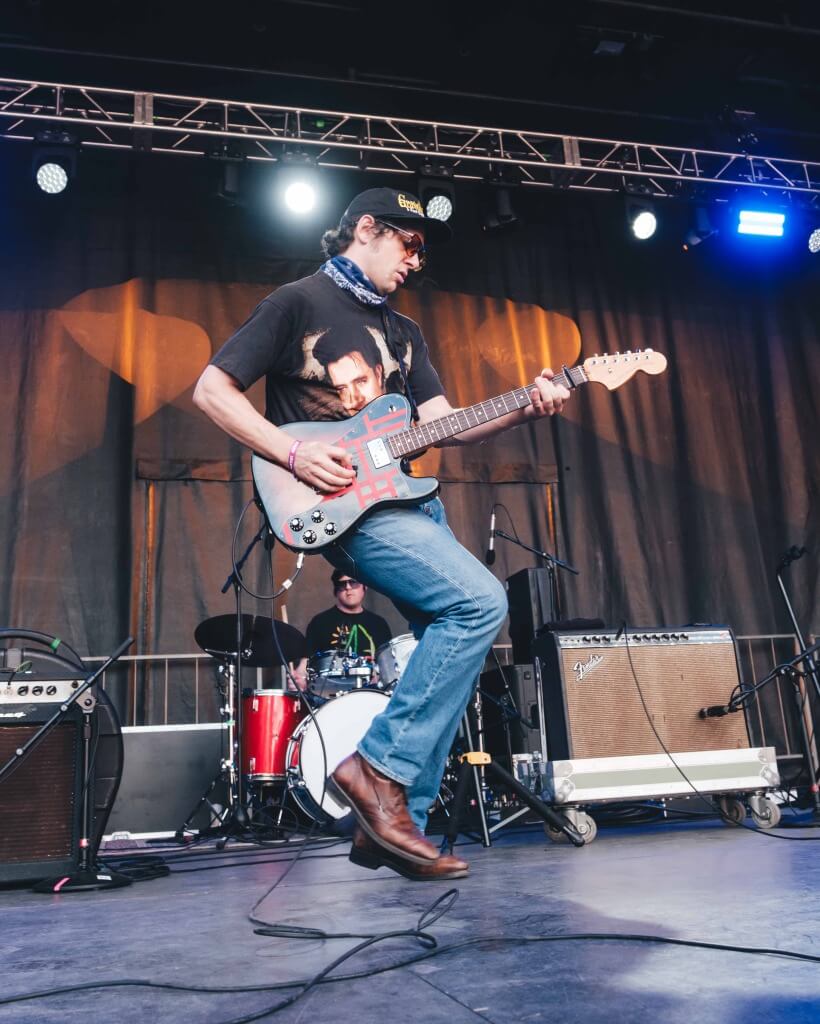
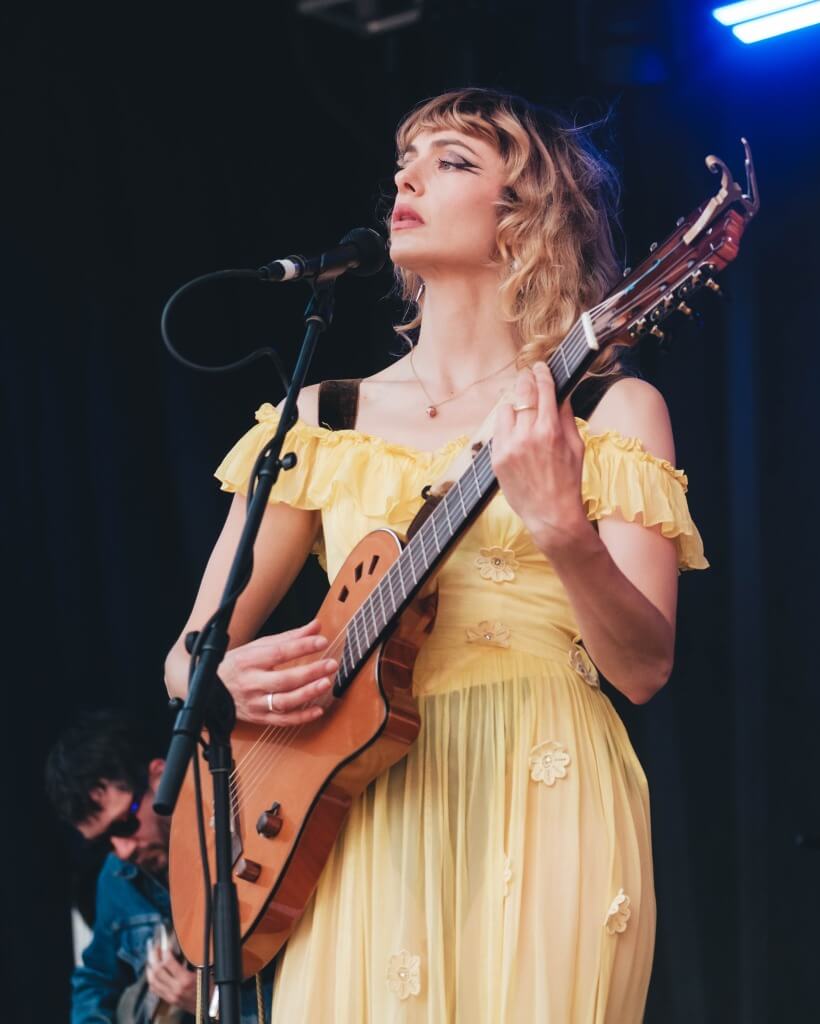
I wake up early Saturday, staring up at gold light and green trees from my rainfly-less tent. I’ve already missed Solid Sound’s AA meeting. At Renee’s Diner, everyone is so friendly, despite our obnoxious neon wristbands. We make a quick stop at Bellevue Falls, a river spot tucked behind a cemetery half an hour from the festival, and I sit on a rock in the creek, staring at the waterfall and those jumping into its pond, thinking about how long it’s been since I was last here. But back at Mass MoCA, it’s too hot to be contemplative. Music festival weather. It smells like sweat and SPF, but it sounds like velvet and fern because Prewn is playing. Izzy Haggerup and her band are masters in building suspense. They shred; their glittery dark reverb and Wednesday-style storytelling lyrics keep the crowd engaged despite the treacherous heat.
Prewn gets extra love from the crowd for having ties to the area. The cheer is bigger than hometown pride. Solid Sound fully roots itself in Western Massachusetts: all the food at the festival, apart from the Grillo’s Pickles sponsor, is from small local businesses. The weekend crowd brings $2-$3 million into North Adams every festival year. Renee and other servers I meet seem totally invigorated by the weekend’s rush. The festival’s website contains dozens and dozens of recommendations around Mass MoCA, attuned to its community and familiar with local brands.
At Courtyard C, Ryan Davis & The Roadhouse Band start their set with classic country before segueing into jam territory. My favorite song is “Flashes of Orange,” an epic that sounds almost art-pop in its synths. Maybe it’s anti-twee country? It’s a fresh find for me, so thank you, Solid Sound, for privileging musical discovery over trendy headliners. Elsewhere, Wilco and the Breeders grace the mainstage hours before their prime slots to take part in something historic: the headliners, along with up to five thousand festivalgoers, break the world record for Most Simultaneous Yo-Yos. For the rest of the weekend, a new sign covers the museum’s hallways: “no yo-yo-ing in the exhibits.”
In the midst of all this real wholesomeness, I keep thinking about the aviators and beard guy. The drivers rolling their eyes while I jaywalk. Mass MoCA makes millions and sits in one of the poorest counties in Massachusetts. A Solid Sound ticket is $350. The parking lot is full of bumper stickers for schools with tuition higher than many people’s income. I understand a level of resentment. The veil is scarily thin up close.
I’m on the wrong side of the right hill for the Breeders, as my line of vision is blocked by lawn chairs and kids slinging yoyos. “Cannonball” starts, and everyone is up dancing: full families, solo watchers, even food vendors stepping along to the anthem. The dad across from me, sporting a Club D’Elf top, spins his daughter ‘round and ‘round. She laughs in her neon Wilco shirt. I shift my focus; Kim Deal’s roars soundtrack the painting in front of me, fake fog rolling over real mountains.
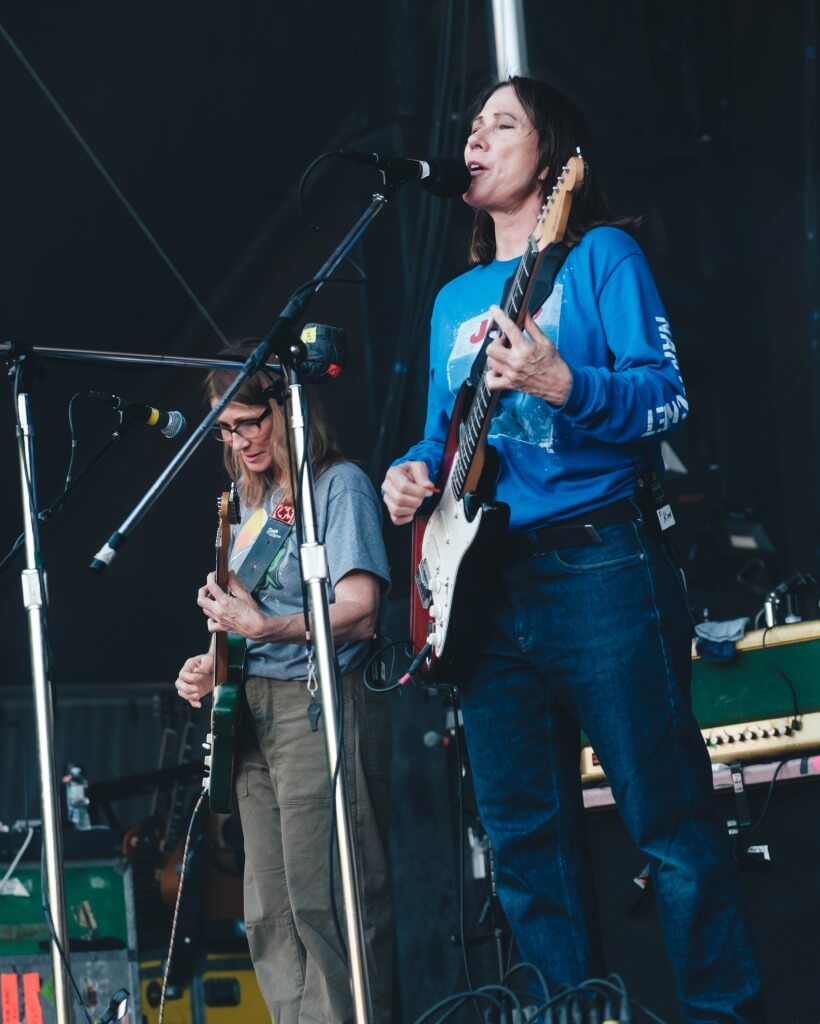
The sun is setting and a sea of graphic tees float toward the stage. Wilco round two. How can a band play two back-to-back two-hour sets and not have them sound repetitive? Tonight, the band is loud: the riffs are jammy, the lights are putting on a full show, the arms are up and moving. It feels like a Dead & Co. gig. Tweedy brings out Natalie Merchant and the guy behind gasps, “Oh my god, I hope they do ‘You and I’.” His wish is granted when Tweedy and Merchant deliver a perfect duet.
The festival grounds feel like an empty city during the latter part of Wilco’s set. The moon is shockingly bright and low, illuminating the quilt of the crowd, big-dogging the Big Dipper. The merch tent still has a line. The vendors are packing up. Parents are carrying their sleepy children. Hyper kids make new friends, comparing yoyos and playing hide-and-seek. Some couples dip out early, excited to “beat the crowd.” No one looks depleted or agitated; no families look like they’ve been arguing all day. Everyone looks content, peaceful. Grateful.
Sunday morning, I say goodbye to Mount Greylock campsite. I wonder if it will be another decade before I return. We hit Mass MoCA one last time. I get to see more Turrell, be inspired by video installations, and discover a new favorite artist, Jeffrey Gibson. I am still involved with the festival even inside the museum. I could tap in as easily as I could tap out. On my way to Laurie Anderson’s show, I run into a pop-up performance. Walking across the courtyard to get to the museum lobby, I catch a glimpse of Hannah Cohen, who looks fabulous and sounds even better. I check the time, defeated. It’s time to go.
On our drive back to the city, every house we pass is picture-perfect, every cloud a statue, the moon so close, bright, and pink. I scan out the window, collaging old memories with new perspectives, seeing Western Massachusetts in its entirety, beyond my teenage refuge. I extend the same curiosity Wilco asks of its audience beyond Mass MoCA’s walls, trying to know the place that hosts us, not just pass through. Solid Sound rewards that kind of attention. In an era when so much live music culture encourages us to optimize our schedules and document our attendance, this festival insists on something slower. It asks people to inhabit the weekend, not simply consume it. To be patient and open, qualities I hope to embody far beyond the Berkshires.
 Keep scrolling for more great stories.