
Star Moles is the best of what’s next
RIYL: Enya, The Lord of the Rings, English degrees, Arthur Russell
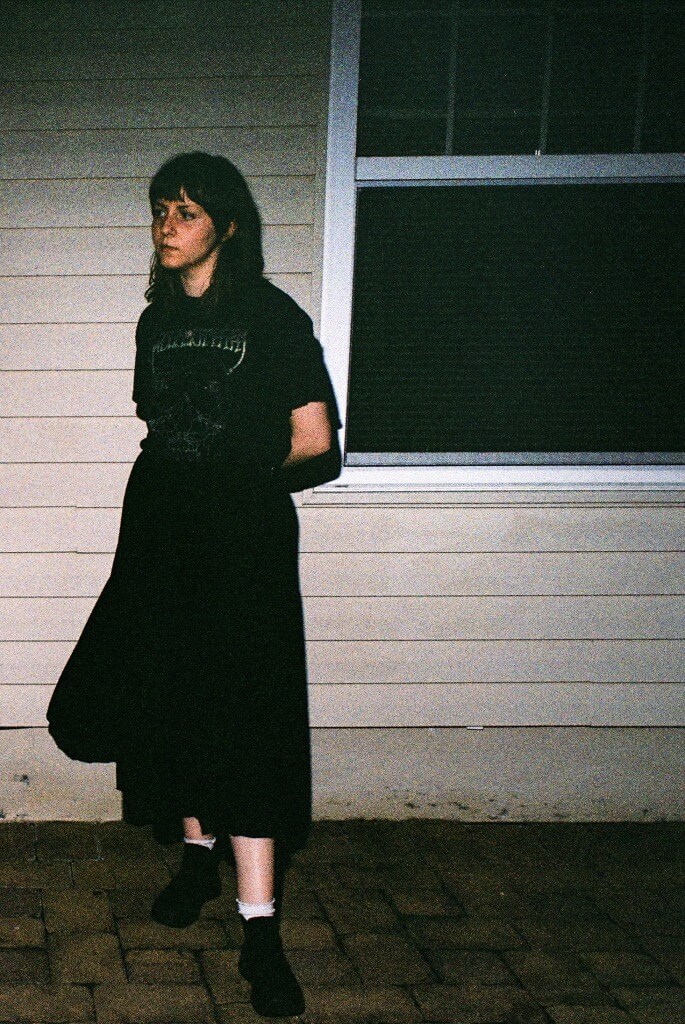
Photos by Betsey Carroll

The Best of What’s Next is a profile column that highlights upcoming acts with big potential—the artists you’ll want to tell your friends about the minute you first hear their music.
Emily Moales got into music through her parents’ CD collection, and her frame of reference is still tethered to that era. When Moales’ dad heard the “Real Magic” melody for the first time, he texted her, “Oh, this reminds me of a Phish song.” Neither of her parents play music, though she says her dad can “play guitar a little bit by ear,” which, if he’s anything like my dad, means he knows the “Smoke On the Water” riff. “I was the first person to bring an instrument into the house,” she says. “My friend’s dad owned a music store, and they gave us guitars as party favors for her birthday one year.” It was just a cheap, nylon-string classical guitar, but Moales used it to teach herself how to play. She also tried the flute and trombone, but her parents quit renting the instruments when she stopped practicing them.
Moales and I are around the same age, born during the late-Nineties to early-Aughts changeover. Our teenage years were post-MySpace, pre-streaming pantheon. We were just old enough to clip iPod Shuffles onto our shirtsleeves. Moales grew up on skiing movies and would burn their “weird, alternative” soundtracks onto CDs. She cites the “YouTube cover songs of yore” as early stimuli and considered making her own until Pandora’s freemium platform (specifically its “Hipster Halloween Radio” station) led her to Enya, the Velvet Underground, and Lord of the Rings scores—all texts that show up clearly in her solo material, which she performs under the name Star Moles.
After graduating high school in New Hampshire, Moales took a gap year and, thanks to a tipoff from an old camp friend, got hooked on home-recorded music. She was into Ariel Pink’s lo-fi template as well as MGMT, which opened a pathway to Foxygen’s early records, namely Jurrassic Exxplosion Phillipic and Take the Kids Off Broadway. Her parents gave her an M-Audio interface with two inputs, and she used it to make music on GarageBand. But the pre-programmed defaults the workstation provided felt too mechanized. “I figured out ways to make the digital sounds I got on GarageBand sound really shitty and cover up all the software-instrument vibes,” Moales says. “[I looked] to artists with a diversity of sound that is out there. Not everything has to sound perfect. It’s a lot more interesting when it doesn’t.”
Scroll through comment sections on Instagram, Reddit, Stereogum, or Bandcamp and you’ll see a loose consensus about the latest Star Moles release, Highway to Hell: it’s one of the best-sounding lo-fi albums in recent memory. You can thank Kevin Basko for that. Basko has released more than two-dozen Rubber Band Gun albums online since 2017, including 2024’s Street Memories and last year’s excellent Record Deal With God. He helped Moales make Camelot in 2018 and now they share a house together in South Philadelphia; their basement doubles as a home studio, where Basko produces records for his Historic New Jersey label.
Moales and Basko’s relationship is almost telepathic, thanks to six years of living together and eight years of working on each other’s music (Moales does backup vox on the best Rubber Band Gun titles; Basko produces every Star Moles tape). Basko went to music school and studied theory, while Moales is self-taught and homegrown. “We’re just big fans of so much music, and we love trying to recreate sounds that we hear on a record,” Moales explains. “We’re always saying, ‘Oh, this reminds me of this song,’ and just pick things apart.” They’ll write songs that mimic other songs then tear apart the details until they’ve been reshaped into something of Star Moles or Rubber Band Gun descent.
“When I go to copy something and make it my own, I’m usually not playing it well or getting it right, so it ends up a lot further from what I initially wanted,” Moales laughs. That’s both a blessing and a curse. Either she ends up not liking the song because she can’t quite achieve the sound she’s after, or what she does come up with, wrong as it may be, becomes its own small world. “Time” from Highway to Hell is a good example: Moales demoed it with a jangly Cleaners from Venus-style sound in mind, but she and Basko filched the acoustic textures from Love Is Overtaking Me and turned it into this part-Arthur Russell, part-lo-fi angst amalgam instead. The steady melodies and emotional swells of “Spinning” call to mind Russell’s Iowa Dream song “Come to Life.”
Moales and Basko have long embraced the constraints of recording to tape, though last year’s Snack Monster was layered digitally in post. Highway to Hell marks a subtle shift: “This is the first one Kevin and I have done together that was not to tape,” Moales says of the album’s “big secret.” Tape was still present and used selectively, but a bulk of the music was tracked digitally. The change wasn’t about abandoning the duo’s process so much as internalizing it. “It gave us a little more freedom,” Moales says. “With analog, there’s limitations that force you to think creatively. You only have so many takes before the tape starts to degrade.” She and Basko applied that mentality and training to digital. They just, as she puts it, “didn’t need the bumpers on the bowling alley anymore.” The result is a record with minimal overdubs and simple arrangements.
Highway to Hell was the first Star Moles album to be written on an upright piano. Moales cops to being a limited guitar player but prefers the songs she writes with the instrument: “The guitar is a little bit more strange to me, so I end up having to write simpler melodies with it. There’s more possibilities.” But the album demos came to life on Moales’ portable Yamaha keyboard, the same one she’s had since childhood, complete with onboard recording banks. Highway to Hell’s big piano centerpiece, “Control Freak,” started as a loop on it. Before she was recording as Star Moles, Moales would use her Yamaha to re-record her favorite songs, teaching herself every part of MGMT’s “Kids” by ear. That’s how she learned about interlocking harmonies, rhythm subdivision, the whole enchilada.
FOUR MONTHS INTO 2026, I’ve returned to Highway to Hell again and again. The music sounds like the colors in my head. I don’t whistle down the street like a cartoon, but I think about these splotchy bedroom pop songs all the time. Moales is our Poet Laureate of the Ordinary, chronicling street-level apocalypses with a liberal arts school wit (“It’s not your fault, my man, that a laugh is enough that you see the white sands on the shores of true love”) and a homebody’s attention to detail (“I woke up today, a beast of elbows and knees”). Highway to Hell luxuriates in its own ennui, dotted with naked dancing devils, little birdies, underdogs, armies of the dead, tilt-a-whirls, earthly oils. Monotony, under Moales’ pen, is full of miracles and false starts.
In the hours before my conversation with Moales, I decided to tidy up my office. I’m something of a bric-à-brac hoarder, and my collection of vintage band T-shirts is always spilling all over the place. Later, as Moales talks about the “Factory Train” origins of the Highway to Hell title over Zoom, I realize—purely by accident—that my 1979 AC/DC Highway to Hell tee is on top of the shirt pile next to me. I grab the shirt and hold it up for her to see. “Has anyone mentioned AC/DC to you since you dropped this record?” I ask. She shakes her head, figuring people are “almost afraid to say it.”
Moales and Basko cycled through a handful of title options, but none of them carried enough weight. “Highway to Hell” became unavoidable. At the same time, the pair was becoming obsessed with Nirvanna the Band the Show. “It’s rare,” she says, “you’re making something and some other quadrant of creativity will come about. There’s a connection—this obvious, staring-you-in-the-face connection— tongue-in-cheek, referential thing. Like, do they know? Is that allowed?” Had Moales known about Nirvanna the Band the Show ten years ago, she could have pulled from Matt Johnson and Jay McCarrol’s playbook and pretended to not know AC/DC’s Highway to Hell exists. The Star Moles album arrived in March not with a season ticket on a one way ride, but a preface written in the liner notes on Bandcamp:
Gone are the albums of knights and dragons
Gone are the kings and queens of Camelot
We’re going to Hel
We’re dying to be someone on a road to somewhere
This album is what happens when we expire
This album is a banned four loko
This album is the burger king on Columbus st
This album is Purgatorio
This album will make you sing songs of praise
Heavy is the head that wears a hat
We hope you like and savor the flavors of heaven
as we walk together hand in hand
as saxophones whine and trumpets pound
Kick me out and put a hole in my head
We’re going home, Sally
It’s a strange, disorienting beacon—one of English-major gibberish hollered from the rooftop of a medieval Wawa. Moales, our humble interpreter, is trapped in a bardo between Bakersfield and Arthurian idyll, and her opening thought on “The End” is one of brainrot drama: “If I put my shirt on backwards one more time, I swear this will be the darkest Tuesday in a thousand years.” It’s a funny thing for Moales to sing, considering that all of these things also happened on a Tuesday in the past thousand years: the fall of Constantinople, D-Day, the Challenger shuttle disaster, Columbine, 9/11, the Deepwater Horizon Oil explosion, and a handful of famous avalanches and earthquakes. But this is who Moales is, what Star Moles represents: the active imagination of a retail worker in a grid city, someone who hyper-fixates on minutia to a near-psychedelic extent. On Highway to Hell, she gives the word “halo” an extra nine syllables. In “Real Magic,” her thoughts scatter, drifting from a postmaster general scam to answering yes-or-no questions about potions at her job.
The plots and characters happening in Moales’ head are better suited for a song than a novel. She prefers it that way anyhow, figuring: “I’m indecisive, but I found songwriting to be the way that I could do that in a more abstract way. You can say things that people will interpret a million different ways and intentionally keep them guessing.” Highway to Hell is, by Moales’ approximation, the most stream-of-consciousness album she’s ever made. The songs are labyrinths of tactile detail. In “Day Off,” she sings about “vest-wearing archangels armed with clipboards and commissions,” a “shoe diva” riding through Teen Vogue on horseback, and a pocket-sized Jesus. “Thinking about my life like that makes it more exciting. I’m always romanticizing the dumbest things going on, the most boring things you can imagine,” Moales adds. “I’m running with the smallest thoughts and letting them go somewhere completely foreign from where they started.” Highway to Hell is her head-sountrack, the songs that fill her work days and grocery store walks.
Moales moved to Philadelphia in March 2020, right before COVID. The run of Star Moles albums that came after her migration—Fight or Flight or Freeze, Multidimension Sugarbliss, and Three Chimes, At Silent Palace!—was anchored in the fantasy and escapism of swamp dystopia, mating rituals, and stadium-sized synthesizers. The songs on Highway to Hell are a scaled-back symptom of Moales adapting to her city’s pace and people—far away from the medieval Latin treatise that inspired Snack Monster a year ago. “How does mid-twenties life in Philly compare to the high conceptual drama of Andreas Capellanus?” I ask Moales. She laughs. “You know, I heard someone say that Philly is America’s most European city. I’ve never been to Europe, but I’m choosing to believe that it’s true.” But Moales notices similarities between her life and Capellanus’: she gets everywhere by foot and every block on her daily route has a beautiful Catholic cathedral on it. “It’s easy to romanticize life here,” she says. The Highway to Hell song “Skip the Party” portrays exactly that.
Back in New Hampshire, there was little in the way of a local music scene. “No one in my high school had bands,” Moales recalls. “There were no shows to go to. Anything that I did, any exposure to actual bands I had, was while visiting friends in Boston.” In Philadelphia, she found a network of collaborators in the Historic New Jersey team: Basko, Sam and Louise Sullivan, Jem Seidel. They all play on each other’s records, it doesn’t matter whose name is on the slip. “It sounds dumb,” Moales says, and then pauses, “but finding a like-minded crew of people who are as passionate about songwriting as I am, I never knew that rapport was possible.”
Moales is as DIY as they come, and her and Basko’s catalogs are as prolific and vast as they are autonomous. It’s less an aesthetic than a philosophy to her. “No method of recording or performance has to have a certain sound attached to it,” she says, nodding to artists like Kate Bush, who self-produced The Dreaming under vastly different circumstances. Historic New Jersey’s goal isn’t lo-fi for its own sake, but fidelity to the song itself. “We’re very serious about what we’re doing,” she says. “We’re having a good time, but we are trying to make the best music that we can.” Big studios and big budgets don’t matter when the records all sound the same. What matters to Moales is simple: “We’re focused on making something that uplifts the writing. If you asked any of us what we care most about, it’s songs.” For all we know, she and Basko are making something as good as The Dreaming in their basement right now.
Listen to Highway to Hell now.
Matt Mitchell is the editor of Paste. They live in Los Angeles.
 Keep scrolling for more great stories.