
Black Country, New Road’s show at Storm King changed my life
On the summer solstice, surrounded by wrought iron sculptures and maple trees and British art-rock, I think I might have finally “lived in the moment.”
Photos by Jess Glass
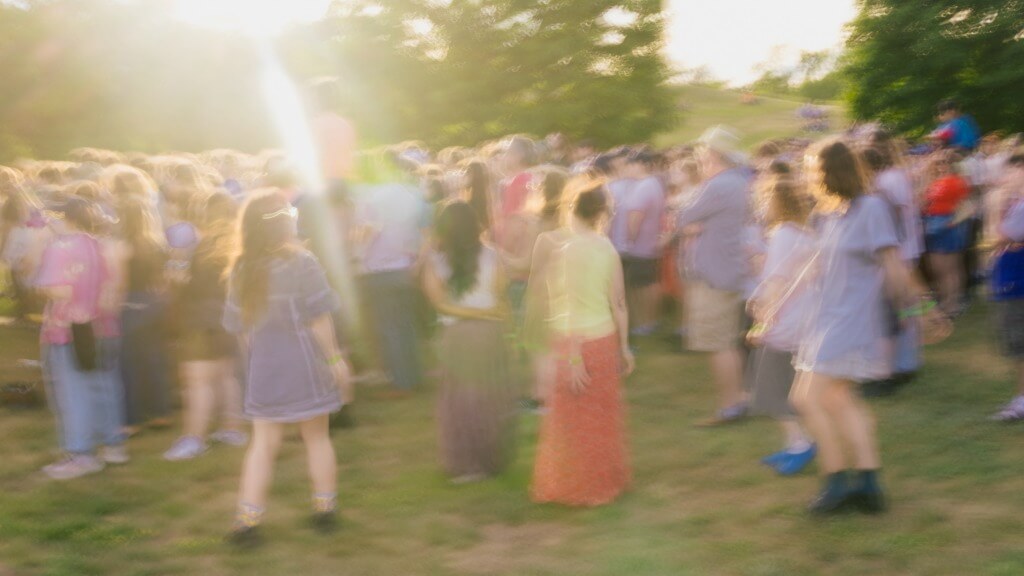
We’re on a hill in front of a field of green grass that seemed to stretch out forever, one angular metal sculpture looming behind us and more studding the landscape ahead like stalagmites. It was evening on the summer solstice, a perfect eighty degrees out; one of those moments that makes you feel like you’ll never die. Suddenly, Grace groaned beside me. “Oh god,” she said, rolling her head back. “All the clichés about leaving the city and coming upstate to nature are true.” (Moments later, she decided to roll down the hill, entrusting me with her bag as she gleefully tumbled down and down for a minute straight. The verdict: itchy, but worth it.)
Loath as we city mice might be to admit it, there are things New York City cannot offer us: open air, visible stars, the smell of native hardwoods. So when the opportunity came to travel upstate to Storm King Art Center to see Horsegirl and Black Country, New Road, I pounced and brought staff writer Grace Robins-Somerville with me. Unlike Grace, I’d been to Storm King once before, a few years back; it was a family day trip, my parents’ camera roll full of my brother and me standing amid endless grass in front of cylindrical Alexander Liberman pieces, a giant half-submerged Buddha head courtesy of Zhang Huan, and George Cutts’ mesmerizing Sea Change, lilting this way and that in the wind. We spent the whole day traversing the 500-acre grounds, and still only saw a fraction of it.
Grace and I didn’t have a whole day. We met up at Grand Central at roughly 2:30 p.m., and—after a Metro North and an Uber—arrived at a punctual 5 p.m., the moment the grounds opened up to concert-goers. Typically, I’m not one to arrive at a show at doors (I am Jewish and thus frequently late), but Storm King is different. I knew we’d have only a mere two hours for sculpture-gawking before Horsegirl took the stage, and I didn’t want to waste a minute of it.
After following a gravel path through the trees and marveling at the outside-ness of it all, we found ourselves staring down a field of yellow-green grass littered with the ruins of the Gilded Age: Liz Glynn’s Open House, concrete couches and footstools and chairs and arched windows scattered through the grass, the dilapidated remains of a long-forgotten form of opulence. We made our way through one final set of arches—a portal almost, easing us out of the wreckage of the past and back into the warm, living present—toward the remarkably small stage in the distance.
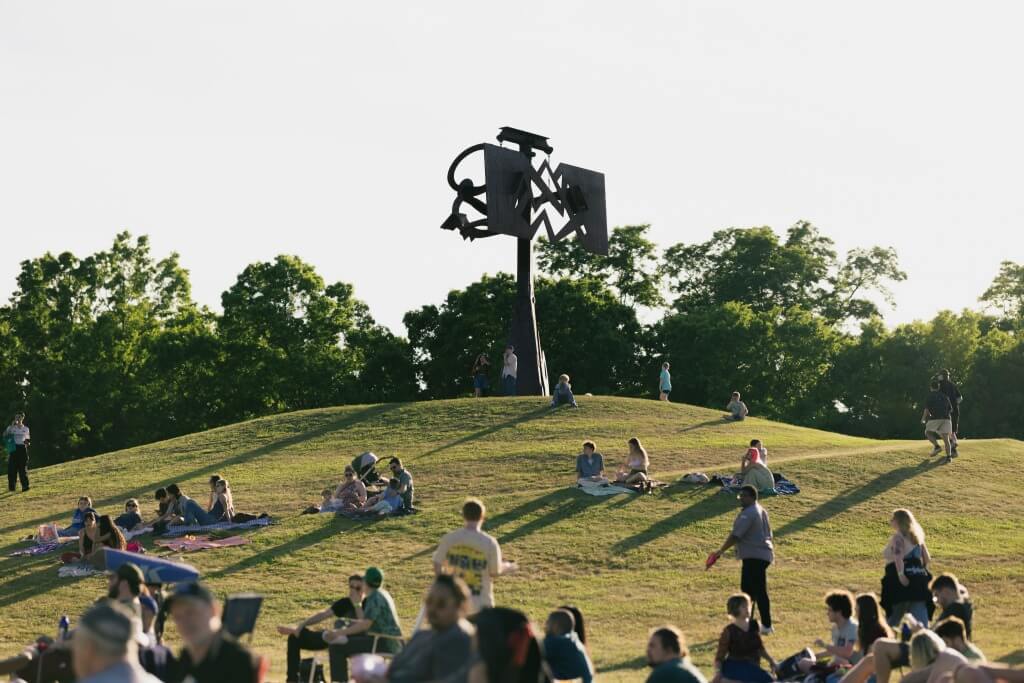
The ground in front of it ran flat, but off to one side rose a miniature hill (the very one Grace would later roll down) with Mark di Suvero’s Frog Legs looming at its crest, a great, twisting wrought-iron figure casting oddly-shaped shadows onto the grass below. As we walked, Grace couldn’t stop remarking on how much the landscape made her think of Midsommar. “Yeah,” I concurred, “if you squint, that metal guy on the hill could be the maypole.”
The stage itself was tiny—especially for a lineup about to play SummerStage a few days later—and the di Suvero works visible through its open back only dwarfed it further: the needle of E=MC2 stabbing the flesh of the sky, the bright red bones of Figolu behind it. By the time we reached the lawn, it was already a quilt of picnic blankets: families sprawled out, kids tearing through the grass, somebody’s tin of strawberries catching the light. We laid our own blanket down under a tree, as close to the front as we could without crossing into the sectioned-off standing room area, then we set off to spend our two hours squinting at the horizon, picking a far-off contortion rising up from the grass, and trekking towards it.
It’s hard to see sculptures like these and not immediately want to climb them, so I led us to one I remembered from my previous Storm King outing: di Suvero’s She, an absurdist metal playground with a wide circle of wood hanging from above—there to be sat on. (Nothing says the female essence like a platform bolted to several tons of iron, after all.) Grace hopped on immediately, clinging to the ropes as her dress blew in the wind. I followed suit, grinning madly. And wouldn’t you have it, approaching in the middle distance was Maya, a mutual friend who brought a little posse of her own, all of whom immediately began scaling the sculpture like a jungle gym.
The six of us drifted on from there, carried on the breeze of our own whims: around Magdalena Abakanowicz’s aptly-named Sarcophagi in Glass Houses; through Alicja Kwade’s LinienLand, a solar system drawn on three-dimensional graph paper to be entered by ducking under bars and clambering over poles; past Alice Aycock’s Three-Fold Manifestation II, which we rechristened the SOPHIE slide on sight; out to the microbial wonder that is Message from the Mud, nineteen columns of pond-scum and algae gone marbled in the sunlight. That might seem like awfully few pieces to see across two hours, but that’s how Storm King is structured: sculptures spread out across the grounds, sparse and distant. The hikes are as much a part of the experience as the sculptures themselves. You have to work—or, more literally, walk—for your art, and it’s strangely refreshing. In a city, everything is at our fingertips all the time. There’s something to be said for having to take the scenic route. (I did, though, make the grave error of wearing uncomfortable shoes.)
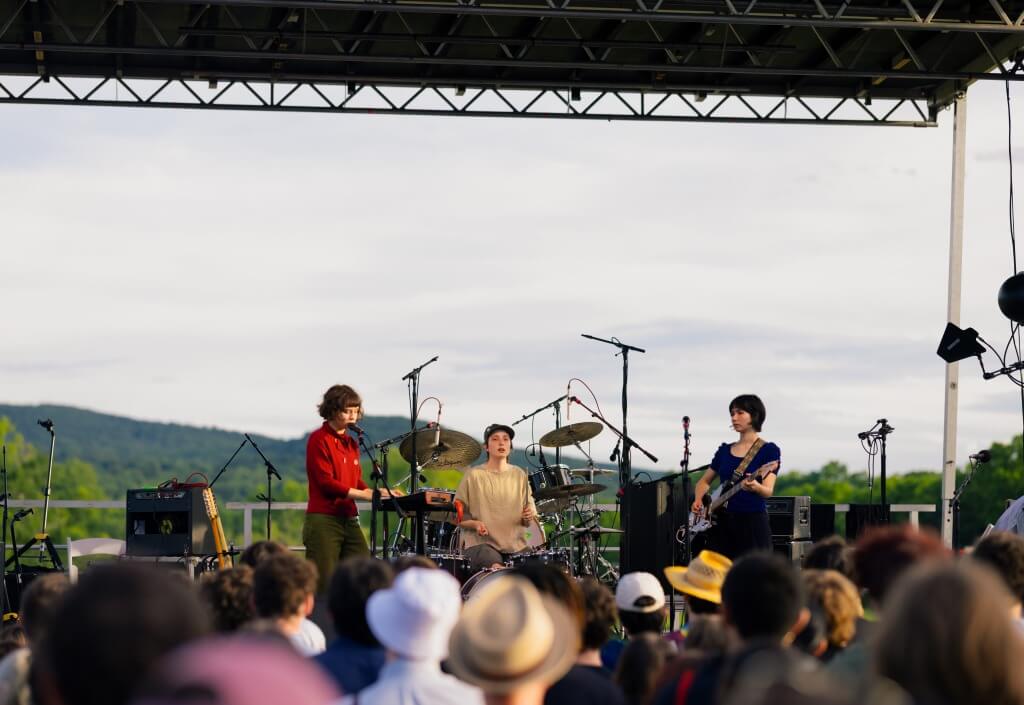
Eventually, we were ushered back to the performance area for Horsegirl. By the time the Chicago trio walked onstage, there was already enough of a crowd in the standing section that I had to crane my neck to see them from my vantage point on the ground. Vocalists Nora Cheng and Penelope Lowerstein sported matching chic haircuts as per usual (“They kick you out if you don’t have a bob,” Grace laughed). I’d seen the twee-punk outfit once before, at a secret show at Nightclub 101 a few weeks back, and honestly, I left feeling strangely let-down, despite really enjoying their 2025 album Phonetics On and On—it was a rather flat set in a tremendously overstuffed room. Horsegirl’s show at Storm King, though, proved that it was an anomaly. Maybe it was the open air, or the gold light going long over the grass, but for the first time, it felt like seeing them where they were meant to be seen. Their expansive indie rock was meant to live in the atmosphere, not suffocate in 101’s shoebox (I say that with love; I’m at 101 practically twice a week). Horsegirl themselves seemed to feel it too: “This is the coolest show we’ve ever played,” Cheng said into the mic, craning her neck to see all the sculptures around her.
The crowd actually had room to dance, too; one guy (who was definitely on something) repeatedly jumped multiple feet in the air, frog-like and overjoyed. There were kids roughhousing down by the tall grass, giggling and shrieking to the lovely earworm “Switch Over”—horseplay soundtracked by Horsegirl. Even with the sound issues during “Rock City” and “2468,” I found myself grinning ear-to-ear. Then in came the riotous drums and punishing guitar line of “Anti-Glory,” and I knew what was coming: “Dance! Dance! Dance!” Cheng and Lowerstein chanted the directive again and again, their monotonous delivery almost hypnotic in its rhythmic dexterity. My friends looked at each other, then one by one followed Horsegirl’s command: they got up from our blanket and joined the outskirts of the crowd, limbs waving as the sun began to set behind them. I stayed behind, determined to stay put and take notes like the diligent writer I am—or, at least, I tried to. But life is about living, and everyone in that crowd looked so alive, glowing orange and swaying to the beat. I got up and danced with the rest of them.
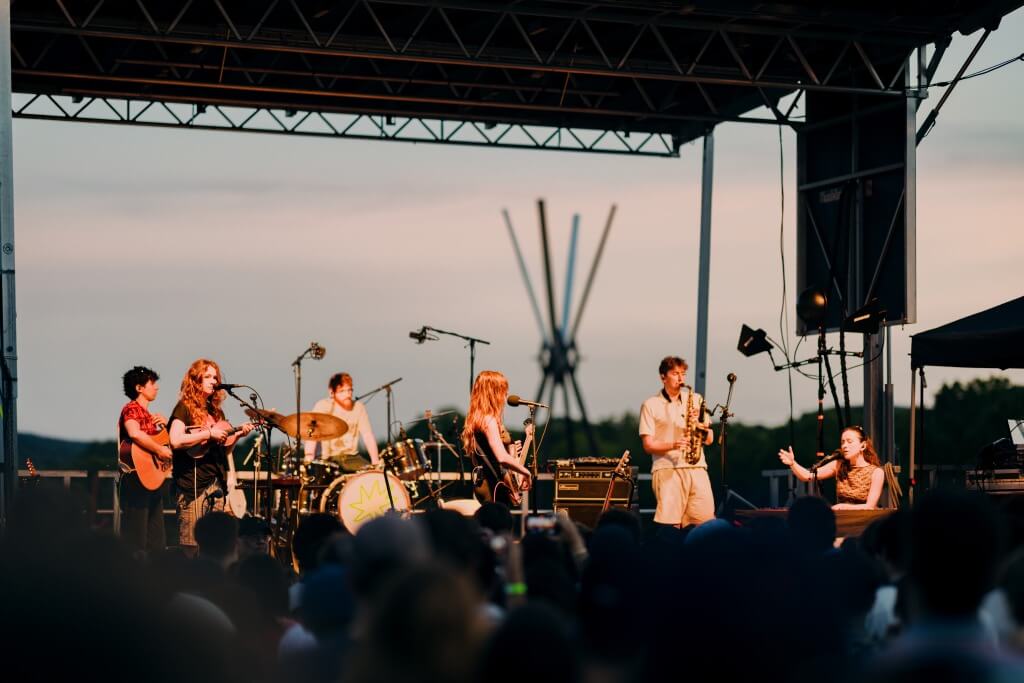
After a quick dinner break (I grabbed a rather mediocre taco), we settled back into our spots just as Black Country, New Road took the stage, an orchestra’s worth of instruments in tow. The British art-rock outfit has spent the last four years reinventing itself: frontman Isaac Wood left the band right as Ants From Up There, their breakthrough and magnum opus, was released to the public. Rather than elect a new frontman, the band split the duties into three—a smart choice, considering the band is made up of six multi-instrumentalist wunderkinds. Violinist Georgia Ellery, bassist Tyler Hyde, and keyboardist May Kershaw all traded off songs on 2025’s excellent Forever Howlong, the group’s first post-Wood studio record. It sounded nothing like Ants’ anguished epics, instead leaning into “something warmer, fuzzier, and—it must be said—kind of twee,” as I wrote in my review of the record last year. It’s a gorgeous album, one I’ve come back to frequently since its release.
While I have no interest in joining the vitriolic online discourse about which iteration of BCNR is better overall, I will say that I cannot imagine a band more perfect for the setting of Storm King than the one we got. BCNR mark II (to use Dexys Midnight Runners’ terms) has made a home in the mystical and mythical, their wildly complex arrangements braiding and blooming in a way that seems almost immaculately conceived, a sonic magic trick. Live, though, you get to watch it unfold. What starts as a fistful of loose strings—clarinet here, violin there, a fluttering voice, a saxophone—turns out to be a maypole in progress, every player a flower girl skipping her ribbon around the pole, the lines twirling and plaiting tighter every time they cross paths. As the band kicked off their set with “Strangers” from the War Child 2 compilation, the sun dipped slowly below the treeline, causing Frog Legs to cast a long shadow down the hill. Art imitates life and form mirrors content, or whatever they say.
I’ll be honest: I was a bit of a shit music critic that night. The only BCNR notes I took were from before the set even really started: “guy in front of me wearing white shirt with handwritten ‘DAD’ on the back, daughter on shoulders” and “someone in crowd at appearance of sax: ‘SAXOPHONE! YES!’” As soon as the opening chords dissipated into the cool night air, I felt it became somehow sacrilegious to do anything other than simply experience.
Now, I’m not one for “living in the moment” or any of that hoaky crap people always try to sell me. I cannot remember a single moment in which I’ve successfully lived. But fuck, when the three-part harmonies hit in “Mary,” all I could do was lie down on my blanket and stare up at the darkening sky, letting the heavenly choir of Georgia Ellery, Tyler Hyde, and May Kershaw cradle me like the blue-lit walls of a sensory deprivation tank.
I was only brought back to reality by the screams of a little girl whose brother started trying to steal her doll right at the start of Hyde’s singular “Nancy Tries to Take the Night.” After a minute of a finger-picked acoustic duet between Hyde and Luke Mark, the lyrics began. Hyde’s voice flitted around like a hummingbird: “There’s a time and a place, and the place, it is now.” I felt struck. The song built and built—with the accelerating interplay between Kershaw’s keys and Lewis Evans’ saxophone, the entrance of Charlie Wayne’s enormous drums—and something in me swelled with it. I stood at some point, weaving through the crowd, wanting to feel its pulse.
Kershaw’s “For the Cold Country” felt like a folktale amid all the greenery; the angelic harmonies and deep violin and medieval melodies hovered in mid-air, unmovable save for the eruption of Wayne’s drums, which blew them all to smithereens halfway through. By the time tell-tale piano plinks and intricate melodic lines of “Socks” rolled around, the sky had been dip-dyed a dark blue. The stage lights, though, were as orange as the sunset before, the band basking in an eternal golden hour—a stark, magnificent contrast to the immense night above. It made for a dramatic rendition of “Dancers,” the sole cut from Live at Bush Hall, Hyde’s searing vocals and Wayne’s percussive storm pinballing off the sculptures in the distance.
The frantic, overzealous harpsichord at the top of “Besties” somehow served as a wordless sign for my friends and me to venture up to the Frog Legs hill, curious about the view (which was, unfortunately, mostly blocked by a tree). But that song sounds the way gleefully running up a field with your friends feels, so it was worth it regardless. Ellery’s voice floated up the hillside: “I want to be anywhere other than this.” For once, I couldn’t relate at all.
One of the frontwomen—I couldn’t make out who from behind the tree—shouted into the mic, “Keep talking about Palestine. Our voice is loud for people who don’t have a voice.” We cheered loud enough to hurt our throats. Then, from the stage below, an unexpected melody rang out: Big Star’s “The Ballad of El Goodo.” We raced down the mound, eager to catch the cover up close. In my excitement, I almost ran straight into a group of giggling teens halfway up the hill, all holding hands as they skipped in a circle. I turned to point out the Midsommar-ness of it to Grace, but she had already sprinted into the crowd. I joined her at the back, then ducked and weaved my way into the sweaty heart of it.
As Kershaw’s songbird-clear voice intoned Forever Howlong’s title song, a strange sense of dread encroached: I could feel that the night was ending. The stars were out, the kids were yawning, the food tents were packing up. I felt an incalculable dismay—how was I supposed to step back into normal life now, to sit on a fluorescently-lit Metro North and finish my lukewarm review of the new Sublime album like I hadn’t just experienced something borderline transcendent? It didn’t feel fair. But I wasn’t given much time to stew; Hyde had started in on “Happy Birthday,” the final song, singing—as if to me specifically—“Cheer up child, the world don’t owe you a thing.” The second directive of the night. I tried to follow this one, too.
We all dragged our feet on the way out, lingering as long as we reasonably could. I took photos of Frog Legs silhouetted against the brightest part of the velvet, star-speckled backdrop, all these little shadow puppets of people moving around it. We eventually joined the collective exodus back to the parking lot, but saw that the herd ahead of us had stopped moving, instead crowding around the edge of the right side of the path. We peeked behind their shoulders: a small clearing surrounded by trees, hidden from the moon and nearly black because of it. Except, that is, for the hundreds upon hundreds of fireflies flickering throughout the entire space. “Nature’s Christmas lights,” I heard someone behind me murmur. It was—and I don’t use this word often—magical. Grace and I stayed there for over five minutes, unable to look away. Try as we might, the scene simply would not come out on video, so all we could do was try to memorize it. I’m notoriously a hoarder of experience, camera phone always in hand, so I never have to forget a thing. Here, I didn’t have a choice. I just had to live it, then pass it by.
Jolted by the realization that we were going to miss our train, we finally made our way back to Storm King’s entrance. It took over forty minutes for an Uber to come, but we didn’t mind. There were people to watch (a guy strumming “Cowboy Nudes” on a guitar seemingly apparated from out of nowhere, causing someone else to yell “I love Geese!” across the lot; a full-blown shouted conversation about Getting Killed ensued), friends to make (we spent the journey home with a couple also heading back to the city), and stars to see (I pointed out the Big Dipper, but that’s it; I’m better at winter constellations). Even as our driver pulled up and we piled into the backseat, Hyde’s voice seemed to linger, following me all the way from the Metro North to the 1 train to my apartment: “Many people would give an arm and a limb to live where you live.” Don’t I know it.
Casey Epstein-Gross is Associate Editor at Paste and is based in New York City. Follow her on X (@epsteingross) or email her at [email protected].
 Keep scrolling for more great stories.