
Bradley Nowell didn’t get to see himself become the voice of a generation
Sublime's idiosyncratic singer died thirty years ago today, before his band's self-titled album became one of the Nineties' defining releases.
Photo by John Dunne/MCA
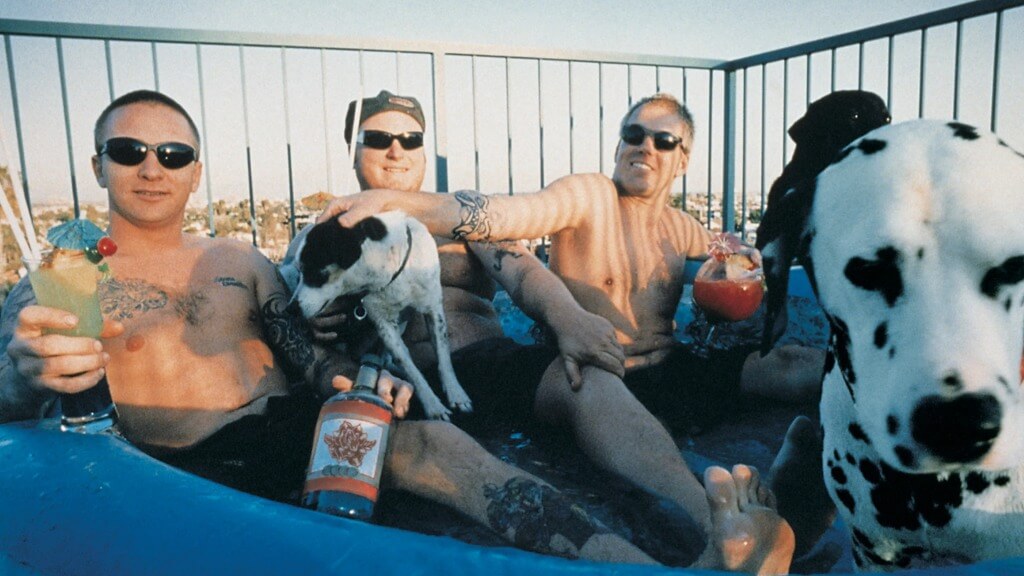
There is no one defined path to music stardom. Sheryl Crow’s first paying gigs were singing commercial jingles for McDonald’s and Toyota, then touring with Michael Jackson as a backing vocalist in the late Eighties. Diana Ross was Berry Gordy’s secretary at Motown Records before he gave her a shot at singing. The Bee Gees experimented with tons of sounds that did not involve ultrasonic falsetto before 1979’s Spirits Having Flown, their fifteenth LP, became their first #1 album. Those humble career starts all have an element of charm. Then there’s Sublime, whose sunny, genre-blending music conquered the world after a tragedy.
Eric Wilson and Bud Gaugh were a pair of childhood buds growing up in Long Beach. After playing in a local punk band, they welcomed Bradley Nowell, along with his love of ska and reggae, into the group, which was eventually renamed Sublime. For a while, they were simply part of the local ska scene, not making much noise nationally. Gradually, though, their profile increased, and in 1992, they independently unveiled their debut album, 40oz. to Freedom. It wasn’t particularly impactful upon release, but by 1995, the album’s signature song, “Date Rape,” became a surprise hit, thanks in large part to airplay from Los Angeles radio station KROQ.
This followed the band’s second album, 1994’s Robbin’ the Hood—a lo-fi release with two tracks that retrospectively stand out. For one, Gwen Stefani, before she and No Doubt became mainstream figures, provided guest vocals on “Saw Red.” Then there’s “Pool Shark,” which has since been thought of as Nowell’s prediction of his own demise. On the track, he sings about heroin addiction: “But now I’ve got the needle / And I can shake, but I can’t breathe / I take it away, but I want more and more / One day, I’m gonna lose the war.”
Nowell had a lot going on thirty years ago. On May 18, 1996, he married Troy Dendekker. Eleven months earlier, she gave birth to their first child, Jakob. At the time, Sublime had built significant grassroots popularity and had just finished recording a new album. The path there wasn’t easy, though, as Nowell had long dealt with addiction. He had been in and out of rehab for four years, but booking agent Rick Bonde believed the singer had been clean for nearly a year, perhaps prompted by fatherhood. He was mistaken. Sublime was in the middle of a run of West Coast shows, and on May 23, they performed in Chico, California. As Wilson would later put it, “We stayed over at some college girls’ house and smoked crack for breakfast.”
The next day, the band carried on and performed at the Phoenix Theatre in Petaluma, California. Some attendees said the show was awesome despite how much the band partied beforehand. Others remember it differently, with one saying, “I thought it sounded awful, especially Brad.” The band holed up that night at the Ocean View Motel in San Francisco. By noon the next day, Gaugh entered Nowell’s room and, according to Bonde, found the singer unconscious on his bed, his face green. Lou Dog, Nowell’s Dalmatian and the band’s de facto mascot, was licking vomit off his owner’s face. The cause of death was later confirmed to be a heroin overdose. Nowell was twenty-eight years old.
Sublime was scheduled to perform just hours later at a sold-out gig at San Francisco’s Maritime Hall. The show was canceled, but fans came anyway, turning what was supposed to be a night of jubilant music into an impromptu wake. Blane Kaplan, one of the band’s managers, told a newspaper, “I would assume that with Brad gone, they’d never play under the name Sublime again.” Jason Westfall, also a Sublime manager, felt the same way, saying, “We will go on in music and do other things. But just like Nirvana, Sublime died when Brad died.” Jon Phillips, yet another manager, spoke of the group’s potential in the past tense: “It looked like the band was ready to explode. The stage was set for greatness.”
But there was still the matter of the band’s upcoming self-titled album. For a while, it seemed doomed. As associates suspected, Sublime had officially broken up. The president of MCA Records, the band’s label, was unsure about the project’s potential for success without an accompanying tour. But Bonde convinced the label head to give it a shot, and Sublime came out on July 30, 1996. The death of an artist often renews interest in their music. 1989’s Mystery Girl, the last album Roy Orbison recorded before his death in late 1988, was his biggest chart hit. Where Sublime differed, though, was that while Orbison had already achieved success before his death, Sublime was still on the ascent, waiting to fulfill its perceived potential. Given the circumstances, MCA’s label head had a point.
Sublime turned out to be undeniable: the album became a hit, reaching a peak at #13 on the Billboard 200. The songs were big too, with lead single “What I Got” reaching #1 on the Modern Rock Tracks chart. Its follow-up, “Santeria,” made it to #3, as did “Wrong Way.” Sublime had arrived, with Rolling Stone later calling them “the biggest rock act of 1997.” In a 1996 Billboard article covering the album’s success, Abbey Konowitch, an executive VP at MCA, said, “It’s so unfortunate that Brad isn’t here to see the way his music is being appreciated and accepted by the public. This is a very significant album in a significant time in music, and we’re fortunate to have this music, though we’re very unfortunate to not have one of the artists around who created it.”
That statement would only resonate deeper as the years went on. Sublime was a hit in its time, but now it’s regarded as one of the defining albums of the mid-Nineties. “Santeria,” with its 1.1 billion streams on Spotify alone, is remembered as among the biggest songs of the decade (as is “What I Got,” which itself has amassed over 600 million plays). Nowell never knew it, but his unforgettable songs and distinct vocal style made him one of the leading musical voices of his generation. In that same Billboard feature, Eric Wilson said of Sublime: “We just want the album to do well so that Brad’s kid can go to a good school, and so that we can continue [to make a] living.” He and Gaugh stayed in music: In 2009, they recruited singer and guitarist Rome Ramirez to join them in a new band called Sublime with Rome. The trio originally intended to re-form Sublime under its original name, but that was stopped after a legal objection by Nowell’s family and estate.
As for Nowell’s son Jakob, he grew up. Though he never knew his father, he’s filled his shoes exceptionally. On several occasions in recent years, Wilson and Gaugh have performed as Sublime again with Jakob on vocals. This renewed version of the band stayed aflame and has already shown some promise: last year’s “Ensenada,” the lead track from this summer’s Until the Sun Explodes, became the band’s first song to top the Alternative Airplay (formerly known as Modern Rock Tracks) chart since “What I Got.” While the early returns have been positive, Until the Sun won’t be as impactful as Sublime. But Brad’s legacy living on through his son is a heartwarming story. If nothing else, it goes to show how winding and unpredictable a band’s journey can be.
Derrick Rossignol is a writer and editor whose work covering music, video games, and other areas of pop culture has appeared in publications like The A.V. Club, The Boston Globe, CBR, The Guardian, Nintendo Life, and Uproxx.
 Keep scrolling for more great stories.