
Sub*T go all in
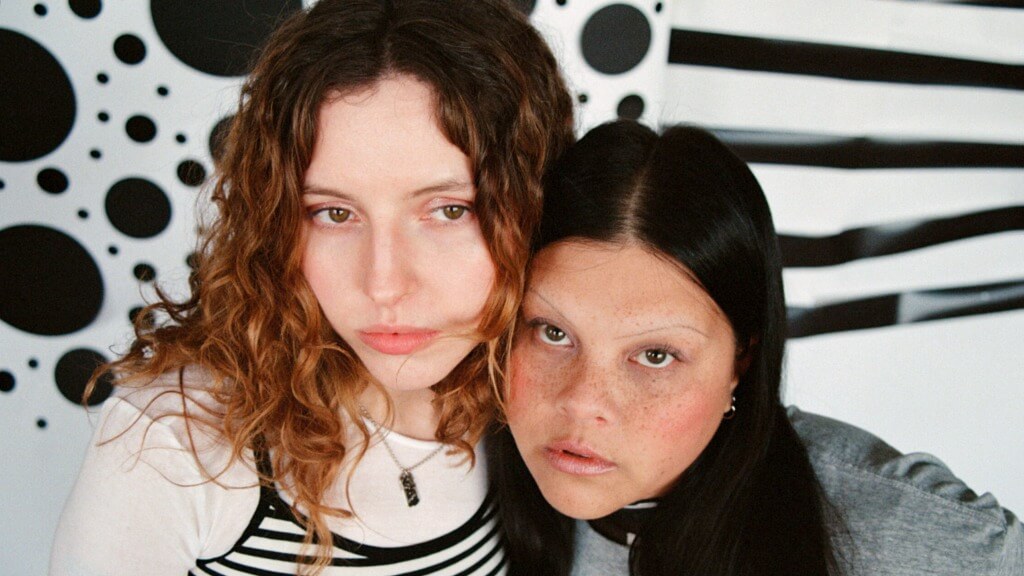
Jade Alcantara and Grace Bennett talk to Paste about their past lives as Directioners, starting a band from scratch, befriending Hinds, and their debut album, How My Own Voice Sounds.

Being a fangirl is a funny thing. Capital F-Fandom can make you feel like you’re standing in the middle of a split-screen between the “real” or “outside” world and another realm that exists in a mostly immaterial way, with its own lexicon and culture that, while not exactly a secret, never feels quite legible outside its insular, obsessive, self-selecting community. Especially when you’re young and your tastes and self-identity are taking shape in tandem and in real time, being a fan of something—a band, a musical genre, a TV or film franchise—is a way of making something about yourself known to others who might actually listen, if only for a moment. The connection found in fandom and the isolation of carrying this thing through the real world go hand in hand: the thing that seems frivolous when you try to put it into words can be a lifeline. At a certain point, it’s not even about the thing you’re a fan of—at least not entirely. Your favorite band becomes a meeting place, a sanctuary for you and your likeminded friends—people you might not have found or connected with through other means.
There’s something uniquely thrilling about finding your people because you’re all under the same spell. It’s a feeling that first captured me when I was twelve years old making my first Tumblr blog and finding a slew of other people, mostly teenage girls, who felt the way I did about Bright Eyes and the Strokes and Arctic Monkeys. Even though these bands were widely beloved by the time I “discovered” them, I still felt like my online friends and I were all being let in on a secret. And even though these bands were often considered cool in the outside world, I knew that there was something distinctly uncool about the intensity with which I loved them. Even as an adult, I still feel a bit of this connection-isolation push-pull whenever I add a new favorite band to my ever-growing personal canon. My chosen profession and some of my most important relationships stemmed from using my intense love of music to build my identity from the ground-up, and sometimes it feels as though every word I’ve ever written is in service of explaining and justifying the enormity of the soundtracks to my life. Being a fan makes me feel connected to history—to a feeling that every fangirl, from my Beatlemaniac foremothers to my Directioner cousins, knows intimately. Fandom itself isn’t purely receptive—it’s interactive—and that place between fandom world and outside world is often the one most ripe for creative risk.
That’s certainly how it was for Jade Alcantara and Grace Bennett, the co-frontwomen of Brooklyn-based rock band Sub*T. The two of them met while living on opposite coasts—Alcantara in the Bay Area and Bennett in Albany and later New York City—through mutual internet fandom friends. Their own friendship and eventual band was the result of them, in Bennett’s words, “craving this connection with other people that has just evolved over time.” Bennett, who’s sitting across from Alcantara and me in the dimly lit greenroom at Elsewhere, just hours before Sub*T’s album release show for their debut record, How My Own Voice Sounds, says the fangirl persona “was really easy to make fun of, but I didn’t care.”
Bennett joined Twitter in 2011 as a One Direction-obsessed teenager. That’s where she met a friend who lived in Long Beach, California—someone she would stay with when she went out West for One Direction shows, and who was also friends with Alcantara. Bennett and Alcantara didn’t meet until years later—post-1D breakup—but already knew of one another through this mutual friend and the general overlap of internet music fandom communities. “I wasn’t on Twitter, but I knew of Grace before we met just from like—this girl I know is on a trip and she’s there and so are these other three people,” Alcantara explains. “That’s just how the internet was, everyone knew everyone, especially if you liked the same bands. We were like, aware of each other before we became friends.”
The way the two of them describe this embryonic stage of their friendship feels like the beginning of so many of my own “ooomfs to irls” platonic love stories—two friends-of-friends looking at one another from across the feed, each seeing a cooler version of ourselves nerding out about the same stuff. Alcantara and Bennett aren’t the first artists I’ve interviewed who are former Directioners, and I doubt they’ll be the last. Among this specific subsection of mostly female, mostly Gen-Z musicians, there’s plenty of sonic variation in the music they’re making, and almost none of it sounds like One Direction. Sub*T’s music calls to mind the fuzzy-guitared, dusky-voiced, grunge-y slacker-pop of Nineties alternative radio—though the refrain of “if this was last summer I’d be there” on “Mirror Image” is the kind of sticky, bittersweet nostalgia that 1D wishes they could’ve spun into this catchy of a hook.
The Directioner-to-music-industry-professional pipeline is real, and it goes beyond just the musicians themselves, proving that fandom can be a highly transferable skill set. It turns out that sometimes in the real world, being passionate, attentive to detail, and eager to connect with others over a shared love of music will get you far. “My One Direction friends, they work at Ground Control Touring, they’re publicists,” says Bennett. “It just grabbed everybody and did not let go.” She explains that Alcantara and her friends were “South by Southwest warriors”—a fandom that I didn’t even know existed: “Like, a group of friends who went to South by Southwest every year, for the entire time,” she tells me. “Like nine people out all day, every day. I was just like, ‘This girl’s so cool!’”
“Hinds was doing twenty shows a week, we were really into shame when they first came to America and they had done like fifteen shows,” Alcantara says. According to her, the Austin-based festival “was just a way to max out on these experiences where you don’t have to leave the city. Coming from being a One Direction fan, I was like, ‘Oh, this is what rock and roll is.’ Playing our first South By as a band, it was just as cool. We played Hotel Vegas at noon and there were so many people there. It was just an awesome feeling.”
As for Hinds, the Spanish garage rock band was a major influence for Sub*T. Alcantara introduced Bennett to them. The first time the duo met in person was at a Hinds show with Twin Peaks. When the two bands went on a West Coast tour between 2017 Coachella weekends, Alcantara attended every single performance and eventually befriended Hinds frontwomen Carlotta Cosials and Ana García Perrote. “I wasn’t really doing music then but I was definitely interested in it,” she tells me. “[Hinds] made me feel just super welcome. And just being a fan of the music they were like, ‘That’s so cool.’ Because they were obsessed with the Strokes, that was their thing. And then when I made a band they were so excited.” This would all culminate in a full-circle moment years later in 2022, when Sub*T opened for Hinds at Music Hall of Williamsburg. “We still had just as much fun in the pit that night,” Alcantara laughs. Back in 2017, before forming their own band was even an idea, Alcantara and Bennett were struck by both inspired by this all-female, unabashed fangirl guitar band, and irritated by the fact that the sight of four women onstage was still a novelty. “Just seeing a band of four women was super cool and also kind of was getting to the core of what was frustrating us,” Bennett explains.
A pair of songs at the midpoint of How My Own Voice Sounds—titled “Sister Species 1” and “Sister Species 2”—seem to track this evolution from fan to creator, the ascent from the audience to the stage. “Skin breaks but I feel nothing / I’m still starving, spit out the seeds,” Bennett deadpans on the former, with Alcantara jumping in to harmonize. “I’m sick of waiting for a ripened moment / To pick a new way.” It feels like the two of them pinpointing that moment of visualizing the outlines of something lacking and stumbling toward a point where they can fill the space. The guitars grow more muted as “Sister Species 1” transitions into “Sister Species 2,” on which Alcantara sings “I collect things to look at / Intentions never are enough.” The moment of self-recognition urging them into creation comes at the swirling, talk-singy chorus: “Everything I wanted to be / Or a sister species / You say ambition’s a curse / You make it look so easy.”
Making it look easy—as the cool and collected onstage versions of Alcantara and Bennett do—takes a lot of work. In 2019, the pair decided to start a band completely from scratch. Neither had any songwriting experience. Other than Bennett’s school-mandated stints in her elementary school band and sixth grade musical, neither band member had ever performed in front of an audience. Both bought guitars without knowing how to play them, and when COVID lockdown came, they had the perfect excuse to devote their ample indoor time to learning. “It was really hard for me. It’s still hard for me,” Alcantara admits. “I wish I grew up playing guitar. But I love it in a lot of ways. It was the first thing I’d done as an adult that was like, I’m gonna do this thing that’s incredibly hard that I’m not feeling like I was born to do it, and I’m gonna do it anyway.”
Sub*T spent two years learning guitar and co-writing songs long distance before they ever played a show. The turning point came in 2021, when they were offered a support slot at, coincidentally, the very same stage they’re headlining the night we speak. The show became the catalyst for Alcantara’s relocation to New York, where she’s lived ever since. “We maybe would’ve played earlier if it was possible,” Bennett says. “When we said yes to that first show we didn’t have a bass player, we didn’t have a drummer. I think we just kind of have to say yes and then everything else will be figured out. You gotta have a reason sometimes to go all in.”
Bennett and Alcantara’s collaborative process hasn’t changed much since that first fateful show. They’ve both grown more confident in their abilities, but the songs come together similarly to how they did when the two were writing from opposite sides of the country. “We’d basically just create a song and it would be pretty formed before we share it with each other,” recalls Alcantara. “And then it turned into a series of voice memos—or, not even voice memos—sending GarageBand files back and forth, and that was really how we wrote all our early music up until this album. I mean, that’s still how we do it. We’re never like, sitting next to each other and being like, let’s write a song right now. I don’t know if it would’ve been different if we’d lived in the same place, but it’s how we started and how we learned and it just felt good to do it this way.”
Sub*T’s best songs are the ones that capture the white-hot nervous energy of the house lights dimming and the band walking onstage, when whatever dingy room you’re in could potentially become home to the show that changes your life. “What’s my life but waiting on an invite?” Bennett asks on “That Kind of Night”—a highlight from the band’s 2024 EP Spring Skin. It also crystallizes that outside-looking-in moment, of witnessing something that elicits such a strong feeling in you and immediately wondering if there’s a way to create that reaction yourself—an integral step in the fan-to-artist ascension. On How My Own Voice Sounds, the song “Standing Room” brings that potential energy to fruition with explosive guitar sounds and Bennett and Alcantara’s layered, newly self-assured narration: “It’s standing room only / But I’m not looking back / I listen to what you told me / I can only look ahead.” Songs like these spring from “the era after being a fangirl,” as Alcantara puts it. “Like, ‘I’m a tough girl, I make the pit, you need us!’ And then we evolved again and were like, we just need ourselves. We can do that too. We can make people dance!”
She continues, “The lyrics are quite emotional for me, but I set out to purposefully make a song that people could still dance around to. That was the end goal. Because we had so much fun at shows and I was in all these mosh pits, it felt like it was necessary. I think we like creating up-tempo, rock-out moments, to let loose. I think we’re always reaching for that because we felt it so many times.”
Both Alcantara and Bennett suffered intense stage fright before they started playing Sub*T songs onstage, but that first show flipped the switch for them. “I remember being in this exact room, being genuinely so nervous,” Bennett says. “But the second we went up there I was just like, wait, this is my music I know this shit. We’re here to perform stuff we’ve been writing for two years, we’ve got two members we trust that know our songs. It honestly did kinda feel like I had started a new version of myself.” That new version of herself, Bennett says, was a bit of a shock to the people who knew her. Being a performer of any kind—let alone fronting a rock band—was not something anyone who knew her before had expected.
How My Own Voice Sounds is an apt title for Sub*T’s debut album, a document of two fans-turned-musicians finding their voices. It both arrives fully-formed and allows you to peer into the self-actualization of its purveyors. “Been quiet so long that I forget how my own voice sounds,” goes the hazy chorus of album closer, “Wide Load.” Traces of those inciting moments—each burst of catharsis in the mosh pit, each flicker of self-recognition in a voice on the radio or a singer standing onstage—exist in what they’ve created, as does the knowledge that the voice that’s finally found its way out has been there all along.
Grace Robins-Somerville is a writer from Brooklyn. Her work has appeared in Pitchfork, Stereogum, The Alternative, ANTICS, Marvin, Swim Into The Sound and her “mostly about music” newsletter, Our Band Could Be Your Wife.
 Keep scrolling for more great stories.