
Suki Waterhouse lacks artistic perspective on Loveland
Not even an all-star cast of co-writers and producers can save Waterhouse from creative limbo on her anemic third album.

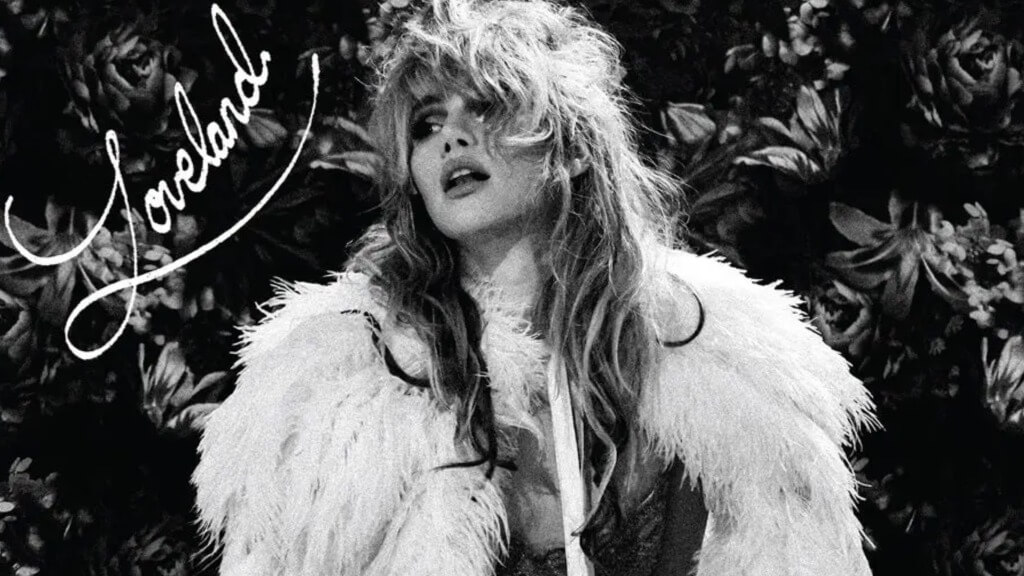
Most people know Suki Waterhouse in some way or another: Daisy Jones & The Six, her breakout single “Moves,” that photo of Bradley Cooper reading Lolita to her in a park, her Belle & Sebastian collab, her Eras Tour opening slot, or simply as Robert Pattinson’s fiancée. But those interactions rarely cohere into a clear artistic identity. What is her story? Who is she, if not a confounding figure in today’s pop landscape, a chameleon who can seem more like a cosplayer than a singular, definitive presence?
And she’s not doing anything wrong, per se. Waterhouse’s music has fallen into a generally inoffensive category, doing nothing particularly inventive yet still retaining her identity as a “cool girl.” Alas, chill cool vibes do not a music career make. They took her where she needed to go with “Moves” and “Devil I Know,” two of the most compelling tracks from her Sub Pop debut, I Can’t Let Go, on which her lax, dazed vocals became her signature. After Daisy Jones & The Six, though, she pivoted away from those touchstones, turning instead toward guitar-based Americana with tracks like “Think Twice” or “My Fun” (she then takes it one step further on Loveland’s “Morals,” with Mick Fleetwood himself appearing on drums). None of it is bad, but little of it packs much of a thematic or sonic punch.
Waterhouse’s third album and Island Records debut, Loveland, comes wrapped in change and polished by new collaborative voices: mega-hit producers and songwriters Amy Allen, Joel Little, and The National’s Aaron Dessner, all of whom collaborate with the likes of Sabrina Carpenter, Taylor Swift, and Harry Styles. Though she’s kept her original creative partners in the fold, it’s hard not to feel the Olivia Dean-ish sheen on tracks like the “Espresso”-indebted “Happy With It” or the bland-if-not-random “Jukebox” (where does “jukebox doo-wop” fit into the push-pull between motherhood and youth, I wonder?). Each producer leaves an obvious fingerprint. You can feel when it’s Allen (the straightforward “Any Man”), when it’s Dessner (the plucking loops of “Almost”), but you never feel when it’s Suki.
Waterhouse is stylistically swayable because of her lack of artistic perspective, which turns her music into anemic, radio-friendly pop that’s a little soulless. Because we can’t really pin her down sonically (more derivative than eclectic), that blurriness bleeds into her thematic identity, with writing that rarely fills gaps or paints a full picture of who she is or even who she wants to be to listeners. The premise of Waterhouse’s “brand,” so to speak, is to be an aspirational, mood-board-inspiring capital-I It Girl, and what we learn about her on Loveland is unrelatable to that extent. She’s practically rubbing her relationship with Robert Pattinson in our faces on “Any Man.”
She tries on different sounds across the Loveland tracklist: the single “When I Get Drunk (I Want You Boy)” has her old sensibilities (drawling vocals, fuzzy, blown-out grit) repackaged in a smooth-jazz disguise. Sauntering, near-dragging drums and gentle pianos stumble in a nearly out-of-time wooze. But some of Loveland’s best moments come only when Waterhouse’s sound evokes the memory of more distinctive artists. “Teardrops” is where the record finally finds some steady footing, but that groundedness comes from how closely it recalls another artist’s style: Lana Del Rey. It’s in the beat (trappy, echoing), the lyrics (“Riding through the city / That we own now,” “I can’t really help you when you’re so high”), the octave-up falsetto harmonies that ring with reverb—the way it spins out and meanders for a second, giving you something to fall into. All of this is to say: it’d be a great Lana song, but it’s not a Lana song, and that’s the problem.
“Puppy Dog Eyes,” tucked away on the album’s back half, contains some of Waterhouse’s more straightforward and vulnerable writing. It works because you can feel the real emotion behind it (“You say you fucking love me / I tripped you, now you’re on your knees”). The music recalls the distortion that flowed through I Can’t Let Go: a thicker, scuzzier rock track that has the oomph of Veruca Salt and the bite of Bully. It’s a song about self-sabotage, about trying to end a relationship but not being able to get all the way there—codependency revealing itself in spite of her. But you can’t really link this POV to the rest of the album; Loveland’s lack of narrative cohesion begs for something more emotionally rich.
Some of Loveland is catchy, especially “Tiny Raisin” and “When I Get Drunk.” But most of this record evaporates the second it’s over. The songs are pleasant enough in the moment that you don’t notice how little actually stuck until you’re trying to hum a tune back five minutes later. It’s frustrating precisely because Loveland is so polished, with so little room for the bombastic, all-consuming sounds that made so much of Waterhouse’s earlier work compelling. In some alternate universe, there’s a trimmed-down version of this tracklist that starts with “Teardrops” and ends with “Loveland,” letting her strongest material breathe. Instead, the album feels overstuffed, favoring polish over cleverness. The issue isn’t that the songs are weak or that Waterhouse is doing a bad job performing them, but the absence of a voice that is unmistakably her own. Three albums in, Loveland fails to answer the question we’ve been asking since I Can’t Let Go: Who even is Suki Waterhouse the musician? [Island]
Cassidy Sollazzo is a music and culture writer based in Brooklyn. Alongside Paste, her work has appeared in Dazed, PAPER, Air Mail, ANTICS, and others.
 Keep scrolling for more great stories.