
The All-American Rejects are a band for the people (and creepy lemons)
Last Friday, the pop-punk icons launched their comeback album with a nostalgia trip in a Brooklyn warehouse lit so poorly we didn’t get a single usable photo.
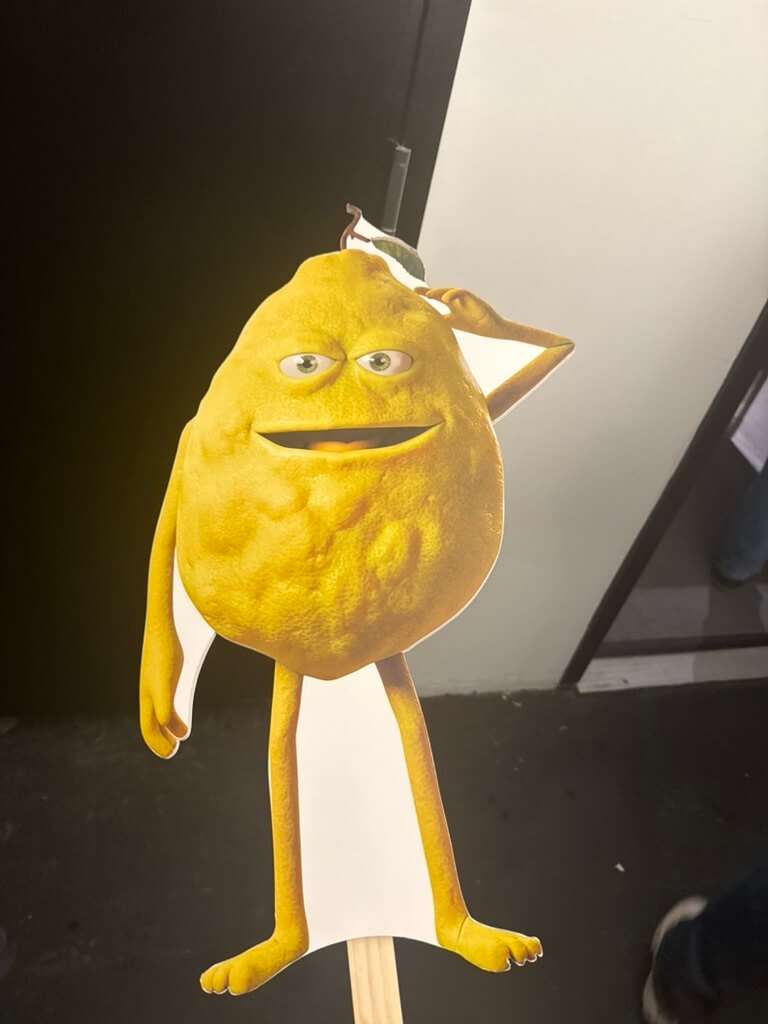
Photo of AAR by Andy Knight / photo of creepy lemon by Miranda Wollen

It feels like summer here in Brooklyn, and the line for the All-American Rejects’ album release show wraps all the way around the block. The band, which released Sandbox, its first new album in fourteen years, on Friday, has experienced something of a renaissance this past year through an admittedly genius marketing stunt. The group spent much of the last year playing what they’ve coined “house party shows,” intimate, ad-hoc performances designed to feel like the grotty frat basements and mothball-ridden garages in which their fan base first encountered the Rejects’ music. Cleveland fans lobbied for the group to do a Taco Bell parking lot show, but that hasn’t come to fruition yet.
For the Rejects’ New York stop, I’ve brought my most tweemo (read: twee-emo) friend, Amal, for the occasion. It’s taking place in an empty warehouse in Greenpoint, the location kept secret until the morning of the event. That the group selected this zillennial haven for their return to the musical scene was, perhaps, no coincidence: most of the audience looks to have been born squarely within the temporal confines of the Clinton presidency, just old enough to classify the Bionicle commercial soundtracked by “Move Along” in the mid-Aughts as a canon event. The walls here are lined with spray-painted tapestries, and the air hangs heavy with an optimism that peaked twenty years ago. Also: a little bit of body odor. In fairness, we’re packed into the space like sardines.
Telescreens, whose forthcoming album Why the Lights Flicker is out June 12, are opening the show. They are loud and buzzy, inspiring people to clap on the beat. But, in truth, I am struggling to focus on Telescreens’ set because of a figure that keeps appearing in the corner of my eye. Out of the sea of people arises an army of anthropomorphic lemons, about two feet tall and attached to sticks so they can bob above the crowd. The lemons are some post-ironic nod to Mike’s Hard Lemonade, the Rejects’ corporate sponsor (and an apt one; this is not Negroni music.) The lemons have deeply human eyes and uncomfortably pockmarked skin; for some reason, their lemony tongues are out. They are unbelievably creepy, and so I find one of my own as quickly as I can. To my roommates’ eventual chagrin, I will find a home for it in our living room.
Soon after the successful search party for my lemon, the All-American Rejects come on (by my count, a few minutes early; they are a respectful band of misfits.) Frank Sinatra’s “New York, New York” plays and, with a blissful lack of cynicism, everyone sings along. A guy behind me looks at the band, takes a deep breath, and says, “I’ve got to crowd surf,” to a companion with the conviction of a soldier at war. Now is not the time to be too cool for anything.
The Rejects open with “Dirty Little Secret,” that explosive, horny magnum opus, and a live wire of excitement sizzles through the crowd. The band sounds great live, even if I can’t see them because they’ve decided not to perform on an elevated platform; Tyson Ritter’s voice is lucid and familiar, Nick Wheeler’s and Mike Kennerty’s guitars bright and sharp. Chris Gaylor sits behind the kit, anchoring the set with a steady, stomping beat. The band breaks into “King Kong,” a peppy, thrumming new song whose disillusioned lyrics belie its stomp-clap beat. And then it’s time for “Swing Swing,” a deliciously self-indulgent breakup dirge that’s retained some cultural stock since breaking into the top ten of Billboard’s Modern Rock Tracks chart twenty-three years ago. Amal, along with most of the audience, is dancing so intently that they seem to be convulsing. The songs are brisk and snappy, four minutes at the most, and they come roiling through in relentless succession. A surge runs through the crowd; the room’s walls seem to close in on us.
We take a restroom break; the temperature has risen ten degrees since the concert began. There is a Torrid brand corset on the floor of one of the stalls, and I do not know what to make of this fact. There’s no time to ponder it, because as the two of us round the hallway back to where the stage is, we hear something that awakens our senses like foxes on the hunt: the opening chords to “Move Along.” There is perhaps no better pop-punk earworm than the 3:58 masterpiece from 2005. It sends us into a group psychosis. People are on the verge of tears; some are, indeed, crowdsurfing.
But the show’s not over yet. One more piece of 2000s greatness awaits us. The ragged opening chords to “Gives You Hell” float into the back of the crowd, where Amal and I are, at this point, taking refuge from the various rogue elbows and hands and feet and hair we’ve been touched just a little too much by. The audience reaches what can only scientifically be categorized as a “flow state.” I am not exempt; as I shout the chorus, I find myself making up imaginary beefs with exes for whom I wish nothing but the best. If that doesn’t signify lyrical greatness, I don’t know what does. In truth, I can’t tell you if an encore is played. I am, at that point, so blinded by my own sweat that I have the sole priority of accessing the quiet outside. But as Amal and I walk home in the air that’s about to become Saturday, we drink water like fish and show our creepy new lemon friend his first taste of the real world.
Miranda Wollen is a staff writer at Paste and is based in New York City. Follow her @mirandakwollen or email her.
 Keep scrolling for more great stories.