
Dash Lewis on “Hang On To Your Ego”
Pet Sounds Project: Track nine on Pet Sounds modulates up rather than down, lending a buoyancy not often found on the album. Put simply, it more closely resembles the group’s surfboards-and-summertime songs of yore than the pocket symphonies that populate the rest of the record.
Photo by Michael Ochs Archives/Getty Images
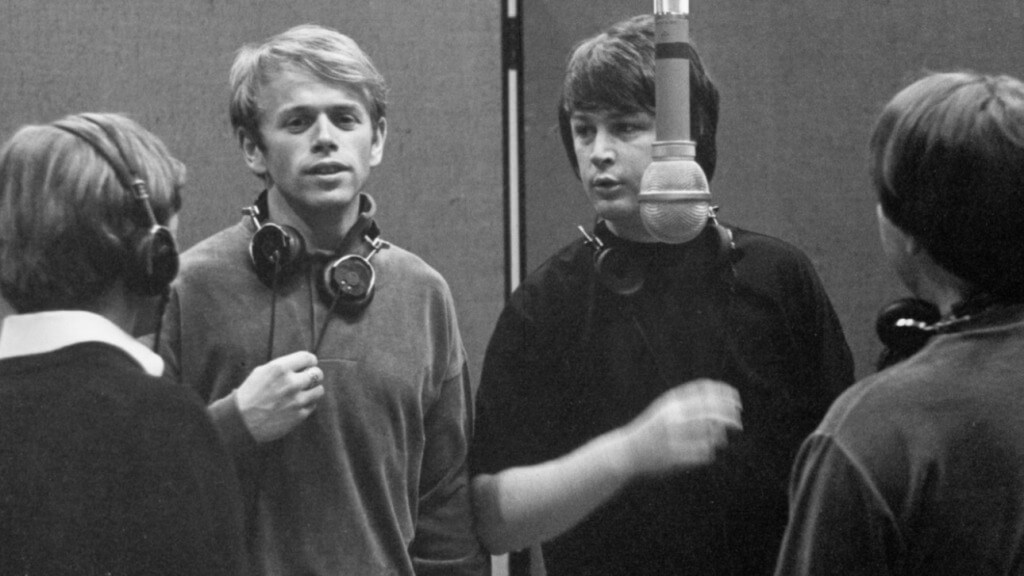
The Pet Sounds Project is Paste’s two-week celebration of the Beach Boys’ eleventh album, which turns sixty years old on May 16, 2026.
A few years ago, a friend of mine rubbed the bags under his eyes and groggily explained the damage he’d inflicted upon himself the previous night. “All I did was listen to Pet Sounds in the living room,” he said, voice strained through stale layers of expensive whiskey. “Why am I so hungover?” It felt, to me, like the perfect way of explaining the effect of that record. Critics over the years have written about it as a psychedelic masterpiece—and it is that, as the wall-of-sound production and heaven-bound harmonies envelop you like a swaddling cloth. But more than its trippy, echoing sonics, Pet Sounds is thoroughly destabilizing; the song structures make no sense, the chord progressions zig and zag unpredictably, and, at the center of it all, there lies a frantic, naked emotional core that pairs especially well with another round or two.
I doubt I could tell you the number of times I’ve cried to “God Only Knows” or felt my breath catch in my throat when Brian Wilson sings, “Wouldn’t it be nice if we were older?” Like my friend, I’ve often found myself sitting on my couch, holding an empty glass, swimming through the haze by the time the needle lifts after “Caroline, No.” The yearning for a tangible, spiritually fulfilling love lingers in the air between the speakers, and I’m half-tempted to refill the glass and flip the record back to side A. There is no resolution, no catharsis, no recognition of some great truth at the end of Pet Sounds, just the terrible beauty of the never-ending journey in service of it all.
The one that always stops me in my tracks, though, is “I Know There’s An Answer.” It’s a deep cut (at least insofar as the song that comes after “God Only Knows” can be a deep cut), and it feels a bit incongruous to the whole. Even at its poppiest, Pet Sounds carries a doleful tone, its melodies drooping over the instruments like a sagging hammock. No matter who takes the lead or how fast the tempo, the vocals always sound like they’re melting, giving the upbeat tracks a desperate, jittery undertone and accentuating the melancholy in the slower ones. “I Know There’s An Answer” is the exception. The singers—Mike Love and Al Jardine on the verses, Brian himself on the chorus—absolutely soar, their voices tracing arcs over the candy-colored arrangement. And unlike most of Pet Sounds, “I Know There’s An Answer” modulates up rather than down, lending a buoyancy not often found on the album. Put simply, it more closely resembles the group’s surfboards-and-summertime songs of yore than the pocket symphonies that populate the rest of the record.
Some of this can be attributed to the bassline, a circular figure that shifts keys a few times while maintaining its repetitive form. It’s mixed louder than most on the album, and has a hypnotic quality—you could easily airlift it into a Spacemen 3 or Wooden Shjips jam, set it adrift on a sea of blistering guitar noise, and have a blissy, neo-kosmische psych excursion on your hands. Wilson positions that bassline as a load-bearing pillar, meticulously fitting every element around it without crowding it out. The tambourine accents hit an inverse pattern to the bass note changes, and your mind can fill in the missing skiffle beat behind it. When the timpani rolls come in during the chorus, it’s like puzzle pieces suddenly falling into place. This thing grooves, which isn’t the adjective I’d use for much else on Pet Sounds.
Perhaps more jarring, though, are the lyrics. Take the title, first of all: In every song before and after, Brian Wilson is searching for something he acknowledges may not be available to him. “Wouldn’t It Be Nice” is a fantasy, a daydream, an optimistic longing for a fairy tale romance that winds up shattered. He pines for another chance at love on “I’m Waiting For The Day,” hoping his affection won’t go unrequited but wary enough not to hold his breath. The lament during the chorus of “I Just Wasn’t Made For These Times,” wherein he plainly, plaintively repeats “Sometimes I feel very sad,” comes after looking around and realizing he lacks a true support system. And, of course, it’s strange to say he knows there’s an answer to the great cosmic questions, even if it’s not immediately apparent, when he’s admitted moments before that only God knows. How did he suddenly arrive at this disruptive moment of confidence? How are we supposed to read it, especially when that illusion is immediately crushed by the bitter jealousy of “Here Today”?
The first line is an observation: “I know so many people who think they can do it alone.” It establishes a sense of authority, an ability to take a measured view from above, and a willingness to learn from others’ mistakes. There’s an implicit recognition that neither logical nor emotional appeals can change the mind of someone who’s dug their heels in, so the question becomes, “What can you say that won’t make them defensive?” One has to wonder if he’s channeling his bandmates and loved ones, all of whom were distressed by his myopic, exacting work on Pet Sounds, an obsession that was eroding his grip on reality. If he recognizes, even unconsciously, that they have a point, it’s interesting to hear him immediately blow past it in the chorus. “I know there’s an answer,” he sings, a line delivered as though he’s pacing back and forth. But here’s the kicker: “I know, but I have to find it by myself.”
It makes more sense when you learn Wilson didn’t write that chorus. Like most compositions on his opus, “I Know There’s An Answer” went through a few iterations and arrangement tweaks as he approached perfection. Its first title was “Let Go Of Your Ego,” which was revised to “Hang On To Your Ego” as he and co-lyricist Tony Asher hammered out the kinks. Wilson meant it to be a critique of the burgeoning drug culture of the Sixties, especially LSD. Perhaps it was a bit hypocritical, as he’d been experimenting with acid and weed around that time—he admitted as much to Esquire in a 2016 interview, explaining that LSD unlocked his creativity. “It helped me write Pet Sounds,” he said bluntly. Perhaps there was a bit of buyer’s remorse, too, an understanding that he may have caused a bit of psychic damage he wouldn’t be able to undo.
The appeal of psychedelics for some is ego death, the feeling of losing yourself and becoming one with the universe, gaining a fresh sense of astral understanding, and opening up new neural pathways in your brain. I have another friend who takes a hero’s dose of mushrooms on his birthday every year and sits in a dark room for the entirety of the trip. He emerges anew, he tells me, able to access, and maybe heal, another part of himself. For Wilson, his dabbling with LSD had the opposite effect, activating and worsening the symptoms of his schizoaffective disorder. In 1965, he began experiencing auditory hallucinations, voices he called “heroes and villains.” Perhaps writing “Hang On To Your Ego,” the original chorus of which is like a note to self—“Hang on to your ego / Hang on, but I know that you’re gonna lose the fight”—was a way to give himself the encouragement no one else would. Perhaps it was just relaying what those voices were telling him.
Mike Love famously hated Pet Sounds. He didn’t understand why Wilson was fucking with the formula that had made them famous, and didn’t get the aim of Brian’s artistry. An entirely different essay could hash over his conservatism (especially how it morphed into an embrace of MAGA fascism in the past decade), but suffice it to say, Love did not dig any allusions to drugs in a Beach Boys song. “Hang On To Your Ego” was too much of a “doper” cut in his eyes, and he demanded that Brian let him adjust the lyrics. So, while the verses went unchanged (including a reference to tripping in the second), we get the contradictory first chorus and a moralistic second one, altering “Now how can I say it / And how can I come on / When I know I’m guilty,” to “Now how can I come on / And tell them the way that they live could be better?” With Love’s tweaks, including the title change to “I Know There’s An Answer,” the song took on a strange stoicism that runs contrary to the existential churning in the rest of the album.
In that sense, “I Know There’s An Answer” might be the key to Pet Sounds. Its uneasy tonal shifts could be the work of the heroes and villains, challenging Brian’s reality, at once offering hope and admonishment. Every time I reach this part of the tracklist, buzzing from the glory of “God Only Knows,” I wonder if Brian put “I Know There’s An Answer” directly after as a message to Mike Love, a way to say, “How foolish you must feel to go up against the cosmos.” If there are answers out there, I doubt they’ve been solely lurking within me this whole time. There’s a ceiling to going it alone, and it’s almost always worthwhile to find kindred spirits, even if they’re only in your life for a brief moment. Maybe it illustrates the point that destabilization is a constant, and Pet Sounds is the most accurate depiction of how truly confusing, frightening, astounding, and exquisite existence can be.
Come back tomorrow to read about “Here Today.”
Dash Lewis is a writer and musician based in Richmond, VA with bylines at Pitchfork, SPIN, Bandcamp and more. When not noodling with synthesizers, he’s in search of a great sandwich. Find him online @gardenerjams.
 Keep scrolling for more great stories.