
Elise Soutar on “Here Today”
Pet Sounds Project: All things are made perfect in a fabled creator’s ears when Brian Wilson's brothers’ voices dance about the mix, playing angelic choir in his mass to his pop messiah. Saints heard voices in their heads, too. Saints suffered for their expression of love.
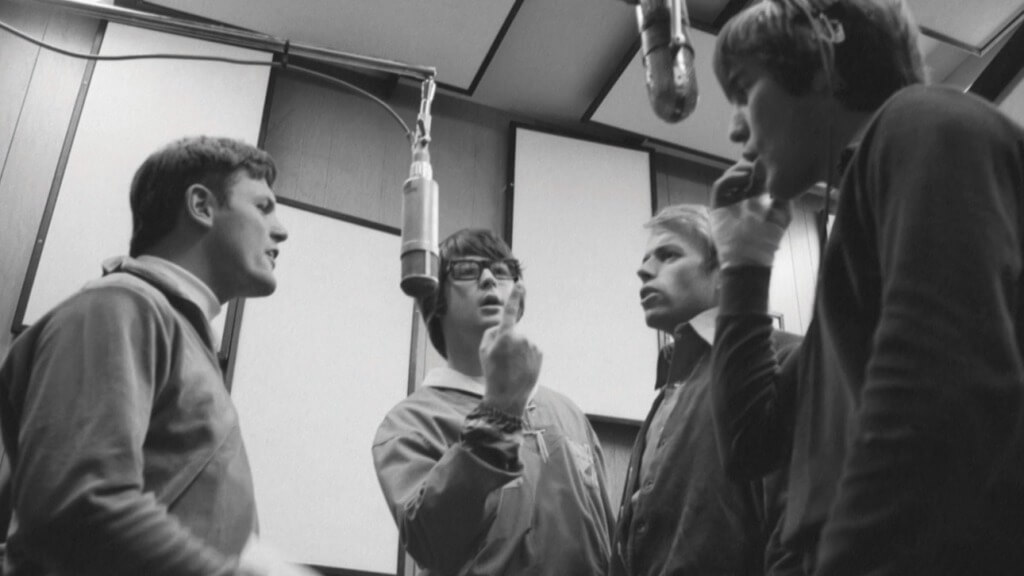
Photo courtesy of Capitol/UMG
The Pet Sounds Project is Paste’s two-week celebration of the Beach Boys’ eleventh album, which turns sixty years old on May 16, 2026.
There’s no finding the Holy Spirit in the overcrowded alleys of Brooklyn Flea record vendors, or the men brushing their splayed elbows against your jacket as they flip through the vinyl stacks, or the ill-fitting skin of the unlovable teenage girl counting her cash in with the heat of their eyes burning on her neck—I should know, it took me years of misfiring at God in those parks until the girl in question got the hint. But the skies opened on one single day when I was maybe 13, when I was staying with my aunt and her husband uptown and was promised a day of record shopping to help fill out my then-nascent collection. These are the types of obsessions you burrow into when you’re running from your collapsing life and praying for some holy thing to scrape that ill-fitting skin away—the kind of obsession that only sixty-year-old men shared with me.
At that time, God mainly existed in a piece of printer paper I’d stamped with an image of Beach Boys figurehead and modern-pop godfather Brian Wilson, over which I’d sketched a halo and wings. As I ran away, panicked from a religion I couldn’t stomach or quite believe in, I found myself devouring every book about his life and his family and his band, listening to Pet Sounds with a sense of duty to learn why everything I loved, which came later, existed in its shadow. I felt, in him, a dumb angel like me fumbling for anything to distract me from myself, something that let me touch an intangible, reassuring light telling me I existed and was fine. The music felt like a challenge, something I had to sit with and revisit to understand, but it felt like a comfort as well. My father owned the album on CD but had never played it for me, so the ritual of my discovery sessions remained solitary as I sought our history out on my own.
So, when I held a copy of the physical record in my hands—a 1966 original, no less, stamped with the name of the man who’d previously owned it—and the sticker price read $40, I let it burn up in my palms as I looked from the man running the booth back down at the Beach Boys and their zootime companions on the cover. He wouldn’t budge on the price, he told me, because it was a mono copy of the original album. Given Wilson’s partial deafness in one ear, he explained that this piece of vinyl in my hands may as well be my holy grail, as it had been mixed “the way he heard it.” God isn’t just handed to you, after all.
Having produced only a crumpled $20 offering from my pockets, my uncle fronted the other half of the money for me, and I went home happy. I didn’t yet know that I hadn’t fully heard what would become (and forever stay) my favorite few seconds on Pet Sounds, the album that placed popular song in the league of the composers of centuries past, reframed how far the average American mind could be stretched and splattered against their turntable, struck young hearts dumb for decades to come.
It’s a moment in the album mix—only to be found in the mono mix, to be clear—deemed worthy of dramatization if you ask the team behind the 2014 biopic Love & Mercy, which starred Paul Dano as a young Brian Wilson in the midst of recording Pet Sounds with world-class Hollywood session players. When movie-Brian’s bandmates return from Japan, on a tour both the real Brian and movie-Brian begged to sit out after suffering a panic attack on a plane, he put them to work recording intricate vocal harmonies to slot into the complex arrangements he’d painstakingly pieced together from the control booth.
The boys all sit around listening to a playback of “Here Today,” when Mike Love, Brian’s cousin and infamous detractor of the record’s direction, points out that he can hear studio chatter from the band laying down vocal overdubs on the track—phantom voices needling through the song’s tightly constructed, carnivalesque instrumental section. “Yeah!” Wilson replies, offering Love a hit off his joint. “I left them in.”
“Voices?” an incredulous Love replies, followed by some not-so-subtle thematic clarification within the dialogue: “The talking in your head? That’s part of the song?”
“It’s part of the music,” Wilson responds, as his cousin takes position to snap over the commercial graveyard he feels Wilson is sleepwalking them toward, “just like all the other instruments we use. We’re playing the studio.”
And that last statement is true enough, but the real Brian Wilson was playing with holy forces, too—injecting messy, hopeless human frailty into an album about messy, hopeless love soundtracked by lush arrangements worthy of devotional song. When asked about the prayer sessions he held with his brother and bandmate Carl while in the studio, presaging his desire to make its aborted follow-up SMiLE a “teenage symphony to God,” he remembered telling Carl “that I wanted to create or make an album that would bring love to people where they don’t really realize that they’re being loved at the level that we were doing it. And he and I would pray for people, we’d pray for the album—it was quite a ritual we got going, you know.”
It recalls Bach—the composer with whom Wilson said he felt the clearest affinity, due to his distinctive use of counterpoint and harmony—composing his Passions for Good Friday services, transposing Bible verses into arias and complex choral passages, arranging grand works worthy of the holy houses in which such pieces could be performed. When Pet Sounds songwriting collaborator Tony Asher turned in the relatively down-the-center, down-on-love lyric sheet to “Here Today,” he hardly seemed to have such a lofty vision for what he heard as a simple tale of heartbreak. He wrote simply and in broad absolutions.
But even if Brian Wilson, like Bach, used other people’s text to ornament his grand work, the Beach Boys’ leader, a famously secular artist, believed in pop music as our most accessible and holy art form. In theory, he claims, Heaven contains perfect and innocent connection and is a place to be shared with other people. All things are made perfect in a fabled creator’s ears when his brothers’ voices dance about the mix, playing angelic choir in his mass to his pop messiah. Saints heard voices in their heads, too. Saints suffered for their expression of love.
Listening to tapes of the sessions for “Here Today,” recorded sixty years ago, I still feel a sense of bewilderment hearing a young Brian Wilson direct his musicians with such a clear, direct vision—calling out requests to the saxophone and trombone players, queuing an organ that sounds like a thick fog struggling to lift, listening to the percussion’s onslaught through the verses. When he records a guide vocal for Mike Love to follow after he returns from tour, his voice seeps empathy, exuding the joy and anguish of a love coming and going “here today and gone tomorrow.” I think it is the most beautiful thing I’ve ever heard, and simultaneously, it makes me glad Mike Love handled the final lead vocal.
Someone once pointed out to me how Love’s vocals on these Brian-genius-period records, jaw tight, delivery straightforward like he’s expecting to launch into “Be True To Your School” immediately after, often create stunning contrast within the songs. Take his outro section at the end of the Smile Sessions track “Cabinessence,” where you can hear how blatantly confounded he is by Van Dyke Parks’ surreal writing, letting the words sit in the back of his throat as if to swallow them in an act of displeasure.
Though the lyrics of “Here Today” tap into a less abstract expression of human sorrow, certainly something he’d be more willing to get on board with, Love’s voice refuses to betray any fanciful ideal and instead sounds cynical to his core—perfect for the material. In the climbing pre-chorus section, where his voice stretches upward with the bassline as his doubtful dance partner, he depicts a man with an earnest warning and a heart sealed shut: “She made me feel so bad / She made my heart feel sad / She made my days go wrong / And made my nights so long.” Sometimes, I think it’s one of the most effective vocal performances in his long, crooked career—especially given the instrumental section to follow, called “Letter C” on the session tapes.
The magic of this midsection in the mono mix begins with that “she made my heart feel sad” in the pre-chorus, where an audible cough clouds Mike Love’s lament, but officially begins with the single strikes of every instrument besides the bass, which dutifully plucks on to undergird the engine of the musical passage. Sleigh bells still join it on its precise groove, but it’s what adds texture beneath the precision that hits the center of my chest, which made me pledge myself to the cause: the Wilsons chattering aimlessly as they clearly believe they are either not being recorded or that the running tape will be discarded. The clearest vocalization comes from Bruce Johnston, Brian’s second tour replacement after Glen Campbell and new addition to the recording band, saying something about the flash on a photographer’s camera, leading me to believe someone was in the studio that afternoon taking stills of the band singing. Just as Brian Wilson yells, “Top, please!” to the engineer, requesting that he start the tape over so they can get a real vocal take, the whole studio band shifts to double-time the rhythm, as if in a pagan march to the end of love, only to return to that climbing pre-chorus and erupt again.
I don’t know if it’s possible to feel a sound as intensely as I do the breath of the Wilson brothers—none of them over twenty-five at the time of recording—knowing what they will endure and that they will leave us under tragic circumstances. Having outlived both of his younger brothers by decades, Brian Wilson died last year and the first thing I chose to take solace in, solely as a fan who had no personal relationship to any of them, was that he was with his brothers in cosmic space, breathing beneath the fanfare wherever angels go to do such things together, with no time or law holding them captive.
The second thing I did was never stop talking or writing about him, or about his hit parade prayer for a spiritual love that one likely won’t stumble upon, but can strive for. A paper Brian Wilson with angel wings, drawn in colored pencil by my teenage hand, still hangs above my desk now, like the St. Anthony rosary medals my grandmother kept in every room, safe now that her own dumb angel was watching. Sometimes, I try to confess to him from his spot taped up on my wall—about finding secrets tucked in the back of the record bin, about Good Friday Passions, about hearing it the way he heard it. I hope he hears how my breath can change each time I play that one specific mix of that one specific section. I hope he sees the love I’m reaching for in his name.
Come back tomorrow to read about “I Just Wasn’t Made For These Times.”
Elise Soutar is a New York-born-and-based music and culture writer.
 Keep scrolling for more great stories.