
Hanif Abdurraqib on “I Just Wasn’t Made For These Times”
Pet Sounds Project: Like many of the songs on Pet Sounds, “I Just Wasn’t Made For These Times” doesn’t end with a neat resolution, or any specific answer to the conundrum presented in the lyrics. It ends on a rotation of the song’s title, almost like a series of affirmations.
Photo by Michael Ochs Archives/Getty Images
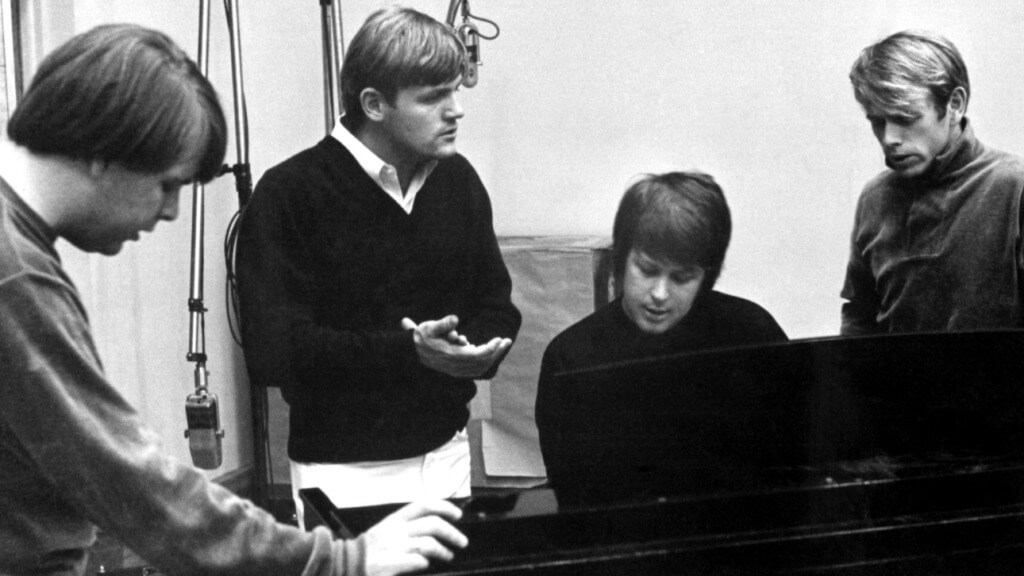
The Pet Sounds Project is Paste’s two-week celebration of the Beach Boys’ eleventh album, which turns sixty years old on May 16, 2026.
Of all the magic that exists within the archive of in-process recordings that would become The Pet Sounds Sessions, I have always been drawn to the clips of isolated vocals that came from them. The isolated vocal take of “I Just Wasn’t Made For These Times” that appears on the sessions is woven with a kind of ache that is, of course, present in the finished version, but at its most naked and uninterrupted by instrumentation, it takes on a different hue. The last lyric that is sung before the wave of harmony washes over Brian’s voice: “They say I’ve got brains / But they ain’t doing me no good / I wish they would.”
When Pet Sounds, and more broadly, that era of Brian Wilson’s work is discussed and assessed, much of it is about the beauty of the sounds he was able to seek and collage together, and the great lengths he went to bring others along with him for the meticulous, and sometimes tedious, ride. This, too, is a highlight of The Pet Sounds Sessions, that you can hear Wilson in the throes of something that, for some, would sound like it is approaching madness. Directing the Wrecking Crew’s stable of elite musicians with half language, half untranslatable sounds, running through take after take of an inch of a song, or running one single instrument back over and over again. In some ways, the behind-the-scenes recording is meant to celebrate and uphold his singular genius, to say this is what it takes to make something that was once thought to be impossible.
But what I also love about much of Wilson’s work—not just Pet Sounds, but the work surrounding it and following it—is that so much of it is about loneliness, or longing, or having been dropped into a world that doesn’t exactly make sense, but still trying to navigate it with care and thoughtfulness, and sometimes failing. “I Just Wasn’t Made For These Times” is one of the plainest,and most direct manifestations of Wilson’s heartache, the interior world that can’t quite align with the exterior world. I love the song so much because I believe I, too, have moved beyond a desire for metaphor or flowery language to convey the feeling. Yes, I could say that it sometimes feels as if I am in orbit, floating in a solar system, my own planet that never quite spins close enough to any other planet for me to touch it. Yes, I could say that I feel like a lone flower, clinging to a patch of grass while monochromatic grey buildings spring up all around it. But it is easier to take a lesson from Brian Wilson, who, at least on this song, simply says “Sometimes I feel very sad / Sometimes I feel very sad.”
It is prophetic, too, though I don’t want to trick myself into thinking that Brian Wilson saw this specific future. The primary engine of the song, the thesis, hinges on that opening sentiment. I have been told I was smart, and so therefore, I imagined myself smart enough to survive this world and whatever world is coming after it, but it turns out that isn’t what it’s going to take. It’s going to take something other than my brain, because my brain isn’t made for the time it exists in.
After over a decade of being in close community with elders and having the honor and privilege of building real relationships and friendships with people significantly older than me, one thing that I have come to cherish is that, for many of them, there is a calm and contentment with the fact that the world has, largely, just passed them by. There’s no special investment or interest in trying to catch up to it, or trying to slot back in to a pace that doesn’t suit them. I get Miss Viola a new cell phone so she can Facetime her daughter who just had a baby, and while trying to set it up and teach her how to use it, she waves me off, and tells me the landline in her room at the senior home will work just fine, always has. When I try to call to set up a cable package for Joe, who is surly and stubborn as they come, he tells me he only needs five channels (“for news and for sports”) and refuses to pay for any others. With a potentially devastating winter storm approaching, I offer my home to Miss Anna in case she loses power and so she’s not alone; she shrugs and insists it ain’t gonna be no storm that kills me.
I think, often, about how these people have taken what could be a feeling of immense loneliness and isolation (or, perhaps, what once was a feeling of loneliness and isolation) and translated it into something worthy of pride, a deep knowing of the self, a deep knowing of exactly what you need, a deep knowing of exactly what will or won’t be the death of you. It is important to recall what comes after the line “Sometimes I feel very sad,” in the form of its repetitions throughout the song’s pre-chorus: the line “ain’t found the right thing I can put my heart and soul into.”
There’s a poem I love by the poet Diane Di Prima, who—among her many other brilliances—wrote a series of political poems titled “Revolutionary Letters.” The poems are all numbered (i.e. “Revolutionary Letter #1,” “Revolutionary Letter #2,” and so on.) The first one, the one that sets the tone for all of them, opens with the line “I have just realized that the stakes are myself.”
I don’t necessarily think I am that much smarter or more intuitive than the average person, but I do have a working brain, and I do have a brain that I would like to keep working, in some capacity, for as long as it can. And I am now confronted with the reality that I am alive in a world that would benefit greatly from my brain no longer working well, would benefit greatly from your brain no longer working well. And there is no shortage of technology to entice you into intellectual surrender, to make you question the reality of what you are seeing. And it is lonely. It does get lonely to decide that you would like to be on the other side of surrender, even as it can seem like the rest of the world is sprinting towards it, and you may be left behind, seeking your own revelations in the quiet of your own self-made solar system.
Like many of the songs on Pet Sounds, “I Just Wasn’t Made For These Times” doesn’t end with a neat resolution, or any specific answer to the conundrum presented in the lyrics. It ends on a rotation of the song’s title, almost like a series of affirmations. Yes, it’s true, I have done the math, and it still turns out the world as it is does not work with my mind and heart. And then the song slowly fades. I think about my beloved elders, and I think about the line that opens Diane Di Prima’s greatest series of works and wonder if the time is approaching for me to realign my relationship with the inevitably arriving waves of isolation. At some point, the isolation has to become a gift, or a weapon. The isolation has to become a gate that you unlock for the right people at the right time. At some point, the world mutates to a point of unrecognizability, and you get to be somewhere else. Sometimes sad, of course. But still alive, still with a heart that works.
Come back tomorrow to read about “Pet Sounds” and “Caroline, No.”
Hanif Abdurraqib is a writer from the east side of Columbus, Ohio.
 Keep scrolling for more great stories.