
The orchestral world of George Martin gets its due
In the countless tellings of the Beatles' story, Martin’s arrangements have received relatively scant attention, but Curvebender’s release of George Martin: The Scores arrives as a corrective.
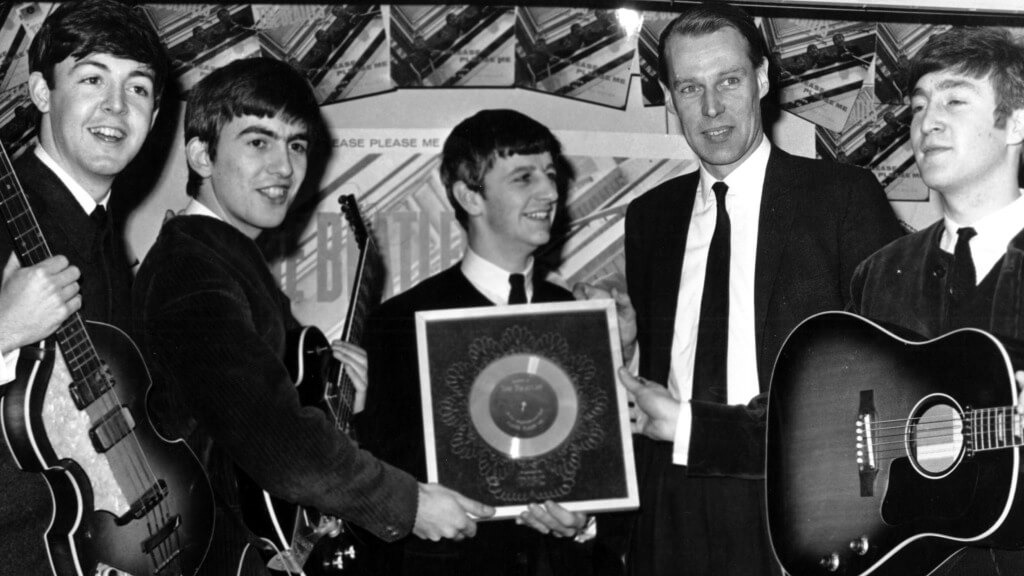
Photo by Michael Ochs Archives/Getty Images
For the last several months, my wife and I have played the Beatles’ “Good Night” on a loop every night to lull one of our twin infant daughters to sleep. It wreaked havoc on our Spotify Wrapped stats, and it may have the unintended effect of making Ringo her favorite Beatle, but at low volume, it seems to calm her.
It’s soothing for us parents, too. Just as the song serves as a balm on the White Album after the psychic and aural assault of “Revolution 9,” it’s a balm after the psychic and aural assault of a day of parenting infants. Unsurprisingly, I’ve come to appreciate the song in a whole new way: a John song that sounds like a Paul song, written as a lullaby for John’s son Julian; Ringo’s most vulnerable vocal on a Beatles track, affecting in its plainness—very Dad.
And then there’s the lush, gorgeous score by George Martin. The harp glissando, the silvery flute evoking cool moonlight, the choir of reassuring voices—I only realized last year that the sustained high note in the opening is the voice of a female soprano—and the only use of the celeste in the Beatles’ catalog, Martin himself playing eight perfectly chosen notes. It’s him going full Hollywood. When I return to the room, I feel like I’m entering a dreamy district of slumberland.
That repeated encounter with “Good Night” made me hear Martin’s arrangements differently, just in time for Curvebender’s release of George Martin: The Scores—three gigantic volumes, which contain the story of George’s life, times, and contributions to the Beatles, centering around the handwritten scores for his musical arrangements with an accompaniment of highly detailed musical analyses—in the producer/composer’s centennial year. The songs include key Beatles compositions, from “Yesterday” to “The End,” a few solo Paul McCartney hits (including “Live and Let Die”), and Martin’s final arrangement: the version of “While My Guitar Gently Weeps” featured in the Cirque du Soleil show LOVE. It comes with a USB drive containing music software audio tracks from a 2016 re-recording session of some pieces—you too can pretend to be George Martin for a day—and plenty of photos capturing the man looking dashing, almost Bogartesque. (A copy of the standard edition was loaned to Paste for sampling.)
You don’t need to read music or know your staccato from your marcato to enjoy the set. But some geeky musical tendencies will certainly help illuminate the collection. There are a couple of semesters’ worth of musical education to be gleaned from these pages, from Indian music styles to aristocratic dance music from the Renaissance. It’s a set for a certain kind of Beatles nerd, to be sure—the folks for whom even the smallest Beatles tidbits warrant serious contemplation. Yes, give me six pages on Martin’s varispeed piano solo on “In My Life”! But it’s also true that, in the countless tellings of the Beatles’ story, Martin’s arrangements have received relatively scant attention compared to, say, the splicing of takes seven and twenty-seven of “Strawberry Fields Forever.” If there’s detailed and considered commentary on Martin’s wondrous Yellow Submarine score out there, I haven’t encountered it.
This collection, then, is a corrective. It was assembled by K.L. Ryan and Brian Kehew, who previously put together the similarly behemothic Recording the Beatles: The Studio Equipment and Techniques Used to Create Their Classic Albums (a used copy is going for $1,289.00 on Amazon). The project was the brainchild of Martin’s son—and Beatles’ music custodian—Giles. “He had complete sympathy, in his scores, to the songs that he was accompanying,” Giles told Paste. The arrangements reveal Martin’s “empathetic and sympathetic nature as a human being and as a musician.”
Indeed, Martin always served the Beatles’ material with taste and sensitivity. But what this set demonstrates is that George was much more than a musical butler, dutifully fetching for the group whatever musical sounds they asked for. Time and again, he boldly asserts his own distinctive musical personality on the Beatles’ output.
For starters, it was Martin’s idea to use a string quartet for “Yesterday.” McCartney, resistant to the idea initially, had to be convinced it wouldn’t sound like muzak. Possibly he was thinking of Martin’s light music renditions of Beatles tunes for the film of A Hard Day’s Night. Martin recorded the aforementioned piano solo for “In My Life,” with its ersatz harpsichord sound, and then showed the group the fully-formed results when they turned up to the studio a couple of hours later. Sprinkling “I Am the Walrus” with nonsense choral interjections was also Martin’s idea. (Lennon had flippantly asked Martin to contribute “your usual rubbish”; turning up to the choral session, the Beatle’s reaction was a laughing, approving “What the hell?”) The symphonic nature of the Abbey Road suite was also something undertaken with Martin’s urging.
This set allows readers to tune into George Martin’s musical contributions and—what a gift this is, at this stage of the game—hear the songs anew. Frankly, this is most exciting when it comes to the psychedelic-era Beatles compositions, all of which feature Martin arrangements that are arguably not just crucial to the song but are the song. The level of invention and innovation in this period is fantastical. How impressive that Martin, sober as a judge, could conjure the feeling of a woozy trip so effectively on “Strawberry Fields Forever” and “I Am the Walrus,” his cello drooping like Dalí’s clocks. How stunning to see the architecture behind the orchestral tsunami of “A Day in the Life”—a sound the likes of which had never been heard before, except perhaps in the fever dreams of Richard Wagner.
Before that, the Bernard Hermann-inspired starkness of “Eleanor Rigby” must indeed have been psychotically shocking, emanating from the radio toward the end of the summer of 1966. (Roger Waters once told me that was the song that changed everything.) Even before that, Ryan and Kehew also make the case that “Yesterday,” while not as obviously revolutionary as all these, was a radical and experimental act for its time in employing a string quartet, a sound “last fashionable in the 19th century.” George Martin: The Scores does indeed dive deep on a couple of pieces composed for Yellow Submarine. Sadly, the film was so rushed that a mess was made of Martin’s meticulously synced cues; here, we can finally study his intentions.
Indeed, the set illuminates many of Martin’s discarded or obscured ideas: the “In My Life” solo wasn’t meant to end so abruptly; the coda for “Glass Onion” isn’t as out-of-left-field as it may seem; the “A Day in the Life” crescendo wasn’t as much of a free-for-all after all. I’d never noticed how overtly Big George’s original arrangement for Little George’s “Here Comes the Sun” suggests a musical representation of the sunrise. But some musical mysteries remain. We may never know more about “A Beginning,” Martin’s orchestral prelude to Ringo’s “Don’t Pass Me By,” apart from that it would have been a moment of Debussyian wonder on The Beatles.
One of the enthrallments of the Beatles’ story is that the tales of its supporting characters are fascinating too. The story of Martin’s relationship with the Beatles is no exception. Is it just the new Dad here talking, or is there something parental about it? In the early days, he served as their nurturer and teacher. They grow up. Pretty soon, they sideline him completely. Finally, they welcome him back into the fold.
In recent years, Beatles historians have taken pains to emphasize how the group wrote and recorded Abbey Road without knowing it would be their final album. But I reckon that George Martin, tasked with arranging string parts for a song called “The End,” had an inkling. I suspect he put his feelings into his arrangements. As he himself admitted, “There’s far more of me on Abbey Road than on any of their other albums.” It goes some way to explaining the joyousness and majesty with which he imbues “Something,” “Here Comes the Sun,” and the closing suite.
Listen to “The End.” Notice how, on the last word of “equal to the love,” there’s a five-note orchestral descent echoing the vocal melody (compare and contrast to the five-note descent that closes “Eleanor Rigby”)—a laying down to rest, the closing of an epic tome. And then there’s the orchestral surge heavenward, the raising of a spirit, a cosmic opening up. It’s the contented exhalation before the ascent that gets me. For me, it’s impossible not to hear Martin’s arrangement here as his own heartfelt send-off to the boys and his time with them, or perhaps a thank you on behalf of all of us—as if saying, in crisp tones, “That was rather marvelous, wasn’t it?”
Similarly, I’m inclined to imagine that Martin, constructing his arrangement for “Good Night,” was writing from the heart. His own infant daughter, Lucie, was about to turn one, and probably not too far from his piano and writing desk. (Naming his daughter “Lucie” a couple of months after “Lucy in the Sky with Diamonds”… How’s that for proof he had sentimental feelings about the Beatles?) We’ve since transitioned away from playing “Good Night” every night. But in our home, where everyone’s relationship to the music of the Beatles is deeply, inextricably entwined with memories and associations over time, “Good Night” will always be our portal back, George Martin beckoning us always into a realm of dreams, sweet dreams.
 Keep scrolling for more great stories.